

Intel's CEO Robert Swan mentioned more frequently during the recent quarterly the shortage of production capacities in the context of rising costs and the shift in the processor assortment towards more expensive models with a greater number of cores. Such transformations allowed Intel to increase the average selling price of mobile processors by 13% and desktop processors by 7% in the first quarter compared to the same period last year. Meanwhile, sales volumes of processors declined by 7% and 8%, respectively. The total revenue of the client products division grew by 4%.
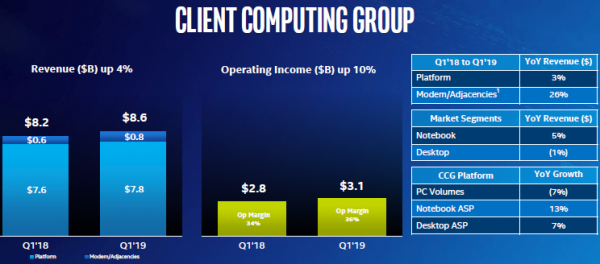
However, revenue from desktop components in the first quarter still decreased by 1%, although there was a 5% increase in revenue in the mobile segment. Intel managed to earn 26% more from modem sales in the first quarter than a year earlier. However, in absolute terms, modem sales did not exceed $800 million, so this growth can hardly be considered a decisive factor against the backdrop of the division's total revenue of $8.6 billion.
The capacity shortage limited the growth of processor sales
It cannot be stated, however, that Intel is satisfied with the impact of the shortage situation on revenue figures. Yes, it started selling more expensive processors, but CFO George Davis admitted in his comments that sales volumes of processors were constrained by the limitations of the company's production capacities.
In the second quarter, as the CFO predicts, the PC segment will generate 8-9% less revenue due to an increased share of processors with fewer cores and more compact chips. The average selling price of processors will decrease, which will negatively affect revenue.
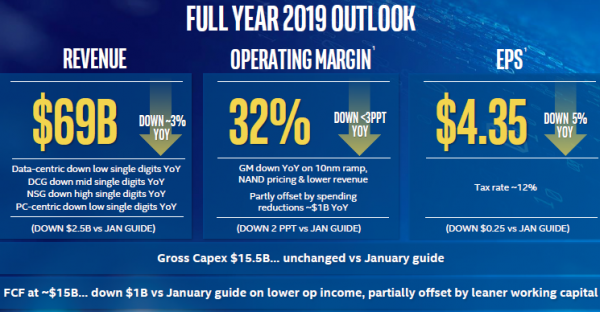
In the first quarter, Intel's revenue was supported by strong demand for gaming systems and commercial computers. By the end of the year, the need to invest in mastering the 10-nanometer technology process will negatively impact Intel's operating profit margin, which will not exceed 32%. This impact will be partially offset by the company's cost reductions of $1 billion, including the abandonment of the development of 5G modems for smartphones.
The shortage of processors will also be felt in the third quarter.
Robert Swan explained that the company has taken steps to increase the production volumes of 14-nanometer processors in the second half of the year, but this will still be insufficient to fully overcome the shortage. The company’s clients will have to accept that in the third quarter, the priority for deliveries will still be given to more expensive processor models. By the way, such a policy has already led to a noticeable strengthening of AMD's position in the laptop segment running Google's Chrome OS, according to independent analysts.
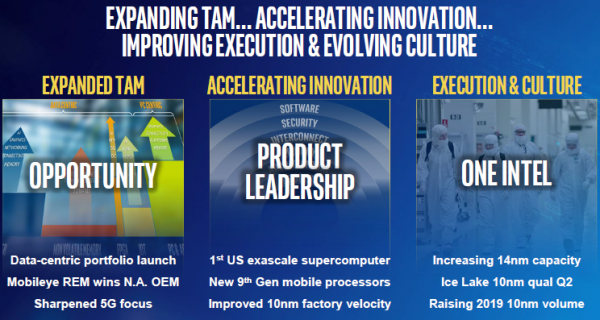
Swan also clarified how the funds released as part of cost optimization will be directed. In addition to mastering the 10-nanometer and 7-nanometer processes, priority will be given to accelerating the release of new products in the client and server segments, as well as the development of artificial intelligence systems, autonomous vehicles, and 5G network infrastructure. The Mobileye division, for example, increased its revenue by 38% in the first quarter, reaching record levels. Intel has seen not only new products but also new clients in the automotive sector.
Source: 3dnews.ru
