

Microsoft announced at one time that it would use about 7 GB of a user's hard drive space to store update files. The advantage of this approach is that it ensures that storage won't run out in the middle of an update. However, the downside is simple — there simply won't be enough space on inexpensive tablets and laptops.
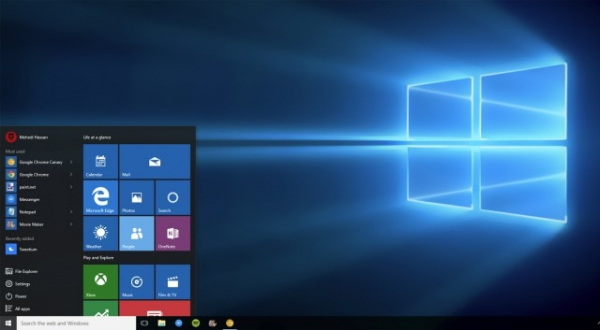
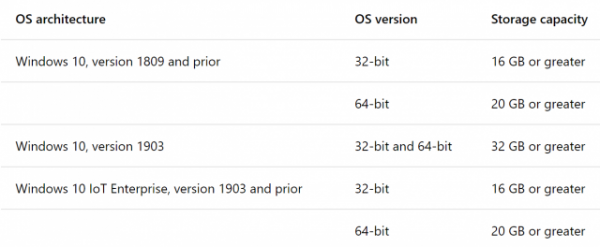
Previously, the minimum storage requirement for Windows 10 was 16 GB for a 32-bit installation, and the additional 7 GB nearly occupied the entire drive. But now the situation even more.
The company's hardware requirements have changed. According to these new requirements, the minimum amount of space for the OS is now 32 GB for both 32-bit and 64-bit versions. This should be sufficient for installing updates on budget devices. It will also encourage hardware developers to increase the built-in memory capacities on cheaper devices.
Let's remember that previously Microsoft the page of processor requirements ahead of the Windows 10 May 2019 Update release. It is noted that AMD Ryzen 3000 and Snapdragon 8cx processors are not on the list, although all other models, both x86-64 and ARM, are present. It is possible that this is simply a typo or incomplete data that will be corrected later.
We also remind you that the pre-release version of Windows 10 May 2019 Update forcibly the update if there are external hard drives or SD memory cards on the PC where it is being installed. As it turns out, the reason lies in incorrect disk reassignment.
Source: 3dnews.ru
