

 A vaccine is a way to signal the immune system with a threat signature, which will then develop an immune response after several training cycles.
Any struggle the body has with an infectious disease involves attempts to recognize the threat signature and develop countermeasures. Generally, this process continues until complete resolution, meaning full recovery. However, there may be infections that:
- Kill the host faster than an immune response can be developed.
- Change faster than the immune system can 'recognize' the pathogens.
- Mask themselves and hide in places that are very difficult to access for the pathogen.
Therefore, in some cases, it's better to arrange drills in advance. That's what vaccines do. An adult resident of the city has been vaccinated against the most dangerous infections in childhood. During outbreaks of infections or when a person is placed in a dangerous environment, it makes sense to get preventive vaccinations. Traveling falls into such situations.
Let's first clarify the basics, then move on to travel and the list of actions.
Why is travel dangerous?
Suppose you are flying to Africa. There, the risk of yellow fever is heightened. A simple vaccine will cost you about 1,500 rubles, including the therapist's consultation and procedural room services, while a higher-level vaccine will be around 3,000 rubles. You can't cure yellow fever with specialized medications (you can only support the body's resources while it fights the illness itself), and it's easy to get infected with a mortality rate of about 10%; the main vector is mosquitoes. The vaccine has almost no side effects. Is vaccination worth it? Probably, yes. But the decision is yours.
So, travel is when you are in an unfamiliar environment, one which your immune system is not accustomed to. After a flight and due to the reaction to thousands of new external factors, there begins to be a light chaos in the body's defenses, making you less colonially resistant to pathogens. Additionally, new environments can host pathogens that simply don't exist where you usually live.
The opposite is also true: you might be a carrier of pathogens that are absent in the current environment. And then the local residents might not be so lucky.
How do vaccines work?
There are 4 main types:
- A weakened version of a pathogen strain can be selected that resembles a real combat strain but does not pose a threat to a healthy organism. These include vaccines for chickenpox, influenza, yellow fever, and so on. This is the simplest way to train: the immune system faces 'training enemies.'
- Viruses and bacteria can be inactivated (for example, by placing them in a formaldehyde medium) and the organism can be shown their remains. Examples include hepatitis A and tick-borne encephalitis. The immune system finds the remains of enemies somewhere in the body and begins to train to eliminate them over and over again because this 'buzz' is not in vain. When a familiar strain enters the body, the general idea of how to deal with it will be understood, and then the immune response will quickly adapt based on previously acquired data.
- Toxoids (weakened or altered versions of microorganism toxins) can be introduced, allowing the body's defense to learn to combat the effects of bacterial activity, which provides much more time to formulate countermeasures during infection. This means that the symptoms of the disease do not affect you, and the body quietly deals with the pathogens without you even knowing they were there. This is the case with tetanus, for example.
- Everything new that belongs to the 'high-tech' category consists of modifiers of gene complexes (to ensure that some protein, in addition to its main function, also cleaves the DNA of the pathogen, for example), molecular vaccines (where the organism is essentially provided with the DNA/RNA signature in pure form), and so on. Examples of molecular vaccines include hepatitis B (virus envelopes without the core), human papillomavirus, and meningococci.
Note that there is no direct correlation between the type of vaccine and its side effects. You might think that a real live pathogen would be more dangerous than a molecular vaccine, but this is not the case. The yellow fever vaccine is considered one of the safest: the chances of side effects are very difficult to distinguish from the statistical error of measurement methods.
What are the side effects?
The most common case is an allergic reaction. For example, the hepatitis B vaccine can exacerbate an allergy to yeast dough. There are also more complex reactions, but in general, all of them are reversible. Detailed statistics are compiled for irreversible (severe) consequences, and a vaccine is not allowed for use if the specific risk for an individual from the disease, considering all probabilities of infection, transmission, recovery, and so on, is lower than the risk of complications. In simpler terms, it is always more reasonable to use a vaccine when it is recommended in the region.
Most side effects are related to the introduction of a weakened virus, toxin, molecular waste, and other exogenous substances into the body. To teach the immune system to fight, it first needs to be slightly shocked. It will respond, and some collateral damage may occur. However, this is a necessary part of training the immune defense.
Does the vaccine only act against one strain?
Not exactly. The comparison with signature analysis is somewhat inaccurate. The immune system builds something like a perceptual hash. This means that if you are vaccinated against one strain of influenza, your immune response will be faster if you are infected with another. In other words, the risk of complications is lower, and the severity of symptoms is reduced.
The influenza virus resembles a sphere, protruding surface glycoproteins and proteins. The most important (hemagglutinin and neuraminidase) are mentioned in the name of the strain, such as H1N1. Influenza can mutate by changing one of its proteins and become H2N1. In that case, the match will be partial, and the body will simply respond less actively. Alternatively, a 'shift' can occur when both proteins change, for example, to H2N3. Then the threat must be recognized almost from the beginning.
Note that this applies to similar strains of the same disease. In the case of meningitis, for example, it involves completely different pathogens, and different vaccines protect you from different sets of meningococci. Additionally, meningitis can be caused by hundreds of other factors.
So in general, the vaccine contains one or several strains of the most common type of pathogen. It helps develop immunity to them and their close versions, accelerating the response time to somewhat distant versions.
What to do before the trip?
The first step is to check the recommendations for the country from the tour operator or elsewhere even before purchasing your ticket. The best source is not the pamphlet provided by the travel agency, but the current recommendations from the World Health Organization. It's also worthwhile to look at the summary for the country from the WHO: it notes recent outbreaks of infections and their consequences. Check the biosafety barrier requirements for your destination country. For example, if you have a flight with a layover in Africa, you may be required to have a vaccination against pathogens common to the transfer airport.
In some cases, without a vaccination document, you may not be allowed into certain countries — this should be checked in advance. Usually, it's either a visa requirement or related to the current epidemiological situation.
An alternative option is to visit a doctor and consult with them. It's better to see an infectious disease specialist at a hospital that receives patients from flights rather than just a primary care physician. Their recommendations will be based on similar sources, but they will be more accurately interpreted and applied to your condition based on your medical history. There are vaccination specialists for travel in Moscow, such as at the Marcynovsky Institute.
So, you've received a list of mandatory and recommended vaccinations. It's up to you to decide whether to follow the recommendations or not. For example, you might decide that if you don't encounter any animals on the way, there's no need to get vaccinated against rabies. It's your right. But remember: the WHO provides recommendations for travelers based on statistics. If it says it's better to do something, it's better to do it.
I’ll go a couple of days before the trip, get vaccinated, and everything will be fine?
No.
First, the antibody deployment time ranges from a couple of days to 3-4 weeks (for the primary set, it can take longer).
Second, some vaccines are administered in courses of 2-3 doses.
Third, not all vaccines can be combined, meaning you can't get all your shots at once.
This means you need to get vaccinated three weeks before your trip if you need a couple of new properties in your body, and six months in advance if it’s your first visit to a tropical country.
Here is the WHO recommendations page for (without dangerous hotspots along the way):
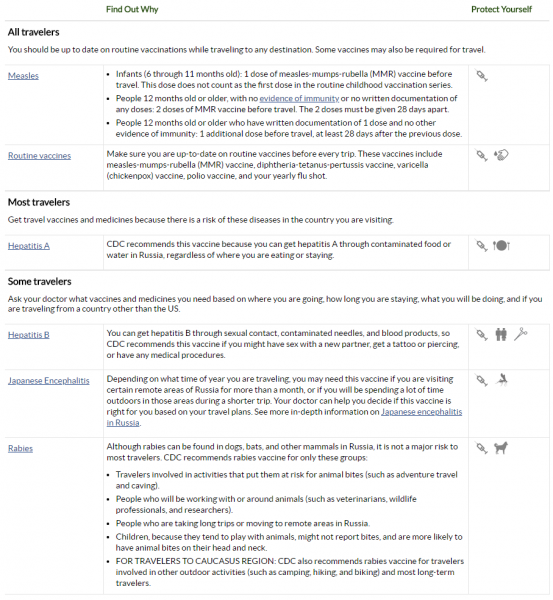
It's best to check vaccinations at the consular department of the Ministry of Foreign Affairs. A complete list of is available. You can also check other features of the country there.
For example, for a cholera vaccination is required.
Here’s another
So, do I need to protect myself against all this in Russia?
Yes. Pay attention to notes and vectors. If you don't have a vaccination against Japanese encephalitis in Moscow, it's not a big deal. The most accessible natural hotspots are in Vladivostok, and even then not every year. But if you're going to Vladivostok, it's worth considering. In practice, the information about Russia on the WHO website is not very accurate because usually the data is provided for countries that have one or two biomes. Our homeland is very healthy, so the kit for Baikal will differ from that for Krasnodar or Arkhangelsk.
What exactly to do for surviving in Russia depends on the type of tourism. If you plan to live in downtown Moscow, it's enough to get vaccinated against the flu and timely 'refresh' children's vaccinations. If you're going to the taiga or going kayaking, you definitely need vaccination against tick-borne encephalitis. If you plan to spend a lot of time with animals or exploring caves—against rabies (bats can carry it). And if you're heading south or to a village without sewage, then against hepatitis A. And hepatitis B will come in handy in case you need assistance at a rural clinic, a cut at a manicure salon, dental work on the way, or unexpected blood transfusions. You fell, tripped, woke up—hepatitis B.
Do vaccines last forever?
No. Some allow lifelong immunity, some are effective for a long time (for example, diphtheria—10 years), and some are very short-term (Japanese encephalitis—for 1 year). Then the effectiveness of antibodies and their production gradually decreases.
This means it's a good idea to start by updating what you missed, then add the basic 'long-lasting' things, and finally get vaccinated before dangerous travels.
So what should I do?
Start updating your antivirus databases right here and now. Specifically, check your entire set of childhood vaccinations. Get to your doctor and ask which vaccinations you are missing.
Typically, the tetanus vaccine (a combination of three pathogens in one vaccine) needs to be updated every 10 years. Most likely, some of your childhood vaccinations have also expired.
Checking the effectiveness of a vaccine is quite simple: in most cases, you can take specific antibody tests to see if protection is still effective. However, a doctor must prescribe the test, as there are 'current' versions of antibodies and 'long-term' ones. You're interested in the latter.
Then add strategically important vaccines. Usually, these are Hepatitis A and B, and Human Papillomavirus.
If you frequently travel to certain regions (or plan to be there in the coming years), check for long-term vaccines like yellow fever and typhoid.
And only then act according to the recommendations of WHO, the Ministry of Foreign Affairs, or your doctor before traveling.
What is highly recommended for adults from this set?
- Whooping cough, diphtheria, and tetanus should be updated every 10 years for an adult. This is useful in Russia and everywhere else in the world.
- Hepatitis A provides lifelong immunity after the course.
- Hepatitis B provides lifelong immunity after the course (but you need to check titers after 10 years).
- Measles, rubella, mumps should be updated every 10 years for adults.
- Chickenpox provides lifelong immunity after the course or after having had the disease in childhood.
- Polio provides lifelong immunity after the course.
- Meningococcal infection provides lifelong immunity if vaccinated at age 5 or older.
- Human Papillomavirus requires a boost every 15 years (some maintain lifelong immunity, check titers before updating).
- Tick-borne encephalitis requires a booster every 3 years if you enjoy sitting by the campfire in Russia.
Can I get everything at once?
No. In one cycle, you can receive 1 to 3 vaccines; then you generally need to wait a month for the next ones.
Some vaccines can be combined, while others cannot. Live vaccines are usually not administered on the same day. Genetically modified ones can be given together, but no more than three vaccines can be given in a day to avoid overloading the body.
BCG, yellow fever vaccines, and rabies vaccines—these are usually not administered together with other vaccinations or among themselves.
Some vaccinations cannot be administered during pregnancy. This applies to live vaccines for measles, rubella, mumps, and chickenpox, which contain live attenuated viruses.
Most childhood and adult vaccines differ only in dosage. This means that if you are receiving two children's doses instead of an adult dose, it is generally acceptable. It counts as one.
Vaccinations should not be overused. Follow only rational recommendations; do not inject everything indiscriminately. The capacities of the immune system are not limitless; excessive exposure may also not be a good idea. If in doubt, consult a doctor.
Are there diseases that can be prevented without vaccines?
Yes. There is no vaccine for malaria, so there are two options—either take prophylactics or treat the disease once contracted. Or douse yourself with mosquito repellent every hour and hope for the best.
Specifically for malaria, look at the specific pathogens in the travel region: some can be treated without problems, while others cannot. For those that cannot: it may be better to take prophylactics and endure their side effects (frequent and not very pleasant). In areas where these pathogens are absent, it might be better to take the risk and spray yourself. The choice is yours. When there is no outbreak, these are merely recommendations.
Prophylactic tablets can be taken to avoid HIV infection, but hopefully, such trips are not very necessary for you.
It is also highly recommended to have a first aid kit with you, so that if you contract a gastrointestinal infection, worms, scabies, or any protozoans, you have something to help yourself. It is better to compile it with the same specialist who will be administering your vaccinations before your trip. Or with your therapist.
When can vaccinations be administered, and when can’t they?
There are contraindications. Generally, if you have a cold before traveling, it's not advisable to visit a doctor for a vaccination during the height of the illness. However, a high fever of 39°C and other signs of illness do not always prevent you from receiving a vaccine. This is particularly true for children who are frequently ill. Therefore, always consult your doctor and disclose all your conditions and chronic diagnoses.
You can read examples of contraindications. .
There are few practical contraindications for not getting vaccinated. For instance, for live vaccines, these include HIV infection and other types of immune deficiencies.
In the case of chronic diseases, the list of vaccines may be broader than usual due to increased specific risks. Additionally, the contraindications of specific vaccines must be considered. Your therapist will review all this during a preventive appointment before vaccination at the hospital.
Can I get vaccinated abroad before another trip?
Yes. Moreover, you can purchase the vaccine at a pharmacy here or abroad and bring it to your hospital to obtain documentation about it. This is relevant when the required vaccine is unavailable in hospitals in your city. It is essential to check the hospital's sanitary requirements for transporting the vaccine beforehand.
The vaccines for the diseases I need are different. Which one should I choose?
The simplest choice usually comes down to selecting between a cheaper and a more expensive option. Generally, the more expensive option means either a different method of pathogen inactivation, a larger library of strains, or something else that otherwise enhances its effectiveness and reduces the likelihood of side effects.
When there are several vaccines of different types, it's best to consult with a doctor or, as a last resort, use the 'default' option.
I've returned, and I'm not feeling very well...
It's better to go to a place that will guarantee they can determine if it's not a Russian infection, as a local therapist might be stumped for a couple of days, which can dramatically affect the disease's progression. So, the best option is to get to an infectious disease hospital (or be taken there by an ambulance). Make sure to tell the doctors where you have been and what you have been doing (for example, trying raw meat from local recipes, petting cute bats, kissing a giraffe). Most likely, you have food poisoning or a cold, but they will test you for all relevant symptoms — from dengue to malaria. There will be a few tests. It might be a bit scary to see people suddenly dropping their masks, but it won't be very painful or last too long. That's just how the laws are in Russia, and overall, it's good for your personal survivability.
What will happen to the passengers on the plane the sick person flew on?
If you do get sick, the first step is to determine what it is. The next actions depend on the infection. If it was malaria, it's nearly impossible to transmit it without the presence of mosquitoes on board (unless you all were sharing blood with each other, but then you would first need a consultation with a psychiatrist). The same goes for dengue, Zika, chikungunya, and yellow fever. However, if it's measles or meningococcal infection, the situation is different, and measures may be taken. The doctor will inform the Sanitary Epidemiological Surveillance (Rospotrebnadzor), and then they will notify everyone and take action to protect against biological threats.
I have read everything, understood, and want to get vaccinated before my trip in a month. How do I do that?
Call your hospital and ask if they have the vaccine for the pathogen you are interested in. Do they? Say that you want it. They will schedule you for an appointment with a therapist, who will then examine you and ask questions. If there are no contraindications, you will be sent to the procedure room. There you will receive the vaccine (an injection in the shoulder, for example), and then they will read you a list of symptoms to watch for in the next day. Afterward, you will sit for half an hour in front of the therapist's or procedure room. After half an hour, the doctor will come out, ensure that you are not having an anaphylactic shock, and send you home. If it was an injection, you won't be able to wet or scratch it for a couple of days.
If your hospital doesn't have the vaccine, call the next suitable one. In any case, it's likely a paid service, so it doesn't really matter where you get it. Just don't forget to collect the vaccination documents — it's better to keep copies in your file at your main hospital.
Sometimes you need to keep documents for your travels. For example, after being vaccinated against yellow fever, you'll receive a special booklet that you must carry with you to Panama. Otherwise, you will only be allowed inside the country for a maximum of 12 hours.
Thanks for the consultation with tropical medicine specialist Victoria Valikova, founder of the volunteer clinic Health & Help in and . If you're interested in her clinic — .
And here are other publications from "Tutu.Tours" and "Tutu.Adventures": , .
Source: habr.com
