


In early 2019, we (together with the portals Software-testing.ru and Dou.ua) conducted a study on the salary levels of QA specialists. Now we know how much testing services cost in different corners of the globe. We also understand what knowledge and experience a QA specialist needs to possess in order to trade their cramped office and modest salary for a beach lounge and a thick stack of currency. Want to learn more? Read our article.
So… Imagine this situation: you arrive for an interview, and a fairly standard question about the 'Expected salary level' comes your way. How do you avoid stumbling on your answer? Some will base their response on their last salary, others on the average salary for this position in Moscow, and some will draw from the salary their QA engineer friend recently boasted about over a cup of tea. But let’s agree, it's all quite vague; you would like to know your worth for sure.
Therefore, any tester interested in financial aspects sometimes asks the following questions:
- How much am I worth as a specialist?
- What skills should I develop to increase my value to an employer?
- Will I earn more by switching from an office job in Barnaul to a remote position in Moscow?
is a kind of universal equivalent of a hired specialist's success in their professional field. If we disregard subjective personal and social factors, few things can convey a hired specialist’s qualifications and level of competencies better than their salary. While we know everything about our income level, we can only guess in which direction to develop in order to increase that income.
According to the Pareto principle, 80% of the funds an employer/client is willing to pay corresponds to 20% of our skills and abilities. The only question is which skills in modern reality fall into that 20%. Today, we will try to find that key to success.
In our research, we chose to start from the 'human' perspective, therefore we are conducting the survey not at the level of CIOs and HR departments, but at the level of individuals who are 'personally' interested in the survey results: you, esteemed QA specialists.
Summary:
Introduction: organizing the survey
In this section, you will find general information about the survey itself and its respondents. Want the juicy details? Feel free to scroll down!
The survey was conducted in December 2018 - January 2019.
To collect most of the data, we used a Google Forms questionnaire, which you can find at the link below:
We would like to thank the portal and personally Natalia Barantseva for their help in conducting the survey. We would also like to give a special thanks to the portal , the VK community , and the Telegram channel .
A total of 1006 respondents participated in the survey, working for companies in 14 countries across 83 cities. For convenience and data visualization, we grouped the geography of all respondents and their employers into 6 distinct regions:
— Russia.
— Europe (EU zone).
— CIS.
— USA.
— Asia.
— Oceania.
The Asian region and Oceania had to be excluded due to their low representation in the sample.
How are QA specialists distributed across employer regions?
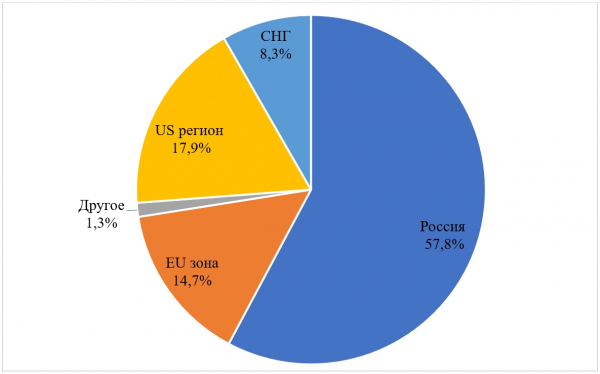
The primary currency of the study was chosen to be US dollars. Not that we all receive salaries in dollars, but they have fewer zeros and a more precise conversion from other currencies.
In what currency do QA specialists receive their salaries?
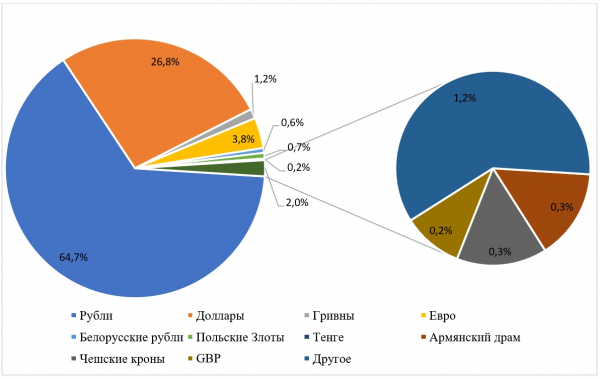
We managed to clearly define 4 main salary ranges:
— less than $600 (with a median of $450);
— $601-1500 (with a median of $1050);
— $1500-2300 (with a median of $1800);
— more than $2300 (with a median of $3000).
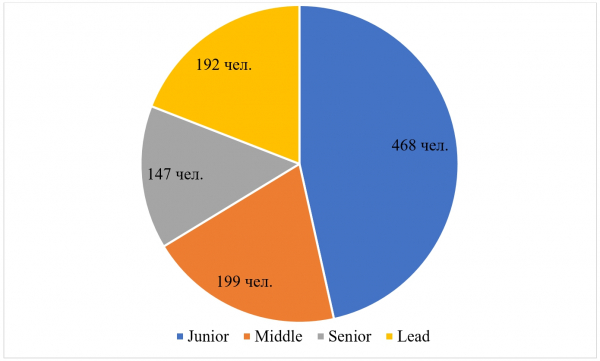
97% of the job titles reported by respondents were identified and classified into 4 classic categories of QA specialists. We intentionally used the classification adopted in international companies, as these terms are frequently encountered even in Russia, while the remaining 42.2% of respondents work for other countries.
How are QA specialists distributed across job categories?
Part one. The salary level of QA specialists in Russia and the World
First, let's determine the salary level of QA specialists in Russia and how it depends on the work format.
How does the level of QA specialist salary depend on their work format (Russia)?
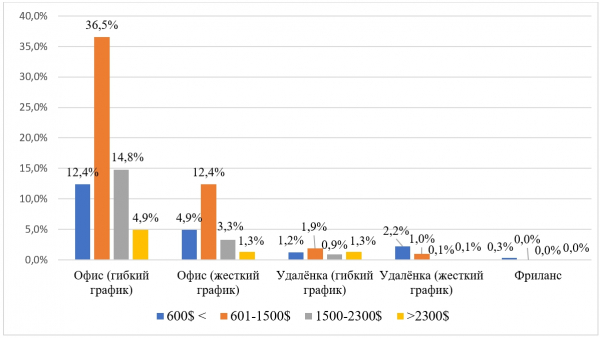
About half of all QA specialists (48.9%) work in an office with a salary ranging from $601 to $1500. Another third also operates in an office format, nearly evenly split into two groups: with a salary < $600 (17.3%) and with a salary of $1500 – $2300 (18.1%).
Interestingly, the percentage of high-paid specialists is significantly higher among proponents of flexible office and remote work schedules than among testers bound by a rigid work schedule. Regarding freelancers, all of its few representatives reported their income level as < $600.
These figures are not unique to the Russian QA services market. Similar trends can also be observed internationally.
Comparison of the average salary of QA specialists (Russia vs World)
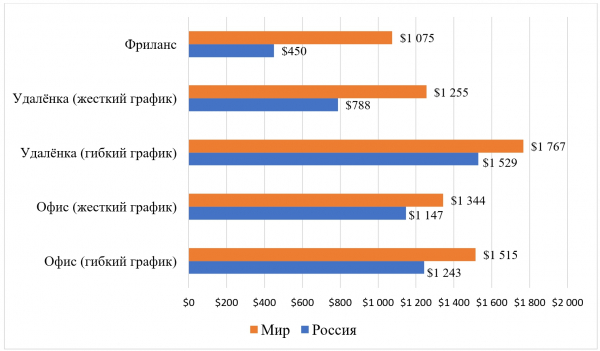
The salary advantages of flexible remote schedules are even more apparent when compared to the global average. This is likely affected by the employer's absence of expenses on office equipment, infrastructure, and organization of the employee's workspace, which are partially converted into their salary. So, if you dream of sipping cocktails by the ocean and earning 24% more than your colleagues battling for the air conditioner remote from 9 to 6, you now have additional motivation.
Interestingly, salaries in Russia lag the most behind global standards in the case of rigid remote formats (35.7%) and freelancing (58.1%), although freelancing, while poorly paid, is much better developed abroad than in Russia.
You might ask: "Where do these salary figures come from? Surely only Moscow and St. Petersburg participated in the surveys." No, colleagues. The cities represented cover almost all of Russia, but we dared not analyze cities with fewer than 20 respondents regarding average salaries. If anyone needs it, write to ask@quality-lab.ru, and we'll share data about other cities.
Average salary level of QA specialists (cities of Russia)
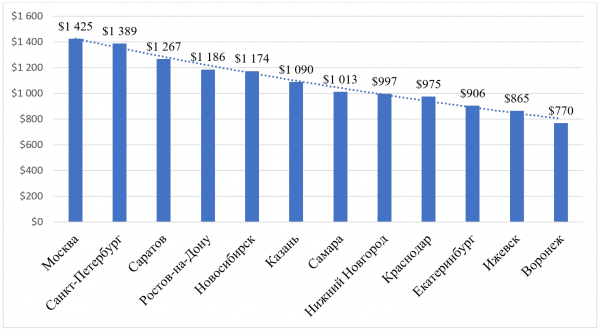
The picture is predictable, with high salaries predominantly found in million-plus cities, except for Saratov, Krasnodar, and Izhevsk. The capitals traditionally share the lead, while the top salaries by city conclude with the Black Earth Region and Voronezh, with the salary difference from Moscow being almost twofold (45.9%).
Interestingly, we do not fully understand how Saratov made it to the top three in salaries. We would be grateful if you could share your thoughts on this matter.
For those who decided to work for the 'decaying Europe' or the nearby CIS, we are pleased to inform you. There are all chances to feel a significant salary increase. Those who are already working for them probably know this without us.
Average salary level for QA specialists (regions of employers)
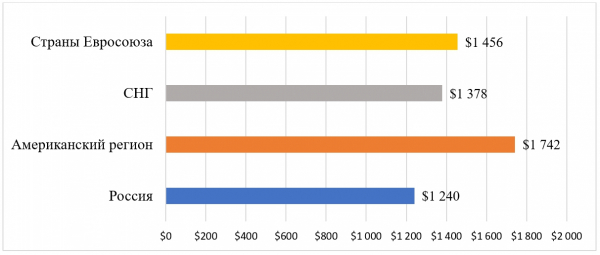
It's predictable that the salary level among Russian employers is on average 10% lower than in the CIS, 14.8% modest compared to Europe, and 28.8% lower than in the USA.
Interesting: Salary levels in Europe and the CIS do not differ as much as we initially predicted (only by 5.3%). Whether this is due to the globalization of the industry, the blurring of the concepts of 'Europe' and 'CIS' in the minds of respondents, or economic prerequisites is hard to say.
It makes sense that higher salaries attract more qualified specialists willing to work for foreign companies. The outflow of specialists becomes easier when large companies open branches in dozens of countries and cities, while remote working formats erase remaining borders.
Where do QA specialists live and work?
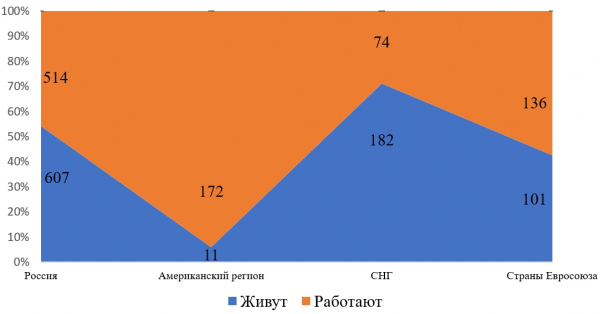
The record holder for recruiting talent from other countries is the USA, where American companies employ 15 times more QA specialists than reside within the states. In the CIS, on the contrary, people tend to prefer living rather than working for local IT companies. In Russia and European countries, there is a relative balance between those working and living.
Interesting: Sometimes the only barrier separating a specialist from transitioning to a Euro-American employer is language knowledge. The labor market in Russia and the CIS is fortunate that this factor still restrains the 'brain drain' in our age.
Part Two. The Dependence of QA Specialists' Salaries on Experience, Education, and Job Position
We could not identify a direct correlation between the salary level of QA specialists and their education. However, we were able to draw some very interesting conclusions about the influence of education on the position held by the specialist.
How does the position/category of a QA specialist depend on their education?
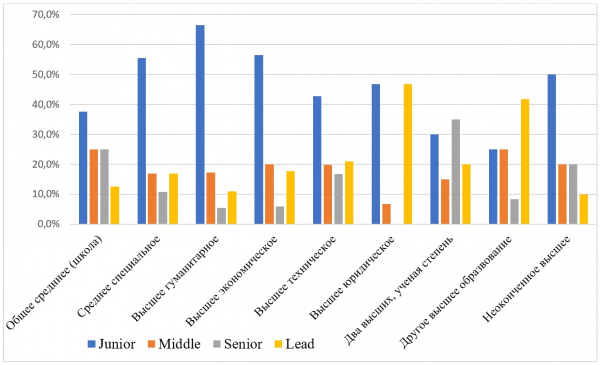
The percentage of juniors is highest among those with humanitarian, economic, and secondary vocational education.
Good leads come from students of technical specialties, lawyers, individuals with academic degrees, and notably, specialists with relevant management education.
Good seniors (senior) arise from technicians and, interestingly, either people with a school education or specialists with two degrees.
As for middles (middle) they are abundant everywhere, except perhaps among lawyers where there are fewer of them.
Interesting: Our statistics, collected over a year of the online testing institute (POINT) operations, fully confirm the aforementioned educational data about juniors. Internal company statistics show that technical specialists climb the career ladder the fastest.
There are many disputes regarding the classification of QA specialists and salary structures by grades. Juniors (junior) earning as much as seniors (senior) and leads (lead) being paid at a middle (middle) salary scale is quite a common practice these days. Let's try to understand.
How does the level of a QA specialist's salary depend on their position/category?
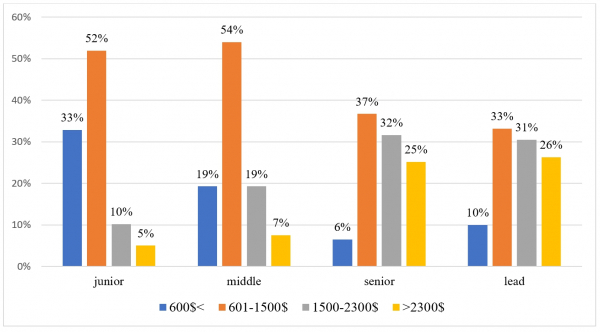
Let’s start by debunking the main myth about seniors moving into management. Transitioning to leads is not an upward step, but a lateral one! The experience accumulated over years of work as a QA specialist hardly aids in the new role since it involves working with people and plans instead of code. Management understands this well, and in practice, we see that neither the salaries nor their structure fundamentally differ for seniors and leads.
The difference between juniors and middles cannot be described as catastrophic either. Yes, on average, a middle often earns $1500-2300 instead of $600. But like juniors, half of all middles receive salaries in the range of $601-1500.
Interesting: The real jump in salaries is evident when comparing middles and seniors. Salaries below $600 become a thing of the past, and 57% of all salaries shift into the range of $1500-3000. We just need to understand what a senior should know and develop in this direction, but more on that later.
Experience, unlike education, directly affects salary levels.
How does the salary level of a QA specialist depend on work experience?
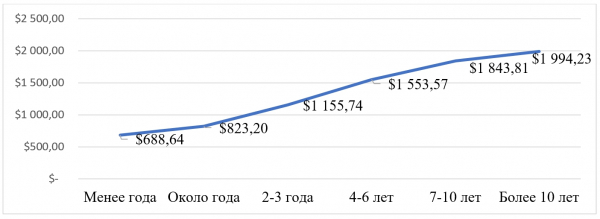
The diagram below shows clearly how the percentage of low-paid specialists falls with experience in the profession, while the number of salaries exceeding $2300 rises.
How do salary ranges change as a QA specialist gains experience?
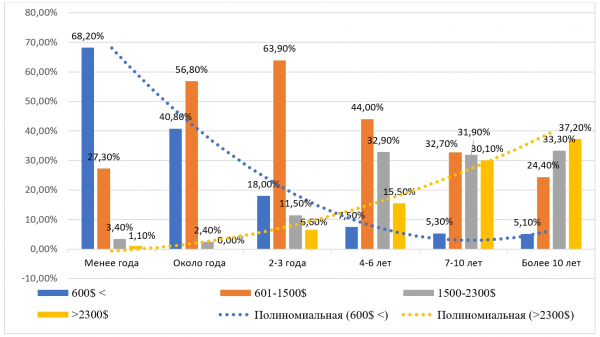
For a junior, the main goal is to get through the first year. Even after that, with a salary of $1500-2300, junior testers may not expect much, but there is a good chance (56%) to join the ranks of specialists earning $600-1500 a month.
Ultimately, judging by the salary, the value of a specialist is formed between 4 and 6 years of work, reaching an average salary level of $1500. After that, the pace of salary growth slows down; for some, it may reach up to $2300 a month, but overall, experience after 6 years in a testing profession simply guarantees an income of $1500-2000, and after that, it all depends on the city, company, and individual.
Interesting: The rate of salary increase for QA specialists during the first 3 years is 67.8%, while the wage growth rate from 7 to 10 years drops to 8.1%.
Part Three. The Dependence of QA Specialists' Salaries on Testing Skill Proficiency
Remember, at the beginning of this article, we tried to understand our worth as specialists. Now let’s move on to analyzing testing skills. What skills do QA specialists possess and how does this impact their salary level?
What skills do QA specialists excel in?
Let’s review the essential minimum skills that are necessary in our profession.
What should every QA specialist know?
- Skill in localization and defect tracking — The most common skill. 4 people do not possess it at all, 16 have poor skills. But 98% of respondents possess this skill well or perfectly.
- Familiarity with bug tracking systems (Jira, Redmine, YouTrack, Bugzilla) — also, only 6 people are completely unfamiliar with this skill.
- Client testing of web applications — 81% of respondents are well or perfectly skilled in this area.
- Familiarity with knowledge management and test case storage systems (wiki, Confluence, etc.) — the same 81%, but only 27% are at a perfect skill level.
- Proficiency in test analysis, test design, and test combinatorics techniques — 58% of specialists are well-skilled in this area, and another 18% are perfect. Should we lag behind them?
Now let’s consider skills that can be considered scarce, and therefore, well-paid in our profession.
What can you boast about to employers/colleagues?
- Experience in developing load testing scripts in JMeter or similar applications. – the rarest skill. 467 people do not possess this skill at all (46.4%). 197 people possess it at a sufficient level (19.6%). Only 49 people have mastered it perfectly, with 36 of them earning over $1500.
- Mastery of reporting systems for automated tests (Allure, etc.) − 204 specialists possess it at a sufficient level.
- Mastery of drivers and frameworks for test automation – 241 specialists.
- Mastery of test frameworks for automation (TestNG, JUnit, etc.) – 272 specialists.
Interesting: The rarest skills turned out to be load testing and automation skills, which confirms the current situation in the QA services job market. The shortage of automation engineers and load testers is clearly reflected in their salary levels compared to other specialists.
Which skills are the most highly paid?
Modestly (up to $1410 per month) basic bug tracking skills, skills in web/mobile applications, test analysis, and layout/responsiveness are paid.
Not far behind (up to $1560 per month) are the skills of integration and database testing, mastery of version control systems and logging. On average, they are paid 10-15% better.
Even better (up to $1660 per month) are the skills of managing test case repositories, mastery of traffic monitoring tools, and foundational skills in localization and defect filing.
Well, if you like the figure of $1770, then, as mentioned earlier, welcome to the league of automation testers, load testers, and continuous integrators, as these skills are, according to our research, compensated the best.
Interesting: mastery of load testing and automation skills increases your salary by an average of 20-25%, with equal position and work experience.
A QA specialist possessing only one or even 2-3 skills is quite rare in the profession. It is more accurate to evaluate the qualifications and salary of a tester based on the total number of skills they have mastered.
How does the level of a QA specialist's salary depend on the number of skills they have acquired?
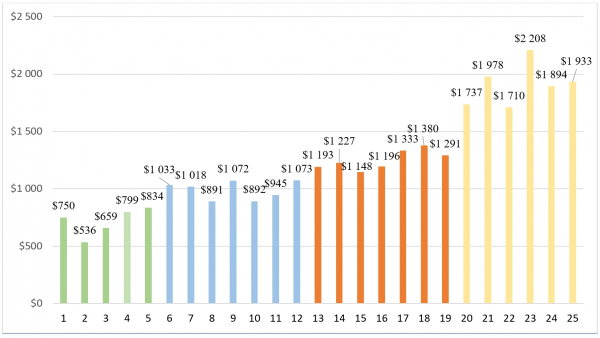
The myth of the profitability of specialization in testing has not been justified. The number of skills in a tester's arsenal directly impacts their salary. Every additional 5-6 skills in a specialist's toolkit leads to a salary increase of 20-30%. The most noticeable salary growth occurs among specialists who have mastered more than 20 skills. These "wunderkinds" earn on average 62% more than narrow-profile specialists with just 5 skills.
Interesting: Only 12 out of 1006 people possess all skills. All of them have high salary levels. All 12 individuals work in offices and have extensive work experience (only one respondent has 2-3 years of experience, while the others are evenly distributed across 4-6, 7-10, and over 10 years of experience).
Conclusion: Portraits of QA Specialists
Instead of boring conclusions and summaries, we decided to create verbal portraits of QA specialists with varying salary levels. The portraits are far from ideal as they reflect a certain set of QA specialists, and therefore may diverge from reality in individual cases. A total of four portraits were created.
The Modest One
Portrait of a QA specialist with a salary level up to $600.
Location: small cities of Russia and the CIS.
Employer: predominantly companies from Russia and the CIS.
Work format: freelance or strict remote work schedule.
Education: any, most often humanitarian.
Category/Position: junior.
Work experience: up to a year.
Well-versed in: 4-5 skills.
Must possess at least:
— bug-tracking systems;
— localization and defect logging skills;
— client testing of web or mobile applications;
— test analysis skills.
Middle Class
Portrait of a QA specialist with a salary of $600-1500.
Location: large cities in Russia (Saratov, Novosibirsk, Kazan, Rostov, etc.) and the CIS, Europe.
Employer: predominantly companies from Russia, the CIS, and small European firms.
Work format: mainly a rigid office and remote work schedule.
Education: any.
Category/Position: junior or middle.
Work experience: 2-3 years.
Well-versed in: 6-10 skills.
In addition to the basic set, possesses:
— integration and database testing skills;
— version control and logging systems.
Affluent
Portrait of a QA specialist with a salary of $1500-2300.
Location:
— Russia (capitals);
— CIS (million-plus cities);
— Europe.
Employer: companies funded from Europe and the USA.
Work format: office formats and flexible remote work.
Education: anything, most often legal or managerial.
Category/Position: middle or senior.
Work experience: 4-6 years.
Well-versed in: 11-18 skills.
Must also possess:
— knowledge management systems and test case repositories;
— traffic monitoring tools;
— version control systems.
Tycoon
The profile of a QA specialist with a salary starting at $2300.
Location:
— regardless of location (global citizen);
— Russia (capitals);
— CIS (capitals);
— Europe (major cities);
— USA.
Employer: companies from Europe and the USA.
Work format: flexible office or flexible remote format.
Education: anything, but preferably technical.
Category/Position: Senior or Lead.
Work experience: >6 years.
Well-versed in: more than 19 skills in testing.
Essential skill set includes:
— 2-3 skills in automated testing;
— 1-2 skills in load testing;
— proficiency in continuous integration systems.
We hope it’s now a bit easier for you to assess yourself (as a QA specialist) in the job market. Perhaps this article will help someone muster patience, focus on learning, and begin to grow in the most lucrative direction. Some might gain the courage and data to discuss a salary increase with their manager. Others might finally decide to leave their homeland and move to the shores of Thailand.
Whoever you are, we wish you good luck, as you already have a rough idea of where and how much you can grow.
Source: habr.com
