

A carrier pigeon loaded with microSD cards can transmit large volumes of data faster and cheaper than almost any other method.
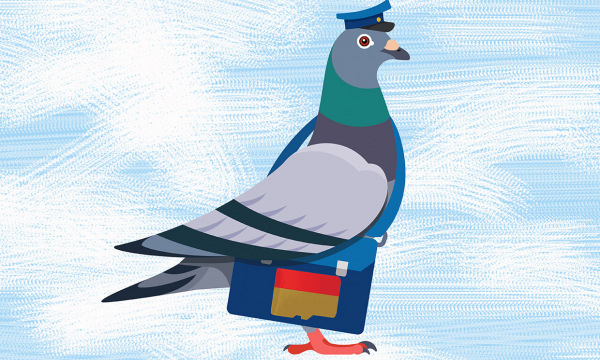
Note: Although the original of this article appeared on the IEEE Spectrum website on April 1, all the facts mentioned are quite accurate.
In February the release of the world's first microSD card with a capacity of 1 terabyte. Like other cards of this format, it is tiny, measuring just 15 x 11 x 1 mm, and weighs 250 mg. It can hold an incredible amount of data in a very small physical space and can be purchased for $550. To put it in perspective, the first 512 GB microSD cards appeared just a year earlier, in February 2018.
We have become so accustomed to the speed of progress in computing that these increases in storage density often go unnoticed, sometimes meriting a press release and a couple of blog articles. More interesting (and likely to lead to more serious consequences) is how much faster our ability to generate and store data is growing compared to our capabilities to transmit it over networks accessible to most people.
This issue is not new; for several decades, various types of 'sneakernets' have been used for the physical transportation of data from one place to another—on foot, by mail, or through more exotic means. One method of data transmission that has been actively used for the last thousand years is carrier pigeons, capable of traveling distances of hundreds or even thousands of kilometers, returning home, and using navigation techniques whose nature is still not fully understood. It turns out that in terms of bandwidth (the amount of data transmitted over a given distance in a certain time), pigeon-based 'sneakernets' remain more efficient than typical networks.
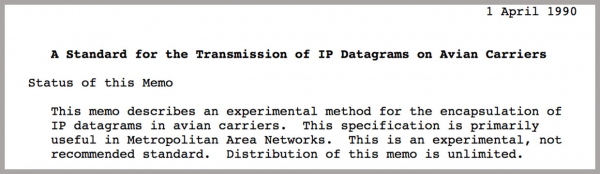
From the 'IP datagram transmission standard via air carriers'
On April 1, 1990, David Weissman proposed a Request for Comment (RFC) titled 'known now as IPoAC. RFC 1149 describes an "experimental method for encapsulating IP datagrams in air carriers" and has several updates regarding both service quality and the transition to IPv6 (published on April 1, 1999, and April 1, 2011, respectively).
Sending an RFC on April Fool's Day is a tradition that began in 1978 with RFC 748, which proposed that after sending the command IAC DONT RANDOMLY-LOSE to a telnet server, the server would stop randomly losing data. Quite a sensible idea, isn’t it? This is one of the characteristics of an April Fool's RFC, explains , who led the networking working group at CERN from 1985 to 1996, chaired the IETF from 2005 to 2007, and now lives in New Zealand. "It should be technically feasible (i.e., not violate the laws of physics), and you should read at least a page before you realize that it's a joke," he says. "And, of course, it should be absurd."
Carpenter, along with his colleague Bob Hinden, also wrote April Fool's RFCs, where they described , in 2011. Even two decades after its inception, IPoAC is still well-known. "Everyone knows about air carriers," Carpenter told us. "Once Bob and I were discussing the rollout of IPv6 at an IETF meeting, and the idea of adding it to IPoAC came quite naturally."
, which originally defined IPoAC, describes many advantages of the new standard:
A variety of different services can be provided through priority pecking. Additionally, there is built-in detection and destruction of worms. Since IP does not guarantee 100% packet delivery, one can reconcile with carrier loss. Over time, carriers self-recover. Broadcasting is undefined, and a storm can lead to data loss. There is a possibility of making persistent delivery attempts until the carrier falls. Audit trails are generated automatically and can often be found in cable trays and on logs [the term log means both "a log" and "a record-keeping journal" / note from the translator.].
An update regarding quality improvements (RFC 2549) adds several important details:
Multicast is supported, but it requires the implementation of a cloning device. Carriers may become confused if they are situated on a pruned tree. Carriers are distributed across the inheritance tree. On average, the TTL of carriers is 15 years, which limits their use in searches across the expanding ring.
Ostriches can be considered as alternative carriers, possessing much greater capacity for transmitting large volumes of information, but ensuring slower delivery and requiring bridges between different areas.
Additional discussion on service quality can be found in .
by Carpenter, which describes IPv6 for IPoAC and mentions potential issues related to packet routing:
The passage of carriers through the territory of similar carriers, without establishing agreements for equal information exchange, may lead to abrupt route changes, packet looping, and out-of-order delivery. The passage of carriers through the territory of predators may result in significant packet loss. It is advisable to consider these factors in routing table algorithms. Those implementing these routes, in order to ensure reliable delivery, should consider policy-based routing that avoids areas dominated by local and predatory carriers.
There is evidence that some carriers tend to consume other carriers and then transport the consumed payload. This may serve as a new method for tunneling IPv4 packets within IPv6 packets, or vice versa.
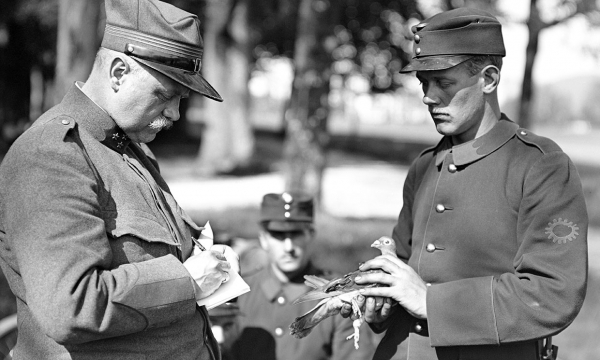
The IPoAC standard was proposed in 1990, but messages sent with carrier pigeons took much longer: the photo shows a carrier pigeon being sent in Switzerland between 1914 and 1918.
It is logical to expect that a standard, the concept of which was invented back in 1990, would have its original format for data transmission over the IPoAC protocol related to printing hexadecimal characters on paper. Since then, much has changed, and the amount of data fitting within a specified physical volume and weight has increased tremendously, while the payload capacity of a single pigeon has remained the same. Pigeons can carry a payload that constitutes a significant percentage of their body weight – an average homing pigeon weighs about 500 grams, and in the early 20th century, they could carry 75-gram cameras for reconnaissance over enemy territory.
We spoke with , a pigeon racing enthusiast from Maryland, who confirmed that pigeons can easily carry up to 75 grams (or possibly a little more) "during the day over any distance." They can cover considerable distances – the world record for a homing pigeon is held by a fearless bird that flew from Arras in France to its home in Ho Chi Minh City, Vietnam, completing a journey of 11,500 kilometers in 24 days. Most homing pigeons, of course, are not capable of flying that far. According to Lesofski, the typical length of a long-distance race is about 1,000 kilometers, with birds averaging a speed of around 70 km/h. In shorter distances, sprinters can reach speeds of up to 177 km/h.
Putting all this together, we can calculate that if we load a homing pigeon to its maximum capacity of 75 grams with microSD cards of 1 TB each, weighing 250 mg apiece, the pigeon could carry 300 TB of data. Traveling from San Francisco to New York (4,130 km) at maximum sprinting speed, it would achieve a data transfer speed of 12 TB/hour, or 28 Gbit/s, which is several orders of magnitude higher than most internet connections. In the U.S., for example, the fastest average download speed is observed in Kansas City, where data via Google Fiber is transmitted at 127 Mbit/s. At that speed, downloading 300 TB would take 240 days – in that time, our pigeon could have circled the globe 25 times.
Let’s assume this example doesn’t look very realistic since it describes some sort of super pigeon, so let’s slow down a bit. Let’s take a more average flight speed of 70 km/h and load the bird with half of the maximum cargo, which is 37.5 grams of terabyte memory cards. Even so, when we compare this method to a very fast gigabit connection, the pigeon wins. The pigeon will be able to circumnavigate more than half the globe during the time our file transfer finishes, indicating that it's literally faster to send data by pigeon to anywhere on Earth than to use the internet for file transfer.
Naturally, this comparison is about raw bandwidth. We aren’t taking into account the time and effort to copy data onto microSD cards, load them onto the pigeon, and read the data once the bird arrives at its destination. The delays are obviously high, so anything other than one-way transfer would be impractical. The biggest limitation is that the carrier pigeon flies in only one direction and to one destination, so you can’t select your data sending target, plus you'll have to transport the pigeons to wherever you plan to send them from, which also limits their practical utility.
However, the fact remains that even with realistic estimates of payload and pigeon speed compared to an internet connection, it’s not easy to surpass the pure bandwidth of a pigeon.
Considering all this, it’s worth mentioning that data transfer by pigeons has been tested in the real world and they performed quite well. A group of Bergen Linux users from Norway in 2001 , sending one ping with each pigeon over a distance of 5 km:
A ping was sent around 12:15. We decided to have a 7.5-minute interval between packets, which ideally should have resulted in a couple of packets remaining unanswered. However, things didn’t quite go that way. A flock of pigeons was flying above our neighbor’s yard. And our pigeons didn’t want to fly straight home; they first wanted to mingle with the other pigeons. And who can blame them, considering the sun came out for the first time after a couple of gloomy days?
However, their instincts prevailed, and we saw how, after frolicking for about an hour, a pair of pigeons broke away from the flock and headed in the right direction. We rejoiced. And indeed, they were our pigeons, as shortly afterward we received a report from another point that a pigeon had landed on the roof.
Finally, the first pigeon arrived. The data packet was carefully removed from its leg, unpacked, and scanned. After a manual OCR check and correcting a couple of mistakes, the packet was accepted as valid, and our celebration continued.
For truly large volumes of data (so much that managing the necessary number of pigeons becomes challenging), physical methods of transport are still required. Amazon offers a service called – a 45-foot shipping container on a truck. One Snowmobile can carry up to 100 PB (100,000 TB) of data. It may not move as fast as an equivalent flock of several hundred pigeons, but it will be easier to work with.
Most people seem to be satisfied with the extremely slow upload speed, and they have little interest in investing in their own carrier pigeons. It really does take a lot of work, says Drew Lesofski, and pigeons don't typically behave like data packets:
GPS technology is increasingly helping pigeon racing enthusiasts, and we are gaining a better understanding of how our pigeons fly and why some fly faster than others. The shortest line between two points is a straight line, but pigeons rarely fly in a straight line. They often trace zigzags, flying roughly in the right direction and then correcting course as they approach their destination. Some are physically stronger and fly faster, but a pigeon that is better at navigation, healthy, and physically trained can outpace a fast-flying pigeon with a poor compass.
Lesofski trusts pigeons enough as data couriers: "I would confidently send information with my pigeons," he says, while also taking care of error correction. "I would release at least three at once to ensure that even if one has a poor compass, the other two will have a better one, and ultimately the speed of all three will be higher."
The issues with implementing IPoAC and increasing the reliability of sufficiently fast (and often wireless) networks mean that many services that relied on pigeons (and there were many) have switched to more traditional data transmission methods over the past few decades.
Due to all the preliminary preparations required to set up a data transmission system with pigeons, alternatives (like fixed-wing drones) might become more viable. However, pigeons still have certain advantages: they scale well, operate at a low cost, are more reliable, possess a very sophisticated obstacle avoidance system both at the software and hardware levels, and they can recharge themselves.
How will all this affect the future of the IPoAC standard? The standard exists, it is available to everyone, albeit a bit absurd. We asked Brian Carpenter if he is preparing any updates to the standard, and he mentioned that he is considering whether pigeons could carry qubits. But even if IPoAC is a bit complicated (and somewhat silly) for your data transmission needs, various unconventional communication networks will remain necessary in the foreseeable future, and our ability to generate vast amounts of data continues to grow faster than our capacity to transmit it.
Thanks to user AyrA_ch for pointing out this information with their , and for the handy , which helps estimate how much faster pigeons really are compared to other data transmission methods.
Source: habr.com
