

After the release of .NET Core 3.0 this year, Microsoft will launch the .NET 5 platform, which will be a significant improvement to the development system as a whole. The main innovation compared to .NET Framework 4.8 will be support for Linux, macOS, iOS, Android, tvOS, watchOS, and WebAssembly. The 4.8 version will remain the last one, and only the Core family will continue to evolve.
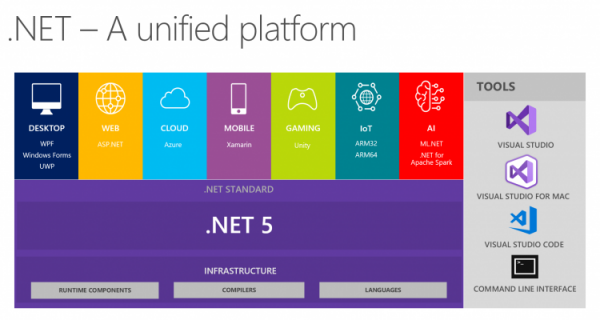
It is reported that development will focus on Runtime, JIT, AOT, GC, BCL (Base Class Library), C#, VB.NET, F#, ASP.NET, Entity Framework, ML.NET, WinForms, WPF, and Xamarin. This will allow for the unification of the platform and provide a single open framework and runtime for various tasks. As a result, applications can be created for different platforms on a common codebase with the same build process, regardless of the application type.
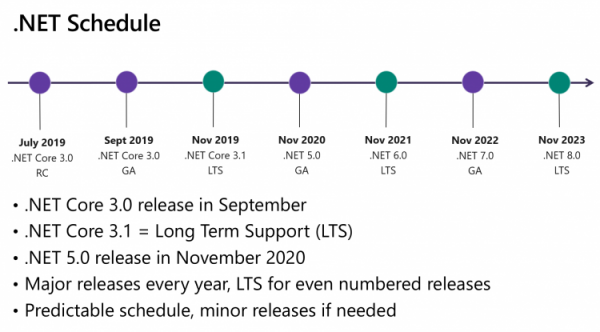
It is expected that .NET 5 will be released in November 2020 and will become a truly universal platform for development. Additionally, the "five" is not the only innovation from Microsoft in the open source space. The company has already released the second version of the Windows Subsystem for Linux (WSL), which is expected to be significantly faster than the first version, and will also be based on its own Linux kernel build.
Unlike the first version, this is a full-fledged kernel, not an emulation layer. This approach will speed up boot times, optimize RAM usage, and improve file system I/O speeds, as well as allow for direct launching of Docker containers.
Interestingly, the company promises not to lock down the kernel and to provide all developments related to it for the community. There will be no ties to distributions. Users, as before, can download any suitable image.
