


– These idiots placed a porcelain container filled with a "gel" in a specially designed chamber, supposedly maximally isolated... They thought the chamber was completely sealed, but when they opened the container with manipulators, the "gel" spread through the metal and plastic like water through a sponge, bursting out, and everything it touched turned back into "gel." Thirty-five people perished, over a hundred were injured, and the entire laboratory building was rendered unusable. Have you ever been there? A magnificent structure! And now the "gel" is flowing into the basements and lower floors... There’s your prelude to contact.
— A. Strugatsky, B. Strugatsky "Roadside Picnic"
Hello, %%username%!
Blame this person for the fact that I'm still writing something. . They inspired the idea.
Simply thinking it over a bit, I decided that a brief excursion into caustic substances would come together relatively quickly. It might be interesting to someone. And useful to others.
Let's go.
Let’s clarify the terms right away.
Caustic — 1. Chemically corrosive. 2. Sharp, causing irritation or pain. 3. Sarcastic, biting.
Ozhogov S.I. Dictionary of the Russian Language. — Moscow: Russ. lang., 1990. — 921 p.
So, we’ll immediately discard the last two meanings of the word. We will also dismiss "caustic" lacrimators — which are not so much caustic as tear-inducing, and sternutators — which cause coughing. Yes, below will be substances that have these properties, but they — which is the main point! — truly corrode materials, and sometimes even flesh.
We will not consider substances that are only caustic to humans and similar — due to the specific destruction of cell membranes. Therefore, mustards will remain out of the picture.
We will consider compounds that are liquids at room temperature. Therefore, we'll not discuss liquid oxygen and nitrogen, as well as gases like fluorine, although they can be considered caustic.
As usual, my perspective will be purely subjective, based on personal experience. And yes — it’s quite possible that I won’t mention someone — leave comments, %username%, within three days of publication I’ll be updating the article with anything I forgot from the very start!
And yes — I don’t have the time or energy to create a ‘top list’, so it will be a mixed bag. And with all exceptions — it turned out to be quite brief.
Caustic alkalis
Specifically — the hydroxides of alkali metals: lithium, sodium, potassium, rubidium, cesium, francium, thallium (I) hydroxide, and barium hydroxide. However:
- Lithium, cesium, rubidium, and barium are excluded — they are expensive and rarely encountered.
- If you, %username%, come across francium hydroxide, its causticity will be the least of your worries — it is extremely radioactive.
- The same goes for thallium — it is incredibly poisonous.
This leaves us with sodium and potassium. But to be honest — the properties of all caustic alkalies are very similar.
Sodium hydroxide — known as 'caustic soda' — is familiar to everyone. Potassium hydroxide as food additive E525 is also known. Both are similar in properties: they are highly hygroscopic, meaning they attract water and 'melt' in the air. They dissolve well in water, releasing a significant amount of heat.
'Melting' in the air essentially means the formation of very concentrated solutions of alkalies. Therefore, if you place a piece of caustic alkali on paper, skin, or some metals (like aluminum) — after some time, you'll find that the material has been significantly damaged! What was shown in 'Fight Club' is quite close to the truth: indeed, sweaty hands in caustic will hurt! Personally, I found it more painful than hydrochloric acid (discussed below).
However, if your hands are very dry — you probably won't feel anything in dry alkali.
Caustic alkalis effectively break down fats into glycerin and fatty acid salts — that's how soap is made (hello, 'Fight Club!'). Proteins are also decomposed, albeit a bit slower — in principle, alkalis dissolve flesh, especially strong solutions — yes, when heated. A downside compared to hydrochloric acid (also discussed below) is that all alkalis absorb carbon dioxide from the atmosphere, thus their strength will gradually decrease. Additionally, alkalis react with components of glass — glass becomes cloudy, although it requires effort to completely dissolve it.
Tetraalkylammonium hydroxides are sometimes classified as caustic alkalis, for example.
Tetramethylammonium hydroxide.
In fact, these substances combine the properties of cationic surfactants (similar to regular soap — only cationic: here the active particle is a polar particle with a '+' charge, while in soap it has a '-' charge) and relatively high basicity. If it gets on your hands, you can lather it in water and wash like soap; if you heat your hair, skin, or nails in an aqueous solution, it will dissolve. Its "causticity" against the backdrop of sodium and potassium hydroxides is rather mild.
Sulfuric Acid
H2SO4
Probably the most well-known in all stories. Not the most caustic, but quite unpleasant: concentrated sulfuric acid (which is 98%) is an oily liquid that loves water and thus takes it away from everyone. By removing water from cellulose and sugar, it chars them. Similarly, it will happily take water away from you, %username%, especially if you pour it on the delicate skin of your face or into your eyes (well, in your eyes it will definitely come with some adventures). Some particularly kind people mix sulfuric acid with oil, making it harder to wash off and allowing for better absorption into the skin.
By the way, while taking water, sulfuric acid heats up quite a bit, making the situation even more intense. Therefore, washing it away with water is a very bad idea. It's better to use oil (to wash it off, not to rub it in — and then wash it away with water). Or use a large stream of water to cool it down immediately.
"First water, then acid — otherwise, disaster will strike!" — this is precisely about sulfuric acid, even though for some reason everyone thinks it applies to any acid.
As an oxidizer, sulfuric acid oxidizes the metal surfaces to oxides. And since the interaction of oxides with acids occurs with water as a catalyst — and sulfuric acid doesn't give up water — the effect known as passivation occurs: a dense, insoluble, and impermeable oxide film protects the metal from further dissolution.
It is through this mechanism that concentrated sulfuric acid is sent far away with iron and aluminum. Interestingly, if the acid is diluted, water appears, and it can't be sent — the metals dissolve.
By the way, sulfur trioxide SO3 dissolves in sulfuric acid to produce oleum — which is sometimes mistakenly written as H2S2O7, but that's not entirely correct. Oleum has an even greater affinity for water.
Personal experience of sulfuric acid on the skin: a bit warm, then slightly burning — washed off under the tap, nothing serious. Don't trust the movies, but I wouldn't recommend letting it drip on your face.
Organic chemists often use chrome alum or the "chrome mixture" — this is potassium bichromate dissolved in sulfuric acid. Essentially, this is a solution of chromic acid, good for washing dishes from organic residue. It burns when it comes into contact with skin, but essentially it's sulfuric acid plus toxic hexavalent chromium. You won't get holes in your skin, maybe just on your clothes.
The author of these lines knows an idiot who used potassium permanganate instead of potassium bichromate. It slightly exploded when it contacted organic material. The people present were just lightly frightened.
Hydrochloric acid
HCl
There are no concentrations above 38% in water. One of the most popular acids for dissolution — it surpasses others because it can be technologically very pure, and in addition to its acidic action, it also forms complex chlorides that enhance solubility. By the way, this is also why insoluble silver chloride is quite soluble in concentrated hydrochloric acid.
When this comes into contact with skin, it burns a bit more intensely, subjectively — it also itches, and besides, it smells: if you work a lot with concentrated hydrochloric acid in a lab with poor ventilation — your dentist will thank you: you'll be enriching him with fillings. By the way, chewing gum helps. But not much. It's better to have good ventilation.
Since it is not oily and doesn't heat up much with water, its corrosiveness is only to metals, and not to all. By the way, steel is passivated in concentrated hydrochloric acid and tells it, "no way!" This is used during transportation.
Nitric acid
HNO3
Also very popular, it is oddly feared — but for no good reason. Concentrated — that's up to 70% — is the most popular; above that is the "fuming" type, which is mostly unwanted. There is also anhydrous — that one can actually explode.
As an oxidizer, it passivates many metals, which become covered with an insoluble film and say: "goodbye" — this includes chromium, iron, aluminum, cobalt, nickel, and others.
The skin reacts instantly according to the xantho-protein reaction — there will be a yellow spot, which means that you, %username%, are indeed made of protein! After a while, the yellow skin will peel off, similar to a burn. It stings less than hydrochloric acid, although it smells just as bad — and this time it's more toxic: airborne nitrogen oxides are not good for the body.
In chemistry, there is a so-called 'nitrating mixture' — the most popular one consists of sulfuric and nitric acid. It is used in syntheses, particularly in the production of a fun substance — nitrocellulose. In terms of causticity, it's the same as chromic acid plus a pretty yellow skin.
There is also 'aqua regia' — this is one part of nitric acid to three parts of hydrochloric acid. It is used for dissolving certain metals, mainly precious ones. The drop method for testing samples of gold items is based on different ratios and adding water — by the way, it's very hard to trick specialists in this method with a counterfeit. In terms of skin causticity — it’s the same as the 'nitrating mixture' plus it smells terrible, an unmistakable odor that is also quite toxic.
There is also 'reverse aqua regia' — when the ratio is reversed, but this is rare.
Phosphoric acid
H3PO4
Actually, I provided the formula for orthophosphoric acid — the most common one. There are also metaphosphoric, polyphosphoric, ultraphosphoric acids — in short, there’s plenty of variety, but it doesn’t matter.
Concentrated orthophosphoric acid (85%) is a sort of syrup. The acid itself is moderately strong, and it is often used in the food industry — by the way, when you get dental fillings, the surface of the tooth is pre-etched with phosphoric acid.
Its corrosiveness is average, but there’s an unpleasant nuance: this syrup absorbs well. So if it drips on things — it will soak in, and then it will gradually start to eat away at them. If a stain or hole occurs from nitric and hydrochloric acids — the phosphoric one will cause the item to disintegrate, especially noticeable on shoes, when the hole starts to crumble until it becomes a complete perforation.
Well, overall it's hard to call it caustic.
HF
Hydrofluoric acid
Concentrated hydrofluoric acid is about 38%, although there can be strange exceptions.
A weak acid that fiercely loves fluoride ions, forming stable complexes with everything it can. Therefore, surprisingly, it dissolves things that other, stronger companions cannot, and is often used in various mixtures for dissolving. When it comes in contact with your hand, the sensations will mostly originate from other components of such mixtures, but there is a caveat.
Hydrofluoric acid dissolves SiO2. That is, sand. That is, glass. That is, quartz. And so on. No, if you splash this acid on a window, it won't dissolve, but a cloudy stain will remain. To dissolve it, you need to hold it for a long time, and preferably — heat it. Dissolving releases SiF4, which is so beneficial for health that it's better to do this under a fume hood.
A small but pleasant nuance: silicon is found in your nails, %username%. So if hydrofluoric acid gets under your nails — you won't notice anything. But you won't be able to sleep at night — it will hurt SO much that sometimes you'll wish to tear off your finger. Believe me, my friend — I know.
And in general, hydrofluoric acid is toxic, carcinogenic, absorbed through the skin, and a lot more — but today we're talking about causticity, right?
Remember, we agreed at the very beginning that there won't be any fluorine? There won't be any. But there will be...
Fluorides of inert gases
In fact, fluorine is a tough character, and you can't mess around with it, which is why some inert gases form fluorides with it. Known stable fluorides include: KrF2, XeF2, XeF4, XeF6. All of these are crystals that decompose in the air at varying speeds and willingly with moisture into hydrofluoric acid. The causticity is corresponding.
Hydriodic acid
HI
The strongest (by degree of dissociation in water) binary acid. A strong reducing agent, which organic chemists utilize. It oxidizes in the air and turns brown, creating stains upon contact. The sensations upon contact are similar to those from hydrochloric acid. That's it.
Chloric acid
HClO4
One of the strongest acids in terms of dissociation in water (competing with superacids — which will be discussed later) has a Hammett acidity function (a quantitative measure of a medium's ability to be a proton donor relative to an arbitrary base; the lower the value, the stronger the acid) of -13. Anhydrous, it is a strong oxidizer, prone to exploding, and is generally unstable. Concentrated (70%-72%) is also a potent oxidizer, often used in the decomposition of biological materials. The decomposition process is interesting and captivating because it can explode during the reaction: one must watch for the presence of carbon particles to prevent excessive boiling, and so forth. Hydrochloric acid is also fairly dirty — it cannot be purified by sub-distillation, and it is prone to explosion! Therefore, it is not used frequently.
When it comes into contact with skin, it burns like hydrochloric acid. It has a strong odor. When you see in movies that someone throws a body into a container of hydrochloric acid and it dissolves, yes, that's possible — but it takes time or requires heating. If heated, it can explode (as mentioned above). So be critical of cinema (I think I saw this in '10 Cloverfield Lane').
By the way, the causticity of chlorine oxides (VII) Cl2O7 and chlorine oxide (VI) Cl2O6 results from the fact that these oxides form hydrochloric acid when interacting with water.
Now let's imagine that we've decided to combine strong acidity with the causticity of fluorine in a single compound: we take a hydrochloric or sulfuric acid molecule and replace all the hydroxyl groups with fluorine! The resulting substance would be quite nasty: it would react with water and similar compounds — and a strong acid and hydrofluoric acid would be generated at the site of the reaction. What do you think?
Fluorides of sulfur, bromine, and iodine
Remember we agreed to consider only liquids? For this reason, chlorine trifluoride ClF3, which boils at +12 °C, although all the horror stories about it being horrendously toxic, igniting glass, requiring a gas mask, and that when spilling 900 kilograms — it can eat through 30 cm of concrete and a meter of gravel — are all true. But we agreed — only liquids.
However, there is a yellow liquid — iodine pentafluoride IF5, a colorless liquid — bromine trifluoride BrF3, pale yellow — bromine pentafluoride BrF5, which are just as effective. BrF5, for example, also dissolves glass, metals, and concrete.
Similarly, among all sulfur fluorides, only the liquid is disulfur decafluoride (sometimes referred to as pentafluorosulfur) — a colorless liquid with the formula S2F10. However, this compound is quite stable at normal temperatures, does not decompose in water — making it not particularly corrosive. It is, however, four times more toxic than phosgene with a similar mechanism of action.
By the way, it is said that iodine pentafluoride was the 'special gas' used to fill the atmosphere in the rescue shuttle in the final scenes of the movie 'Alien' from 1979. I honestly don't remember.
Superacids
The term 'superacid' was introduced by James Conant in 1927 to classify acids that are stronger than ordinary mineral acids. Some sources classify hydrochloric acid as a superacid, but it is not — it is an ordinary mineral acid.
A series of superacids consists of minerals that have halogen attached: the halogen pulls electrons towards itself, causing all atoms to become very agitated, and as usual, hydrogen gets away in the form of H+ — kaboom: thus, the acid becomes stronger.
Examples include fluoro-sulfuric and chloro-sulfuric acids
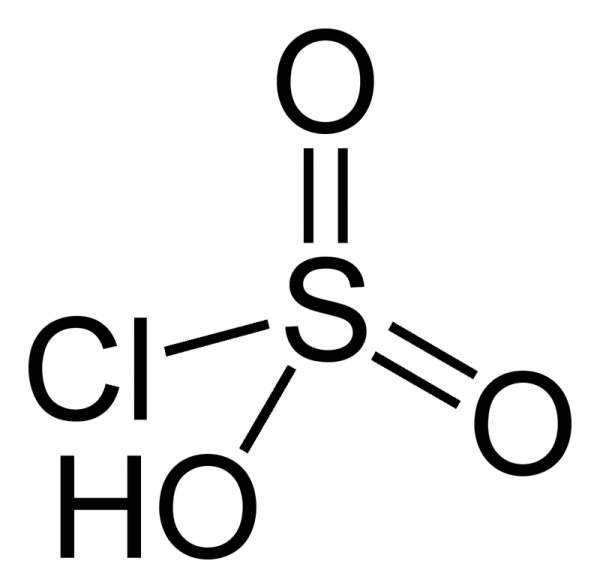
Fluoro-sulfuric acid has a Hammett function of -15.1; by the way, due to the presence of fluorine, this acid gradually dissolves the vial in which it is stored.
Then some clever person thought: why not take a Lewis acid (a substance capable of accepting a pair of electrons from another substance) and mix it with a Brønsted acid (a substance capable of donating a proton)! They mixed antimony pentafluoride with hydrofluoric acid — resulting in hexafluoroantimonic acid HSbF6. In this system, hydrofluoric acid releases a proton (H+), while the conjugate base (F−) is isolated by a coordinate bond with antimony pentafluoride. This forms a large octahedral anion (SbF6−), which is a very weak nucleophile and a very weak base. Once 'liberated', the proton induces the superacidity of the system — with a Hammett function of -28!
Then others came along and said, why take the weak Brønsted acid — and came up with something else.
Tetrafluoromethanesulfonic acid
— is already a superacid in itself (Hammett function — 14.1). So, they again added antimony pentafluoride to it — resulting in a decrease to -16.8! The same trick with fluoro-sulfuric acid resulted in a decrease to -23.
Then a group of scientists from the chemistry department at a Californian university, led by Professor Christopher Ried, collaborated with colleagues from the Institute of Catalysis at the Siberian Branch of the Russian Academy of Sciences (Novosibirsk) and invented carboranoic acid H(CHB11Cl11). Well, it was named 'carboranoic' for the average person, but if you want to feel like a scientist — say '2,3,4,5,6,7,8,9,10,11,12-undecachloro-1-carba-closo-dodecaborane(12)' three times fast.
This is what the beauty looks like.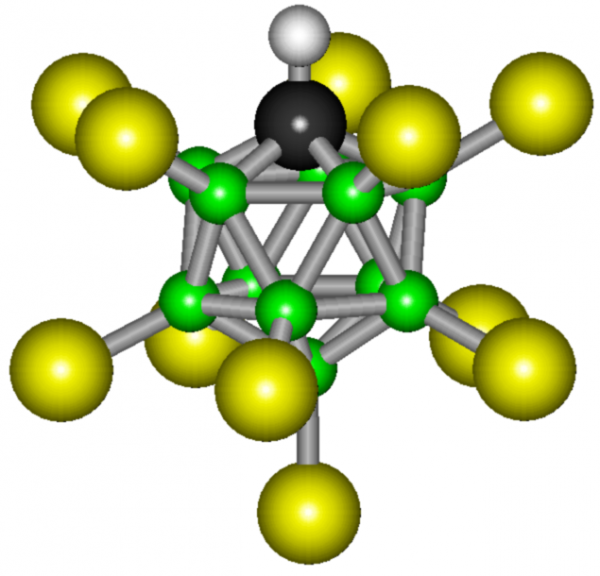
This is a dry powder that dissolves in water. This is indeed the Strongest Acid known at the moment. Carboranoic acid is approximately a million times stronger than concentrated sulfuric acid. In standard scales, it’s impossible to measure the strength of the acid because it protonates all known weak bases and all solvents in which it dissolves, including water, benzene, fullerene-60, and sulfur dioxide.
Later, Christopher Ried said in an interview with Nature's news service: 'The idea of synthesizing carboranoic acid came from fantasies “about molecules never before created.” Together with his colleagues, he wants to use carboranoic acid to oxidize the inert gas xenon atoms — simply because no one has ever done this before. Original, to say the least.'
Well, since superacids are just ordinary acids, they act like ordinary acids, just a bit stronger. It’s clear that they will burn the skin, but that doesn’t mean they will dissolve everything. Fluorosulfonic acid is a special case, but that’s all thanks to fluorine, just like in hydrofluoric acid.
Trihaloacetic acids
Specifically — trifluoroacetic and trichloroacetic acids.

They are charming and pleasant for their combination of properties as an organic polar solvent and a fairly strong acid. They smell — similar to vinegar.
The cutest is trifluoroacetic acid: a 20% solution destroys metals, cork, rubber, Bakelite, polyethylene. It burns on the skin and forms dry ulcers that reach down to the muscle layer.
Trichloroacetic acid is like the little brother in this regard, but it also has some strength. By the way, applause for the fairer sex: in pursuit of beauty, some opt for the so-called TCA peeling procedure (TCA stands for TetraChloroAcetate) — when this very trichloroacetic acid is used to dissolve the upper rough layer of the skin.
However, if the cosmetologist gets distracted on the phone, a fail might happen.
Well, that's roughly how it is when talking about liquid and pungency. Will there be any additions?
Source: habr.com
