

Hello, %username%.
As usual, I will not calm down.
And the cause is iodine pentafluoride and !
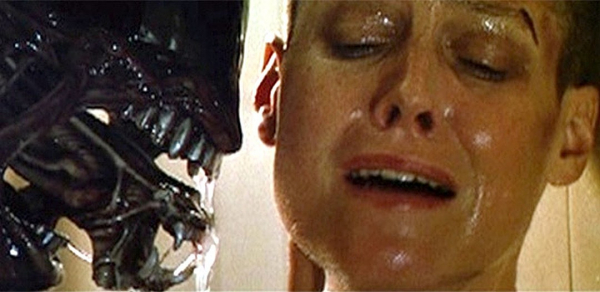
In general, I hope we all remember the beginning of Ridley Scott's work and the simply stunning film 'Alien,' which I recommend despite it being from 1979. By the end of this article, I will prove that the film is not just cool — it is EDUCATIONAL!
For this, we will stretch our memory and recall the ending: Ripley boards the shuttle and suddenly discovers the Alien there.
Now there will be a few pictures, warm memories, and some chemistry.
Discovering the Alien, Ripley decides to blow special gases on it. While humming a tune about the star of luck, Ripley opens this simple panel.
Special gases on the shuttle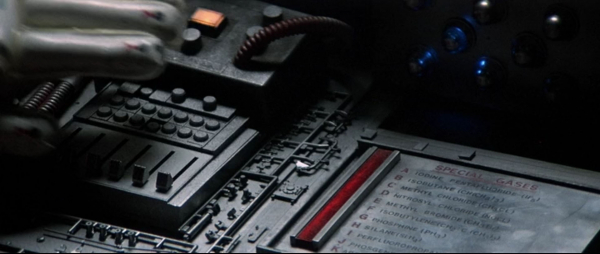
The list is more than curious:
- A. Iodine pentafluoride.
- B. Isobutane.
- C. Methyl chloride.
- D. Nitrosyl chloride.
- E. Methyl bromide.
- F. Isobutylene.
- G. Phosphine.
- H. Silane.
- I. Perfluoropropane.
- J. Phosgene.
- K. Something starting with 'A,' argon? I don’t know, can’t make it out.
So, Ripley first tries to smoke our friend with iodine pentafluoride:
First attempt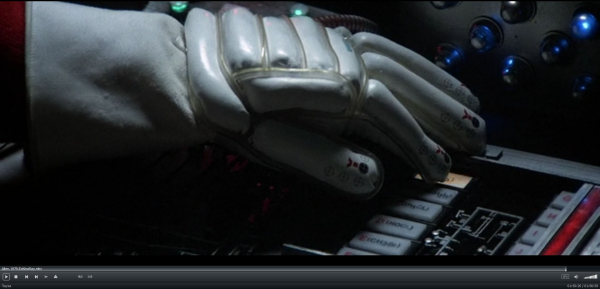
The Alien hardly celebrates these actions.
Then — we smoke it with methyl chloride.
Second attempt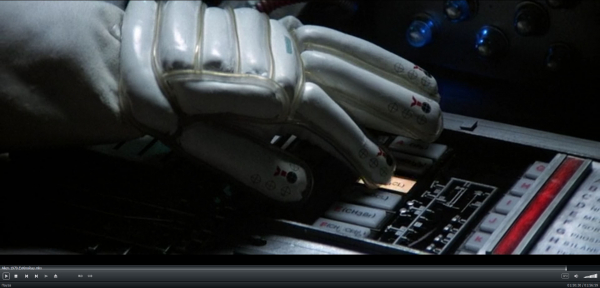
Still zero effect.
On the third try — success! We smoke the creature with nitrosyl chloride.
Third attempt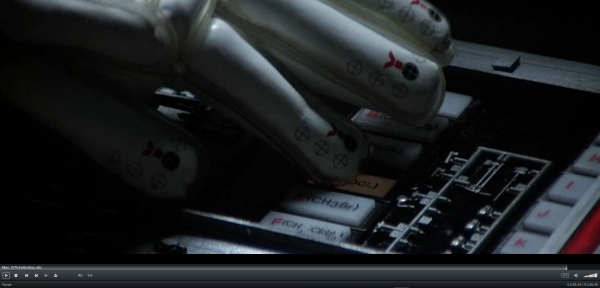
And then the writhing and flailing began.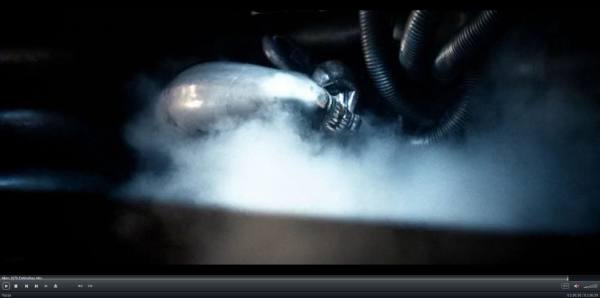
It all ended with throwing it into space and burning it in the engine's exhaust.
By the way, the Alien didn't burn in the exhaust, which is quite important.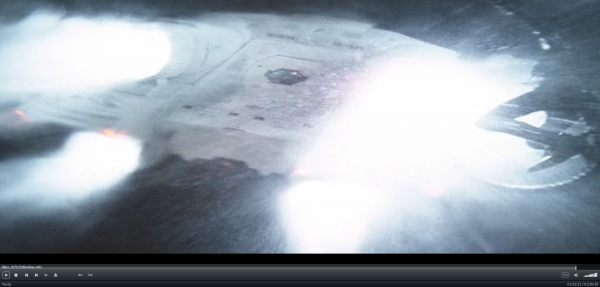
Now, let's analyze what we've seen.
What gases are these?
'Special gases on the shuttle' — indeed a strange set.
1. Iodine pentafluoride IF5
Actually, iodine pentafluoride is not a gas but a heavy yellow liquid with a boiling point of 97.85 °C. , it is a very powerful fluorinating agent, which means if our creature was blown with this stuff at boiling water temperature — it's indeed resilient! Many questions arise about what the shuttle itself is made of since iodine pentafluoride easily destroys not only metals but also glass. There are also questions about Ripley’s spacesuit — but that’s another story.
2. Isobutane C4H10
Isobutane is a common flammable gas (by the way, with an octane number of 100) that can be used in internal combustion engines and as a refrigerant. Ripley did not use it — and rightly so: if iodine pentafluoride didn't yield results — what good would it do? Especially since there could be sparks later — meaning it could have exploded.
3. Methyl Chloride CH3Cl
Methyl chloride is a colorless toxic gas with a sweetish smell. Due to its faint odor, toxic or explosive concentrations can easily go unnoticed. Methyl chloride was also previously used as a refrigerant, but due to its toxicity and explosiveness, it is no longer used for that purpose. Its primary current application is in polymer production, as a methylating agent in organic synthesis, as rocket fuel, as a medium in low-temperature polymerization, as a liquid for thermometric and thermostatic equipment, and as a herbicide (also limited due to toxicity).
The toxicity of methyl chloride is related to its hydrolysis to methanol — and further, as I have already mentioned in .
Ripley either didn't know biochemistry or hoped that the Alien also had alcohol dehydrogenase in its system and that it could be safely consumed. But, as expected, the trick didn't work — Ripley's second attempt was unsuccessful.
4. Nitrosyl Chloride NOCl
Nitrosyl chloride is a red gas, toxic, with a choking smell. It is typically observed as a product of the decomposition of aqua regia — a mixture of hydrochloric and nitric acids — that's what it smells like, and its plume rises above it when heated (along with nitrogen oxides). I've also .
Nitrosyl chloride is widely used as a chlorinating agent; it is also registered as a food additive with the index E919 — as a color enhancer and stabilizer for baked goods. Occasionally, it was also used for purifying and disinfecting drinking water.
In the food industry, nitrous chloride is used very little, while in its pure form, this substance poses the most serious danger to life and health. Inhalation of its vapors causes severe irritation of the mucous membranes, pulmonary edema, bronchospasm, asthma attacks, as well as a range of other manifestations of respiratory system dysfunction. Physical contact leads to chemical burns on the skin.
It's no surprise that it was very disliked by Alien.
5. Methyl Bromide CH3Br
It resembles methyl chloride in nature. In addition to its use in organic synthesis, it is used as a fumigant to disinfect plant materials from scale insects, false scales, and mealybugs, as well as to combat stored product pests, particularly fresh and dried vegetables and fruits, and less frequently, for grain treatment. It is prohibited for use as a fumigant due to its toxicity according to the Montreal Protocol.
It was also used for treating second-hand clothing, but it was discontinued due to its toxicity (so you can shop securely at SecondHand).
Ripley was absolutely right not to use it—what good would it do if methyl chloride didn’t help?
6. Isobutylene C2H4(C3H7)2
A flammable gas, commonly used in the production of polymers. Nothing special, the effect will be like that of isobutane.
7. Phosphine PH3
A toxic gas that disrupts metabolic processes and affects the central nervous system, as well as the blood vessels, respiratory organs, liver, and kidneys. It was considered a chemical warfare agent—and incidentally, one of the toxic products of the interaction of yellow phosphorus with water (again a reference to ). Pure gas is odorless, while technical-grade contains impurities, which give it the smell of rotten fish.
Phosphine is used in the synthesis of organophosphorus compounds, as a source of phosphorus contaminants in semiconductor production, and as a fumigant—an alternative to the banned methyl bromide. Apparently, akin to bromide and chloride, Ripley decided that phosphine wouldn't help.
8. Silane, or rather, monosilane SiH4
A colorless gas with an unpleasant odor. It should be noted that in the presence of oxygen, monosilane oxidizes with a flash even at liquid air temperatures. It's reported that silane is toxic with an LC50 of 0.96% for rats — but understanding the properties of silane and the necessity for rats to breathe something, either the rats suffocated from lack of oxygen, or they burned in silane flame, or .
It is used in various organic synthesis reactions (producing silicone polymers, etc.), as a source of pure silicon for the microelectronics industry in the production of crystalline and thin-film photoconverters based on silicon, LCD screens, substrates, and technological layers for integrated circuits, as well as for obtaining ultra-pure polycrystalline silicon.
I think Ripley was indeed afraid of fire, which is why she didn't use silane on the Alien.
9. Perfluoropropane C3F8
Perfluoropropane is a typical representative of perfluorinated hydrocarbons. It can be used as a refrigerant. It is difficult to ignite, non-explosive, and has low toxicity. Like all perfluorocarbons, it can create a strong greenhouse effect many times worse than CO2, which could potentially be used for terraforming. By the way, it does not create a greenhouse effect.
It seems Ripley decided that perfluoropropane would not be useful, as it is only good for suffocating animals that breathe oxygen — but considering how the Alien was thrashing about in space, it was not a viable option.
10. Phosgene COCl2
A good choice of poison for humans and mammals — I've written about it . It is also used in organic synthesis.
It seems Ripley understood that the Alien is too different from mammalian biology, which is why she didn't choose phosgene. Perhaps it was "number four" after nitrogen trichloride. It's unknown here.
11. A? Argon?
There's really nothing special — an inert gas. It does not react with anything.
Also pointless, just like perfluoropropane.
Conclusions
- Ripley acted thoughtfully and deliberately in a stressful situation: she prevented a fire and carefully selected gases to flush out the Alien — everything was done correctly.
- It’s completely unclear what the Alien is made of. Judging by the acidity of its saliva — it must contain something like chlorotrifluoride, but then its temperature should be below +12 °C; otherwise, this substance would boil. Its blood is made of bromine fluorides (I’m referring to them ) ? So what is it made of: it doesn’t fear high or low temperatures, but has a significant coefficient of thermal expansion — let’s remember the ending of "Alien 3," where after molten lead, it could be exploded with spraying water. Silicon-based materials won't work — fluorides would dissolve it. Is it some kind of fluorinated organic compound? But then why did nitrosyl chloride affect it? Here, the filmmakers have left a mystery.
- It’s completely unclear what the ship is made of: it doesn’t fear hot iodinated pentafluoride or nitrosyl chloride — but is corroded through by the Alien's saliva. If the Alien's blood contains superacids (read about those in ), then its resistance to gases is strange. If the Alien’s blood contains fluorinated halogens, it’s odd that the ship was corroded by them, yet it withstood iodinated pentafluoride. This is the second mystery.
- The commercial tow ship "Nostromo," or rather, the escape shuttle, is unexpectedly equipped with gases needed for organic synthesis (fluorination, methylation, polymer reactions, chlorination), gases for treating crops from pests, fuel gases, refrigerants, raw materials for semiconductor production, and gases for terraforming. Was it expected that the astronaut would use high-tech tools for survival? On the other hand, it’s a distant future (the original script mentioned the year 2087)...
- "Alien" is an amazing movie. Unlike other Hollywood films — it is thought out even to such chemical details.
Source: habr.com
