

- The current 14nm manufacturing process will remain operational at least until 2021.
- Intel's presentations about the transition to new technologies mention various processors and products, but not desktops.
- Mass production of Intel's 7nm products will not begin until at least 2022.
- All engineering resources will be redirected from the 14nm process to the 7nm one, while other specialists will handle the 10nm process.
Leaks from Dell's roadmap some insight into Intel's plans for new processor releases, and in the desktop segment, 14nm products are expected to be around for quite a while based on this source of information. However, Intel's investor event this week could shed light on the truth regarding the release timelines for 10nm and 7nm products, and everything would be fine if it weren't for the disappointing silence from company representatives regarding the timelines for new desktop processors.
The initial plan for Intel's adoption of 10nm technology had to be adjusted.
It's no secret that six years ago, Intel was confident in its ability to begin mass production of 10nm processors in 2016. As has been explained multiple times by various Intel executives who have changed over time, overly aggressive targets for geometric scaling of transistors were set when planning the transition to the 10nm process, and the timeline for 10nm product release could not be met.
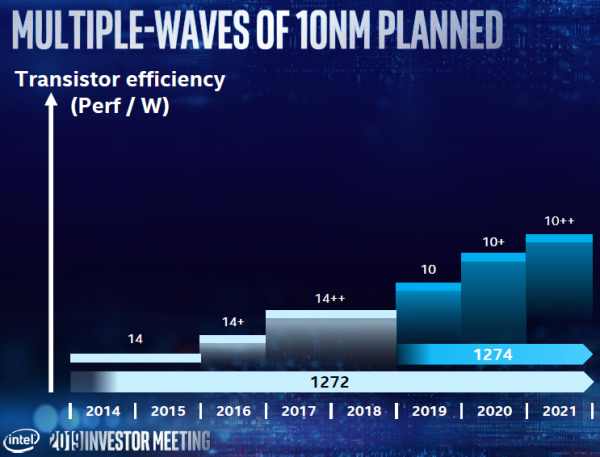
Last year, shipments of 10nm Cannon Lake mobile processors began, but they were only suitable for use in ultra-thin mobile devices, had no more than two cores, and the integrated graphics subsystem on the chip had to be disabled. In fact, the volumes of Cannon Lake shipments were not significant, which is why Intel now indicates 2019 as the start of the 10nm process adoption period. Mobile 10nm Ice Lake processors will be presented in June this year, and shipments to laptop manufacturers will also begin then, with finished computers based on them expected to be released in the second half of the year.
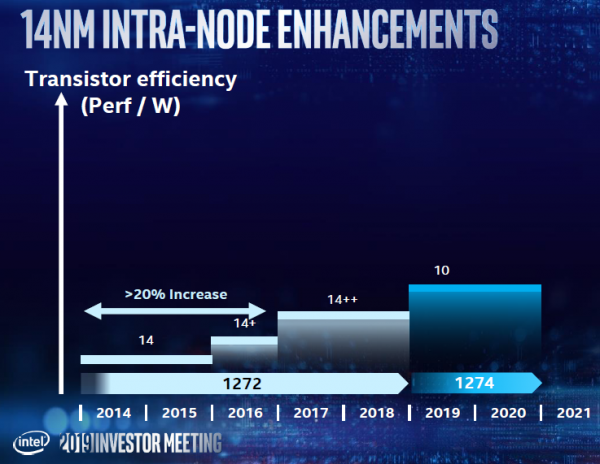
According to the official version, Intel's 14nm process technology has undergone three generations in its evolutionary development, with even more minor improvements. Intel proudly claims that the performance per watt increased by 20% when moving from the first generation of the 14nm process to the third.
Moreover, if you look at Intel's recent presentations from the May investor event, you'll find that the lifecycle of the 14nm process has been extended through 2021. By that time, the mass production of the first 7nm products will begin, while the 14nm process will still be relevant for a specific range of Intel products.
There were no mentions of transitioning desktop processors to the 7nm technology.
Even a leak regarding Intel's plans from Dell's presentation about the timeline for 10nm processors for desktop use was not included. In this context, the focus was primarily on mobile processors with ultra-low power consumption, with a core count not exceeding four. Even in this case, they are expected to become widely available no earlier than 2021. By that time, the 10nm Tiger Lake processors will be released, offering support for PCI Express 4.0 and produced using the second generation of 10nm technology. The Tiger Lake processors will also feature new graphics with 96 compute units, utilizing a shared architecture with discrete products announced in 2020.
By the end of 2019, the 10nm Lakefield processors with a complex spatial Foveros architecture, integrating both system logic and memory in a single package, are expected to be released. Even the 'presumably desktop' first discrete graphics processor from Intel in the last twenty years will be launched in 2020 using 10nm technology; however, desktop processors transitioning to 10nm technology were not mentioned at the investor event.
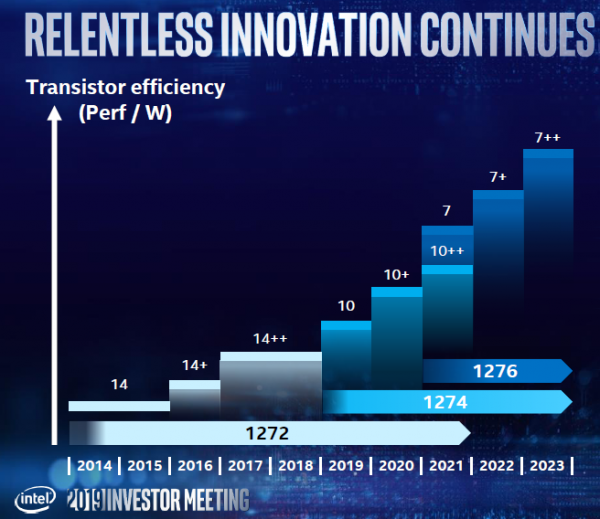
There is also quite a bit of certainty in the server segment. Before the 10nm Ice Lake-SP processors are released in the first half of next year, the 14nm Cooper Lake processors, which are structurally compatible with them, will be launched. Intel has not specified the technology to be used for the successors to Ice Lake-SP in the form of Sapphire Rapids, but Navin Shenoy acknowledged during a Q&A session with analysts that the second product to be released using 7nm technology, after the GPU for compute accelerators, will be a central processor for servers. servers. Considering that the 7nm debut will occur in 2021, both 2021 and later periods are equally suitable for the debut of the central 7nm server-class processor. Sapphire Rapids is expected to debut in 2021, with its successor appearing in 2022.
Thus, in describing its current plans for migrating to the 7nm process, Intel clearly mentions graphics and central processors for server applications, while leaving desktop and mobile applications in the background.
The 7nm technology rush: a distant hope for desktop products
Intel CEO Robert Swan made several important statements regarding the adoption of 7nm technology. Firstly, he stated that after 2021, this technology would allow the company to reduce operating costs. This confidence is based on the fact that the company currently has to develop three technology processes in parallel: 14nm, 10nm, and 7nm. Attempts to catch up with the lag in the 10nm process are increasing cost levels, and when the 7nm technology is fully established, the company hopes to regain control over expenses according to its multi-year plan.
Secondly, Swan stated that all engineering staff involved in creating Intel’s 14nm products will be redirected to master the 7nm technology. Among these, we know of many desktop processors with a high core count and performance. Does this mean that this team of specialists will succeed in creating desktop 7nm processors? The answer to this question will likely need to be sought beyond the current decade.
Thirdly, the head of Intel clarified that mass production of Intel products using 7nm technology will commence only in 2022, after the release of the first discrete graphics processor, which will be launched a year earlier with 7nm technology employing extreme ultraviolet lithography. It's difficult to confidently state whether these will be desktop or mobile processors, as Intel's priorities for transitioning products to new technology nodes have shifted.
Source: 3dnews.ru
