

The meeting of Intel's management with investors that took place a few days ago was notable not only for the announcement of , but also for the disclosure of plans for the implementation of and technologies. At the same time, some remarks from top executives contained quite interesting and even ambiguous statements on related topics. Among the standout speakers was Raja Koduri, Intel's Senior Vice President and Chief Architect for Systems and Graphics.
Koduri's presentation at the event focused on the software ecosystem being developed around Intel's hardware components. However, during his talk, he took the time to compare Intel's approach with what competitors are doing in this area. Curiously, not a single name of other companies was mentioned; instead, references were made to certain rivals of Intel marked by colors—green and red. It is hard to imagine that such color masking could really work, so what Koduri said afterwards left many genuinely puzzled. He expressed considerable disdain towards the red competitor, which effectively targeted his former employer.
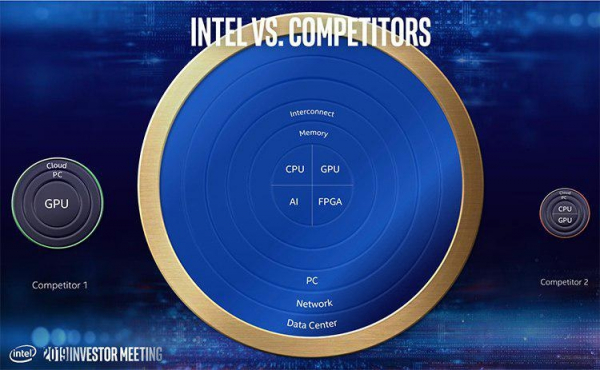
The point is that until the end of 2017, Raja Koduri held the position of head of AMD's graphics division, so he surely has a very good understanding of what that company does and how. Nevertheless, his report included the following statement: "[AMD] has two architectures, there is no strategy regarding memory or interconnections that I have heard of, and the developer ecosystem is tiny. In fact, without our invaluable contributions, they would have had no ecosystem that meant anything."
It should be noted that this statement is somewhat controversial in itself. But particularly surprising is that Raja seems to have forgotten what he himself worked on a few years ago. When he was at the 'red competitor,' he was involved in the development of both the Infinity Fabric interconnect and the creation of Radeon Instinct accelerators, which were designed precisely for solving artificial intelligence tasks.
It's hard to believe, but back in mid-2017, the same Raja Koduri was saying something entirely different on behalf of AMD: "Infinity Fabric allows us to connect different engines together on a single die much more easily than before. Furthermore, it is truly a high-speed interconnect bus with low latency. This is crucial for linking all our developments with maximum speed and efficiency. Infinity Fabric will serve as the foundation for the design of all our future integrated circuits."
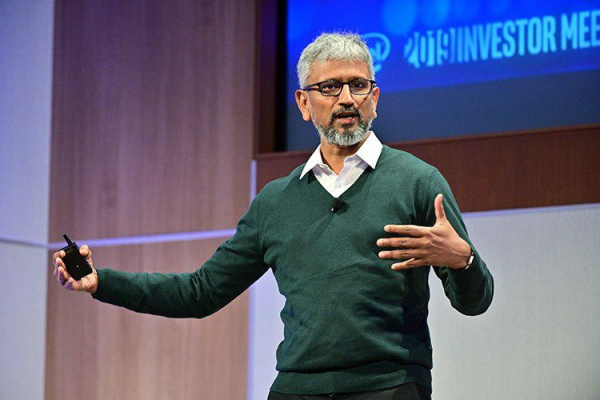
However, in the world view presented by Koduri, NVIDIA represents a much larger and more serious competitor to Intel than AMD. This is partly because Raja fundamentally chose not to acknowledge many of AMD's activities. Along with his denial of the existence of interconnect technology at the red competitor, he also left out information about AMD's developments in artificial intelligence, and moreover turned a blind eye to the fact that AMD is gaining significant weight as a supplier of solutions for data centers.
We wouldn't dare to speculate on the reasons behind such selective amnesia from Intel's leading graphics specialist, but it's worth noting that what Raja said next about the software ecosystem of the microprocessor giant is indeed interesting. The fact is that while Intel is operating on four fronts—CPU, GPU, artificial intelligence, and FPGA—the company wants to prepare a unified API for developers that would allow them to create software for Intel hardware using a single approach.
Thus, the goal is to significantly simplify the work of programmers, who currently have to deal with different Intel products as if they were solutions from ten different companies, as Koduri himself described. In the future, Intel plans to implement the oneAPI concept, within which something akin to a unified "store" of libraries and tools for developers will be created. The company also intends to rely on open-source developments, much like AMD does now.
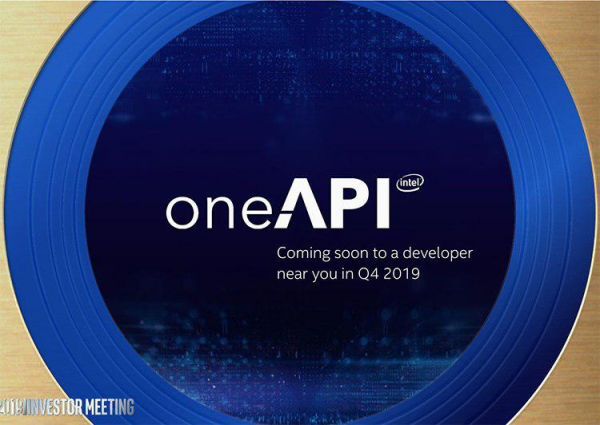
"We strive for open standards accessible to all," says Raja Koduri. "Intel has the best experience in working with open source in the industry. For instance, we rank number one in the Linux kernel development team." In other words, Intel intends to give increased attention to the software ecosystem accompanying its future products. This means that promising solutions, such as discrete graphics, will receive serious software support from the very beginning of their existence.
Source: 3dnews.ru
