

Other articles in the series:
- The History of Relays
- The History of Electronic Computers
- The History of the Transistor
- The History of the Internet
For roughly seventy years, AT&T, the parent company of Bell System, faced almost no competitors in American telecommunications. The only significant rival was General Telephone, later known as GT&E, and then simply GTE. Yet, by the mid-20th century, it had only about two million telephone lines, which represented no more than 5% of the total market. The period of AT&T's dominance—from its gentlemen's agreement with the government in 1913 to the point when the same government broke it up in 1982—essentially marks the beginning and end of a peculiar political era in the USA; a time when citizens were able to believe in the benevolence and efficiency of a large bureaucratic system.
It's difficult to dispute the external performance of AT&T during this period. From 1955 to 1980, AT&T added nearly one and a half billion kilometers of telephone lines for voice communication, most of which were related to microwave radio. The cost per kilometer of line fell tenfold during this time. This reduction in cost benefited consumers, who felt a continuous decrease in their actual (inflation-adjusted) phone bills. Whether measured by the percentage of households that had their own phone (90% by the 1970s), the signal-to-noise ratio, or reliability— the USA could reliably boast the best telephone service in the world. Not once did AT&T give reason to think that it rested on the laurels of existing telephone infrastructure. Its research division, Bell Labs, made foundational contributions to the development of computers, solid-state electronics, lasers, fiber optics, satellite communication, and more. Only when compared to the exceptional pace of the computer industry could AT&T be considered a slow-moving company. However, by the 1970s, the idea that AT&T was lagging in innovation gained enough political weight to lead to its temporary breakup.
The disintegration of the cooperation between AT&T and the U.S. government was slow and took several decades. It began when the Federal Communications Commission (FCC) decided to tweak the system a bit—removing one loose thread here, another there… However, their attempts to restore order only unraveled more and more threads. By the mid-1970s, they looked on in confusion at the chaos they had created. Then, the Department of Justice and federal courts intervened with their scissors and closed the matter.
The main external driver of these changes was a small new firm called Microwave Communications, Incorporated. But before we get to it, let's take a look at how AT&T and the federal government interacted during the more prosperous 1950s.
Status Quo
As we saw last time, in the 20th century, two different types of laws were involved in overseeing industrial giants like AT&T. On one side was regulatory law. In AT&T's case, the observer was the FCC, established by the Telecommunications Act of 1934. On the other side was antitrust law, enforced by the Department of Justice. These two branches of law differed significantly. If the FCC can be likened to a lathe, periodically convening to make small decisions that gradually shaped AT&T's behavior, then antitrust law resembled a fire axe: it is usually kept in the cupboard, but its application is not particularly subtle.
By the 1950s, AT&T was facing threats from both directions, but all were resolved fairly peacefully, with little impact on AT&T's core business. Neither the FCC nor the Department of Justice disputed that AT&T would remain the dominant provider of telephone equipment and services in the U.S.
Hush-a-Phone
Let's first consider AT&T's relationship with the FCC through a small and unusual case involving third-party devices. Since the 1920s, a tiny company from Manhattan called Hush-a-Phone Corporation has made a living selling a cup that connected to the part of the phone that you had to speak into. By speaking directly into this device, users could avoid eavesdropping from people nearby and also block out some background noise (for example, during a busy trading floor). However, in the 1940s, AT&T began to pressure these third-party devices – that is, any equipment connected to Bell System devices that Bell System did not manufacture.
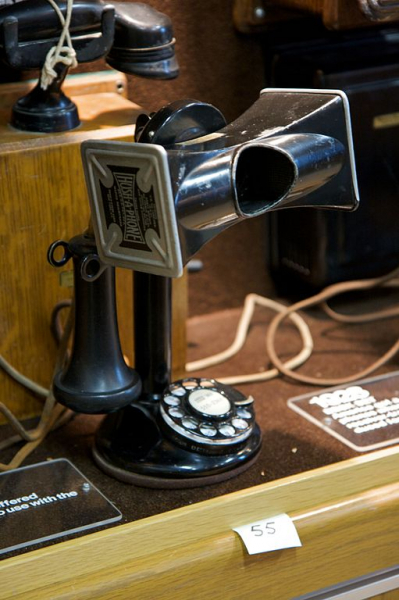
The early model of Hush-a-Phone connected to a vertical phone
According to AT&T, the modest Hush-a-Phone attachment was indeed a third-party device, which meant that any subscriber using such a device with their phone could be disconnected for violating usage rules. As far as we know, this threat was never actually carried out, but the mere possibility likely cost Hush-a-Phone a fair amount, particularly from retailers who were reluctant to stock their equipment. Harry Tattle, the inventor of Hush-a-Phone and the 'president' of the business (though the only other employee of his company, besides himself, was his secretary), decided to challenge this approach and filed a complaint with the FCC in December 1948.
The FCC had the authority to both establish new rules as a legislative body and to resolve disputes as a judicial body. In its judicial capacity, the commission made a decision in 1950 while considering a complaint from Tuttle. Tuttle did not appear before the commission alone; he was armed with expert witnesses from Cambridge, ready to testify that the acoustic qualities of the Hush-a-Phone surpassed those of its alternative—a cupped hand. The experts included Leo Beranek and Joseph Carl Robnett Likelyder, who would play a much more significant role in this story than this brief cameo suggests. The position of the Hush-a-Phone was based on the facts that its design was superior to the only possible alternative, that as a simple attachment to the phone, it could not harm the telephone network, and that private users have the right to make their own decisions regarding the equipment they consider convenient.
From a modern perspective, these arguments seem irrefutable, while AT&T's position appears absurd; what right does a company have to prohibit individuals from attaching anything to a phone in their own home or office? Should Apple have the right to stop you from placing your iPhone in a case? However, AT&T's plan was not specifically to press against Hush-a-Phone, but to protect the broader principle of banning third-party devices. Several compelling arguments supported this principle, related both to the economic aspect and public interest. To begin with, using a separate telephone device was not a private matter, as it could connect with millions of other subscribers' devices, and anything that degraded call quality could potentially impact any of them. Additionally, it is worth noting that at that time, telephone companies like AT&T owned the entire physical phone networks. Their ownership extended from central switches to the wires and the telephone devices themselves, which users rented. Therefore, from a property rights perspective, it seemed reasonable that the telephone company should have the right to control what happens to its equipment. AT&T had invested millions of dollars for decades in developing the most complex machine known to humanity. How could every small dealer with a wild idea lay claim to rights to profit from these advancements? Finally, it is worth considering that AT&T itself offered numerous devices to choose from, ranging from signal lights to shoulder mounts, that were also rented out (usually by enterprises), and the fees for which went into AT&T's coffers, helping to keep basic service costs low for ordinary subscribers. Diverting these revenues into the pockets of private entrepreneurs would disrupt this redistribution system.
Regardless of your feelings about these arguments, they convinced the commission – the FCC unanimously concluded that AT&T has the right to control everything that happens with the network, including the devices that connect to the telephone. However, in 1956, a federal appellate court rejected the FCC's decision. The judge ruled that while the Hush-a-Phone may degrade the quality of voice communication, it only affects those subscribers who use it, and AT&T has no grounds to prevent this private decision. Additionally, AT&T has neither the capability nor the intention to prohibit users from muting their voices in other ways. "To say that a telephone subscriber can achieve a certain result by cupping their hand and speaking into it — the judge wrote — but cannot do so using a device that leaves their hand free to write or do anything they want, would be neither fair nor reasonable." And although the judges seemed to disapprove of AT&T's arrogance in this case, their verdict was narrow – they did not completely overturn the ban on third-party devices, instead only confirming the right of subscribers to use the Hush-a-Phone at their discretion (in any case, the Hush-a-Phone did not last long – by the 1960s, the device needed to be redesigned due to changes in the structure of handsets, and for Tuttle, who must have been over 60 or 70 at that time, it was already too much). AT&T adjusted its tariffs to indicate that the ban on third-party devices connected to the phone electrically or inductively remains in effect. Nevertheless, this was the first sign that other parts of the federal government would not necessarily treat AT&T as leniently as the regulators from the FCC.
Consent decree
Meanwhile, in the same year that the appeal court case regarding Hush-a-Phone was ongoing, the Department of Justice ended its antitrust investigation into AT&T. This investigation traces back to where the FCC itself began. It was driven by two main facts: 1) the company Western Electric, a major industrial giant, controlled 90% of the telephone equipment market and was the sole supplier of such equipment for the Bell System, from telephone exchanges leased to end users to coaxial cables and microwave towers used to transmit calls from one end of the country to the other. And 2) the entire regulatory apparatus that contained AT&T's monopoly relied on limiting its profits as a percentage of its capital investments.
The problem was as follows. A suspicious person could easily imagine a conspiracy within the Bell System aimed at exploiting these facts. Western Electric could inflate prices for the rest of the Bell System (for instance, charging $5 for a cable of a certain length when its fair price was $4), while simultaneously increasing its capital investments in dollar terms, along with the company's absolute profits. For example, suppose the Indiana state regulatory commission set a maximum return on invested capital for Indiana Bell at 7%. If Western Electric requested $10,000,000 for new equipment in 1934, the company could earn $700,000 in profit—however, if the fair price for that equipment was $8,000,000, then it would only yield $560,000.
The Congress, concerned about the deployment of such a fraudulent scheme, conducted an investigation into the relationships between Western Electric and the operating companies included in the original FCC mandate. The investigation took five years and spanned 700 pages, detailing the history of the Bell System, its corporate, technological, and financial structure, and all its operations, both foreign and domestic. Regarding the initial question, the authors of the study found it essentially impossible to determine whether the prices set by Western Electric were fair or not – there was no comparable example. Nevertheless, they recommended instituting enforced competition in the telephone market to ensure fair practices and foster efficiency improvements.
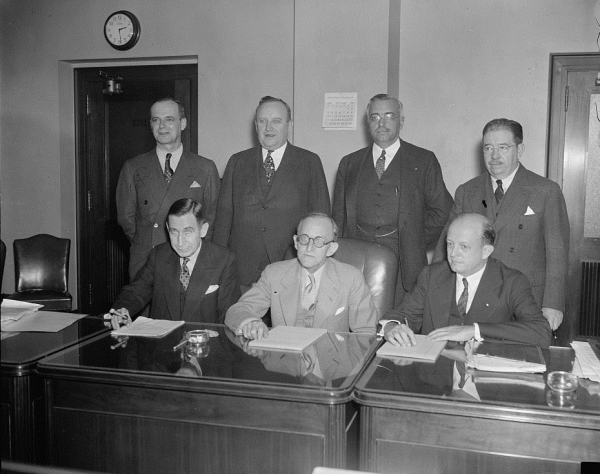
The seven members of the FCC commission in 1937. Damn good-looking guys.
However, by the time the report was completed, in 1939, war loomed on the horizon. At such a time, no one wanted to interfere with the country's communication backbone. However, ten years later, the Justice Department under Truman revived suspicions regarding the relationships between Western Electric and the rest of the Bell System. Instead of lengthy and vague reports, these suspicions materialized into a much more active form of antitrust litigation. It compelled AT&T not only to divest Western Electric but also to split it into three distinct companies, thus creating a competitive market for telephone equipment by judicial decree.
AT&T had at least two reasons to be concerned. First, the Truman administration displayed its aggressive nature in enforcing antitrust laws. In 1949 alone, aside from the lawsuit against AT&T, the Justice Department and the Federal Trade Commission filed suits against Eastman Kodak, the large grocery chain A&P, Bausch and Lomb, American Can Company, Yellow Cab Company, and many others. Second, there was the precedent of the case 'United States v. Pullman Company'. Pullman Company, like AT&T, had a service division that operated sleeping railroad cars and a manufacturing division that constructed them. And, as with AT&T, the prevalence of Pullman's service and the fact that it only operated cars made by Pullman meant that competitors could not emerge on the manufacturing side. Similarly, despite the suspicious relationships between companies, there was no evidence of price abuse by Pullman, nor were there dissatisfied customers. Nonetheless, in 1943, a federal court ruled that Pullman violated antitrust laws and was required to separate its manufacturing and service operations.
But ultimately, AT&T avoided being broken up and was never taken to court. After many years of uncertainty, in 1956 it agreed to a settlement with the new Eisenhower administration to end the disputes. The change in the government's approach to this issue was particularly influenced by the change in administration. Republicans were much more favorable to big business than the Democrats, who promoted the ''. However, economic conditions should not be ignored – the continuous economic growth fueled by the war contradicted the popular arguments of supporters of the 'New Deal' that the predominance of large businesses in the economy inevitably leads to recessions, stifling competition and preventing prices from falling. Finally, the growing scale of the Cold War with the Soviet Union also played a role. AT&T had served the military and the Navy during World War II, and continued to collaborate with their successor, the U.S. Department of Defense. In particular, in the very same year that the antitrust lawsuit was filed, Western Electric began work on in Albuquerque, New Mexico. Without this laboratory, the United States would not have been able to develop and create new nuclear weapons, and without nuclear weapons, they could not pose a significant threat to the USSR in Eastern Europe. Therefore, the Department of Defense had no desire to weaken AT&T, and its lobbyists defended their contractor before the administration.
The terms of the agreement required AT&T to limit its operations in the regulated telecommunications business. The Justice Department allowed several exceptions, mainly for work with the government – it did not intend to prohibit the company from operating at Los Alamos Labs. The government also required AT&T to issue licenses and provide technical consulting on all existing and future patents at reasonable prices to any local companies. Given the diversity of innovations created in Bell Labs, such a relaxation in licensing would help fuel the growth of American high-tech companies for several decades to come. Both of these requirements seriously impacted the formation of computer networks in the United States, yet they did not change AT&T's role as the de facto monopolistic provider of local telecommunications services. The fire axe was temporarily returned to its cabinet. But very soon a new threat would come from an unexpected part of the FCC. The lathe, which had always operated so smoothly and gradually, would suddenly begin to bite deeper.
The first thread
AT&T had long offered private communication services that allowed clients (usually a large company or government division) to rent one or more phone lines for exclusive use. For many organizations that needed active internal negotiations – television networks, major oil companies, railroad operators, the U.S. Department of Defense – this option seemed more convenient, economical, and secure than using the public network.
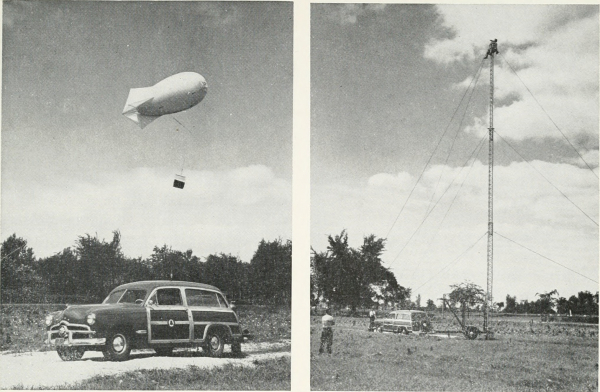
Bell engineers set up a private radio-telephone line for a power company in 1953.
The spread of microwave relay towers in the 1950s significantly lowered the entry costs for long-distance telephone operators, making it more profitable for many organizations to build their own networks rather than lease them from AT&T. The political philosophy of the FCC, established through many of its rules, was to prohibit competition in telecommunications unless the existing operator could not or did not want to provide equivalent services to customers. Otherwise, the FCC would encourage inefficient resource waste and disrupt a carefully balanced system of regulation and rate averaging that kept AT&T in check while maximizing service levels for the public. The established precedent did not allow private microwave communication to open to everyone. As long as AT&T wanted and could offer private telephone lines, other operators had no right to enter that business.
At that time, a coalition of interested parties decided to challenge this precedent. Almost all of them were large corporations with the resources to build and maintain their own networks. Among the most notable was the oil extraction industry (represented by the American Petroleum Institute, API). Pipelines crisscrossed entire continents, wells were scattered across vast and remote fields, research vessels and drilling sites were spread throughout the globe, so industry representatives wanted to organize their own communication systems tailored to their specific needs. Companies like Sinclair and Humble Oil wanted to use microwave networks to monitor pipeline statuses, remotely control drilling rig motors, and communicate with offshore platforms without waiting for permission from AT&T. But the oil extraction industry was not alone. Virtually all forms of large business, from railroads and freight carriers to retail and automotive manufacturers, submitted petitions to the FCC requesting permission to establish private microwave systems.
Faced with such pressure, the FCC opened hearings in November 1956 to determine whether new frequency bands (around 890 MHz) should be allocated for such networks. Given that the only opposition to private microwave networks came from the telecommunication operators themselves, the decision on this matter was an easy one. Even the Department of Justice, believing that AT&T had somehow misled them during the last agreement's signing, voiced support for private microwave networks. This became a norm – for the following twenty years, the Department of Justice consistently intervened in FCC matters, repeatedly hindering AT&T's actions and advocating for new market entrants.
The strongest counterargument from AT&T, which they constantly returned to, was that newcomers would inevitably disrupt the delicate balance existing in the regulatory system by trying to reap the rewards. That is, large businesses enter to create their own networks along routes where construction costs are low, and traffic is high (the most profitable routes for AT&T), and then lease private lines from AT&T in areas where building is most expensive. Ultimately, regular subscribers bear all the costs, and the low tariff levels for them can only be maintained through very profitable long-distance telecommunications services, which large companies will not pay for.
Nevertheless, in 1959, the FCC in its so-called "Decision Above 890" [i.e., in the frequency range above 890 MHz / note from the translator] ruled that every newcomer to the industry could create their own private long-distance network. This was a turning point in federal policy. It challenged the fundamental assumption that AT&T should operate as a redistributive mechanism, charging wealthy customers to provide inexpensive telephone service to users in small towns, rural areas, and poor neighborhoods. However, the FCC continued to believe that it could have its cake and eat it too. It convinced itself that this change was insignificant. It affected only a small percentage of AT&T's traffic and did not impact the core philosophy of public service that had governed telecommunications regulation for decades. After all, the FCC was merely trimming one protruding thread. Indeed, the "Above 890" decision had little consequence on its own. However, it initiated a chain of events that led to a true revolution in the structure of American telecommunications.
Further reading
- Fred W. Henck and Bernard Strassburg, A Slippery Slope (1988)
- Alan Stone, Wrong Number (1989)
- Peter Temin with Louis Galambos, The Fall of the Bell System (1987)
- Tim Wu, The Master Switch (2010)
Source: habr.com
