

Intel Corporation on expanding the distribution's scope , previously positioned as a specialized solution for container isolation. The new version allows developers to use the distribution as a user environment. By default, GNOME desktop is offered, but KDE Plasma, Xfce, LXQt, Awesome, and i3 are optionally available.
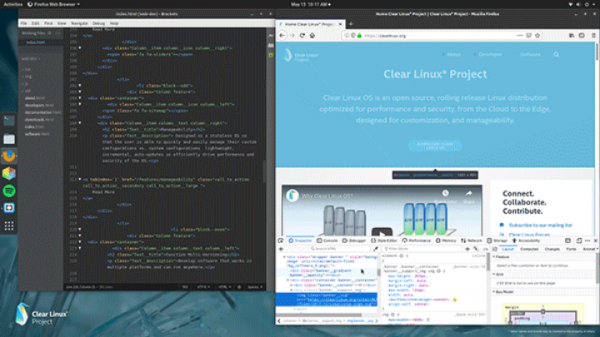
The Clear Linux distribution ensures strict application isolation using containers, which are separated through full virtualization. The core part of the distribution contains only the minimal set of tools for running containers and is updated atomically. All applications are packaged as Flatpak or bundles, running in separate containers.
The developer edition, in addition to preparing bundles with graphical and user applications, is notably enhanced with hardware support, integration of a debugging system based on FUSE, the addition of a new installer, and the introduction of , which offers bundles for deploying development environments using various languages and technologies.
A separate base set is provided , including build tools based on the latest versions of LLVM and GCC with optimizations for Intel chips (components specific to container infrastructure are highlighted in the set ). Preconfigured sets for deploying machine learning systems (Deep Learning Reference Stack based on Intel DL Boost with optimizations for Intel Xeon Scalable) and big data analytics (Data Analytics Reference Stack based on Apache Hadoop and Apache Spark) have also been added.
Features of Clear Linux:
- The binary delivery model of the distribution. System updates can be performed in two modes: applying patches to the running system and a complete system update through the installation of a new image in a separate Btrfs snapshot and replacing the active snapshot with the new one;
- Aggregation of packages into bundles (), forming ready functionality, regardless of how many software components they consist of. The bundles and system environment images are created based on an RPM package repository, but are delivered without package separation. Inside the containers, a specially optimized copy of Clear Linux is executed, containing the required sets (bundles) to launch the target application;
- An efficient update installation system, embedded into the core of the distribution, ensuring accelerated delivery of updates that fix critical issues and vulnerabilities. An update in Clear Linux includes only the data that has changed, so typical patches for vulnerabilities and errors occupy only a few kilobytes and are installed nearly instantly;
- A unified versioning system — the version of the distribution represents the state and versions of all its components, which is convenient for creating reproducible configurations and tracking changes in the distribution's components at the file level. Changes/updates to any part of the system always result in the overall version of the distribution being changed (while in conventional distributions only the version number of a specific package increases, in Clear Linux the version of the entire distribution increases);
- A stateless approach to configuration definition, suggesting that different classes of settings are separated (OS, user, and system settings are stored separately), the system does not maintain its state (stateless) and does not contain any settings in the /etc directory after installation, generating settings on the fly based on templates specified at startup. To reset system settings to default values, one can simply delete /etc and /var;
- full virtualization (KVM) for running containers, which ensures a high level of security. The startup time of containers is slightly behind traditional container isolation systems (namespaces, cgroups) but is acceptable for launching application containers on demand (the startup time of the virtual environment is about 200 ms, with an additional memory consumption of 18-20 MB per container). A mechanism is used to reduce memory consumption. (direct access to the file system bypassing page cache without using block device level), while the technology is used for deduplication of identical memory areas (Kernel Shared Memory), which allows for the organization of resource sharing of the host system and connects the same system environment template to different guest systems.
Source: opennet.ru
