

This year can confidently be called the year of gaming graphics cards. In 2019, NVIDIA practically unleashed all its firepower — at the time of writing this article, even , equipped with 4 GB of memory, had already been presented. Very soon, AMD will showcase a series of gaming graphics adapters , however, it was this company that introduced a record-breaking device — , equipped with 16 GB of HBM2 memory. As a result, a rather interesting situation has developed in our market. When it comes to gaming systems suitable for entertainment at Full HD resolution and above, graphics cards with 2, 3, 4, 6, 8, 11, and 16 GB of video memory can be used. Such variety hasn't been seen in a long time.
In general, in my opinion, the question "How much video memory is really needed for modern games?" is more relevant now than ever. Let's take a look at how much video memory modern games consume and how contemporary graphics cards perform under various conditions.
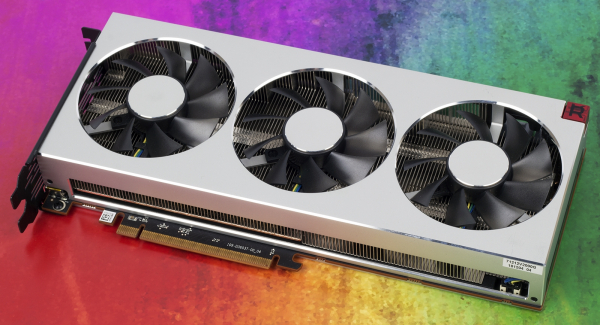
Modern Graphics Cards and Their Applications
First, let's clarify which graphics cards in 2019 belong to the gaming category. We will immediately define the terminology to avoid unnecessary questions: the phrase "gaming graphics card" refers to a device that provides a conditionally comfortable frame rate (with dips no lower than 30 frames per second) in modern AAA titles at a resolution of at least Full HD with at least medium graphics quality settings. This point is debatable, but fundamentally, another definition would simply exclude a couple of lower-end AMD and NVIDIA models, such as the Radeon RX 560 and GeForce GTX 1050, for example. That said, the list of gaming graphics cards available in stores looks as follows:
| Modern Gaming Graphics Cards | |||
| Full HD | WQHD | Ultra HD | |
| AMD | Radeon RX 560 2 GB; Radeon RX 560 4 GB; Radeon RX 570 4 GB; Radeon RX 570 8 GB; Radeon RX 580 4 GB; Radeon RX 580 8 GB; Radeon RX 590 8 GB | Radeon RX Vega 56 8 GB; Radeon RX Vega 64 8 GB | Radeon VII 16 GB |
| NVIDIA | GeForce GTX 1050 2 GB; GeForce GTX 1050 3 GB; GeForce GTX 1050 Ti 4 GB; GeForce GTX 1060 3 GB; GeForce GTX 1060 6 GB; GeForce GTX 1650 4 GB; GeForce GTX 1660 6 GB | GeForce GTX 1660 Ti 6 GB; GeForce GTX 1070 8 GB; GeForce GTX 1070 Ti; GeForce RTX 2060 6 GB; GeForce GTX 1080 8 GB; GeForce RTX 2070 8 GB | GeForce GTX 1080 Ti 11 GB; GeForce RTX 2080 8 GB; GeForce RTX 2080 Ti 11 GB |
| Volume of video memory of devices available on the market | 2, 3, 4, 6, 8 GB | 6, 8 GB | 8, 11, 16 GB |
Naturally, if a particular accelerator is listed in the WQHD or Ultra HD column, it is suitable for gaming at lower resolutions. As you can see, the highest number of graphics cards is clustered in the easiest mode, and this is not surprising at all. Thus, 61.19% of gamers with the Steam client use Full HD displays. Our focus in this article will mainly be on performance in this resolution. In this category, according to our table, there are models with 2, 3, 4, 6, and 8 GB. Of course, the owners of high-end graphics cards also play at Full HD resolution, but they certainly have enough video memory.
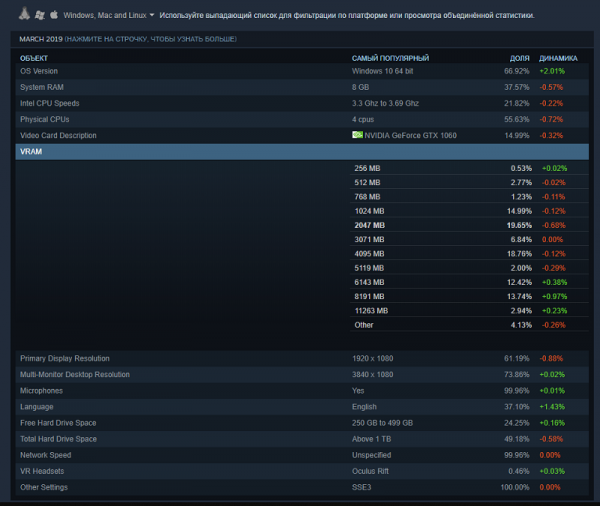 | 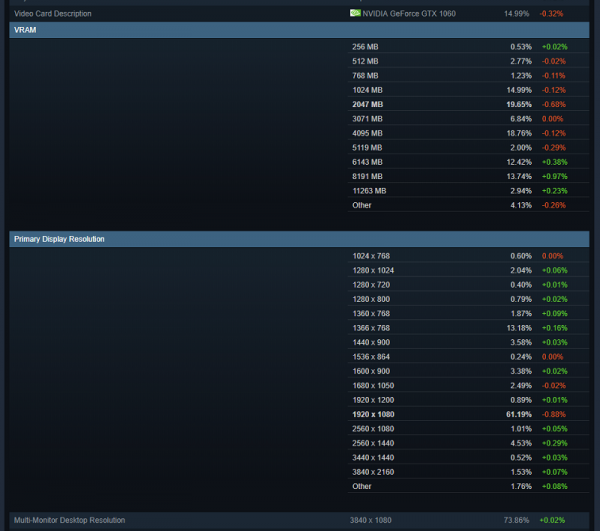 |
But let's take another look at the Steam statistics. Interestingly, the percentage of owners of monitors with a resolution of 1920 × 1080 is steadily declining. Meanwhile, there is a noticeable increase in the WQHD resolution. As for graphics cards, those with 2 GB of memory occupy the leading position (19.65%), which seems quite strange in 2019. However, the following picture looks quite logical: over the month, the number of graphics cards with 8 GB of video memory increased by almost one percent. If this trend continues, adapters with 8 GB of VRAM will take the top spot in 2020 — they have already surpassed devices with 6 GB.
In my opinion, the processes happening are quite expected and logical. Gamers are moving from Full HD to higher resolutions. In 2019, there are already at least four graphics cards available that perform well at Ultra HD resolution. In WQHD, I counted as many as 8! Naturally, the faster the graphics card, the more video memory it has. Still, this rule is nonlinear, as each chip designer has their own vision of what is happening.
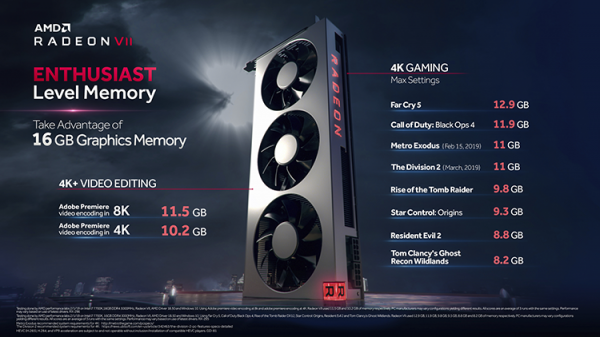
For instance, the Radeon VII is a direct competitor to the GeForce GTX 1080 Ti and GeForce RTX 2080. The current flagship has a hard time competing with the latter, not only in terms of performance but also in terms of supported technologies: the 'red' flagship cannot offer hardware ray tracing. However, recently data has been revealed Well, in 2020 this gaming console (and AMD graphics cards, of course) will support DXR. I think it is now clear to everyone that ray tracing is not just a passing fad, even though there are currently only three games that support this technology.
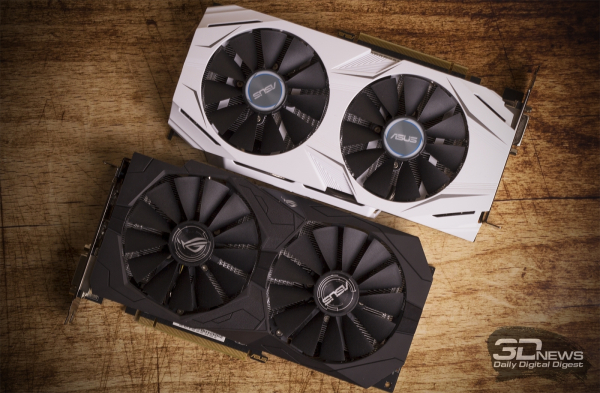
Since that’s the case, AMD, when announcing the Radeon VII, had to focus on the one 'sore spot' of NVIDIA graphics cards—a small (and, in the 'red' camp’s opinion, insufficient) amount of video memory, especially when comparing the GeForce RTX 2080 to the 'seven'.
The 'sore spot' is indeed present in NVIDIA's new releases. For some reason, there was a noticeable reduction in video memory in a number of graphics cards. Skeptics believe this was done on purpose: you’ll buy a GeForce RTX 2060, and in a year or two you’ll quickly rush out to get a new graphics card. Optimists, on the other hand, think that if NVIDIA has decided this—then these guys know something about the games of the near future. After all, the 'greens' work closely with many development studios. Regardless, some of NVIDIA’s new Turing generation graphics cards have indeed taken a step back concerning VRAM. See for yourself:
- The GeForce RTX 2080 Ti, priced astronomically, has no more video memory than the former GeForce flagship—the GTX 1080 Ti, despite there being nothing preventing the card from being equipped with 16 GB.
- The GeForce RTX 2080 8 GB has similar performance to the GeForce GTX 1080 Ti 11 GB, but has less VRAM.
- The GeForce RTX 2060 6 GB has performance similar to the GeForce GTX 1070 Ti 8 GB, but less VRAM.
- The GeForce GTX 1660 Ti 6 GB has comparable performance to the GeForce GTX 1070 8 GB, but has less VRAM.
- The GeForce GTX 1650 4 GB has similar performance to the GeForce GTX 1060 6 GB, but with less VRAM.
Moreover, the listed graphics cards (except for the GeForce RTX 2080 Ti and GeForce GTX 1650) have similar price points, meaning they were still competitors even in 2019.
If we also add AMD graphics cards to our list, we get some dramatic situations that could make long-forgotten Brazilian soap operas well-known to Russian television viewers envious. For instance, which one to choose:
- GeForce GTX 1650 4 GB, Radeon RX 570 4 GB, Radeon RX 570 8 GB, or GeForce GTX 1060 3 GB?
- Radeon RX 580 4 GB, Radeon RX 580 8 GB, Radeon RX 590 8 GB, GeForce GTX 1060 6 GB, or even GeForce GTX 1660 6 GB?
- GeForce GTX 1660 Ti 6 GB, GeForce GTX 1070 (Ti) 8 GB, GeForce RTX 2060 6 GB, or Radeon RX Vega 56 8 GB?
It is clear that when choosing a graphics card, one should not focus solely on the amount of video memory — a tactic often used to mislead unprepared buyers in some electronics supermarket stuck in the 90s. However, with similar performance levels, questions arise: why does this model have four gigabytes of VRAM, while that one has eight? I will try to answer those questions below.
How much video memory do modern games consume?
Video memory consumption was measured in fourteen applications. The graphs display the maximum and average load values recorded after 30 minutes of random gameplay. I did not round the results obtained. VRAM load metrics were tracked using MSI Afterburner (with a polling rate of 100 ms) and HWiNFO64. Among other programs, only clients from Steam, Origin, Uplay, and Epic Store were active during game launches. The list of games and the settings used are provided in the table below.
The video memory consumption measurements were conducted using AMD Radeon VII and GeForce RTX 2080 Ti graphics cards. You can examine the setup details on the second page of the article in the paragraph "Testing Methodology and Setup."
| Games, AMD Radeon VII, NVIDIA GeForce RTX 2080 Ti | |||
| Title | Graphic Quality | Anti-aliasing | API |
| Dota 2, online game | Maximum quality | Without anti-aliasing | DirectX 11 |
| World of Tanks 1.0, online game | Configuration — "Ultra" | TSSAHQ | |
| The Witcher III: Wild Hunt, Novigrad and surroundings | Configuration — "Extreme", NVIDIA HairWorks — max, post-processing — max, HBAO+ | AA | |
| GTA V, city boundary | Max graphics quality, shadows — max soft, additional quality settings — on, image resolution scaling — off, 16 × AF | FXAA + 8 × MSAA | |
| FarCry 5, beginning of the game, segment before the car falls from the bridge | Configuration — "Maximum", HD textures — on. | TAA | |
| Assassin’s Creed Odyssey, island of Cephalonia | Configuration — "Highest" | High | |
| Watch_Dogs 2, San Francisco and surroundings | Configuration — "Ultra", HBAO+, object shadow under headlights — 4 cars, HD textures — on. | Temporal filtering MSAA × 2, SMAA | |
| HITMAN 2, mission "Finish Line" | Maximum quality | SSAA × 2 | |
| Final Fantasy XV, benchmark | Maximum quality, all NVIDIA "goodies" — off, DLSS — off. | TAA | |
| Shadow of the Tomb Raider, beginning of the game | Maximum quality | SMAA4x | DirectX 12 |
| Deus Ex: Mankind Divided, "Utility" complex | Maximum quality | MSSA × 8 | |
| Battlefield V, missions "Quietly and Unnoticed", "Last Tiger" | Configuration — "Ultra", DXR — off. | TAA High | |
| Metro Exodus, Volga | Configuration — "Extreme", NVIDIA HairWorks — on, PhysX — off, DXR — off. | TAA | |
| Wolfenstein II: The New Colossus, Manhattan | Configuration — "Mein Leben!" | TSSAA(8)x | Vulkan |
First of all, I want to draw your attention to a few points. Firstly, maximum graphics quality settings were used for this testing. Even at Ultra HD resolution, I didn't shy away from setting the highest anti-aliasing mode in some games. This was done intentionally to find out the peak GPU memory consumption.
Secondly, the list includes games from different eras. For instance, you can see that even an older (but still popular) AAA title like GTA V can load any modern graphics card significantly.
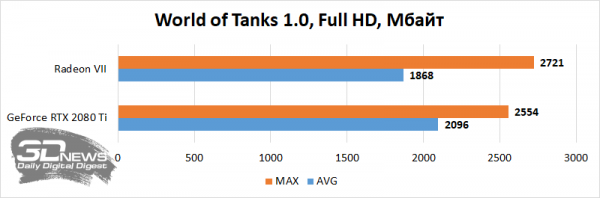
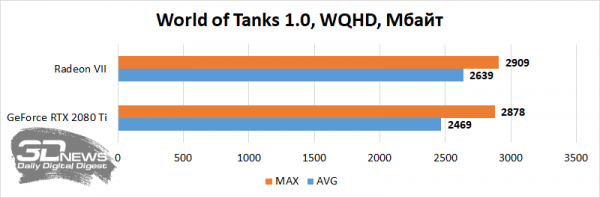
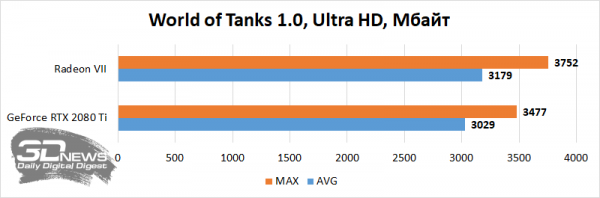
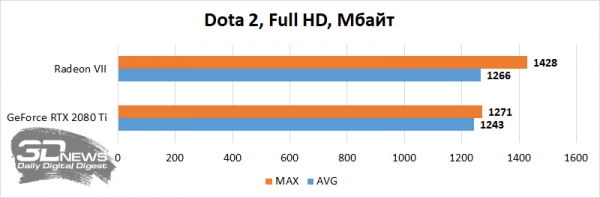
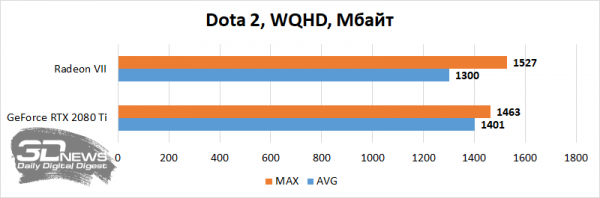
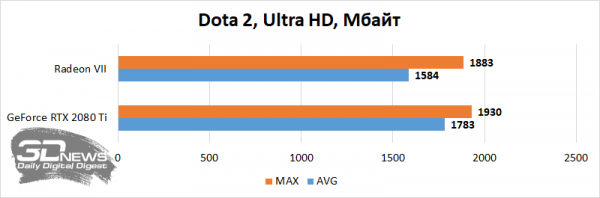
Thirdly, the list features World of Tanks and Dota 2 — popular multiplayer games worldwide, designed so that as many players as possible can enjoy them with comfortable FPS. Consequently, these programs have the most lenient system requirements.
Now, let's pause to elaborate — the following article will exclusively discuss resource-intensive games. The results of the GPU memory consumption measurements in "Tanks" and "Dota" are presented separately. We see that when using maximum graphics quality even at Ultra HD resolution, a graphics card with 4 GB of memory will be quite sufficient. Naturally, the device's GPU must provide the player with a comfortable FPS. Unlike single-player games, frame rate is essential in multiplayer franchises, but that's a topic for another article.
In most cases, gamers playing multiplayer games are not averse to using minimal graphics quality settings to increase performance in-game. Therefore, it is safe to say that graphics cards with 2, 3, and 4 GB of memory are sufficient for such programs. The amount of video memory is far from the most crucial parameter here. So I consider this question settled.
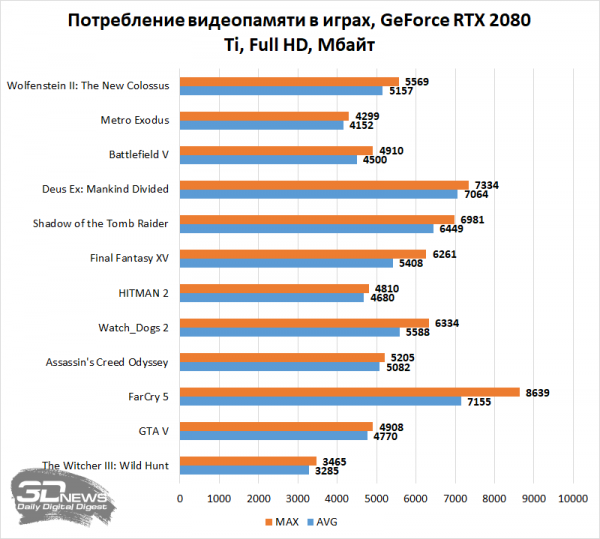
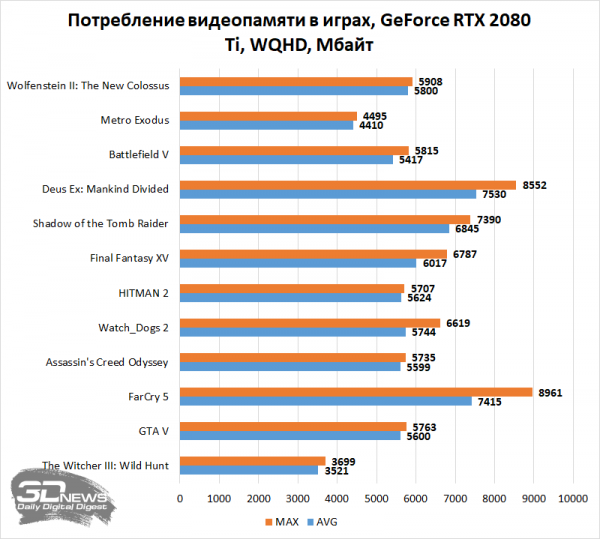
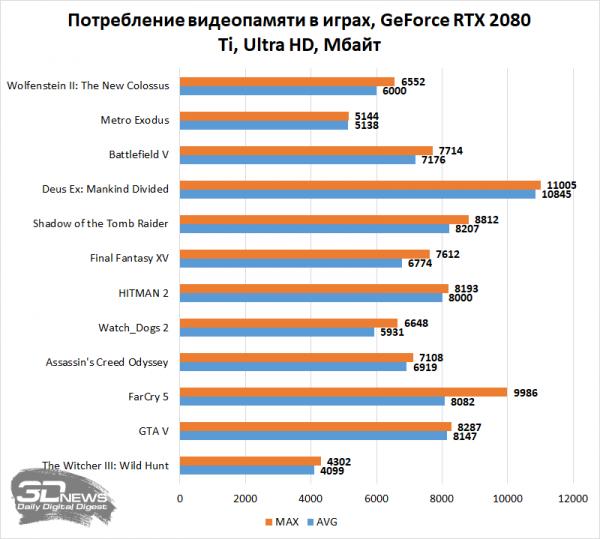
Everything changes when it comes to more demanding games. Here, developers will find a way to utilize all the resources of your graphics card! Above are graphs with the GeForce RTX 2080 Ti, below are those with the Radeon VII.
Let's gather some statistics:
- In 11 out of 12 games at Full HD resolution, the GPU memory consumption exceeds 4 GB; in 5 out of 12 programs, it exceeds 6 GB; in 1 application out of 12, it reaches 8 GB.
- In 2 out of 12 games at WQHD resolution, the video memory consumption exceeds 8 GB.
- In 5 out of 12 games at Ultra HD resolution, the video memory consumption exceeds 8 GB; in 1 program out of 12, it reaches 11 GB.
As always, one should approach any kind of statistics with a degree of skepticism. On one hand, the results are quite expressive and speak for themselves. It turns out that graphics cards with 4 and 6 GB are, so to speak, out of the game. I won’t even mention graphics cards with 2 GB VRAM (and I remind you again that they are the majority among PC owners).
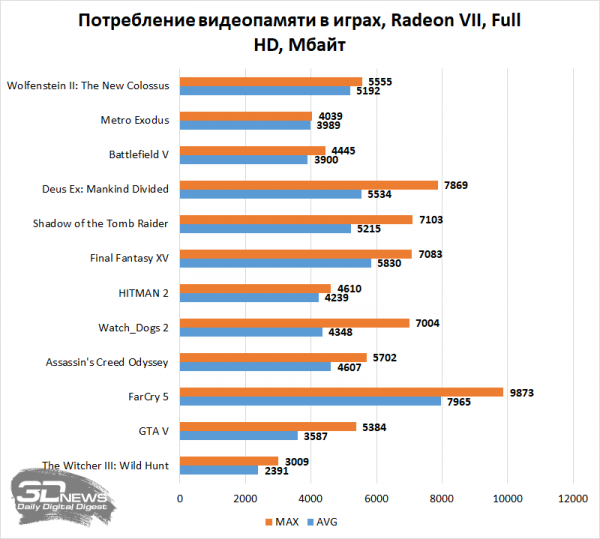
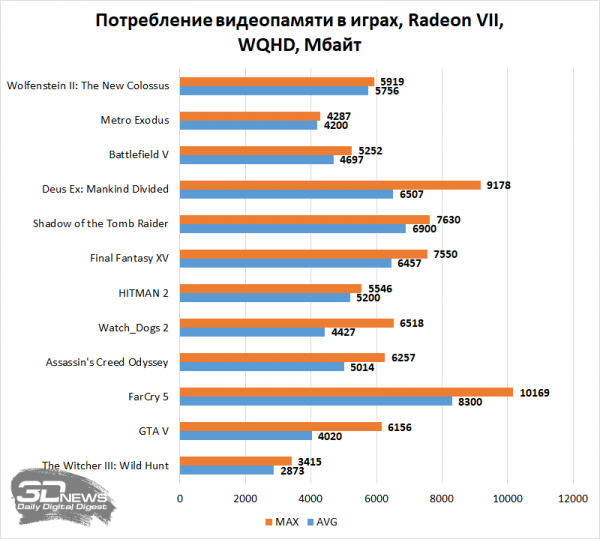
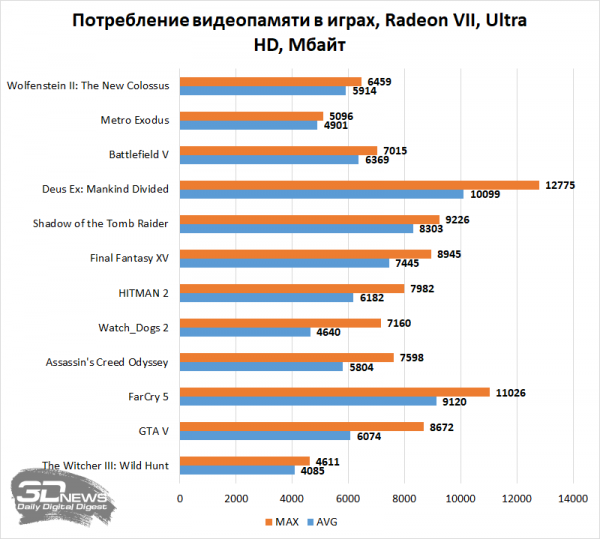
On the other hand, it doesn’t always make sense to use maximum graphics quality settings or additional parameters that theoretically enhance the image. For example, there's no need to set 4K resolution if you're using a small monitor — with a diagonal of no more than 27 inches. Or, for instance, there's no point in using heavy anti-aliasing modes if the graphics card simply cannot handle them and ensure a comfortable FPS for the gamer. Look, I enabled 8x anti-aliasing in Deus Ex: Mankind Divided — well, I saw that the Radeon VII outperformed the GeForce RTX 2080 and GeForce RTX 2080 Ti in terms of video memory consumption. But what’s the point? The average FPS at 4K resolution with those settings approaches zero, although it was amusing to see, for statistical sake, that games can indeed
Finally, the test results are based on 14 games that I personally selected. Naturally, more programs could have been added to the test, but you can’t test everything at once, and 14 projects is quite a substantial sample.
As I mentioned, the graphs show the maximum video memory consumption and the so-called average VRAM consumption. The second parameter is somewhat absurd, like the well-known saying 'the average temperature in the hospital.' Nevertheless, it is included in the graphs to visually demonstrate how much video memory consumption in games can vary under different conditions. The difference between the average and maximum figures is particularly noticeable in open-world games. And for some reason, along with the Radeon VII graphics card.
I would like to draw your attention to one more point. Some games load maximum data into the video card’s memory if the graphics accelerator has the appropriate resources. This fact suggests that perhaps it’s not all that dire, and if a game can consume, say, more than 6 GB of video memory, it does not necessarily mean that, for example, the GeForce RTX 2060 will experience issues. We will definitely verify this later.
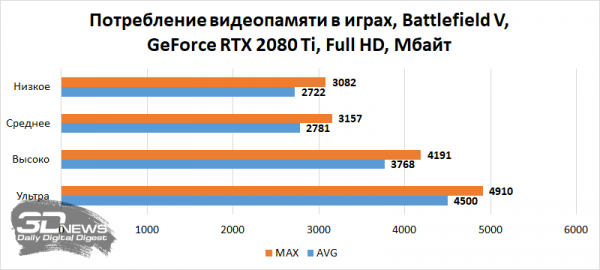
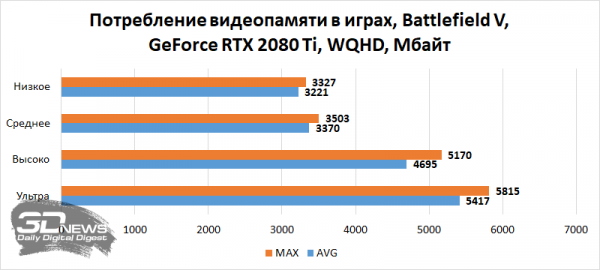
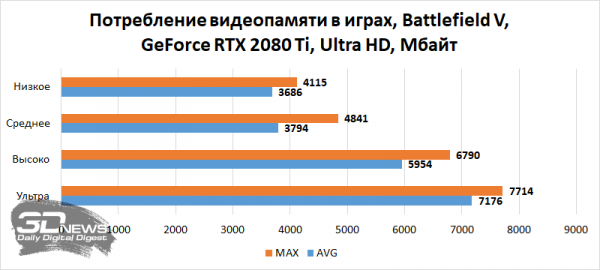
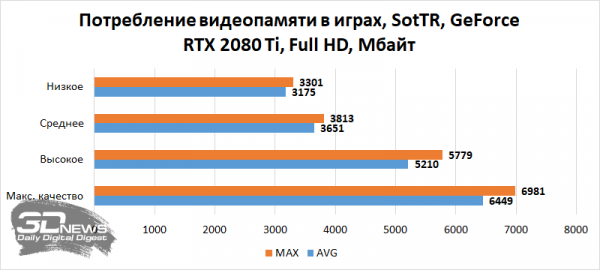
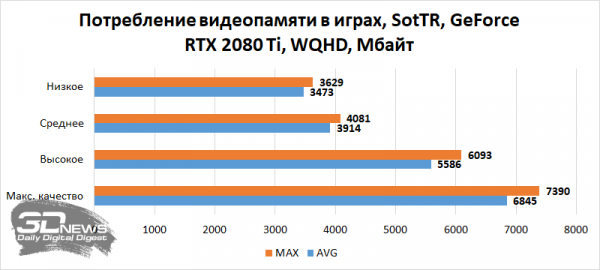
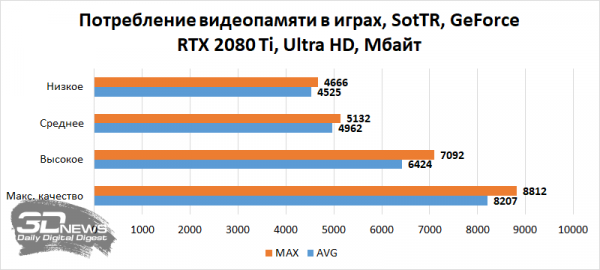
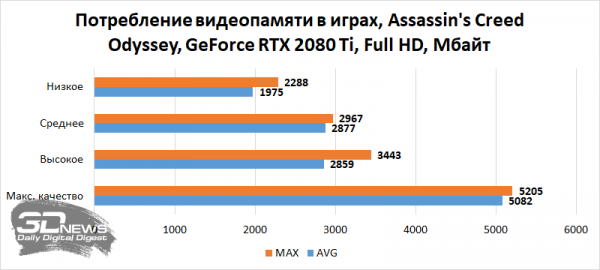
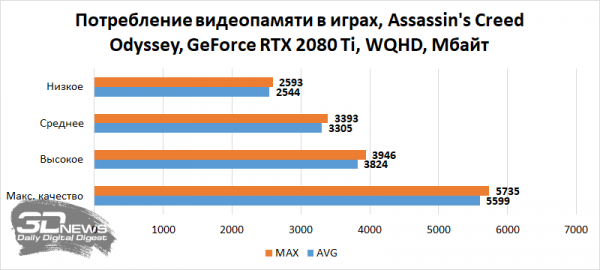
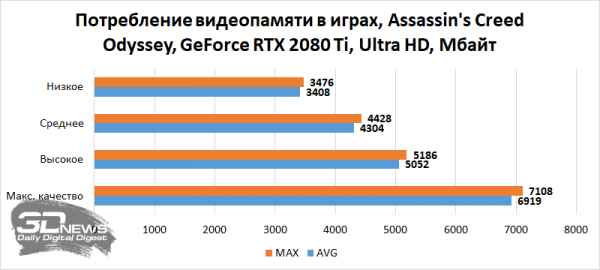
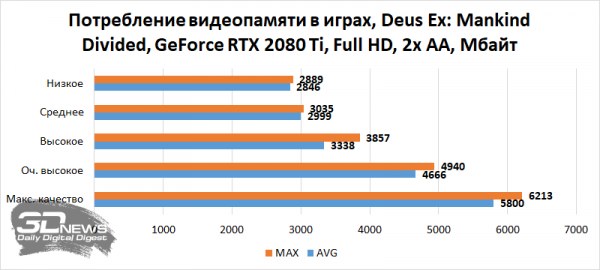
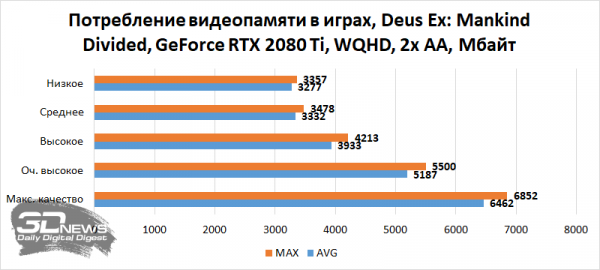
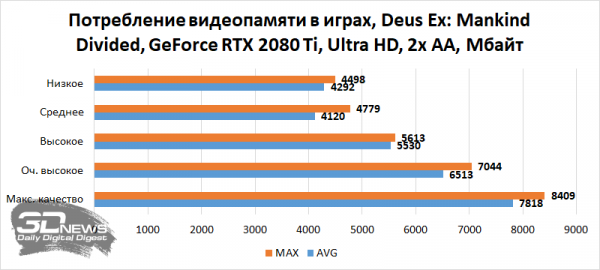
PC gaming is great because users can choose which settings to adjust to make the on-screen image noticeably smoother. You can also take a simpler route by activating a certain graphics quality mode within the game itself. Typically, programs with high system requirements have four or even five presets to significantly lower the entry threshold. I used such modes in some games.
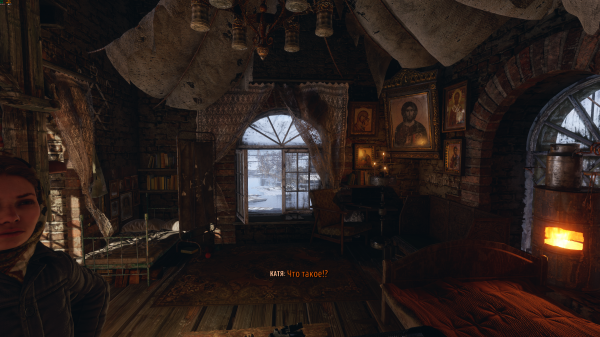
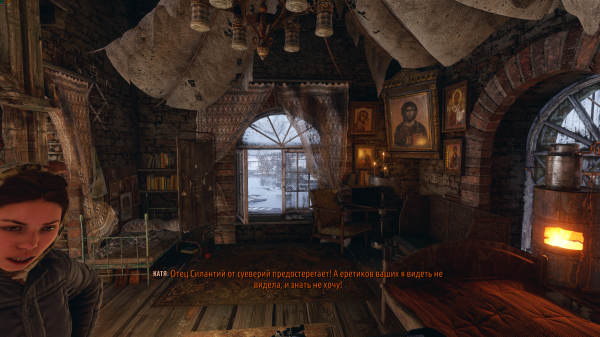
I think that after viewing the previous 12 graphs, any additional comments are unnecessary. The transition from maximum quality (which can be called 'Extreme', 'Ultra', 'Beyond', 'Very High', 'Highest') to 'High' results in a colossal decrease in video memory consumption. This immediately raises the question: is there any point in maxing out all the sliders?
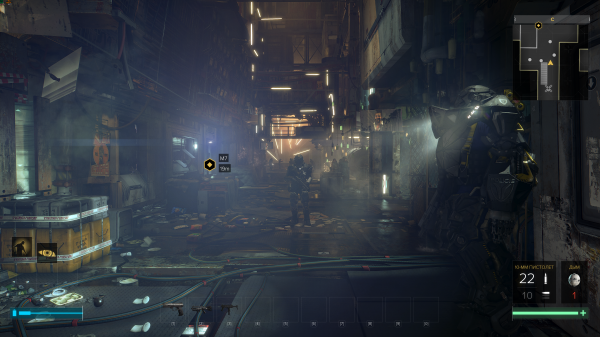 | 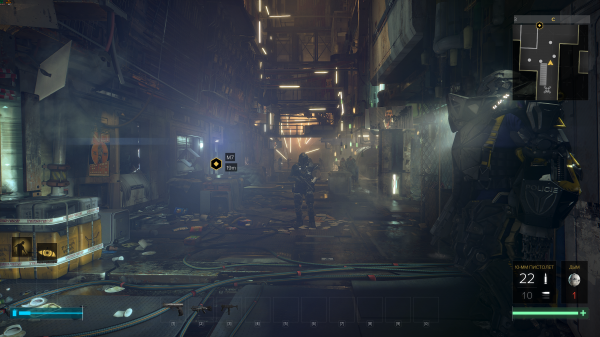 | 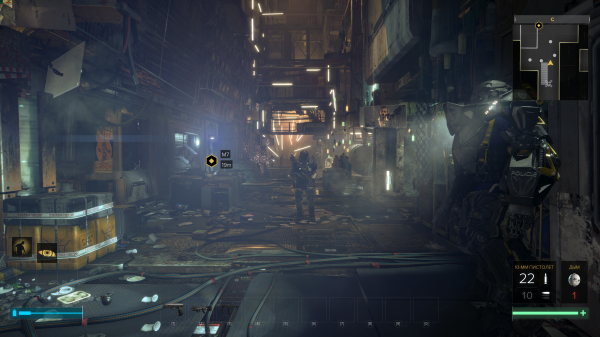 | ||
 |  |  | ||
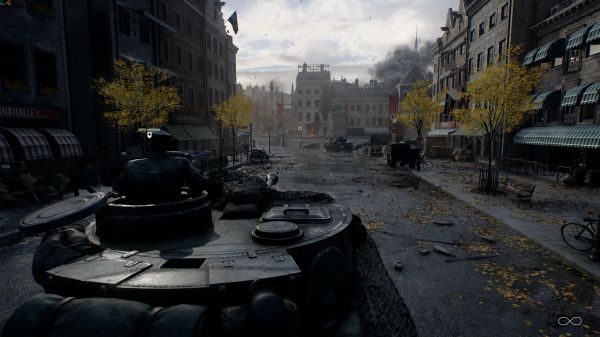 | 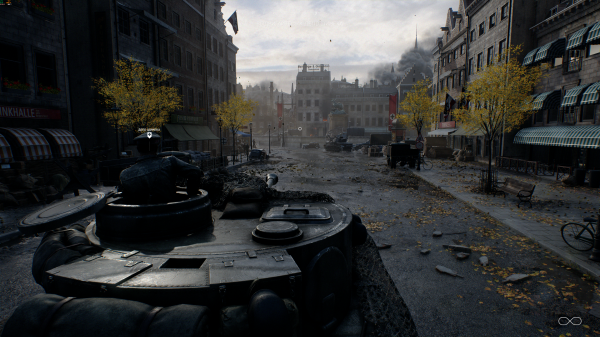 | 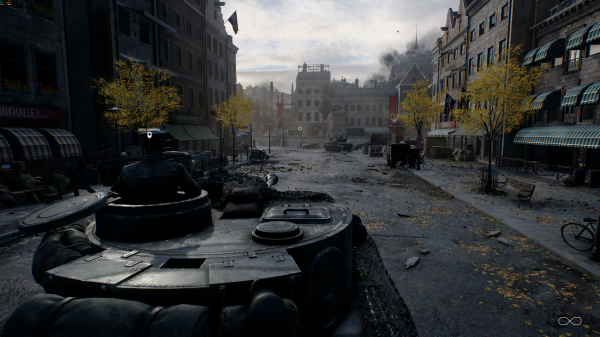 | ||
Sometimes, it’s very hard to distinguish between the maximum and high graphic quality in a game. Some graphics chip developers have claimed: play as intended. A good advertising slogan. And indeed, when purchasing an expensive video card, one wants to crank everything up to the max without overthinking it. However, this is not always possible — often one has to make some compromises. In the second part of the article, we will explore video cards that demonstrate a commendable level of performance but face issues due to insufficient video memory — this situation can be particularly frustrating.
To be fair, studying graphic quality through images is like following your favorite football team's game through a text broadcast rather than being at the stadium. You seem to have all the data in front of you, but something feels missing...
What exactly is video memory spent on in games?
The dependency of memory consumption on texture quality
Let's return to the testing. To assess the dependency of memory consumption on texture quality, we conducted additional measurements at Ultra HD resolution, using the GeForce RTX 2080 Ti in our setup.
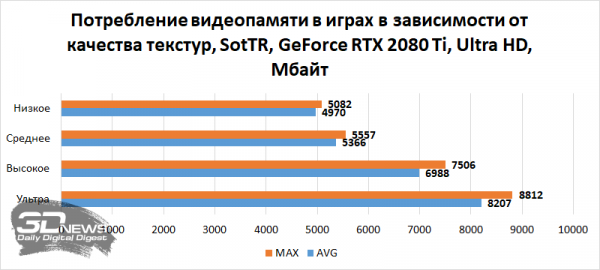
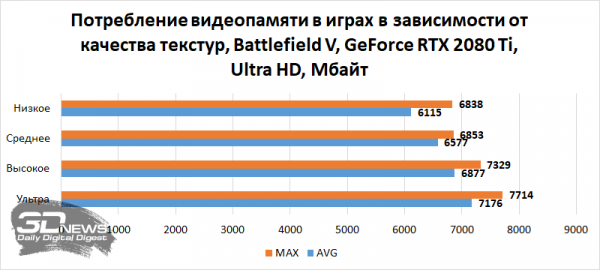
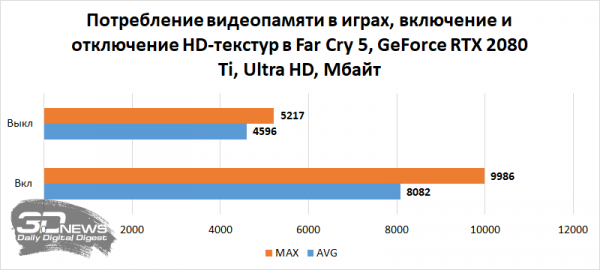
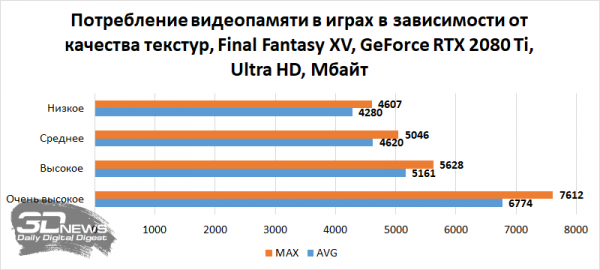
It's no coincidence that the most resource-intensive graphical elements in any game are textures. For instance, in Far Cry 5 (the most controversial game on the list), enabling HD textures nearly doubles VRAM consumption!
 |  | |
The screenshots above provide a clearer example from this game, which allows users to easily notice the difference between HD textures and regular ones.
The dependency of memory consumption on anti-aliasing
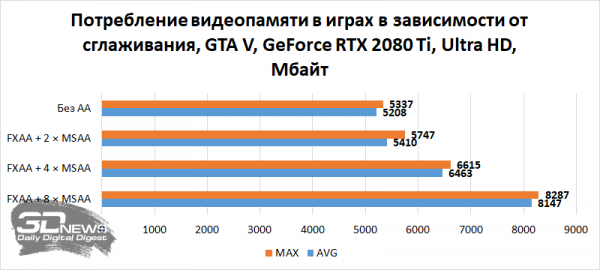
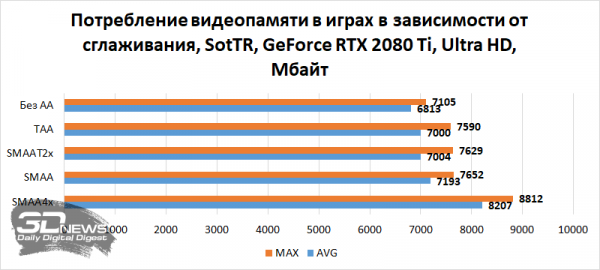
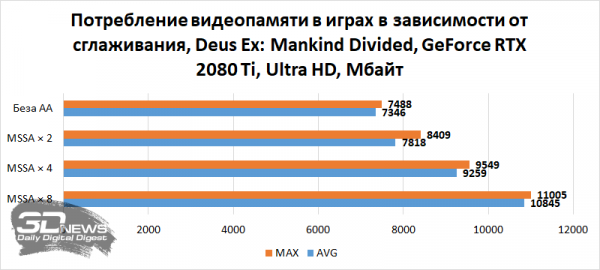
Anti-aliasing significantly consumes video memory. Today, there are many types of anti-aliasing available, and all of them affect VRAM usage to some extent. I didn’t just randomly include the rather old (yet still popular) GTA V. We can see that in Ultra HD resolution, enabling 8x MSAA causes VRAM usage to exceed 8 GB! This is a game that was released on consoles back in 2013.
Of course, using such an AA mode at 4K resolution makes no sense, but we mention it here for clarity.
The dependency of memory consumption on ray tracing usage
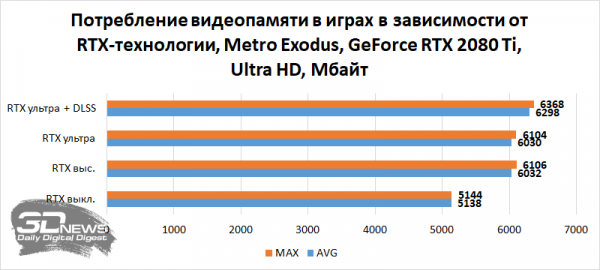
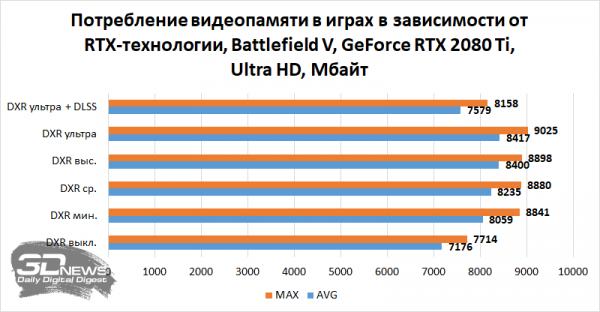
The two graphs above clearly show that using the DXR feature significantly increases video memory consumption. I would like to remind you that modern graphics cards that support hardware ray tracing are equipped with either 6, 8, or 11 GB of VRAM (with the Titan RTX and its 24 GB being an exception). I will discuss some 'spicy' features of using DXR in games in the second part of the article.
The dependency of memory consumption on the chosen API
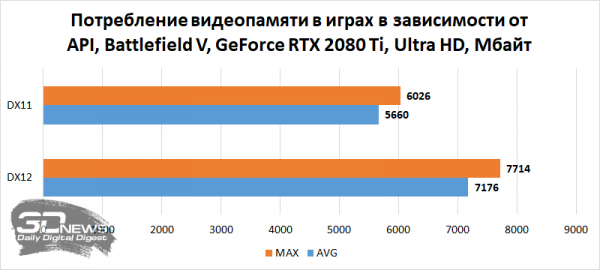
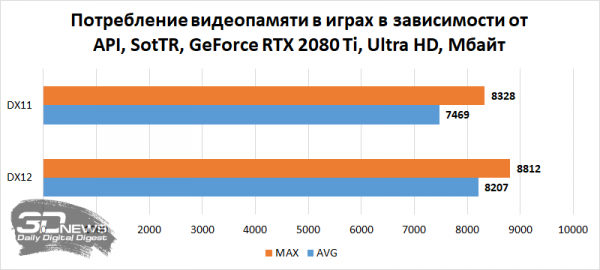
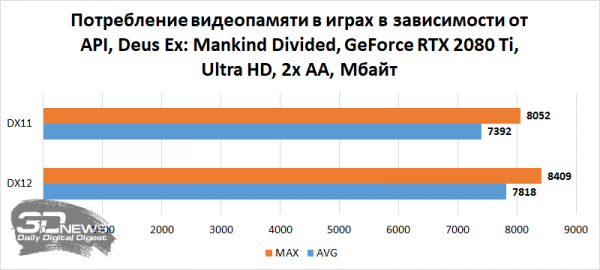
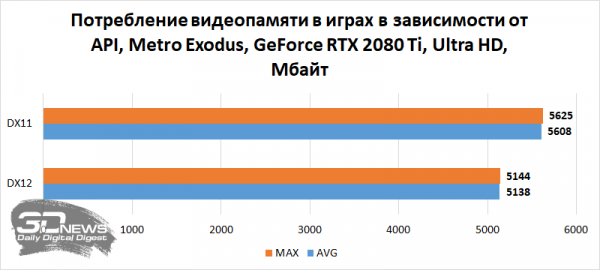
Finally, it became apparent that the choice of API, specifically the version of DirectX, notably affects video memory consumption in games. Interestingly, DirectX 12 proves to be more resource-intensive for graphics accelerators.
I have examined many parameters of modern games in terms of VRAM consumption, but the mentioned options are the most resource-intensive when it comes to memory. Naturally, if FPS drops are due to insufficient video memory, it is necessary to lower the quality of these parameters by one step, or even more.
That's why we gathered here today. The only criterion that any gamer will agree on is smooth graphics.. And if everything works well, you’ll agree that we won’t be concerned about issues like insufficient video memory. That’s what we will check in the second part of the article — on the next page.
Source: 3dnews.ru
