

Even without a deep understanding of mobile communication standards, anyone will surely say that 5G is better than 4G/LTE. However, it's not that simple. Let's figure out how 5G is both better and worse, and what use cases are most promising considering the current state.
So, what does the 5G technology promise us?
- A speed increase of several times up to 10 Gbps,
- A decrease in latency by several times down to 1 ms,
- An increase in connection reliability (packet loss error rate) by hundreds of times,
- An increase in the density of connected devices (106/km2).
All of this is achieved through:
- multichannel (parallelism across frequencies and base stations)
- increasing carrier frequencies from units to tens of GHz (bandwidth of the radio channel)
5G will enhance 4G in traditional areas, whether it's instant movie downloads or seamless connections between mobile applications and the cloud. Does this mean we can do away with delivering the Internet to our apartments and offices via cable?
5G will provide universal connectivity for everything, integrating broadband, energy-intensive protocols with narrowband, energy-saving ones. This will open up new avenues unavailable to 4G: machine-to-machine communication on land and in the air, Industry 4.0, the Internet of Things. , that the 5G business will generate $3.5T by 2035 and create 22 million jobs.
Or not?..

(Source of image – Reuters)
How it works
If you know how 5G works – skip this section.
So, how will we achieve such fast data transmission in 5G as described above? It's not magic, is it?
The speed increase will occur due to the transition to a higher frequency range – previously unused. For example, the frequency of home WiFi is 2.4 or 5 GHz, while existing mobile networks operate around 2.6 GHz. But when we talk about 5G, we are immediately referring to tens of gigahertz. It's simple: we increase the frequency, reduce the wavelength – and the data transmission speed increases dramatically. The network overall becomes less congested.
Here is an illustrative comic showing how it was and how it will be. It was:
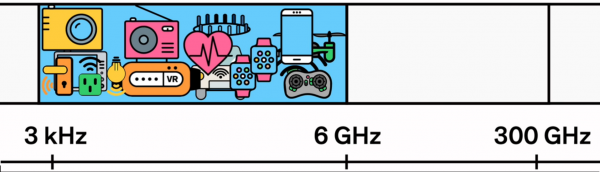
It will be:
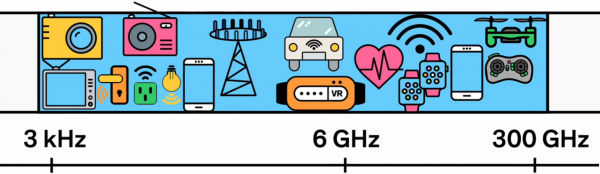
(Source: IEEE Spectrum, )
The frequency has increased many times over, so in 5G we are dealing with much shorter, millimeter waves. They do not pass well through obstacles. Consequently, the network architecture is changing. Previously, our connectivity was provided by large, powerful towers that offered coverage over long distances, but now we will need to place many compact, low-power towers everywhere. And keep in mind that in large cities, a lot of stations will be required due to signal blockage by tall buildings. For reliable coverage in New York, we need the number of base stations by 500 (!).
According to from Russian operators, the transition to 5G will cost them about 150 billion rubles—an amount comparable to previous expenses for deploying the 4G network, even though the cost of a 5G station is lower than existing ones (but many are needed).
There are two types of networks: fixed and mobile.
To reduce energy consumption and increase range, the technology of beamforming is used—a dynamic steering of the radio beam to specific users. How is this done? The base station remembers where and when the signal came from (it originates not only from your phone but also as reflections from obstacles), and using triangulation methods, it calculates your approximate location and then builds the optimal signal path.
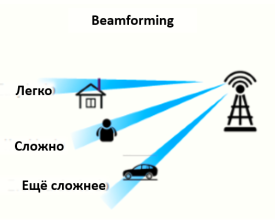
Source: Analysys Mason
However, the need to track the receiver's position leads to some differences for fixed and mobile use cases, which is reflected in various usage scenarios (more on this later in the 'Consumer Market' section).
Status Quo
Standards
There is no accepted 5G standard. The technology is too complex, and there are too many players with conflicting interests.
The proposed standard 5G NR (New Radio) is in a highly developed stage by the organization 3GPP (3rd Generation Partnership Project), which developed the previous standards, 3G and 4G. 5G uses two radio frequency bands (Frequency Range, or simply FR). FR1 offers frequencies below 6GHz. FR2 – above 24GHz, known as millimeter waves. The standard supports both stationary and moving receivers and is a further development of the 5GTF standard from the American telecom giant Verizon, which supports only stationary receivers (this type of service is known as fixed wireless access networks).
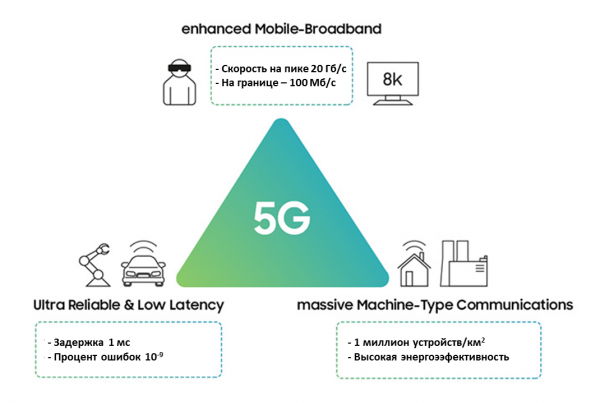
The 5G NR standard provides for three use cases:
- eMBB (enhanced Mobile Broadband) – defines the mobile internet we are familiar with;
- URLLC (Ultra Reliable Low Latency Communications) — has high requirements for response speed and reliability – for tasks such as autonomous transport or remote surgery;
- mMTC (massive Machine Type Communications) – supports a large number of devices that send data infrequently – a case for the Internet of Things, such as meters and monitoring devices.
Or briefly, the same as in the picture:
It is important to understand that initially the industry will focus on the implementation of eMBB, as it is the more understandable scenario with existing cash flows.
Implementation
Since 2018, large-scale testing has been conducted, for example, at the Winter Olympics in South Korea. In 2018, all four major Russian operators conducted tests. MTS tested the new technology — usage scenarios with video calls, high-definition video transmission, and online games were tested.
In South Korea, for the first time in the world, 5G service was offered at the end of 2018. Worldwide commercial deployment is expected in the next year, 2020. At the initial stage, the FR1 frequency range will be used as an extension of existing 4G networks. According to the Ministry of Digital Development, in Russia, 5G is expected to begin appearing in million-plus cities from 2020. In practice, large-scale deployment will be determined by the possibility of monetization, and this aspect of 5G is still unclear.
What is the problem with monetization? The thing is, telecom operators currently do not see significant grounds for modernization: existing networks manage the load quite well. And now, 5G is regarded more as a marketing tool: the 5G icon on a phone screen will definitely be a plus in the eyes of telecom operator subscribers. A noteworthy anecdotal case is with , displaying a 5G icon in the absence of a real network, for which competitors filed a lawsuit for deception.
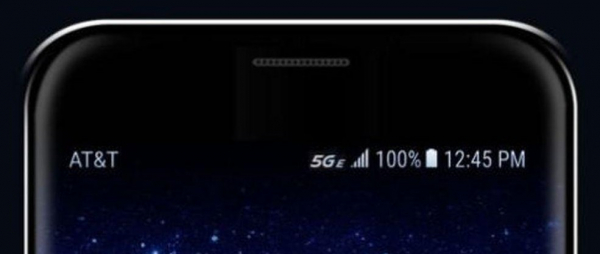
Upon closer inspection, it's evident that the icon actually reads '5GE' — which stands for 5G Evolution, and suddenly this is not the 5G we think of, but merely a label crafted by marketers for the existing LTE network with some improvements.
Chipsets
Microelectronics companies have already invested billions of dollars in 5G. Samsung offers chips for 5G NR cellular modems (), Qualcomm (), Huawei (). Modems from Intel, a new player in this market, are expected by the end of 2019. Samsung's modem is built on 10nm FinFET technology and is compatible with older standards starting from 2G. In the frequency range up to 6GHz, it provides download speeds up to 2 Gbps, while using the millimeter wave range increases the speed to 6 Gbps.
Phones
Almost all Android phone manufacturers have announced plans to implement 5G. Samsung unveiled its flagship Galaxy S10 in a 5G version at the Mobile World Congress in late February 2019. Its release in Korea took place on April 5. In the USA, it appeared on May 16, connecting with the Verizon network. Other carriers are also joining in: AT&T has announced plans to launch a second smartphone in cooperation with Samsung in the second half of 2019.
Throughout the year, 5G smartphones from various manufacturers, mainly high-end ones, will hit store shelves. Some estimates suggest that the new technology will increase device costs by $200-300 and subscription fees by 10%.
Consumer Market
Case 1. Home Internet
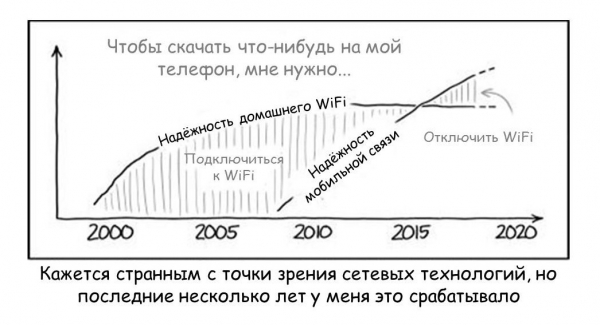
5G fixed wireless access networks will become an alternative to wired internet in our apartments. Where the internet used to come into our apartment via cable, in the future it will come from a 5G tower, and then a router will distribute it through the usual home WiFi. Major industry players have completed preparations, synchronizing the release of routers for sale with the rollout of 5G networks. A typical 5G router costs $700-900 and provides download speeds of 2-3 Gbps. This way, operators will solve the "last mile" problem and reduce costs associated with laying cables. And there's no need to worry that existing backbone networks will struggle with the increased traffic coming from 5G networks: research is underway on utilizing the existing reserve of fiber optic networks — the so-called "dark fiber."
How new will this scenario be for users? Already, some countries are moving away from traditional home wired internet and switching to LTE: it turns out to be faster and cheaper to use mobile connectivity in all situations, provided there are convenient plans. This situation, for example, has arisen in Korea. And it is illustrated in this comic:
Case 2. Mass Gatherings
Surely everyone has found themselves in an unpleasant situation: you arrive at an exhibition or stadium, and mobile connectivity disappears. And this is precisely at the moment when you want to post a photo or write on social media.
Stadiums
Samsung conducted a test in collaboration with the Japanese telecom operator KDDI at a 30,000-seat baseball stadium. Using test 5G tablets, they were able to demonstrate streaming 4K video simultaneously on multiple tablets.
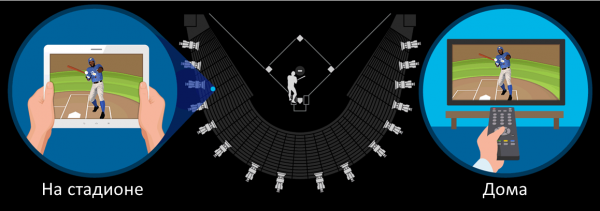
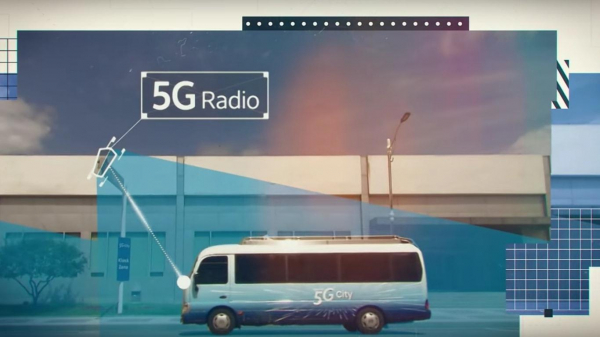
The stadium is one of three scenarios illustrated in the demo zone called 5G City, located in Suwon (Samsung's headquarters). Other scenarios include an urban environment (connecting cameras, sensors, and information displays) and a high-speed access point for delivering HD video in a moving bus: while it passes the point, a film can be downloaded.
Checkers [Шашки] (Lukasz Oktaba)
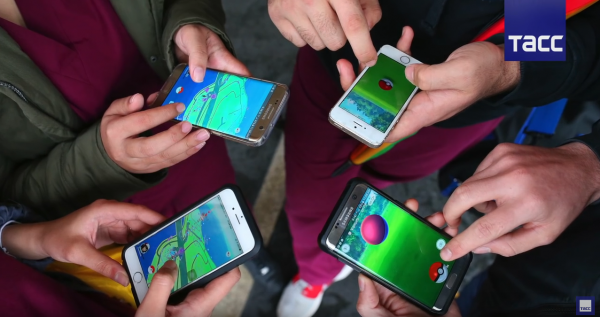
Niantic, the creator of the world-famous geolocation game Pokemon Go, has high hopes for 5G. Here's why: recently, group events called raids were introduced in the game. In raids, you need to coordinate with other players to collectively defeat particularly strong Pokémon, creating interesting situations in real life. For instance, the main legendary location in the game featuring the rarest Pokémon, Mewtwo, is at Times Square in New York City – just imagine the crowd that can gather there, consisting not only of Pokémon hunters but also tourists.
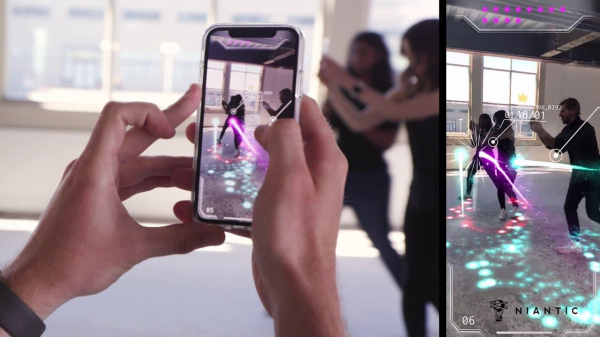
Augmented reality is also seen as the "killer app" for 5G. In this you can see the concept of real-time magical duels currently being developed by Niantic in a new game inspired by "Harry Potter." Niantic has already partnered with Samsung and telecom operators Deutsche Telekom and SK Telecom.
Transport
Finally, an interesting case involves trains. There is an idea to equip the railway with 5G connectivity for the entertainment and comfort of passengers. Research by the University of Bristol : to achieve high-speed seamless connectivity, the railway needs access points spaced 800 meters apart!
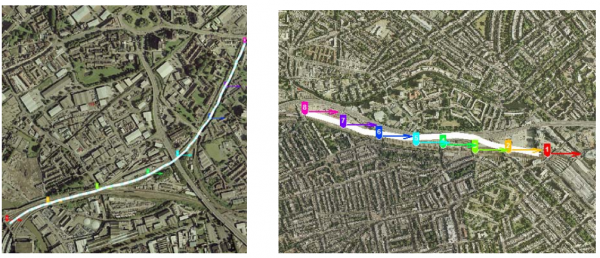
An example of how to position access points along the railway
Tests were successfully conducted on a train operating near Tokyo – they were by Samsung in collaboration with the telecom operator KDDI. During the tests, a speed of 1.7 Gbps was achieved, and during this process, 8K video was downloaded and 4K video was uploaded from a camera.
New use cases
However, all of this is more about solving familiar problems. What fundamentally new capabilities can 5G offer us?
Connected car
The main advantage is low latency, allowing vehicles to communicate with each other at speeds of up to 500 km/h. Unlike human drivers, cars will finally be able to negotiate maneuvers among themselves or with stationary infrastructure, making roads safer. Interestingly, the system will take weather conditions into account: everyone knows that braking distances are longer in slippery weather, so the rules in such a system must change accordingly.
The European association 5GAA (Automotive Association) is already uniting over 100 major telecom and automotive manufacturers worldwide to accelerate the deployment of the C-V2X (Cellular Vehicle-To-Everything) system. The association's key objectives are comprehensive road safety and traffic efficiency. Cyclists and pedestrians with 5G smartphones can also rely on safety. Road users within a range of up to 1 km will be able to communicate directly, while at larger distances, 5G coverage will be necessary. The system will create corridors for police and ambulances, anticipate sensor data exchange between vehicles, facilitate remote driving, and other wonders. After the launch of C-V2X, the association plans to apply the experience gained to 5G V2X, aiming at Industry 4.0, smart cities, and everything that moves utilizing 5G.
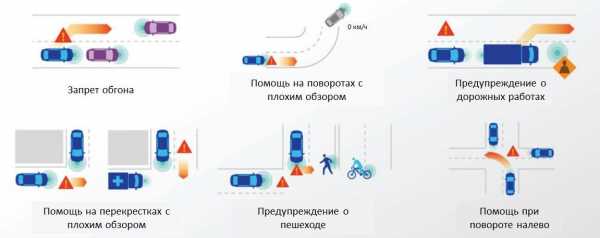
Examples of situations that can be resolved using Connected Car. Source: Qualcomm.
5G will allow not only ground vehicles but also aircraft to connect. This year, Samsung, in collaboration with the Spanish internet provider Orange, , how a remote pilot controlled a drone flight using the deployed 5G network, receiving high-resolution video stream in real time. The American provider Verizon acquired , promising millions of 5G-connected flights. The company's drones are already connected to Verizon's launched 4G network.
Industry 4.0
In general, the term "Industrie 4.0" was coined in Germany for its industrial modernization program. The association (5G Alliance for Connected Industries and Automation) has been bringing together manufacturing companies interested in utilizing 5G since 2018. The highest requirements for latency and reliability are placed on the control of industrial robots, where response times cannot exceed tens of microseconds. Currently, this is addressed using Industrial Ethernet (for example, the EtherCAT standard). It's quite likely that 5G will also compete for this niche!
Other applications, such as communication between industrial controllers or with human operators, as well as sensor networks, are less demanding. Currently, most of these networks use cables, so wireless 5G appears to be an economically viable solution, additionally allowing for quick production reconfiguration.
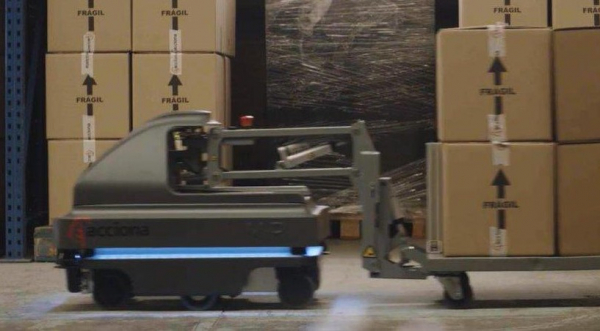
In practice, economic feasibility will lead to the implementation of 5G in the most expensive areas related to human labor costs, such as forklift operators in factories and warehouses. For example, the European engineering company Acciona demonstrated . The cart transmits 360-degree high-resolution video, and a remote operator will assist it in getting out of unforeseen situations. The cart utilizes 5G technologies from Cisco and Samsung.
Remote collaboration technologies will advance further. This year, it was demonstrated how an expert surgeon observes an oncology operation in real time, taking place many kilometers away, showing his colleagues how to better perform the operation. As the technology improves, he will be able to take a more active role by directly controlling the surgical instruments.
Internet of Things
First and foremost, 5G will address the issue of numerous poorly supported communication standards for the Internet of Things, which we believe currently limits the development of this sector.
Here, 5G can offer the following:
- Ad hoc networks (without routers)
- High density of connected devices
- Support for narrowband, energy-efficient communications (10+ years on one battery)
But it seems that large businesses are currently more interested in other scenarios distinct from the Internet of Things. A quick search online found no demonstrations by key players showcasing the advantages of 5G for the Internet of Things.
In concluding this topic, let's focus on an interesting opportunity. Currently, reliance on a socket or the need for battery replacement limits the choice of 'things.' Low-frequency inductive wireless charging works only at a distance of a few centimeters. 5G and its directed millimeter waves will enable effective charging at distances of several meters. Although existing standards don't specify this, we have no doubt that engineers will soon find ways to exploit this possibility!
Opportunities for Developers
If you are interested in this topic, what should you explore next?
Connections. You will be able to meet 5G players at the upcoming Russian conferences May 29-30, May 30-31, June 25-27, October 24.
Among academic contacts, it is worth noting held at the Institute for Problems of Information Transmission.
Funding. Key players are holding competitions for the use of 5G in various fields. In the USA, Verizon recently launched the ‘Built on 5G Challenge’ for Industry 4.0, immersive consumer applications (VR/AR), and breakthrough ideas (transforming our ways of living and working). The competition is open to registered small businesses in the USA, with applications accepted until July 15. The prize pool is $1M. Winners will be announced in October this year.
Employment. In addition to the big four mobile operators, there are several companies in Russia planning to use 5G in the near future. The business model of the leading content delivery provider in Russia and the CIS, CDNVideo, is chargeable based on the volume of traffic received. The use of 5G, which potentially lowers this cost, will allow the company to reduce expenses. PlayKey promotes cloud gaming, so it’s no surprise that it also plans to use 5G.
Open Source, apparently, will play a key role in the infrastructure. The American supports 5G. The European brings together those wishing to bypass proprietary components of 5G infrastructure. Strategic directions include support for 5G modems and software-defined systems, heterogeneous networks, and the Internet of Things. virtualizes radio access networks (Radio Access Networks). The implementation of the core network is available from .
Authors:

Stanislav Polonsky — Head of Advanced Research and Development at Samsung Research Center

Tatyana Volkova — Author of the training program for the IoT Academy project at Samsung, specialist in corporate social responsibility programs at Samsung Research Center
Source: habr.com
