


Having covered the theoretical foundations, let's move on to the description of the hardware component of cable television networks. I will begin the discussion from the subscriber's television receiver and elaborate more than in I will talk about all components of the network.
Contents of the article series
- Part 5: Coaxial distribution network
- Part 6: RF-signal amplifiers
- Part 7: Optical receivers
- Part 8: Optical backbone network
- Part 9: Headend
- Part 10: Troubleshooting in the CATV network
Cables
The TV socket connects to the splitter inside the apartment, or (if there is only one TV) — to the riser in the distribution panel on the stairwell. As you know, each extra connection is a potential failure point, so when troubleshooting, it's important to pay close attention to every joint.
Inside the apartment and up to the panel, a well-known coaxial cable type RG-6 is generally used, which is terminated with simple connectors that usually only make contact with the shield, while the central conductor connects to the device or adapter's input as is.



For routing the main lines, RG-11 cable is used, which has lower attenuation over distance and greater durability. There is also a self-supporting version of this cable with a steel wire in the shielding for aerial installations.
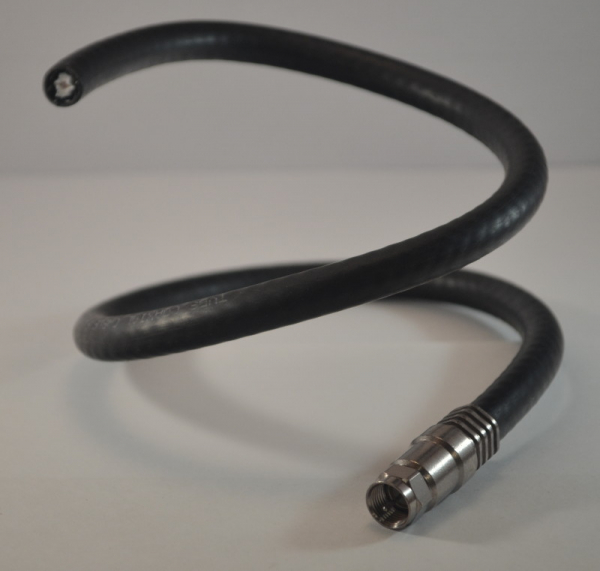
This cable is thicker and stiffer, which is why more complex connectors are used for terminations: these are either crimp connectors similar to their smaller counterparts or threaded assemblies typical of industrial-grade equipment.
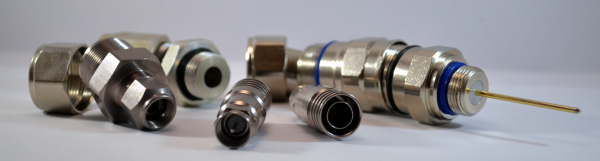
Crimping a connector onto such a cable can be tricky, and problems often arise right after installation due to failure to adhere to the standard length for stripping (6.3mm for the center conductor + 6.3mm for the shield), or later due to poor contact during crimping without special tools.
Splitters and distributors
Splitters and distributors are used in the construction of the riser.
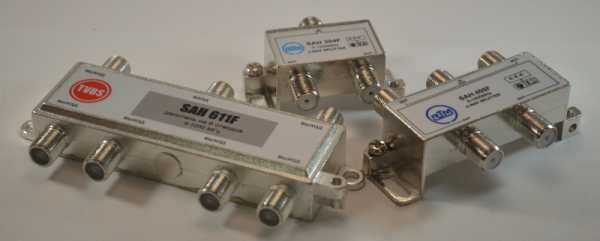
Inside, they consist of a junction of LC circuits for matching the output wave resistance. If a coaxial cable is divided without such a device, simply with twists, the reduced resistance from parallel connections will prevent the signal from passing completely, causing part of it to be reflected back into the trunk, which will lead to interference and noise in the signal.
The fundamental difference between splitters and dividers lies in the presence or absence of a linear output (OUT). Losses on such an output are minimal, around 1-5 dB depending on the rating. On subscriber taps (TAP), attenuation can range from 8 to 30 dB or more. This is necessary to ensure a consistent signal level at subscriber taps despite varying levels in the trunk.
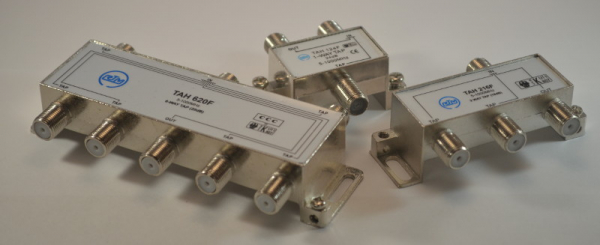
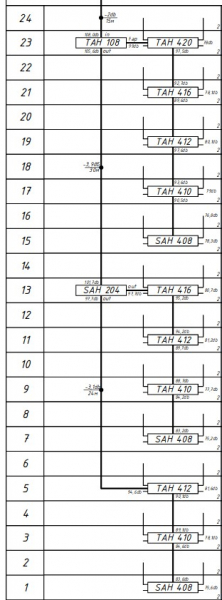
If at the beginning of the riser we have a signal at 105 dBμV, to deliver the required 75 dBμV to the subscriber from the tap, a splitter that attenuates 30 dB must be installed. Additionally, at the far end of the trunk, the signal may drop to less than 85 dB; in this case, a splitter with minimal losses on the taps, which is 8 dB for a 4-output model, is necessary. The nominal attenuation and the number of outputs are typically coded in the device's marking: in the image above, for instance, 620 denotes 6 subscriber taps, each attenuating by 20 dB, plus one trunk output. The designations TAH and SAH are not standardized, but they are quite common and correspondingly indicate splitters (tap) or dividers (split).
To reduce the signal level difference between sections of the riser in high-rise buildings, it is necessary to break it into several parts using trunk splitters. This helps to streamline the range of subscriber splitters and provide a signal level that is as close as possible to the required one at the subscriber tap.
In the diagram on the left, I have illustrated an example of a riser constructed from top to bottom and divided into three sections ("pilasters"). Only 5 types of subscriber splitters are used for 12 floor panels. If there were no division, we would have to use 12 types with a step of 2-3 dB. For the far end, we likely wouldn't be able to find a splitter at all, as even a two-output "half" splitter attenuates 4 dB, and with a larger number of outputs, we might exceed the budget for attenuation.
In cases where the system uses remote powering of equipment (I will definitely cover this in the following sections), the main splitters look slightly different:
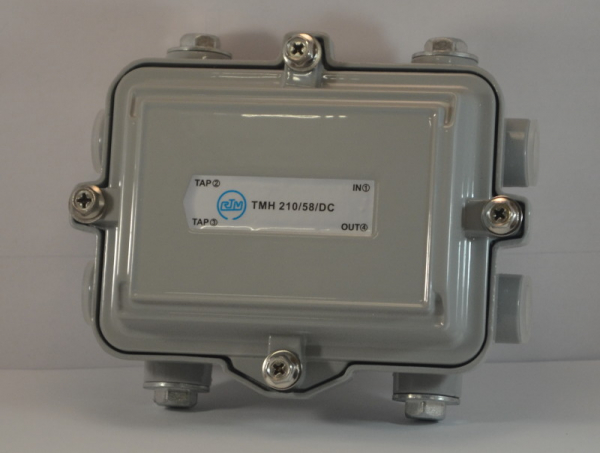
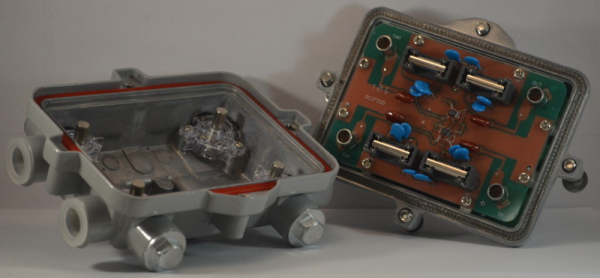
Due to the massive housing and thoughtful design, the best insulation is ensured both for the current-carrying parts from external influences and for the external environment from the considerable current that can flow through the cable.
Protection Elements
To protect the equipment from possible incidents on the cable, as well as to shield subscribers from malfunctions of active equipment, insulators are installed at the beginning of the risers, providing galvanic isolation between the main section and the distribution.

To eliminate signal reflection from mismatched outputs (this is structurally only through-off takes, but there is a possibility that due to poor assembly or a defect in the splitter, subscriber outputs might also have a wave resistance different from the required), they should be blocked with matched absorbing plugs, which often also serve as a function of a "secret" in cases where individual contracts for service provision are concluded with residents.

Source: habr.com
