

We continue our series of articles about Cisco Hyperflex. This time we will introduce you to the operation of Cisco Hyperflex in high-load database environments such as Oracle and Microsoft SQL, and compare the results with competing solutions.
Additionally, we are continuing to showcase Hyperflex capabilities across various regions of our country and are pleased to invite you to upcoming demonstrations of the solution, which will take place in Moscow and Krasnodar.
Moscow – May 28. Registration .
Krasnodar – June 5. Registration .
Hyperconverged solutions were not considered suitable for databases, especially under high loads, until recently. However, with the use of the UCS hardware platform for Cisco Hyperflex, which has proven its reliability and performance over the past 10 years, this situation has changed significantly.
Want to learn more? Then welcome to our catalog.
Introduction
Currently, there are two approaches to organizing hyperconverged solutions. The first approach is based on software-defined solutions that are delivered as software, with customers selecting the hardware independently. The second approach is based on turnkey solutions, which include both software and hardware, as well as technical support. At Cisco, we follow the second approach and provide ready-made solutions to our customers, as this is the only way to guarantee stable system behavior, quality technical support from a single manufacturer, and high performance.
Indeed, the high performance of the system is one of the key factors in deciding whether to use a particular product for mission-critical tasks.
Today, organizations typically host critical tasks on classic three-tier architecture solutions (Storage System > storage network > servers). At the same time, most organizations strive to simplify and reduce the cost of their IT infrastructure without compromising its stability and performance. For this reason, more and more frequently customers are turning their attention to hyperconverged solutions.
In this article, we will discuss the latest tests (February 2019) conducted by the independent laboratory ESG (Enterprise Strategy Group). The testing emulated the operation of high-load databases such as Oracle and MS SQL (OLTP tests), which are among the most critical components of IT infrastructure in a real production environment.
This workload was executed on three solutions: Cisco Hyperflex and two software-defined solutions installed on the same servers used in Hyperflex, namely the Cisco UCS servers.
Test Configurations
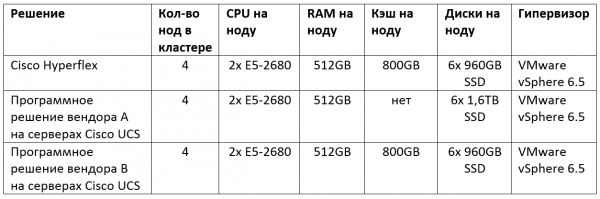
Vendor A's system does not use caching, as the cache configuration is not supported by the solution developer. For this reason, disks with larger storage capacity were used.
Testing Methodology
OLTP tests were performed with four virtual machines and a dataset of 3.2 TB. Before each test, each VM was populated with recorded data using a testing tool. This ensures that the test reads 'real' data and writes it to existing blocks, instead of merely returning zero blocks or zero values directly from memory. This occurs when data is not populated, so it was crucial to ensure the test accurately reflects how data is read and written in the application environment. Filling this large working set took a considerable amount of time, but in our view, it was a productive investment as it provides more accurate performance data.
Testing was conducted using the HCI Bench tool (based on Oracle Vdbench) and I/O profiles intended to emulate complex, mission-critical OLTP workloads using Oracle and SQL Server backends. Block sizes were assigned in accordance with emulated applications with 100% random data access.
Oracle Database Workload
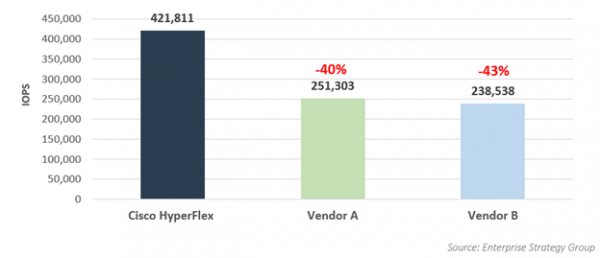
The first test conducted was an OLTP test designed to emulate an Oracle environment. Vdbench was used to create a workload with varying read and write ratios. The test was performed on four virtual machines. During the four-hour test, HyperFlex managed to demonstrate over 420,000 IOPS with a latency of only 4.4 milliseconds. Software solutions A and B were able to show only 238,000 and 251,000 IOPS, respectively.
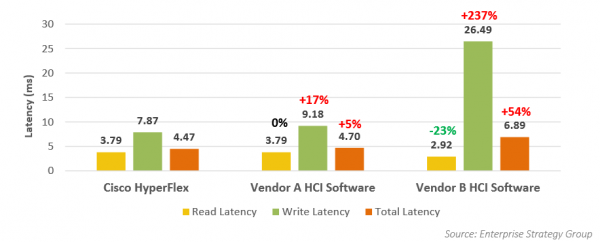
The latency levels in different systems were approximately the same, except for the write latency for vendor B, which averaged 26.49 ms, with very good read latency metrics at 2.9 ms. Compression and deduplication were active in all systems.
Microsoft SQL Server workload
Next, the OLTP workload was examined, which was intended to emulate the Microsoft SQL Server DBMS.
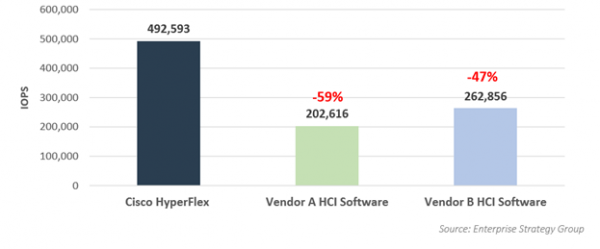
As a result of this test, the Cisco HyperFlex cluster outperformed both competitors A and B by about two times. Cisco achieved 490,000 IOPS compared to 200,000 and 260,000 for vendors A and B.
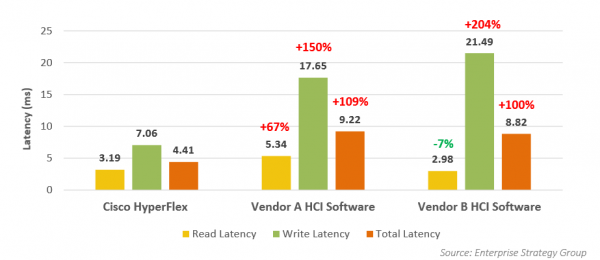
The latency results in Cisco HyperFlex did not differ significantly from the Oracle test, being at a good level of 4.4 ms. Meanwhile, vendors A and B showed results significantly worse than in the Oracle test. The only positive aspect for competitive solution B was the consistently low read latency at 2.9 ms; in all other metrics, HyperFlex outperformed competitive solutions by two times or more.
Conclusions
Testing conducted by the independent lab ESG not only reaffirmed the commendable performance level of the Cisco HyperFlex solution but also proved that hyperconverged systems are now ready for widespread use in mission-critical tasks.
Hyperconverged systems have long been considered more suitable for non-critical workloads. In 2016, ESG conducted a survey among large companies. They were asked why they preferred traditional infrastructure over hyperconverged. 54% of respondents said the reason was performance.
Let's move to 2018. The picture changed: a follow-up survey by ESG revealed that only 24% of respondents still believed that traditional approaches were better in terms of performance.
When the evolution of technology alters the criteria for solution choices in the industry, there often arises a discrepancy between what customers want and what they can obtain. Manufacturers that can identify the gaps and fulfill them gain a competitive advantage. Cisco offers a hyperconverged solution that provides simplicity and cost-effectiveness, along with reliably high performance that is both lacking and required by customers for mission-critical workloads.
Cisco is steadily advancing in the field of hyperconverged systems, as evidenced not only by the excellent features of the Cisco Hyperflex solution but also by its presence in the market. Therefore, in the fall of 2018, Cisco rightfully entered the group of market leaders in HCI according to Gartner.

You can already see that Hyperflex is an outstanding solution for the most complex and demanding business tasks by visiting our demonstrations, which will take place in the cities of Moscow and Krasnodar.
Moscow – May 28. Registration .
Krasnodar – June 5. Registration .
Source: habr.com
