

AMD's CEO Lisa Su stated at the annual shareholders' meeting that advanced packaging solutions like the use of 'chiplets' will be one of the foundations of the company's success in the future. CTO Mark Papermaster, in the latest video from the series , created by AMD's press service, focused on current issues facing the semiconductor industry.

Mark said that throughout the previous fifty years of AMD's existence, the industry has regularly faced barriers that initially seemed insurmountable, but engineers always found a way out of the situation. It is precisely these difficulties that drive innovation and the search for new solutions to problems. At the same time, as the CTO notes, the so-called 'Moore's Law' empirical rule no longer holds true solely due to the advancement of semiconductors, and increasing computational performance can no longer rely solely on this factor.
"Everyone in this industry is bound by the same laws of physics," explains Mark Papermaster. Each new stage of lithographic technology becomes more expensive, takes longer to develop, and no longer delivers the same increases in transistor performance. AMD has decided to adopt innovative packaging solutions to maintain the pace of processor performance increases. In parallel with the development of the Zen processor architecture, the high-speed interface Infinity Fabric has been developed, resulting in a packaging approach referred to as 'chiplet' (from English chiplet — a small silicon die). Papermaster deemed it possible to state that AMD will be the first in the industry to apply 'chiplets.'
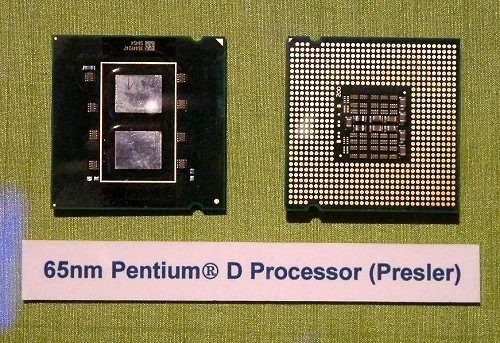
Counterarguments can be made against this ambitious statement. In any case, several chips on one substrate were seen at Intel as early as 2006, when it began producing 65nm Pentium D processors of the Presler family. Later, in 2010, within the Clarkdale family, Intel combined heterogeneous chips on one substrate that were produced using 32nm and 45nm processes, respectively. Finally, the recent collaboration between Intel and AMD to create Kaby Lake-G processors was characterized by the emergence of an AMD discrete graphics solution alongside Intel's own chip on the same substrate. In terms of design diversity, such a hybrid had little competition.
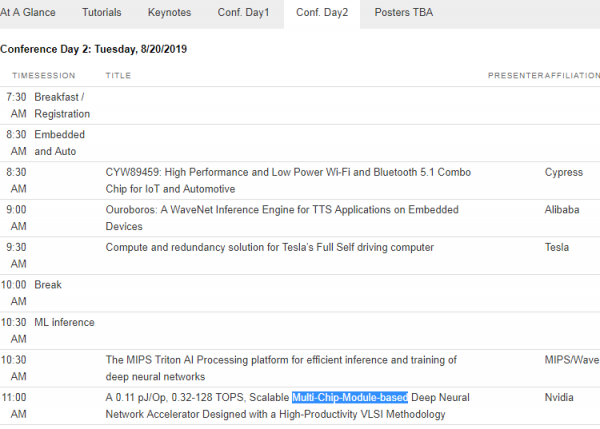
It cannot be said that NVIDIA neglects this idea, although its founder and longstanding leader tries to emphasize at every opportunity how complex and large monolithic chips are. First of all, NVIDIA's research division has a scientific paper comparing monolithic and multi-chip layouts, and the advantage has been acknowledged for the latter. Secondly, at the August conference, NVIDIA, with the support of its partners, will present a prototype neural network accelerator featuring a multi-chip layout.
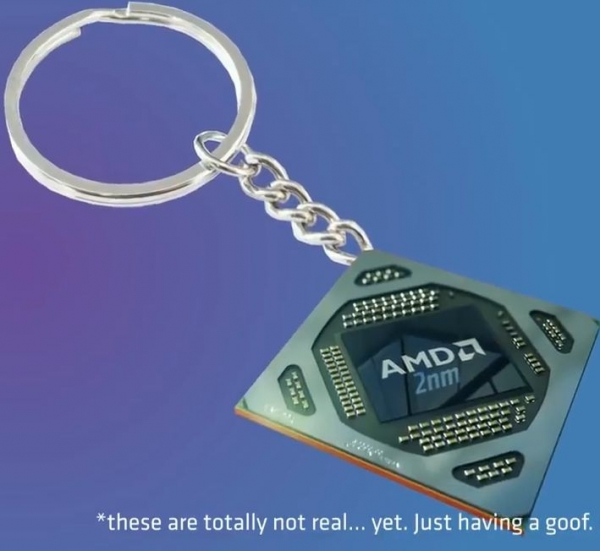
It should be noted that AMD does not dismiss the idea of further progress in mastering advanced technology processes, and before discussing its methods of working with students, it showcased a mock-up of an imagined 2nm graphics processor. This collage demonstration was preceded by a mention of the "30th generation Ryzen processor." Today's youth will work on developing future products, so the company pays special attention to staffing in this area.
Source: 3dnews.ru
