

This article has also been translated into English and published on .
When summer arrives in Chicago, the shores of Lake Michigan transform into a postcard picture. Miles of volleyball nets, bike paths, baseball fields, and sandy beaches. Fluffy white clouds in a high sky. The blue of the lake, adorned with white specks of boats of all shapes and sizes, accompanied by colorful lights, cheerful music, and happy vacationers. And in August, for three days, the entire shoreline becomes a stage for the Air and Water Show.
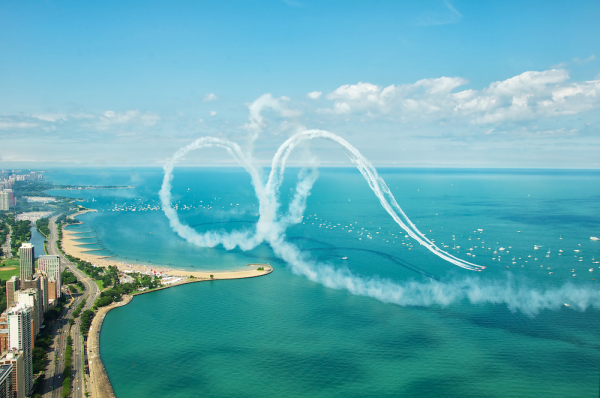
As if that weren't enough, every week from Memorial Day to Labor Day, Navy Pier hosts fireworks. On one of those wonderful summer evenings, we were aboard our friend's boat. It was a Saturday, and towards the end of the party, he pulled the boat right to the best spot for the fireworks. So, when night fell, exotic multicolored fire flowers exploded around us in all directions.
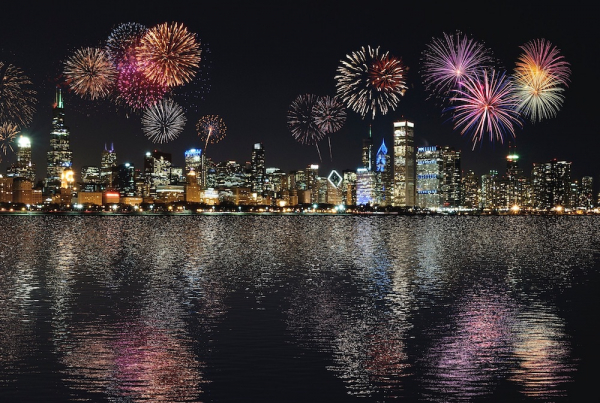
In my slightly tipsy and content brain, the thought occurred that I had seen something like this before.
The Big Bang
It all began 13 billion years ago. A burst of colossal energy created space and immediately filled it with radiation and hot, opaque plasma. As the universe expanded and cooled, the fundamental forces separated. After 240,000 years (an instant on a cosmic scale), matter was finally able to capture electrons and form the first neutral atoms—hydrogen and helium.
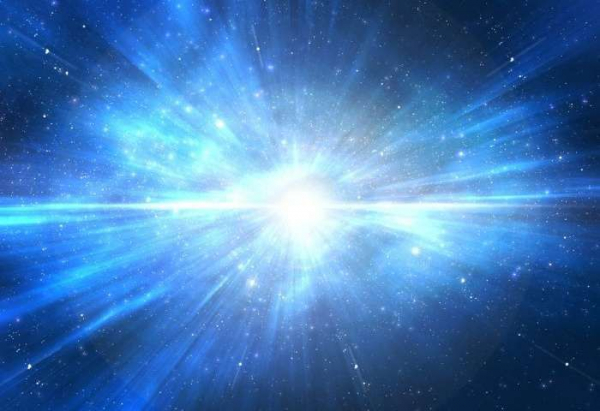
For a time, the cosmos became transparent, allowing photons to freely scatter in all directions, which they took full advantage of. Hydrogen and helium had formed, but stars had not yet appeared. This period is called the 'Dark Ages' because, for a time, absolutely nothing happened.
The force of gravity gradually gathered gas into clouds. In some places, clumps of gas became compacted so tightly that pressure ignited nuclear fusion. The first stars emerged. Bursting into brilliant flames, the first generation of stars lived a brief but extremely fiery life. Their furious burning rapidly consumed all fuel, and massive blue giants began to explode as supernovae, filling the universe with heavy elements.
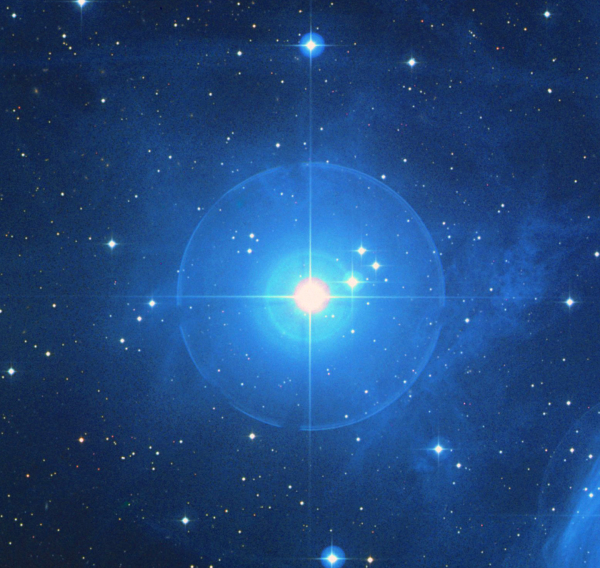
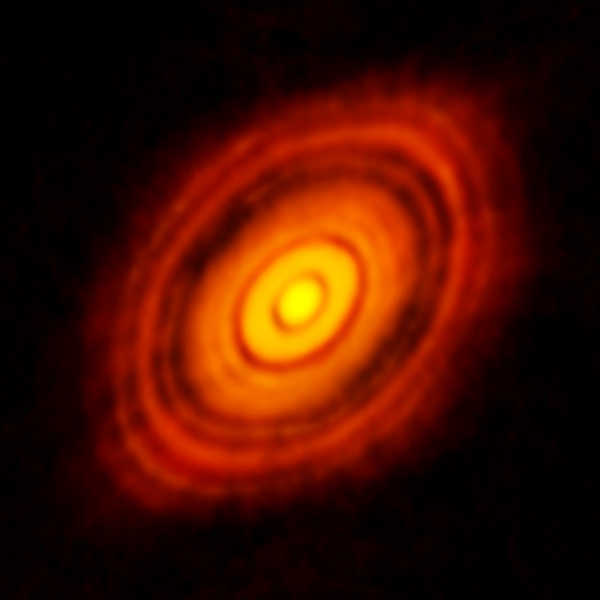
But gravity did not relent. Now it was gathering stardust into galaxies. Waves of compression passed through the rotating giant disks, collecting gas and dust into arms, brightly shining due to the large number of newborn massive stars. Thus, our Sun was born.
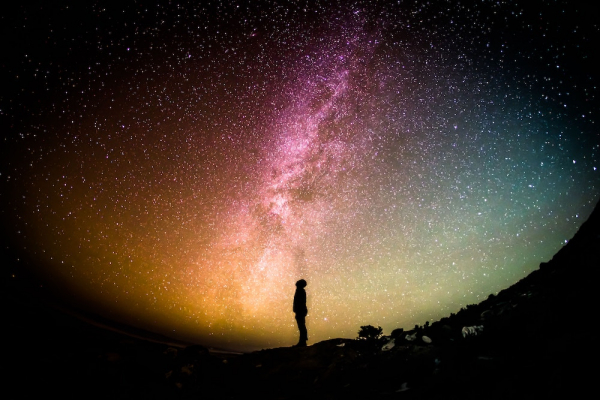
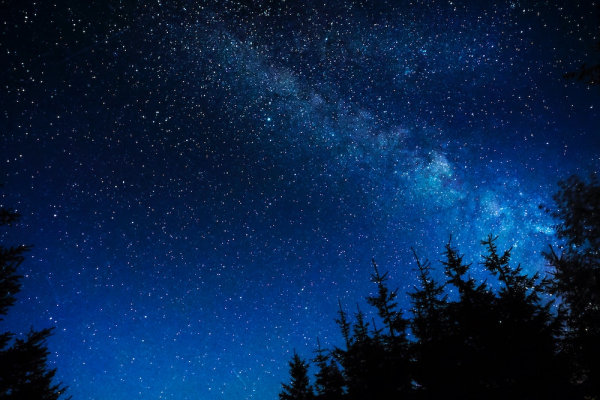
And this is the moment in which we currently live. When the night comes — on a cloudless night, drive away from the city, look at the sky, and for a second imagine that you are inside a firework, and someone has pressed pause on time. Like in slow motion, wherever you look, sparks of burning powder shine. Disks and spheres of galaxies are scattered across the entire field of vision. Clouds and entire curtains of multicolored smoke — nebulas.
If we were to restart the flow of time now, in a few billion years we would see fewer and fewer newborn stars. More and more, there would be burnt-out ashes and dust. And suddenly, unexpectedly, the show is over. A pair of relativistic jets not far away. Wherever you look, like embers in a dying fire, red dwarfs glow dimly. A slightly warm cosmos stretches over infinite distances.
But while the show continued, it was the best show in the Universe! Literally!
Embers of life
Let's rewind our film a bit backwards, to a more interesting time, right after supernovae and neutron stars filled the Universe with heavy elements.
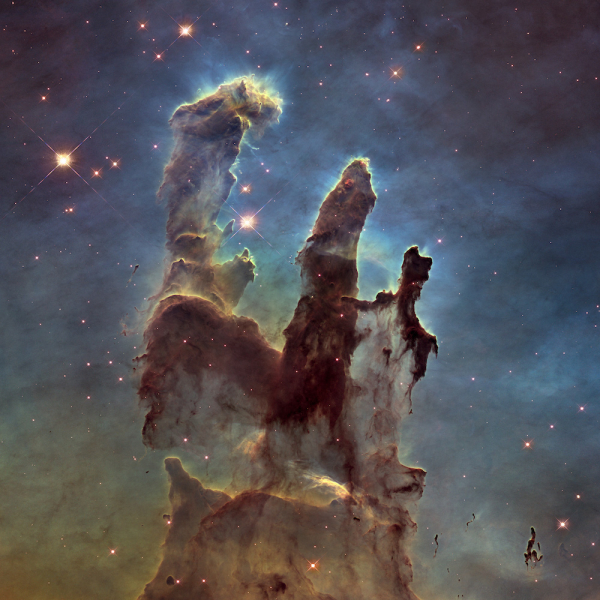
This is the era of the reign of second-generation stars. Thanks to a whole palette of elements in the stellar nurseries, this time we see the birth not just of powerful supergiants. Huge, swirling clouds of gas and dense dust around protostars are now gathering into solid particles, into cobbles, into rocky planets.
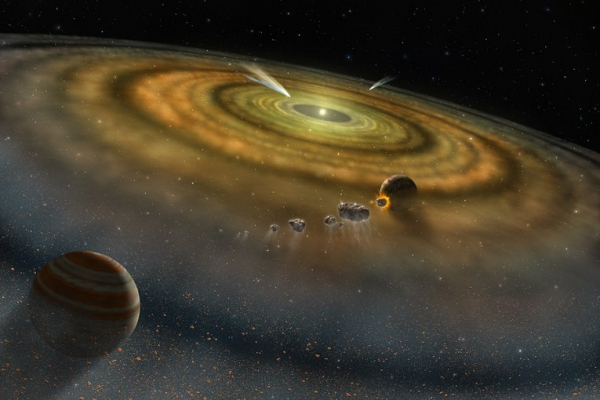
In the early stages of life, such a newborn star system is filled with asteroids flying in all directions. They merge, collide with each other at orbital speeds, creating planets and moons. But wait a couple of hundred million years — and almost everything that could have crossed paths has met; the solar system is as clean as after a major cleanup. A shining, fresh star at the center of the system bathes the surfaces of the planets in warm rays. The magnetic fields generated by the cores and mantles of the planets protect them from harsh radiation. As a result of chemical reactions, complex organic compounds emerge.
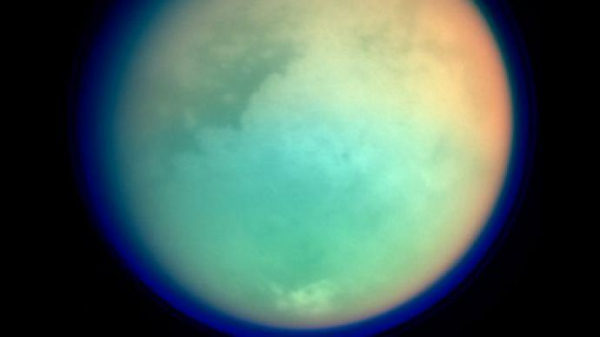
And, in principle, our story could end here. Chemical reactions utilize all available elements. For eternity, the planets will heat up during the day and cool down at night. The change of seasons will evaporate lakes in summer and freeze them in winter. An example of such eternity is found in our Solar System — it's Titan.
But this did not happen on Earth. A self-sustaining chemical reaction once created proto-life, and evolution took over. Soon, the entire planet was covered with living beings.
At first, complex organic elements provided by the non-living nature were essential for supporting life. Life, like a river mill, used the 'low-entropy packets' prepared for it, complex molecules, breaking them down and releasing potential energy. A small initial spark, like the first twigs ignited in a prepared fire, gives rise to a whole fiery storm.
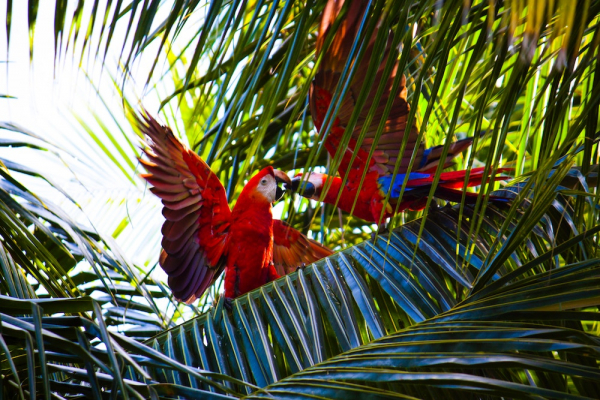
But then plants learned to draw energy directly from the Sun. Complex ecosystems emerged. And the more complex life becomes, the more energy sources it knows how to utilize. The greater the role it begins to play, the more effectively it creates entropy. Each stage of development, each change of energy sources transforms the planet. Next — the star system. And then — the universe itself.
If we had a special telescope capable of detecting life, and we pointed it at our universe, we would witness the birth of humanity. From a smoldering speck, like from a burning splinter, an ever-brightening flame ignites. From a thin layer of bacteria to the Cambrian explosion. From dinosaurs to the Anthropocene.
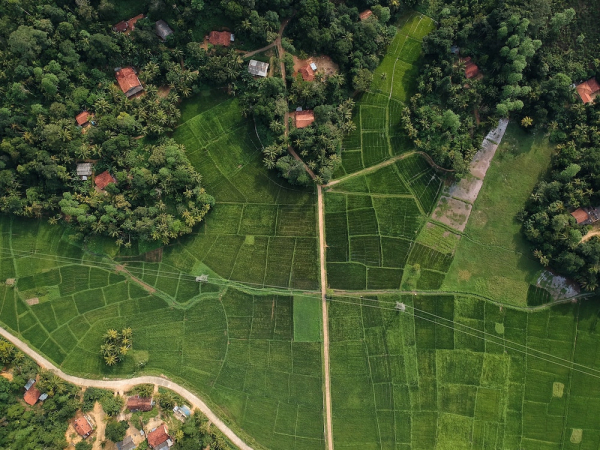
In a firework display the size of the universe, intelligence plays a special role. It ignites its own lights. Intelligence transforms the appearance of the universe with its genius and ingenuity. This is a new kind of firework. A firework of signals in neural networks. A firework of personalities. A firework of complex communities. The universe seems to come alive, awakening and beginning to realize itself.
But in the very beginning, there was a dazzling flash. You and I, and every living being around us. We are all just shining sparks of the firework of the Big Bang.
[1]
[2]
[3]
[4]
[5]
[6] (moon)
[7]
[8]
Source: habr.com
