

You've created your own program or game and now want to sell it worldwide. Most likely, you will need to localize the graphical interface and, ideally, the documentation.
Where to start? How to choose someone to carry out the translation? How will the price be formed? This will be discussed in the article by our technical writer Andrey Starovytov.

Step 1 – determine which languages you will translate into
First, you need to decide which specific markets you want to enter. This will affect the set of languages into which your product needs to be localized. If it's difficult to decide immediately, you can start with English – this language is taught worldwide as a universal means of communication. To expand your presence in Europe, you may also consider the main languages of the Old World – German, French, Spanish, and Italian.
If you plan to enter Asia, you will first need Japanese (many Japanese buyers insist that the product be translated into Japanese), as well as Chinese and Korean.
Step 2 – determine who will do the translation
Once you have determined which languages your documentation needs to be translated into, the next important question arises – who will do it?
There are 3 options – in-house translators, freelancers, and translation companies. Let's consider the pros and cons of each:
1) In-house translators:
Pros:
++ these translators generally have a good understanding of the product; they better understand how to phrase things clearly, where to keep it short, and where to provide details to make the text clearer for the user;
++ you will be sure that the texts are consistently translated by the same person; you can manage the process more effectively – correcting the translator if you feel that something is going wrong. In short, these translations will be of the highest quality.
Cons:
— you need to hire in-house translators, which means a permanent salary, benefits, plus a workspace – it can be very expensive overall.
Conclusion: if you have a large company and constantly have texts to translate, then you need to hire an in-house translator. If not, it’s worth considering other options.
2) Freelance.
If you need to translate a small amount of text (for example, localizing a small mobile game), and you have found a good specialist, this option might suit you better than all the others.
Pros:
++ it will be relatively inexpensive. You pay exactly what you were quoted for the translation.
Cons:
When working with a freelance translator, always keep the following points in mind:
a) If there happens to be a peak load before release and a lot of text needs to be translated quickly—will that be possible for the freelancer?
b) If you like the specialist and you will be contacting them periodically, at some point, feeling in demand, they might significantly raise their prices for services.
c) When working with a freelancer, you need to carefully draft and discuss the contract—prices for translation; deadlines; whether the specialist will correct the text for free if you are not satisfied with the translation, whether any automation translation system will be used, and if so, which one; will you get the translation memory returned if you decide to change specialists.
d) Since freelancers are not very familiar with your product, you will have to provide detailed comments (especially for interface texts)—where each phrase is used, what to translate in the infinitive and what in the imperative, where to be shorter, and where you can be longer, what each term means, and so forth. All of this is essential to ensure the translation is of high quality.
Conclusion: if you need to translate a little and want to save money, it may be worth considering a freelancer—assess the situation.
3) Translation company.
If you have a fairly large volume of text to translate, but with fluctuating peak loads (sometimes a lot, sometimes medium, sometimes little), it might be worth signing a contract with a translation company (I will immediately say that we at Parallels chose this path.)
Pros:
++ Such companies usually have their own staff of translators.
++ You sign a non-disclosure agreement (NDA) in which you clearly specify all points: rights, obligations, prices, deadlines.
++ Most often, the price in the contract is specified for a full range of services. That is, you are assigned a personal manager who will handle only your company. If you need something translated – you send it to them. They, in turn, will prepare the files for the translators (I will explain this in more detail later), decide which translator will take on your order, distribute the workload, gather questions from the translators, communicate your answers to them, and send you the translated files. In short, you send something for translation, and from there, everything will be managed by the translation agency.
Cons:
— Translations through such a company will be more expensive than through a freelancer (although cheaper than through an in-house translator).
— As with freelancers, the agency's translators do not know your product and see phrases/text in isolation from the overall context. Therefore, to obtain a quality translation, you will also need to provide detailed comments with screenshots, grant remote access, create a visual video about the product, and so on.
Step 3 – Choose who will specifically do the translation
Since we work with a translation agency, we pay special attention to this question, but some of the following points can also be used when selecting a freelancer or an in-house translator.
Of course, it's great if someone can personally recommend someone to you. If not, you can find various translation agencies on Google, create a short list, and then make your choice.
When choosing, pay attention to the following:
1) Translation quality
Be sure to ask for a translation of something from your subject area as a test assignment.
Of course, it would be good to have a specialist who can assess the quality of the translation.
In principle, you can assess the quality of the translation into Russian (if you are creating a product in English). Or assess the quality of the translation into English – surely someone among your friends/acquaintances/relatives knows English well.
For other languages (especially Asian ones), you may need to contact an external person. You can try to find someone through acquaintances or social media. It's also worth reaching out to another translation company, but there is one nuance – they might tell you that everything is bad in order to offer their own services.
2) File formats for translation
Determine in advance what format will be convenient for you to send and receive files for translation (xml, xliff, po, etc.) and clarify whether that format is supported by the translation company.
3) Translation deadlines
Check how long the translation will typically take. Of course, everything depends on the volume and complexity of the text, but you should discuss the time frame, for example, 2-4 days.
At the same time, make sure to clarify if it’s possible to speed up the process in case of force majeure, so that there are no situations where you need something translated quickly for an urgent update, and they tell you that according to the contract, it might extend up to 5 days.
4) Minimum word volume for translation
Specify what the minimum word volume for translation should be, at which point the price for localization will be calculated "per word" rather than "per linguistic hour." We will explain more about the "per word" and "per hour" pricing shortly.
5) Price
This is quite a complex question. When you ask for pricing for services, you will certainly receive prices for both new words and for words that fall under various categories – context match, repetitions, low fuzzy, high fuzzy…
We will similarly discuss all these categories, what they mean, how they are assessed, and how the price is calculated in the second part of this article.
In the meantime, try to assess the overall price level based on your financial capabilities and your comfort level working with translators.
Sometimes a low price may indicate that the company is deliberately engaging in a price war, lacking qualified specialists, and consequently providing subpar translations. However, it could also be the case that the company is genuinely working with integrity and is simply trying to establish itself in the translation services market with a low price. Occasionally, companies may have different pricing for various categories of words. For instance, one company may offer translation at $0.23 per word, while another offers it at $0.21. It seems that the second option is cheaper, but its pricing for high fuzzy matches might actually be more expensive than the first one, resulting in the same total cost or even higher (a detailed breakdown of different categories — context match, repetitions, low fuzzy, high fuzzy — will be provided in the second part of the article.)
6) Find out how the company calculates the translation cost
Ask the company to estimate the cost of translating the text you need, and closely examine how the quotation will be structured – the detailed price list.
If you receive a simple, clearly hastily put together Excel table of 2 lines: 'words: a certain quantity and price: a certain amount' – this is a reason to doubt the seriousness of such a company. The fact is that translators primarily use various CAT tools – automated systems that assist in translations. This does not mean they perform machine translation. Such systems allow analyzing your files, determining how many new text fragments need to be translated, what can be borrowed from previous translations (translation memory), how best to translate certain terms, and so on. After such analysis, these systems categorize the text and automatically calculate the final translation price based on the number of words in each category. This approach significantly reduces the risk of human error.
Below is an example of such pricing:
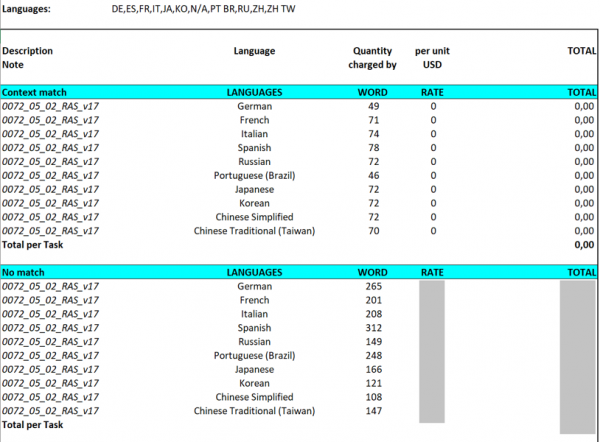
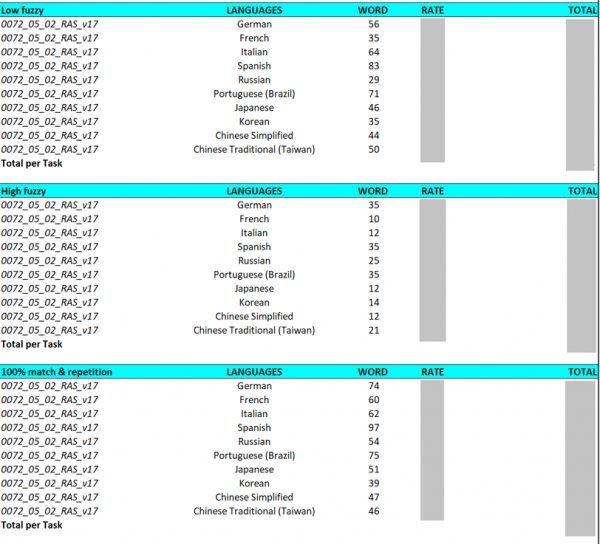
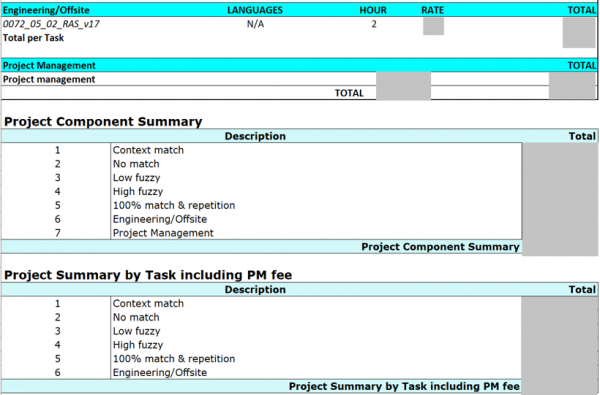
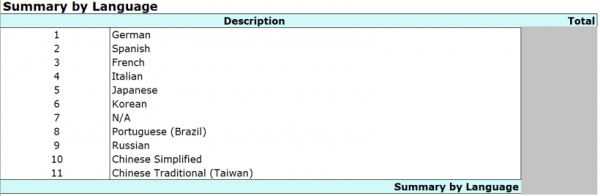
In the next part of the article, we will delve deeper into how to interact with a translation company, what services will incur charges, how the text that needs to be translated will be categorized, and how the final price for translation is calculated.
To be continued…
Source: habr.com
