

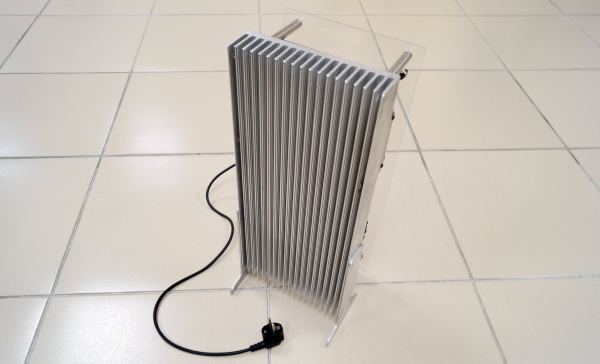
Today, I will tell you about an interesting device. It can heat a room when placed under a window, just like any other electric convection heater. It can also heat "smartly", following any conceivable and inconceivable scenarios. It can easily manage a smart home by itself. You can play on it and (oh, Cosmos!) even work. (beware, there are many large photos below)
From the front, the device looks like a large aluminum radiator of considerable weight. As we approach, peering from above:
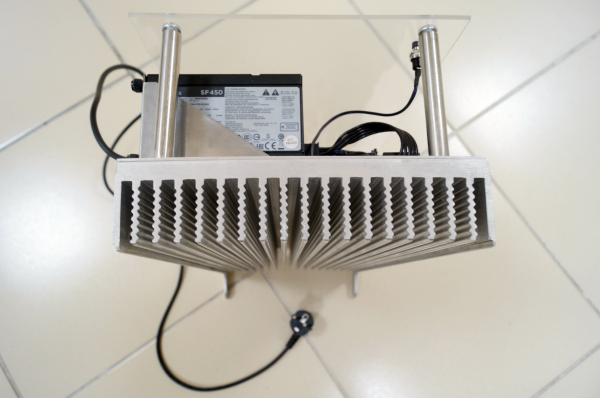
Hmm… it looks like a compact power supply for some computer components. As we walk around the device, what do we see:
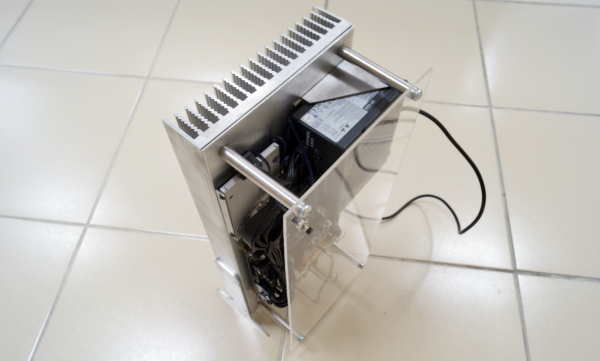
… could this be a computer?..
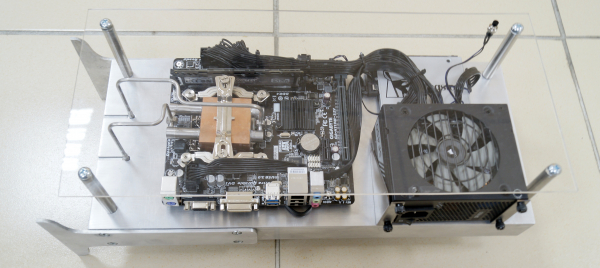
Indeed… a computer. Here's an SFX power supply, an SSD, a motherboard… it even has a power button. And yet, something seems to be missing…
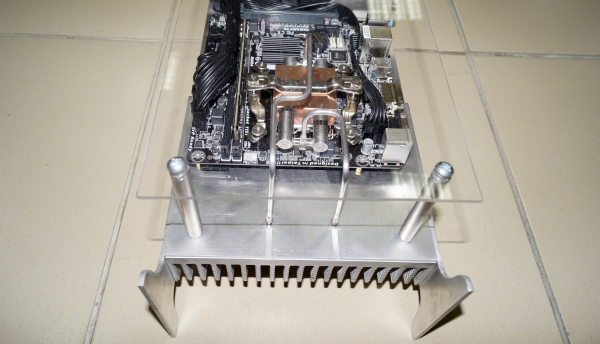
Indeed. There is no cooling fan on the processor. Maybe it has some kind of atom or something similar that doesn't generate heat? No, it's an Intel Core i3 7100. A quite capable processor. But how is this possible? Here’s how:
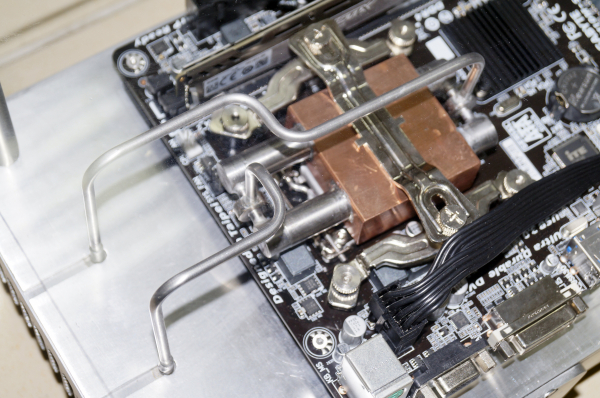
Instead of the standard cooler, heat from the processor is removed using a system of heat pipes and transferred to a large aluminum radiator. All the components of the system are attached to this radiator.
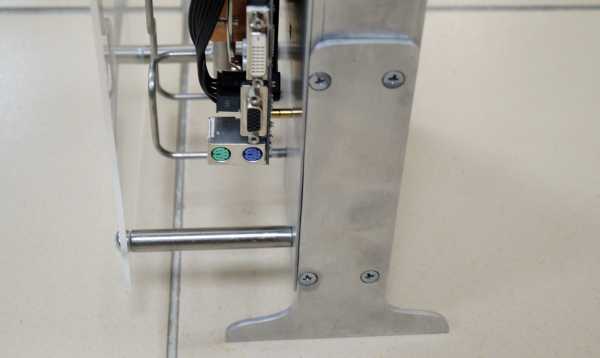
As a result, we have a unique "case" in a steampunk style. It actually looks quite decent on an office desk.
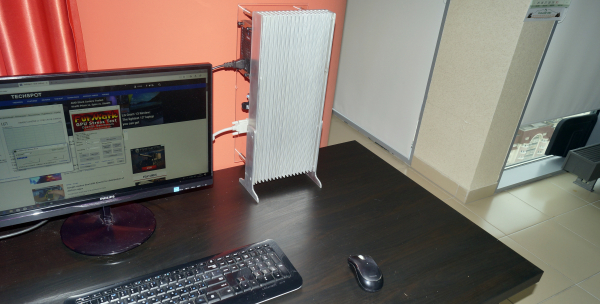
A modern desktop computer assembled from standard components with completely passive, silent cooling of the processor section — a dream for many geeks.
I remember a few years ago I was installing a huge heatsink on a processor that could cool a not-so-hot, mid-range processor without a fan. The case wouldn't close properly, but I was overjoyed by the quiet operation of the resulting system.
With heat pipes, silent systems can achieve new performance limits. The aluminum radiator of the discussed PC, measuring 20*45 cm, can dissipate 120W of heat from the processor. So, using an Intel Core i3 is not the peak capability of the solution in question, since the rated power of this processor is only 51W.
Such cooling systems are now quite rare. The only competitor I know of is the startup Calyos, which for some reason has been overlooked by Habr. They had a very successful campaign on Kickstarter, raising €262,480 against a goal of €150,000. However, it seems that there are currently no noticeable successes in implementing their plans.
The system described here is produced in my hometown of Yekaterinburg and is ready for production. It's far beyond just a bare idea. The goal of this article is to understand whether silent solutions interest the Geektimes audience of Habr. If the topic turns out to be engaging, we will have a lot to discuss in future installments.
Source: habr.com
