


This article is written in addition to at the request of the community.
In this article, we will explore the magic of numbers in decimal numbers. We will consider the numbering not only accepted in GOST (Unified System for Design Documentation), but also in GSP (Unified System for Software Documentation) and CASS (Complex of Standards for Automated Systems), as HARB is mainly composed of IT specialists.
In accordance with the requirements of GOST, GSP, and CASS standards, each product (program, system) must be assigned an identifier — a decimal number.
The designation is assigned in accordance with the rules established in the standards. This was invented by people in ancient times for the unification and simplification of product and documentation identification, accounting, and archiving.
Let's break down the simple procedure for assigning a decimal number so that it does not seem like an ancient ritual, and the assigned numbers are not magical figures.
For each set of standards, we will consider the order of actions separately.
Unified System for Design Documentation
In GOST, the system for designating products and their design documents is established by .
Each product is assigned its unique designation.
The designation of a product can be assigned in two ways:
- centralized – within the framework of a procedure defined by the ministry, department, or industry;
- decentralized – according to the rules adopted in the developing organization.
The structure of the product designation and the main design document is shown in Figure 1.
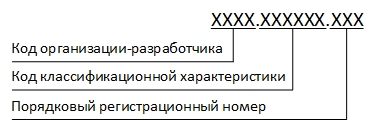 |
| Fig.1 – Structure of Product Designation |
The code of the developing organization for design documentation is a four-digit letter code, consisting of letters such as ABVG, assigned according to the Codifier of developing organizations.
To obtain a four-digit letter code, the developing organization must contact . It should be noted that this service is paid. For example: The enterprise NVP "Bolid" has a four-digit letter code of the developing organization "ACDR", JSC "Bastion" — "FIASH«.
For civil-use products, it is acceptable to use a code from the All-Russian Classifier of Enterprises and Organizations () of the developing enterprise instead of a four-digit alphanumeric code. The OKPO code (an eight- or ten-digit number) is a mandatory attribute for any organization and changes only when the enterprise shifts its direction and type of activity; otherwise, it remains constant for the entire duration of the company's existence.
The classification characteristic code is assigned to the product and design documentation according to the classifier of products and design documents in machine engineering and instrumentation (the ESKD Classifier). In the Russian Federation, there is the 'All-Russian Classifier of Products and Design Documents', , which is a systematic collection of names of classification groupings of objects classified — products of primary and auxiliary production across all sectors of the economy, technical documents, and their codes, and is a component of the Unified System for Classification and Coding of Technical and Economic Information.
The classification characteristic is the main part of the product designation and its design documentation. The classification characteristic code is assigned according to the ESKD Classifier and consists of a six-digit number that sequentially denotes the class (the first two digits), subclass, group, subgroup, and type (one digit each). The ESKD Classifier is constructed using a hierarchical decimal method, based on a logical transition from general to specific within the classified set.
The structure of the classification characteristic code designation is as follows:
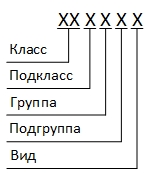 |
| Fig.2 – Structure of the classification characteristic code |
The classifier is accompanied by detailed recommendations for searching and determining the classification characteristic code of the product.
For example, it is necessary to determine the classification characteristic code for a single-channel power supply unit with an input voltage of 220V AC at a frequency of 50Hz, with an output stabilized voltage of 12V DC and an active power of 60W.
First, you need to determine the class number in the class and subclass grid based on the product name.
In this case, the class is suitable. 43XXXX "Microchips, semiconductor devices, vacuum devices, piezoelectric devices, quantum electronics, resistors, connectors, power converters, secondary power supply means".
You should also select the subclass. 436XXX "Systems and sources of secondary power supply".
Based on the grid of groups, subgroups, and types, you need to determine the group in the selected subclass, relying on the characteristics of the device being developed: 4362XX "Single-channel secondary power supply sources with single-phase AC input voltage", subgroup: 43623X "With regulated DC output voltage and output parameters" and type: 436234 "With a power of more than 10 watts up to 100 inclusive, voltage up to 100 inclusive".
Thus, the classification characteristic code for a single-channel power supply unit with an AC input voltage of 220V at a frequency of 50Hz with a regulated DC output voltage of 12V and an active power of 60W will be: 436234.
The serial registration number is assigned according to the classification characteristic from 001 to 999 within the developer organization's code under decentralized assignment of designations, and in centralized assignment — within the code of the organization designated for centralized assignment.
For example, this number can be the sequential number in the product designation accounting card. The form and procedure for maintaining the product designation accounting card are established in GOST 2.201-80.
Thus, for the considered example of selecting a classification characteristic, the product designation may look as follows:
The designation of a non-primary design document must consist of the product designation and the document code established by the standards of the Unified System for Design Documentation (ESKD), recorded next to the product designations without a space, assigned according to Table 3. GOST 2.102-2013 "Types and Completeness of Design Documents".
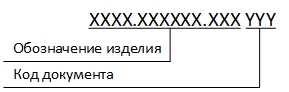 |
| Fig.3 – Designation of a Non-Primary Design Document |
For example, the electrical schematic diagram: FIAШ.436234.610E3
Designation of product executions and documents when performing design documents in a group and basic method involves adding a serial execution number to the product designation through a hyphen. In the group method of document execution, one execution is conditionally taken as the main one. This execution should only have a base designation without a serial number, for example, ACDR.436234.255. For other executions, the serial execution number from 01 to 98 is added to the base designation. For example: ACDR.436234.255-05
It is permitted to designate executions by adding three-digit serial numbers from 001 to 999.
In the case of a large nomenclature of products with common design characteristics, it is allowed to use an additional execution number, which is recorded through a dot and must be in the form of a two-digit number, except for 00. The structure of such designation is shown in Figure 4.
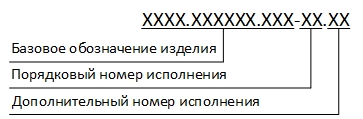 |
| Figure 4 – Application of the execution number and the additional execution number |
Executions using an additional number are designated when there are variable characteristics (coatings, parameters, their limit deviations, climatic working conditions, additional equipment of the product with component parts, etc.), which are possible for all executions.
The additional execution number must be in the form of a two-digit number, except for 00. The number or each of its digits can denote one characteristic or a set of interrelated characteristics.
Newly developed component parts of these products, depending on the same characteristics, are designated using the same additional execution number. If necessary, such parts can be designated without using the additional execution number.
When an additional number is present, all executions should be designated using a two-digit serial execution number from 01 to 98.
Serial and additional execution numbers are established independently of each other.
At the stage of developing the sketch project, it is recommended to designate the sketches and design documents according to the following structure:
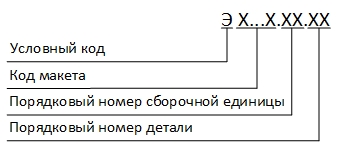 |
| Figure 5 – Designation of sketch design documents |
Unified system of software documentation
Designations of programs and software documents are assigned according to the guidelines .
The designation of programs and documents must consist of groups of characters separated by periods (after the country code and the code of the developing organization), spaces (after the document edition number and document type code), and hyphens (after the registration number and the document number of that type).
A registration system for designating programs and software documents is established.
Like in GOST, in GSP It is stipulated that the designation of the product is simultaneously the designation of its software document – the specification.
The structure of the program designation and its software document – the specification is shown in Figure 6.
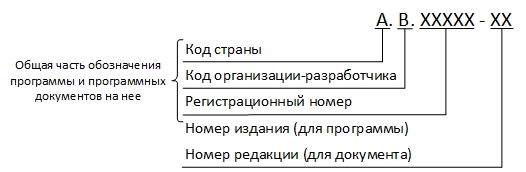 |
| Fig. 6 – Structure of program designations |
The country code is assigned according to the guidelines , with the choice of encoding (Latin, Cyrillic, or numeric code) being made by the developer in accordance with the rules adopted at the enterprise. A four-digit letter code or OKPO code may be used as the code for the developing organization.
GOST 19.103 states that the program registration number should be assigned in accordance with the All-Union classifier of programs; however, this has not been published, so it is permissible to assign such a code from 00001 to 99999 according to the order established at the developing enterprise.
In some cases, the general Russian classifier of products by types of economic activities is used to form the program registration number .
The edition number of the program must be formatted from 01 to 99.
Example of a program designation:
- using the developer organization code of four letters:
- ROF.ABCD.62.01.29-01
- 643.ABCD.62.01.29-01
- using the OKPO code:
- ROF.98765432.62.01.29-01
- RU.98765432.62.01.29-01
- RUS.98765432.62.01.29-01
- 643.98765432.62.01.29-01
The structure of designating other software documents is shown in Figure 7:
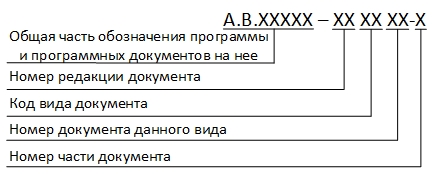 |
| Fig. 7 – Structure of designating other software documents |
The edition number of the document must be formatted from 01 to 99. The document type code is assigned according to Table 4 . If necessary, the document is assigned a sequential number of this type ranging from 01 to 99, and the part number of the document in ascending order from 1 to 9.
Examples of designating the document "Operator's Guide" (the second such document for this program, part 3):
- РОФ.АБВГ.62.01.29-01 34 02-3
- 643.АБВГ.62.01.29-01 34 02-3
- РОФ.98765432.62.01.29-01 34 02-3
- RU.98765432.62.01.29-01 34 02-3
- RUS.98765432.62.01.29-01 34 02-3
- 643.98765432.62.01.29-01 34 02-3
The final version of the designation system for programs and software documents must be defined by the developing organization in internal regulatory documents.
Set of standards for automated systems
The formation of the decimal number of the automated system should be found in .
In accordance with the GOST, each developed document should be assigned an independent designation. A document presented on different data carriers must have a single designation. The letter "M" is added to the designations of documents executed on machine carriers.
The designation of the document has the following structure:
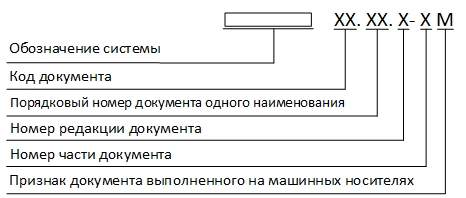 |
| Fig. 8 – Structure of designating documents for automated systems |
The structure for designating an automated system or its part is as follows:
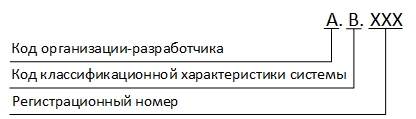 |
| Fig. 9 – Structure of designating an automated system or its part |
The choice of the code for the developing organization proposed by GOST should be made according to the all-union classifier of enterprises, institutions, and organizations (OKPO) following the rules established by industry standards. Currently, it is necessary to use the all-Russian classifier – OKPO, not the outdated all-union document. As the code for the developing organization, a four-letter code from FGUП "STANDARDINFORM" is also acceptable.
The classification code of the system should be selected from , which replaced the all-union product classification mentioned in GOST 34.201-89, as well as the abolished all-Russian product classifier (OKP) effective from January 1, 2017.
It should be noted that the classification code from OKPD2 can be selected based on the name of the automation object, for example: 26.51.43.120 – information and electrical measuring systems, measurement and computing complexes, and installations for measuring electrical and magnetic quantities (for instance, an automated information and measuring system for the commercial accounting of electricity (AIIS KUE)), 70.22.17 – business process management services (BPM ASU); 26.20.40.140 – means of information protection, as well as information and telecommunications systems protected using information protection means (information internet portals).
GOST 34.201-89 also suggests using the all-union classifier of subsystems and task complexes of automated control systems (OKPKZ) for assigning the specified characteristics. This classifier has ceased to be effective in the Russian Federation, and no replacement has been developed. Therefore, there is currently no alternative to choosing the classification characteristics of the automated system according to OKPD2.
The ordinal registration number of the system (part of the system) is assigned by the service of the developer organization responsible for maintaining the registry and accounting for designations. Registration numbers are assigned from 001 to 999 for each classification code.
The document code consists of two alphanumeric characters and is separated from the system designation by a dot. The code for documents defined by this standard is applied according to column 3 of table 2. The code for additional documents is formed as follows: the first character is a letter denoting the type of document according to table 1, the second character is a digit or letter indicating the ordinal number of this type of document.
Other items are included in the document designation if necessary.
Sequential numbers for documents of the same name (2 digits) are assigned starting from the second one, separated from the previous designation by a dot.
The edition number of the document is assigned starting from the second one, in ascending order from 2 to 9, separated from the previous value by a dot. The next edition number is assigned if the previous edition is preserved (not canceled).
The part number of the document is separated from the previous designation by a hyphen. If the document consists of one part, no hyphen is used, and the part number of the document is not assigned.
The designation of a document executed on machine carriers is introduced if necessary. The letter 'M' is separated from the previous designation by a dot.
Thus, the designation AIIS KUE may look like this:
- 98765432.26.51.43.120.012
- ABCDEF.26.51.43.120.012
Example of the designation for the document 'Technological Instruction' (the third document of this type, second edition, part 5, created in electronic form):
- 98765432.26.51.43.120.012.I2.03.02.05M
- ABCDEF.26.51.43.120.012.I2.03.02.05M
Structural schema of the complex of technical means (the only document of this type within the project, the only edition, in one part, issued on paper):
- 98765432.26.51.43.120.012.S1
- ABCDEF.26.51.43.120.012.S1
Conclusion
It is allowed to use a unique identification system that is accepted in the development organization. However, note that without special explanations, this system will be unclear to anyone. The described system for assigning designations to products and documents according to standards can be deciphered by any specialist (designer, developer, programmer).
The following sources were also used in writing the article:
Source: habr.com
