

The entire history of humanity is a series of attempts to dismantle the old order of things and build a new, certainly better one. (Anonymous Author)
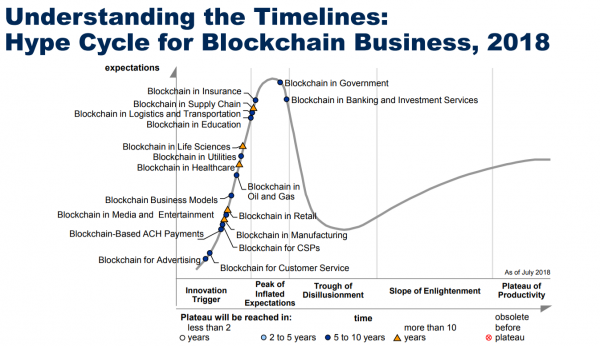
In the previous article we examined the technologies that underlie all blockchains. It's time to understand what tasks modern blockchains can solve. First, let’s look at the analytics of the current state of blockchain and its future prospects. As a technical specialist, I appreciate Gartner with its numerous technology maturity cycles (Hype Cycles). The graph shows the maturity cycle of blockchain in business as of the end of 2018. What conclusions can be drawn?
Analytics from Gartner
- The graph shows that many modern industries are trying to apply blockchain to solve their production tasks, and new industries emerge every year that start exploring blockchain.
- However, not a single industry has yet reached either the productivity plateau or even the slope of enlightenment.
- Of course, not all industries that are currently on the way to the peak of expectations will reach the productivity plateau, but judging by the scale of the movement, in 5-10 years we will witness the widespread use of a number of cases.
- And where are Bitcoin, mining, and cryptocurrency in general, you may ask? These technologies do bring significant profit? They were on last year's graphs, but this year they have already left the productivity plateau within their designated 10 years.
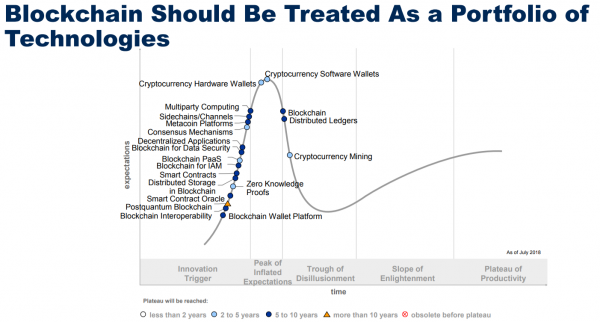
The next graph shows the maturity of blockchain technologies:
What can be said about this graph?
- Most modern blockchain technologies are also on the wave of discussion. But not because they are new technologies, but because industries are exploring their applicability to their data structure, volume, and processing speed, looking for ways to increase efficiency and reduce costs with blockchain technologies.
- Interest in cryptocurrency mining, classic blockchain, and, in general, distributed ledger technology is starting to decline.
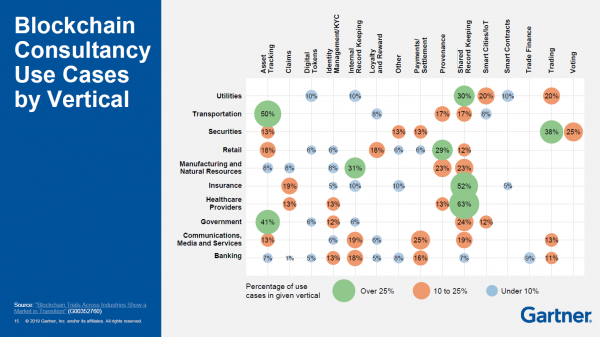
Now let's look at the cases for which industries are trying to apply blockchain. In late 2018, Gartner conducted a study and presented its results in the form of a matrix, where cases are listed horizontally, industries vertically, and the circles at the intersections show how in-demand a particular case is in a given industry:
What conclusions can be drawn from this table?
- Most projects use blockchain for recording, distributing, and sharing data (Shared Record Keeping and Internal Record Keeping).
- A significant portion of projects use blockchain to track the movement of value or changes in ownership (Asset Tracking).
- Identification (Identity Management) is gradually becoming necessary in almost all industries.
- Currently, tokenization (Digital Tokens) is not particularly in demand, and surprisingly, the same can be said for smart contracts (Smart Contracts).
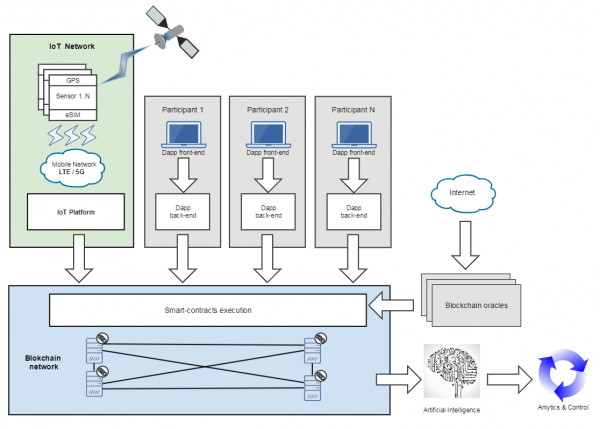
Generalized blockchain scheme
When drawing a blockchain relevant to any industry, all diagrams are fundamentally the same: there is a blockchain network, in which participants record and read information using Dapp (decentralized application). The differences lie in the details; for example, information in the blockchain can be recorded not only by people but also by IoT (Internet of Things) devices. Let's consider a generalized scheme using the IoT example, as it is one of the most discussed applications of blockchain. Additionally, we will equip IoT devices with a SIM card for data transmission, using a mobile network from a telecom operator, or better yet eSIM, so that arbitrary mobile networks can be utilized. The mobile network will, of course, be 5G, as servicing IoT devices is one of the primary applications of 5G networks. GPS/GLONASS modules can track locations. For smart contracts to function properly, it is essential to have information from external sources, such as current stock or currency rates. For this, so-called blockchain oracles are used. The final touch is an artificial intelligence module for data analysis. , that AI (Artificial Intelligence) algorithms will work effectively on data from the blockchain, as they are complete, consistent, and unambiguously time-stamped.
Thus, we have obtained a generalized scheme for blockchain projects. Now, any title can be added to it, making the scheme suitable for various industries. For example, "Tracking the Movement of Tankers for the Oil Industry" or "Manufacturing Parts for the Automotive Sector" or "Supply of Farm Meat to Retail Stores."
Blockchain + IoT + 5G + GPS + AI
Let's move on to specific cases.
Case Analysis
Let's select cases for the mentioned industries and consider which blockchains they can be implemented on. It turns out that we don't need to search for anything, as there exists a relevant "" with examples and links. It includes cases of blockchain applications in the following industries:
- automotive industry
- public sector
- mining sector
- healthcare
- culture and art
- real estate
- manufacturing
- retail
- agriculture
- telecom
- transportation
- financial sector
- energy sector
- copyright management
Conclusions from the Case Set Analysis
- Of course, blockchain fits well with fintech, as transactions and the transfer of ownership of assets are the foundation of the financial system.
- Blockchain is logically applicable in cases involving "supply chains," such as container transportation. A container is seen as an asset that is transferred from one transport company to another. Or, for example, the labeling of food products and tracking the entire supply chain from the farm to retail stores. In this case, the buyer can be assured that the product was produced by a specific manufacturer under specific conditions. Currently, such information on labels can only be taken at face value.
- A relevant case of identity management (IAM) and the storage of personal data. With the advent of blockchain, a solution has emerged based on storing personal data in a distributed ledger, and using the Zero Knowledge Proof protocol, individuals can decide which data to share with whom. For instance, a classic example is confirming that a citizen is over 18 years old. Currently, a passport or driver's license is used for this purpose, which includes data unrelated to the verification itself, such as residency. With blockchain, it will be possible to verify that a person is 18 without disclosing other information.
- In this same context lies the case of recording patients' medical data on the blockchain, allowing for its transfer between institutions without violating confidentiality. This is a common feature of many cases, where, on one hand, there is a need for the identification of individuals and unhindered information dissemination, and on the other, it is essential to protect (encrypt) personal and private data.
Blockchain and Government
In many countries, there are government programs aimed at blockchain development. This is also true in Russia, in which blockchain (distributed ledger) is considered one of the development directions. For the government, the development of blockchain is relevant in the following areas:
- Creation of registries for property transactions, for example, real estate;
- Creation of registries for recording civil status acts, such as registrations of births, marriages, and divorces;
- Recording the results of elections and voting in the blockchain.
Blockchain and Telecom
Cases implemented in the telecom industry will impact the majority of people. the most relevant application of blockchain for telecom operators is to solve the following tasks:
- Operators can eliminate intermediaries (clearinghouses) in providing roaming services and make payments directly to each other.
- Identification of individuals and IoT devices.
- Automatic counting of service level agreement (SLA) violations based on smart contracts and payment of compensations.
- Maintaining a distributed database of stolen phones.
- Managing a distributed database for MNP (Mobile Number Portability) and eliminating the intermediary in the form of a centralized database.
Blockchain analysis
For the purpose of systematization, I attempted to find a classification of blockchains by generations. I didn’t find a universally accepted one, but everyone agrees that the first generation is Bitcoin, the second is Ethereum, and everything beyond that depends on personal preferences. I think the following classification makes sense:
- First generation (Bitcoin): supports only the functionality of transferring cryptocurrency from one account to another.
- The second generation added smart contracts (Ethereum) and multi-currency support (BitShares).
- The third generation allows for operations not only with cryptocurrency but also with any digital assets, implementing arbitrary business logic and flexibly configuring the consensus algorithm. An example of a universal blockchain is Hyperledger Fabric.
Let’s also consider representatives of all generations in terms of the characteristics that will help understand which cases can be implemented on each blockchain:
Bitcoin
Ethereum
Bitshares
Hyperledger Fabric
Exonum
Blockchain generation
1
2
2
3
3
Website
Performance in TPS
7
20-30
10,000
1000
10,000
Is it possible to create a private blockchain
none
none
yes
yes
yes
Number of nodes in the network
More than 10,000
More than 10,000
Effectively 20-30 nodes
Efficiency is determined by the Apache Kafka system
Efficiency is determined by BFT consensus: 10-20 nodes
Average transaction fee
0.5$
0.1$
less than in Ethereum
none
none
Supported operating systems for nodes
Windows, Linux, MacOS
Windows, Linux, MacOS, Raspberry Pi
Ubuntu, Windows
Windows, Linux, MacOS
Linux, MacOS
Node deployment
Manually
Manually, Docker
Manually
Docker, docker-compose
Manually, Docker
Consensus
PoW
Pow
DPoS
Voting system, uses Apache Kafka
BFT
Smart contract
Not in the conventional sense
Programming language Solidity
Pre-installed and their number is limited. Additional coding in C++
Programming languages Go, JS
Rust
Programming language used to write the blockchain
C++
C++
C++
Go
Rust
DB for storing blockchain data
LevelDB
LevelDB
LevelDB
goleveldb — LevelDB in Go
RocksDB
Development and maintenance
Satoshi Nakamoto & Co
Vitalik Buterin & Co
Dan Larimer & Co
The Linux Foundation, IBM, Oracle
Bitfury Group
Limitations when implementing cases
Performance and availability of fees.
Performance and availability of fees. Suitable for pilots and PoCs.
Availability of fees and a limited number of implemented use cases.
Hyperledger Fabric - nothing holds back unless high performance is expected.
Exonum limits BFT consensus and has a high entry threshold, as implementing smart contracts requires them to be embedded into the source code.
Conclusion
Currently, employing any new technology is often presented as a solution to a problem. Therefore, first, it is crucial to confirm if blockchain is indeed needed in this specific case. To do this, answer the questions: is all the mentioned functionality necessary?
- Cryptography
- Immutability and completeness of data history
- Distribution
- Decentralization
- Tokenization
- Smart contracts
If not all listed characteristics are necessary, it may be more efficient to apply technologies other than blockchain. However, if it is decided to use blockchain, one must consider the features of blockchain that, due to its nature, cannot be changed:
- Different blockchains have different technical characteristics and limitations, so depending on the case, one must choose the appropriate blockchain.
- Depending on the consensus, the performance of the blockchain can differ by orders of magnitude. And if a specific blockchain is chosen, it is likely that it cannot be 'optimized'.
- Linear scalability is a common requirement for information systems. Blockchain, however, can scale worse than linearly.
- The data that needs to be stored may have a structure that decreases the efficiency of blockchain application.
- In private blockchains, security must be ensured to be no less than in the used corporate IT systems.
Due to these limitations, blockchain is currently mainly used in the simplest cases where eliminating intermediaries is necessary or where authenticity and immutability of data among participants who are not under a single control is required.
In the next part, we will expand blockchain in the cloud and see how everything works.
This is only the beginning!
Source: habr.com
