

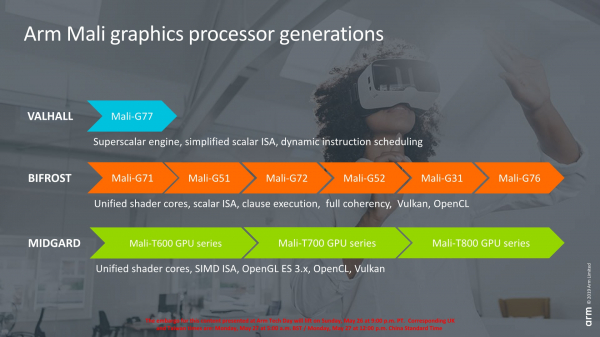
Alongside the new processor core ARM has introduced a graphics processor designed for next-generation mobile SoCs. Mali-G77, which should not be confused with the new display processor , represents a shift from the ARM Bifrost architecture to Valhall.
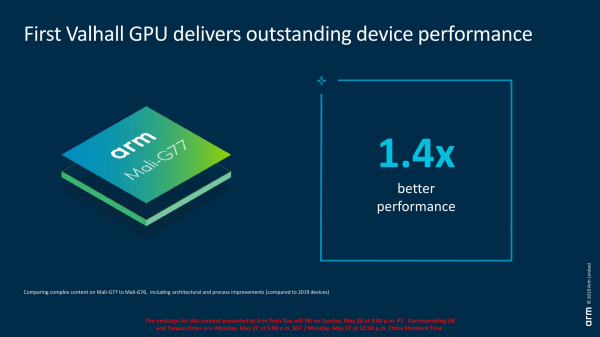
ARM claims a significant increase in graphics performance for Mali-G77, with a 40% boost compared to the current generation Mali-G76. This has been achieved through both the manufacturing process and architectural improvements. Mali-G77 can have between 7 to 16 cores (with the potential for scaling from 1 to 32), with each core nearly the same size as that of G76. Consequently, high-performance smartphones are likely to be equipped with the same number of GPU cores.

In gaming, performance gains can be expected at a level between 20 to 40%, depending on the type of graphical workloads. According to results from the popular Manhattan GFXBench test, the significant advantage of the new graphics processor over the current generation will cause concern for competing company Qualcomm regarding a substantial improvement in Adreno graphics performance.
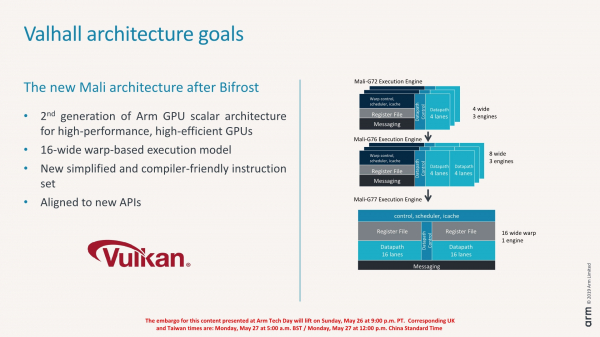
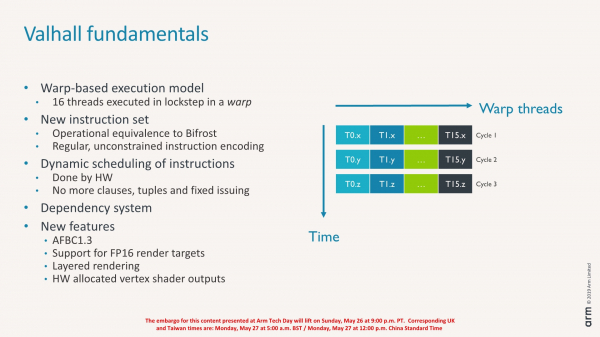
According to ARM, the new Mali-G77 architecture itself ensures an average 30% improvement in energy efficiency or performance. The second generation of the ARM Valhall scalar architecture allows the GPU to execute 16 instructions per cycle on a CU, compared to eight in Bifrost (Mali-G76). Among other innovations are fully hardware-managed dynamic instruction scheduling and an entirely new instruction set, while maintaining backward compatibility with Bifrost. Support for the ARM AFBC1.3 compression format and other features (FP16 render targets, layered rendering, and vertex shader outputs) have also been added.
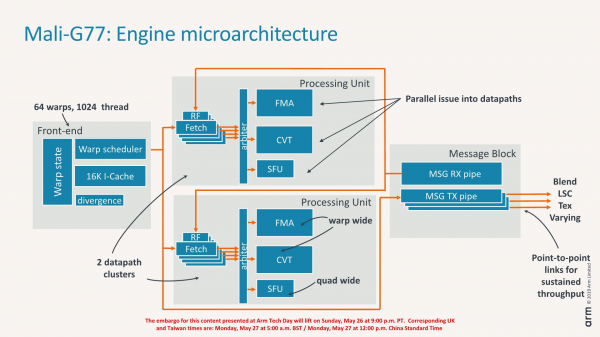
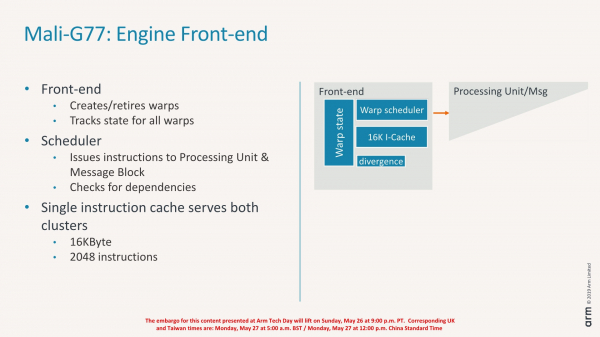
The Bifrost CU contained 3 command execution engines, each including an instruction cache, register, and Warp control block. The distribution across these three engines allowed for the execution of 24 FMA instructions with 32-bit floating point precision (FP32). In Valhall, each CU has only one command execution engine, split between two compute modules capable of processing 16 Warp commands per clock cycle, thus providing a total throughput of 32 FP32 FMA instructions per CU. Due to these architectural changes, in parallel calculations, Mali-G77 can perform one third more mathematical calculations compared to Mali-G76.
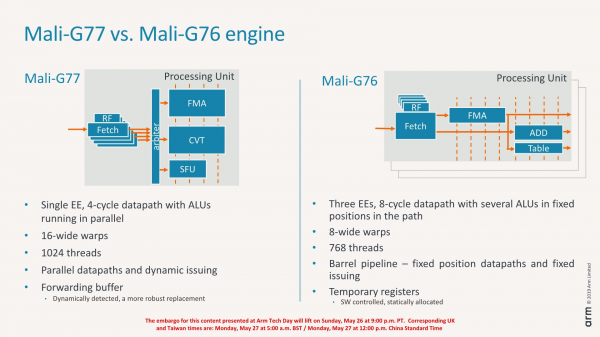
Moreover, each of these CU compute modules contains two new mathematical functional blocks. The new conversion module (CVT) handles basic integer, logical, branching, and conversion instructions. The special functions block (SFU) accelerates integer multiplication, division, square root, logarithms, and other complex integer functions.
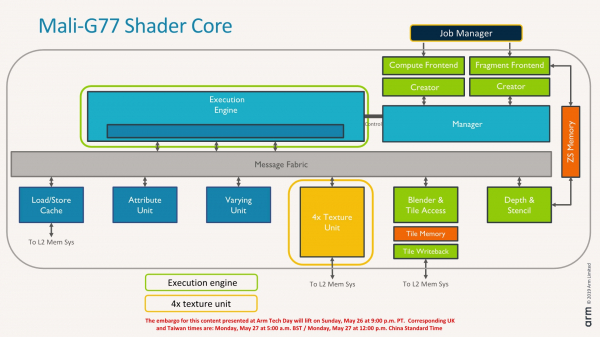
The standard FMA block has several configurations supporting the execution of 16 FP32 instructions per cycle, 32 FP16, or 64 INT8 Dot Product. These optimizations can provide up to a 60% performance increase in machine learning applications.
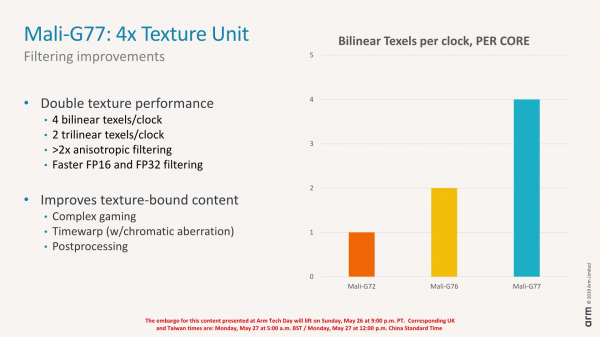
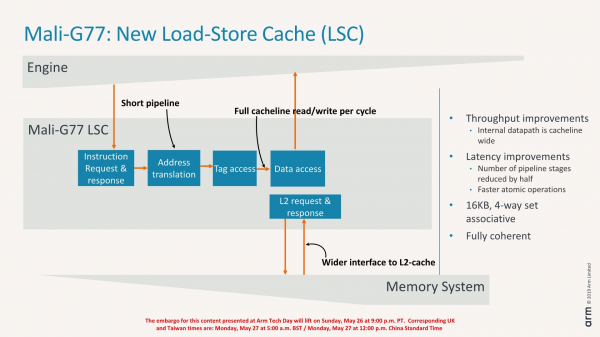
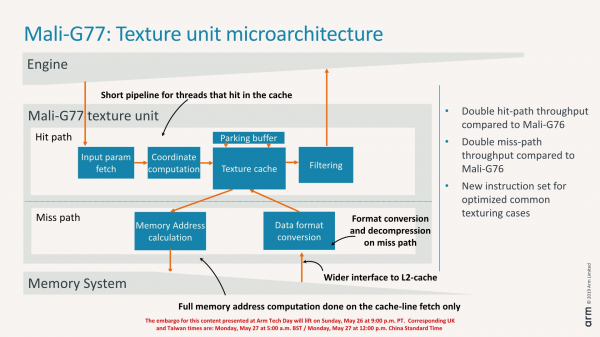
Another key change in Mali-G77 is the doubling of the texture module's performance, which now processes 4 bilinear texels per clock cycle compared to two previously, and 2 trilinear texels per clock cycle, providing faster FP16 and FP32 filtering.
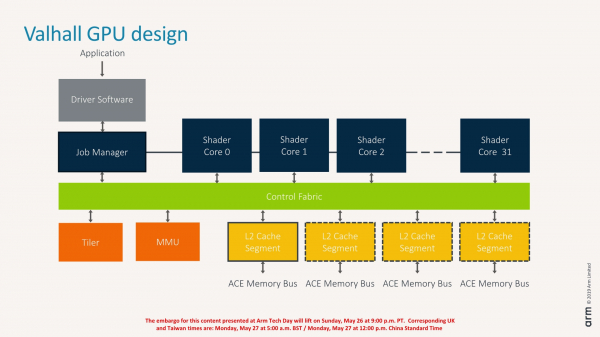
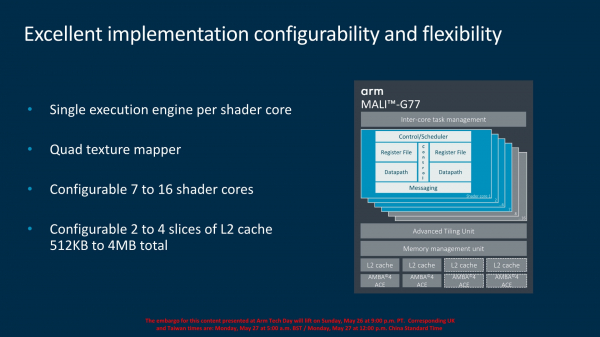
ARM has also made a number of other changes, resulting in Mali-G77 and Valhall promising significant performance improvements for gaming workloads and machine learning tasks. Importantly, power consumption and chip area remain at Bifrost levels, which promises the release of mobile devices with higher peak performance without increasing power consumption, heat dissipation, and size requirements.
Source: 3dnews.ru
