

Moving to work in Australia or Thailand at 25 with no family is not that difficult. There are plenty of such stories. But relocating when you’re almost 40, with a wife and three kids (aged 8, 5, and 2) is a task of a different complexity. Therefore, I want to share my experience of moving to Germany.

There has been a lot said about how to search for jobs abroad, process documents, and move—I won’t repeat that.
So, in 2015, my family and I were living in a rented apartment in St. Petersburg. We spent a long time thinking about how to relocate, what to do about school, available spots in kindergarten, and the rented apartment. We made several important decisions:
- We are going for at least 2 years.
- We will all move at once.
- We will not leave the rented apartment in St. Petersburg (30,000 per month + utilities—quite a reasonable sum).
- We will keep the spots in kindergarten and school for now, just in case.
- We each take one large suitcase and one small bag for every family member.
Over more than ten years of living together, we accumulated so many necessary and unnecessary things in the apartment and on the balcony that it's hard to convey in words. What we could sell in a month, we sold; some things were taken by friends. We had to simply toss away 3/4 of the rest. I don’t regret it at all now, though back then it was incredibly hard to throw it all away (what if we need it?).
We arrived in a three-bedroom apartment that had been prepared for us. There was only a table, 5 chairs, 5 folding beds, a refrigerator, a stove, and a set of dishes and cutlery for 5 people. It's livable.
For the first 1.5 to 2 months, we lived in such Spartan conditions while dealing with paperwork, kindergarten and school applications, contracts for gas, electricity, internet, etc.
School
From practically the first day of being in Germany, your child is required to attend school. This is mandated by law. However, there was a problem: none of our children knew a single word of German at the time of the move. Before relocating, I read that a child without a language might be placed one or even two grades lower. Alternatively, they could be sent to a special integration class for six months to learn the language. At the time of the move, my son was in the second grade, and we thought that he wouldn’t be sent to kindergarten anyway, so dropping down a grade wouldn't be such a big deal. However, he was accepted into the second grade without any downgrading. Moreover, the school principal said that since the child doesn't know any German, one of the teachers will work with him for free! Surprising, isn't it? The teacher would either take him from less important classes (like music, physical education, etc.) or during after-school programs. Additionally, he had two hours of German lessons at home each week with a tutor. After a year, my son became one of the best students in his class in German, among German children, in Germany!
Our primary school is located in a separate building with its own yard. Children are simply sent outside to play during breaks if it's not raining. The yard features a large playground with a sandbox, slides, swings, carousels, a small soccer area, and tables for table tennis. There is also a variety of sports equipment like balls, jump ropes, scooters, etc., which can be used without any issues. If it rains, children can play board games in the classroom, color, craft, or read books in a special corner, relaxing on the couch with pillows. The children really enjoy going to school. I still can't believe it.
On his first day, my son arrived at school in classic trousers, a shirt, and leather loafers (the same attire he wore to school in St. Petersburg, though in St. Petersburg, he also had a tie and vest). The school principal looked at us disheartened and said that it would be uncomfortable for the child to sit in class, let alone play during breaks, and that at a minimum, he needed to bring different, more comfortable shoes, like cloth slippers.
What really stood out about the Russian school was the incredible amount of homework In the first and second grades, my wife would spend 2-3 hours every evening helping our son with his homework because it was simply too much and too difficult for him to handle alone. This isn't because he is not smart; it's just that the amount and complexity are overwhelming. There is a special after-school program where, for 50 minutes, the teacher helps the children with their homework. After that, they go outside to play, and there is almost no homework left to do at home. Sometimes, once a week, the children spend half an hour doing something at home if they didn't finish it in school, and usually, they do it themselves. The main point is: if a child didn't manage to complete all the homework in an hour, it means they were given too much, and the teacher was wrong, so it is essential to inform them to assign less next time. No homework is assigned from Friday to Monday, or during holidays. Children also have the right to rest.
Kindergarten
The situation with kindergartens varies in different places; some people wait for 2-3 years in line to get in, especially in large cities (just like in St. Petersburg). But few know that if your child doesn't attend kindergarten and stays home with mom, she can receive a compensation of 150 euros per month (Betreuungsgeld). In general, kindergartens are paid, costing about 100-300 euros per month (depends on the federal state, city, and the kindergarten itself), with the exception of attending kindergarten for children one year before school — in this case, kindergarten is free (children should socially adapt to school). Since 2018, kindergartens have become free in some German states. We were advised to contact a Catholic kindergarten, as it was located near our home and was significantly better than other kindergartens in the area. But we are Orthodox!? It turned out that Catholic kindergartens and schools are reluctant to accept evangelicals, Protestants, and Muslims, but they are eager to accept Orthodox children, considering us brothers in faith. All that's needed is a baptism certificate. In general, Catholic kindergartens are considered among the best. They receive good funding, but they also cost more. My younger children also do not speak German. The educators said the following about this: don’t even try to teach your child to speak German; you will teach them incorrectly. We will do it ourselves much better than you, and it’s easier than retraining them later; you should teach them Russian at home. Moreover, they bought a Russian-German phrasebook themselves to initially find common ground with the child. I can’t imagine a similar situation with a foreign child who doesn’t speak Russian in a kindergarten in St. Petersburg or Voronezh. By the way, in a group of 20 children, there are usually 2 educators and one assistant working at the same time.
Key differences from our kindergartens:
- Children bring their own breakfast. Usually, it's sandwiches, fruits, and vegetables. Sweets are not allowed.
- The kindergarten operates only until 4 PM. The child must be picked up by that time. If not picked up, there will be overtime payment for the educator and a warning. After three warnings, the kindergarten may terminate the contract with you.
- There are no lessons. Children are not taught to read, write, count, etc. They play, mold, build, and draw – they engage in creative activities. Classes only occur for those children who are going to school next year (but even then, children will not be taught to read or solve problems; these activities focus mainly on overall development).
- The groups are intentionally mixed-age. Children aged 3-6 years are together in one group. Older children help younger ones, while younger ones look up to the older ones. This is not due to a lack of groups or educators. We have three such groups in our kindergarten. There is a separate group for toddlers, specifically for children from one to three years old.
- The child chooses what and when to do activities. Only mealtimes and group activities are scheduled.
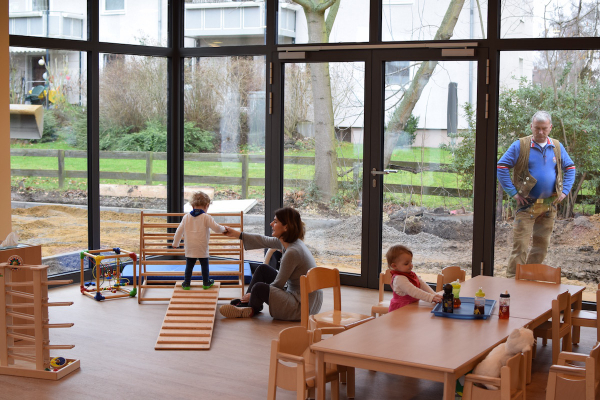
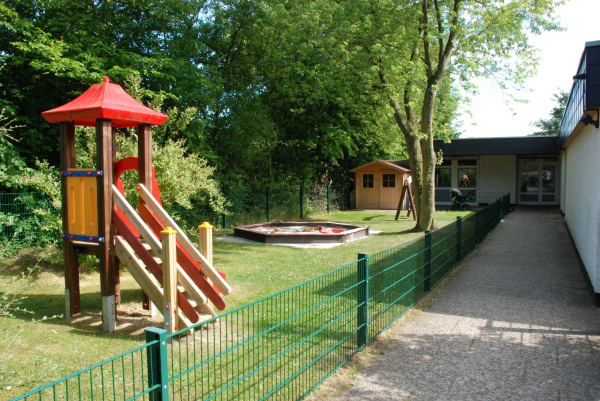
- Children can go outside whenever they want. Each group has its own exit to a fenced outdoor area of the kindergarten, where a caregiver is always present. A child can dress themselves and go out to play anytime. In our group, there is a special board divided into sections: bathroom, creativity, construction corner, sports corner, dolls, yard, etc. When a child goes outside, they take a magnet with their photo and move it to the 'Yard' section. In the summer, parents bring sunscreen, and caregivers apply it to the children to prevent sunburn. Sometimes, large pools are inflated for the children to swim in (for this, we bring swimwear during the summer heat). The yard has slides, swings, a sandbox, scooters, bicycles, and more.This is what our group looks like.


- Caregivers occasionally take the children for walks outside of the kindergarten. For example, a caregiver might take the children to the store to buy fresh rolls for lunch. Can you imagine a caregiver with 15 children in a local grocery store? Neither could I! But now, it's a reality.
- Children often go on trips to various places. For example, to a pastry shop where they knead dough, shape figures, and bake cookies together with the pastry chef. Each child then takes home a large box of cookies. Or to the city fair, where they ride carousels and eat ice cream. Or to the fire station for an excursion. Moreover, no transfer is ordered for this; the children travel by public transport. Such events are paid for by the kindergarten.
Benefits
It may seem strange, but every family officially residing in Germany has the right to receive child benefits. For each child until the age of 18, the government pays 196 euros a month (even to foreigners who came here for work). For three children, as one can easily calculate, we receive 588 euros net in our account each month. Moreover, if a child continues their education at a university at 18, the benefit is paid until they turn 25. Surprising! I didn't know about this before moving! And it's a very good addition to the salary.
Wife
Usually, when moving abroad, wives do not work. There are many reasons for this: lack of language skills, outdated education and qualifications, unwillingness to work for significantly lower pay than their husbands, etc. In Germany, the employment agency can cover language course costs for a spouse who is not working due to lack of language knowledge. As a result, my wife has learned German to a C1 level over these three years and enrolled this year in a local university for applied programming. Fortunately, education is almost free. By the way, she is 35. Prior to this, in St. Petersburg, she obtained a higher education in PR and worked in her field.
Career
It so happened that our first city, where we arrived, turned out to be quite small – with a population of about 150,000 people. I thought this was not a big deal. While we settle in, adapt, gain experience, we would then move on to Stuttgart or Munich. After a year of living in Germany, I started to think about my future career. The current conditions were good, but there's always a desire for better. I began to explore the job market in my city and other cities and realized several initially non-obvious things.
- In the field of system administration and support (my specialization at the time of moving), salaries are lower than in development. There are far fewer job openings, and career and salary growth opportunities are also limited.
- German language. 99% of all job openings require a good level of German. That is, there are about 50 times fewer openings where only English is sufficient than those that require knowledge of German. In smaller cities, job vacancies requiring only English are almost non-existent.
- Rent. The cost of renting in large cities is much higher. For example, a 3-room apartment of 80 sq. m. in (population 1.4 million) will cost between 1400 – 2500 per month, while in (population 200 thousand) it is only 500 – 800 euros per month. However, there is a caveat: it is very difficult to find an apartment for 1400 in Munich. I know a family that lived in a hotel for 3 months before finding any apartment. The fewer the rooms, the higher the demand.
- Salary disparity between large and small cities is only around 20%. For example, the portal gehalt.de lists the salary range for a as €4,052 – €5,062, while for a it is €3,265 – €4,079.
- The job market. As Dmitry wrote in the article , in large cities there is an ‘employer’s market’. But this is true only for large cities. In small cities, there is a ‘worker’s market’. I have been tracking job vacancies in my city for two years. I can say that IT vacancies often remain open for years, not because companies are trying to snag the cream of the crop. No. They simply need normal people who are willing to learn and work. Companies are willing to grow and develop, but they need qualified employees, and there are few of them. They are ready to hire and train employees, and offer good pay in return. In our company, out of 20 developers, 10 were completely trained from scratch by the company through a system of vocational education (). The Java developer vacancy in our company (and in many others) has been open for more than two years consistently.
That’s when I realized there was no point in moving to a big city, nor did I want to at that time. A small cozy town with developed infrastructure. Very clean, green, and safe. The schools and kindergartens are excellent. Everything is nearby. Yes, salaries in Munich are higher, but this difference is often completely eaten up by the higher rent. Additionally, there are issues with kindergartens. Long distances to kindergartens, schools, and workplaces, just like in any large city. The cost of living is higher.
So we decided to stay in the town we initially arrived in. And to have a better income, I decided to change my specialty while already here in Germany. I chose Java development, as it turned out to be the most in-demand and well-paid field, even for beginners. I started with online courses in Java. Then I independently prepared for the certification of Oracle Certified Professional, Java SE 8 Programmer. I took the exams and received the certificate.
For two years, I was also learning German. Starting to learn a new language at almost 40 years old is difficult. Really difficult, plus I always believed that I had no aptitude for languages. I always got threes in school for Russian and literature. But having motivation and regular practice paid off. In the end, I passed the German language exam at the C1 level. In August of this year, I found a new job as a Java developer in German.
Job search in Germany
It’s important to understand that the job search in Germany when you are already here is significantly different from when you are in Russia. Especially when it comes to small towns. All further remarks regarding job searching are solely my personal opinion and experience.
Foreigners. Most companies generally do not consider candidates from other countries or without knowledge of German. Many simply do not know how to process foreigners and what to do with them in general. I think that most employers in Russia also do not know how to process foreigners. And why should they? What could be the motivation? Only if they cannot find a candidate locally under the desired conditions.
The places for job vacancies have been discussed many times.
Here is a list of the most relevant places to look for jobs.
I would like to specifically mention the website of the state employment service: . Surprisingly, there are actually many good job openings there. I even believe that this is the most comprehensive collection of current job vacancies across Germany. Furthermore, the site contains a lot of useful firsthand information on diploma recognition, work permits, benefits, document processing, etc.
The hiring process in Germany
is really a process. In St. Petersburg, I could attend an interview and start working within two days, but here it doesn't work that way (especially in smaller cities). I will share my experience next.
In January 2018, I decided on the company I wanted to work for and began to study the technology stack they used. In early April, I attended a local university job fair for beginners, where a large number of employers from the IT field were represented. It feels quite uncomfortable to be a beginner developer at 40 years old, surrounded by twenty-somethings. There, I met the HR manager of the very company I wanted to join. I briefly told her about myself, my experience, and my plans. The HR manager praised my German and we agreed that I would send her my resume. I sent it. I received a call back a week later, and they said they wanted to invite me for the first interview as soon as possible… in three weeks! Three weeks, Carl?!?
The invitation for the first interview was also sent to me in writing, stating that there would be four people present from the employer's side at the interview: the CEO, the HR director, the IT director, and the system architect. It was a real surprise for me. Usually, you first interview with HR, then with a specialist in the department you are joining, then with the manager, and only then with the director. However, knowledgeable people told me that this is normal for smaller cities. If such a team is present at the first interview, it means the company is basically ready to hire you if everything stated in the resume is true.
The first interview went quite well, as I thought. But the employer took a week to 'think it over'. A week later, I received a call informing me that I successfully passed the first interview and they are ready to invite me for a second technical interview in two weeks. Another two weeks!!!
The second, technical interview, was just a check to see if I matched what was on my resume. After the second interview, there was another week of waiting, and bingo – they liked me, and they are ready to discuss the terms of cooperation. I was scheduled to meet for a discussion of the job details another week later. At the third meeting, they asked me about my desired salary and the date when I could start working. I replied that I could start in 45 days – on August 1. And that's also fine. No one expects you to start tomorrow.
In total, from sending the resume to the official offer initiated by the employer, it took 9 weeks!!! I don't understand what the person who wrote the article was hoping for. , when they thought they would find a job locally in two weeks.
Another non-obvious point. In St. Petersburg, usually, if you are out of work and ready to start a new job tomorrow – that’s a big plus for the employer, because everyone needed someone yesterday. In any case, I haven't encountered it being perceived negatively. When I was hiring staff myself, I also viewed it as normal. In Germany, the opposite is true. If you are out of work, it is a really negative factor that significantly affects the likelihood of being hired. Germans are always interested in gaps in your resume. A break in employment of more than a month between previous jobs raises concerns and questions. Again, I must emphasize that this concerns small towns and work experience in Germany itself. Perhaps, in Berlin, things are different.
Salary
If you are looking for a job while in Germany, you will hardly find any salary information in job postings. Compared to Russia, this seems quite inconvenient. You can spend two months on interviews and correspondence only to find out that the salary level in the company does not meet your expectations at all. So, what to do? You can consider looking for jobs in public institutions. Employment there is paid according to the tariff grid. . Abbreviated TV-L. I am not saying that you should go work in government structures. But this tariff grid is a good benchmark for salaries. Here is the grid for 2018:
| Category | TV-L 11 | TV-L 12 | TV-L 13 | TV-L 14 | TV-L 15 |
|---|---|---|---|---|---|
| 1 (Beginner) | 3.202 € | 3.309 € | 3.672 € | 3.982 € | 4.398 € |
| 2 (After 1 year of employment) | 3.522 € | 3.653 € | 4.075 € | 4.417 € | 4.877€ |
| 3 (After 3 years of employment) | 3.777 € | 4.162 € | 4.293 € | 4.672 € | 5.057 € |
| 4 (After 6 years of employment) | 4.162 € | 4.609 € | 4.715 € | 5.057 € | 5.696 € |
| 5 (After 10 years of employment) | 4.721 € | 5.187 € | 5.299 € | 5.647 € | 6.181 € |
| 6 (After 15 years of employment) | 4.792 € | 5.265 € | 5.378 € | 5.731 € | 6.274 € |
Moreover, previous work experience can also be taken into account. Tariff category TV-L 11 includes regular developers and system administrators. Senior system administrators and senior developers are classified as TV-L 12. If you have a doctoral degree or you are a department head, you can confidently apply for TV-L 13, and if you manage 5 people at TV-L 13, your tariff is TV-L 15. That means a beginner sysadmin or programmer earns €3200 at the entry level, even in public institutions. Commercial companies usually pay 10-20-30% more depending on the requirements for candidates, competition, etc.
UPD: As rightly noted , that is what a sysadmin with experience earns, not a beginner sysadmin.
The tariff grid is indexed every year. For example, since 2010, salaries in this grid have risen by approximately, while inflation during the same period was around. Additionally, a Christmas bonus of about 80% of the monthly salary is often found, even in government companies. I agree, it's not as lucrative as in the USA.
Working Conditions
It is clear that working conditions vary greatly from company to company. However, I want to share what they can be like, based on my own experience.
Working day My schedule is not fixed. This means I can start work anytime between 06:00 and 10:00. I don't need to inform anyone about this. I am required to work 40 hours a week. I can work 5 hours one day and 11 hours another. Everything is simply recorded in the time tracking system with the project name, request number, and hours spent. Lunch breaks are not included in working hours. But I can skip lunch if I want. It's very convenient for me. For three days, I arrive at work by 07:00 while my wife drops off the kids at daycare and school, and I pick them up (she has evening classes). The other two days are the opposite: I drop off the kids and arrive at work by 08:30, and she picks them up. If you work less than 4 hours in a day, you need to notify your supervisor.
Overtime is compensated either with money or time off, at the employer's discretion. More than 80 hours of overtime is only possible with written consent from the supervisor; otherwise, it won't be paid. So, overtime is more of an employee initiative than a supervisor's.
Sick Leave. You can be sick for three days without a doctor's note. You just call the secretary in the morning, and that's it. No need to work remotely during this time. Feel free to rest. Starting from the fourth day, you will need a sick note. Everything is paid in full.
Remote Work is not practiced; everything is done only in the office. This is related, firstly, to commercial confidentiality, and secondly, to GDPR, as we have to deal with personal and commercial data of various companies.
Vacation 28 working days. That's right, working days. If the vacation falls on holidays or weekends, it is extended by their number.
Probation Period is 6 months. If a candidate does not fit for any reason, they must be notified 4 weeks in advance. That means you cannot be fired in one day without working off. More precisely, you can, but with payment for an additional month. Likewise, a candidate cannot leave without a month's notice.
Lunch at Work. Everyone brings their own food or goes out for lunch to a café or restaurant. Coffee, those famous cookies, juices, mineral water, and fruits are unlimited.
This is what our department's refrigerator looks like.
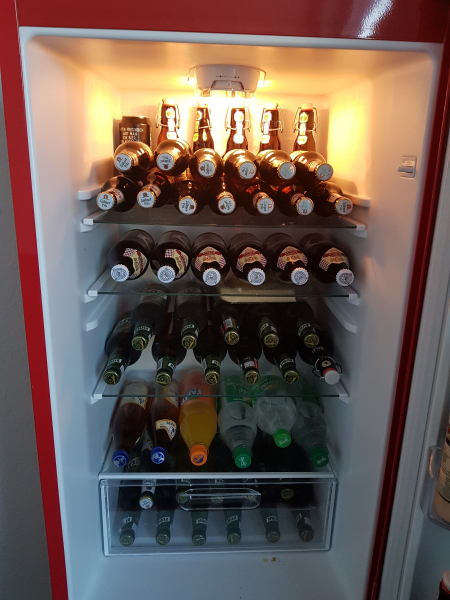
To the right of the refrigerator, there are three more boxes. Beer can be consumed during working hours. All the beer is alcoholic. We don't stock anything else. And no, this is not a joke. That is, if I take a bottle of beer during lunch and drink it—this is normal, albeit unusual. Once a month, after the department meeting at 12:00, the entire department goes out to the balcony for a tasting of different beer varieties.
Bonuses Additional corporate pension provision. Sports. Corporate doctor (Something like a family doctor, but for employees).
A lot has been covered. But there is even more information. If the material is interesting, I can write more. Vote for interesting topics.
UPD: My telegram about life and work in Germany. Brief and to the point.
Only registered users can participate in the survey. , please.
I have more to share
Taxes. How much we pay and what for
Healthcare. For adults and children
Pensions. Yes, foreign nationals can also receive pensions earned in Germany
Citizenship. It is easier for IT specialists to obtain citizenship in Germany than in many other Schengen countries
Renting an apartment
Utilities and communication. Based on my family's experience
Standard of living. So how much is left after paying taxes and all mandatory payments?
Pets
Side jobs
635 users voted. 86 users abstained.
Source: habr.com
