

I love programming – it works wonders. But you know much more about programming than I do.
However, wonders are found not only in programming but also in a rather stagnant and rigid field like accounting. Yes, indeed, in accounting, towards which I have ambivalent feelings: a genuine and strong affection (after all, it is my original profession) and an equally long-standing and passionate dislike (I know things about accounting that you can't even imagine).
This time, let's focus on the positive. Allow me to tell you about a wonderful invention in the field of accounting methodology called the 'depreciation fund.'

I suspect you haven't heard of the depreciation fund, and even if you have heard of it, you probably have no idea what it was used for. You are not alone. It’s unlikely that modern accountants are familiar with it – only those dinosaurs whose work experience exceeds thirty years may know about it. The concept of a depreciation fund disappeared from accounting practice back in 1992, and even before that, its economic significance was largely understood only by higher-level accounting and management tiers, meaning not by all ordinary accountants. Therefore, the removal of the depreciation fund from the Chart of Accounts did not cause a public outcry. I understand, it was a busy time: the social order of a vast state was changing, and the entire legislative framework was being reviewed...
But let’s not jump ahead. Let's get started.
Here are the accounting entries for fixed asset accounting according to the Chart of Accounts from 1985:
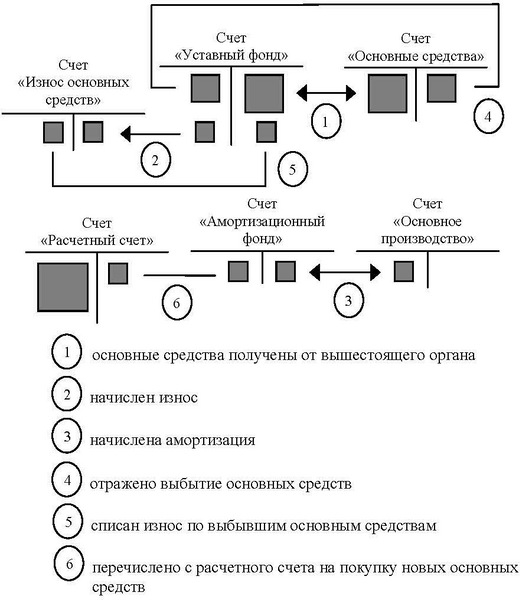
Clearly, accounting entries mean nothing to IT specialists. Therefore, I won't dwell on them but will explain the essence of the matter.
In the past, during the planned economy, state enterprises received fixed assets (that is, means of production, if we use economic terminology) from ministries. The ministries could allocate money for the purchase of fixed assets, but this did not change the essence of the matter.
In the process of operation, fixed assets gradually wore out and became unusable, so enterprises would purchase them again as needed.
Thus, the depreciation fund allowed for the control of fixed asset usage, in the sense that it limited the purchase of fixed assets within the volume initially received from the ministry.
According to the correspondence mentioned above, the balance on the involved accounts indicated the following:
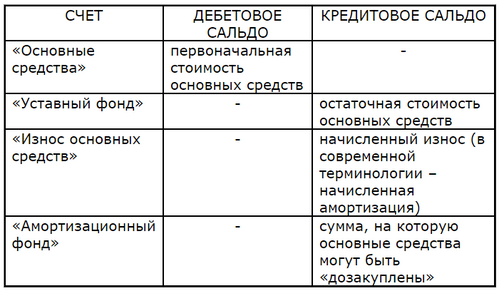
It accounted for everything that is currently accounted for (top lines), plus the amount by which fixed assets can be additionally purchased (bottom line). Hence the term 'depreciation' in the account name: arithmetically, it is merely the sum of accrued depreciation, which changes in the following manner:
- increased by the amount of accrued depreciation,
- decreased by the amount of purchased fixed assets.
Didn’t get it? Let me explain.
The state enterprise was entitled to purchase additional fixed assets up to the amount of the depreciation fund, but not more.
Suppose the enterprise received equipment worth 2 million rubles from the ministry. The depreciation fund is zero, and additional equipment purchases are not possible.
Time passed, and depreciation of 300 thousand rubles was accrued on the equipment. Accordingly, the depreciation fund increased by 300 thousand rubles: it became possible to purchase equipment for this amount.
Purchased equipment for 200 thousand rubles. The depreciation fund was reduced accordingly by 200 thousand rubles, leaving 100 thousand rubles available for additional equipment purchases.
And so on, as needed.
As a result, the cost of equipment at such a state enterprise could not exceed 2 million rubles — the sum initially allocated by the ministry. There was a formal possibility to purchase additional equipment (if there were free funds, of course), but it was impossible to formalize such a purchase with accounting entries: the account correspondence did not allow for that. In the absence of a depreciation fund, no chief accountant would have signed a payment, let alone a receipt document. To put it in accounting terms, fixed assets were purchased from the depreciation fund, and nothing else. Thus, the thought of illegally purchasing fixed assets never even crossed the directors’ minds; it was simply too risky. Of course, mistakes were made, and shortcuts were taken — but they were done in more cunning and discreet ways.
Notice how beautifully the desired effect was achieved: not through a normative prohibition or the necessity of reporting to the tax authority, which would surely be done nowadays, but through trivial accounting entries! A true marvel, in my opinion. It is for these methodological features that I adore accounting.
Now let’s turn to modern times.
Does a modern director have the ability to purchase as many fixed assets as they wish? Oh yes, provided there is an amount in the company's bank account. And does the director have the ability to transfer all the funds available to the enterprise to LLC 'Dandelion'? This happens frequently. Are there any restrictions on the use of funds received from the founders? There are some legislative restrictions, but there are no methodological ones, and this is a defining factor. Once the director receives the funds from the founders, they have the unobstructed possibility to funnel them into an offshore account, and then bankrupt the enterprise. (Please, don’t upset me — don’t say that for these purposes there is a charter capital account: this account merely shows the amounts listed in the founding documents, nothing more.)
Even within the current capitalist logic, this is a blatant injustice. Founders invest in the development of an enterprise, which implies that a specific amount must be allocated for fixed assets, a certain sum for working capital, and the remaining part of the authorized capital should form the payroll fund and reserves for unforeseen circumstances. The established proportions must be maintained during production, meaning during the ongoing replacement of fixed and working assets. These proportions can be controlled through the correspondence of accounting accounts, as the need for control—whether from ministries or private investors—remains unchanged. Unfortunately, accounting control has been deliberately destroyed in favor of the capitalist directors.
I do not intend to whitewash the accounting of the Soviet era—there was plenty of historically introduced eclecticism and nonsense—but there were also remarkable insights and discoveries in Soviet accounting, such as the depreciation fund and other similar funds. Miracles, there’s no other way to put it.
Source: habr.com
