

"What’s the matter? It’s the path of many glorious ones."
N.A. Nekrasov
Hello everyone!
My name is Karina, and I’m a "dual-role employee" — I combine studying in a master’s program with working as a technical writer at Veeam Software. I want to share how I’ve managed this. At the same time, someone might learn how to enter this profession, as well as the pros and cons I see in working while studying.
I’ve been working at Veeam for about six months now, and it has been the most eventful six months of my life. I write technical documentation (and am learning to write it) — currently, I am working on the guide for Veeam ONE Reporter () and guides for Veeam Availability Console (there was a write-up about it ) for end-users and resellers. I also find it challenging to answer the question, "Where are you from?" in just a few words. The question "How do you spend your free time?" is also not an easy one.

The perspective of a working student when they're being told about the lack of free time
If needed (and if I really think hard), I can write some program or even a simple neural network on Keras. If I really push myself, I could use TensorFlow. Or conduct semantic analysis of text. Maybe write a program for that. Or declare that the design is absolutely inadequate and justify this with Norman's heuristics and user experience funnels. Just kidding, I don’t remember the heuristics by heart. I will tell you about my studies too, but let’s start with where I came from and why it’s quite complicated to explain (especially at university). And as you’ve already figured out, I will be assisted by the classic of Russian literature, Nikolai Alekseevich Nekrasov.
"You will be at the university! The dream will come true!"
I was born in Dimitrovgrad. Few people know, but it’s a small town in the Ulyanovsk region, and the Ulyanovsk region (as communication with people has shown, not many know about it either) is located in the Volga region, which surrounds the Volga river, from the confluence of the Oka river and lower. We have a research institute for atomic reactors, but not every school student in Dimitrovgrad decides to dedicate themselves to nuclear physics.
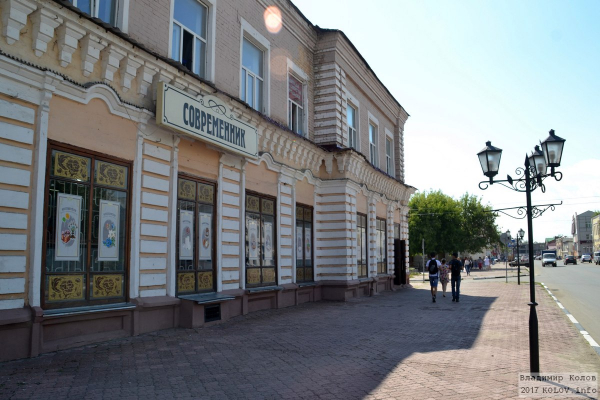
Dimitrovgrad, Central District. Photo from the site
So when the question of higher education arose, it became clear that I would be sent far away from home for a long time. At that point, I had to seriously contemplate who I wanted to become when I grow up and what I wanted to study.
I still have no answer to the question of who I want to be when I grow up, so I had to base my decisions on what I enjoy doing. And I liked, you could say, opposite things: on one hand literature and foreign languages, on the other - mathematics (and to some extent programming, that is, computer science).
In search of a combination of the incompatible, I stumbled upon a program for training linguists-programmers implemented at the Higher School of Economics (HSE) in Moscow and Nizhny Novgorod. Since I have a strong allergy to Moscow, I decided to submit my documents to Nizhny, where I eventually successfully enrolled in the bachelor’s program ‘Fundamental and Applied Linguistics.’
Having endured a barrage of questions like 'Higher School of Economics - will you become an economist?' and 'It’s in all the places, what university is it?' along with other associations around the highest degree of punishment and 'what will you work as?', I arrived in Nizhny, settled in a dormitory, and began living my cheerful student life. The main fun was that we were supposed to become applied linguists, but what we were to apply ourselves to…
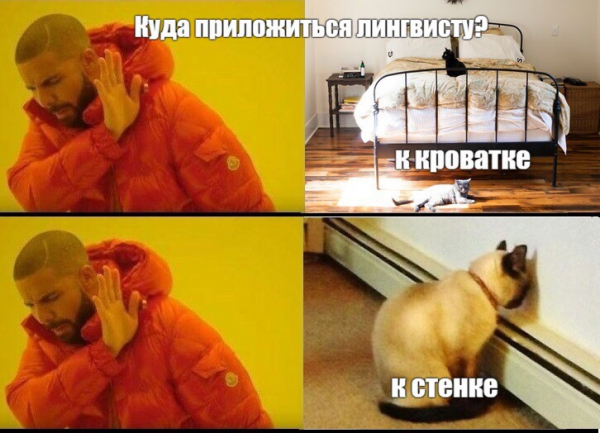
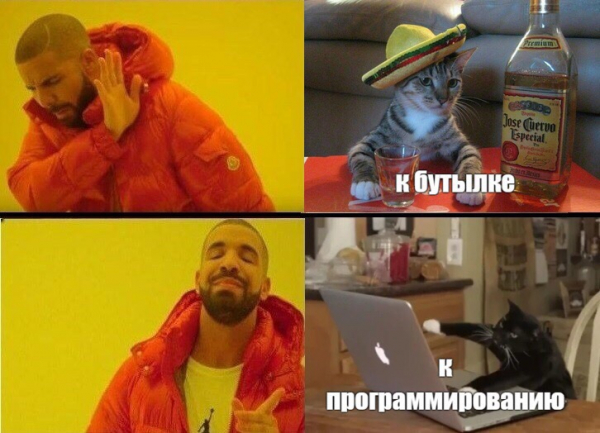
It was mainly towards programming that we were directed, all the way to machine learning and writing neural networks in Python, but who is to blame and what we should do after graduation was still not very clear.
Salvation came in the form of the vague term 'technical writer', which first appeared in my mother’s lexicon, and then among my instructors in the course around the fourth year. Although what it is and what to do with it was not very clear. It seemed to be a humanitarian job, but you also need to understand technology, and possibly even be able to write code (or at least read it). But that’s not certain.
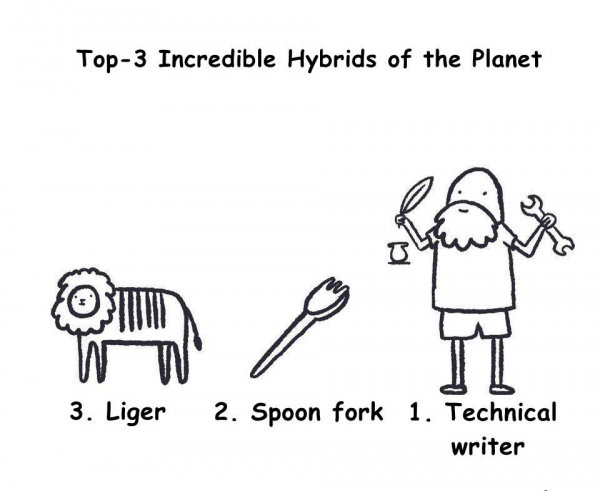
The three most incredible hybrids on our planet: tiger-ly, spoon-fork, technical writer
It was during my fourth year that I first encountered this profession, meaning a job vacancy for it, at Intel, where I was even invited for an interview. I might have stayed there if not for two circumstances:
- The end of my bachelor’s program was approaching and the thesis was still unwritten, and I couldn’t find a master's program in Nizhny that I liked.
- Suddenly, the 2018 World Cup arrived, and all students were politely asked to leave the dormitory around mid-May because it was being handed over to volunteers. Due to the same World Cup, all studies finished earlier, but it was still disappointing.
These circumstances led to the fact that I was leaving Nizhny forever, so I had to decline Intel's invitation for an interview. That was a bit disappointing too, but there was no choice. I needed to figure out what to do next.
I see a book in my bag — well, you’re heading off to study…
The question of enrolling in a master's program was not up for debate; more specifically, it was, but only a positive answer was acceptable. I still had to decide what master's program to choose and what I wanted to be when I grew up; I still didn't really understand what I wanted to do. I started worrying about this back in winter and initially wanted to go to SPbGU for a linguistics-related specialty, but a couple of trips there quickly extinguished that desire, and I had to find a new option just as quickly.
As we say here, "after the Higher School, you can only enroll in the Higher School." The educational systems, rules, and traditions are too different. Therefore, I turned my attention to my home university, or rather to its St. Petersburg branch (my aversion to Moscow greeted me again). The choice of master's programs wasn't very extensive, so I decided to start writing a motivation letter for one and urgently boost my math skills for another. The letter took about two weeks, while my math skills took all summer...
Of course, I got accepted exactly where I needed the motivation letter. And here I am — in the 'Information Systems and Human-Computer Interaction' program at the St. Petersburg Higher School. Spoiler: only now have I somewhat learned to answer the question, "What are you studying for?"
At first, it was hard to explain to my classmates where I'm from: few can imagine being born in one place, educated in another, and coming back to study in a third (and I fly home to a fourth, yeah).
But from here on, this isn’t what we’ll be discussing, but work.
Now that I’m in St. Petersburg, the job search question has become a bit more pressing than in Nizhny. For some reason, there was almost no studying in September, and all my energy was focused on finding a job. Which, like everything in my life, was found almost by chance.
"The situation isn't new either – don't be shy, you'll be fine!"
On the HSE job page, developer positions at Veeam were posted, and I decided to check what kind of company it was and if there were any other opportunities. 'Something else' turned out to be a junior technical writer position, to which I sent my little resume after some thought. A few days later, I received a call from Nastya – a charming and very positive recruiter, who conducted a phone interview. It was exciting but interesting and very friendly.
We discussed several times whether I would be able to manage everything. My classes are in the evening, starting at 6:20 PM, and the office is relatively close to the educational building, so I was confident that I could balance both (after all, there weren't really any other options).
Part of the interview was conducted in Russian, and part in English. They asked me about what I studied at university, how I learned about the technical writer profession and what I think about it, and what I know about the company (at that moment it was 'nothing', which I admitted honestly). Nastya told me about the company, various social perks, and that I needed to complete a test task. This was already the second big step.
The test task consisted of two parts: translate the text and write instructions. I worked on it for about a week, taking my time.
-New insights: I learned how to connect a computer to a domain (which actually came in handy later).
-Interesting fact: I overwhelmed all my acquaintances who had already found jobs, asking them to check my translation and read the instructions. I was still incredibly nervous sending in the task, but everything went perfectly: soon Nastya called and said that the technical documentation team liked my test task and they were looking forward to meeting me in person. The meeting was scheduled for about a week later, and I exhaled for a while, diving back into my studies.
A week later, I arrived at the office on Konderatievsky Avenue. It was my first time in this part of St. Petersburg, and honestly, I was a bit scared. It felt even more intimidating when I didn't recognize Nastya by her voice – in reality, it turned out she was more delicate. Luckily, her friendliness overcame my shyness, and by the time I entered the small cozy meeting room with my interviewers, I had calmed down somewhat. I spoke with Anton, the department head, and Alyona, who later turned out to be my future mentor (I hadn’t thought about that during the interview).
It turned out that everyone really liked my test assignment – that was a relief. All the questions were based on it and my very brief resume. Once again, we discussed the possibility of combining work and study due to the flexible schedule.
It turned out that I had one last stage waiting for me – a test assignment in the office itself.
After considering it and deciding that it was better to deal with everything at once, I agreed to take it right away. Thinking back, this was my first visit to the office. Back then, it was still quiet, dark, and a bit mysterious.
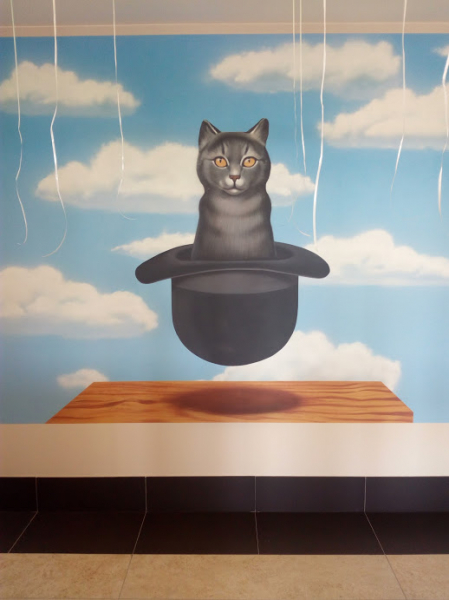
Some walls in the corridors and halls of the office building are decorated with reproductions.
The entire time I was working on my assignment, which took much less than the allotted 4 hours, no one spoke – everyone was focused on their work, looking at their monitors, and no one turned on the big lights.
Colleagues from other teams wonder why the big lights aren’t on in the technical writers' room? We respond1) You can't see people (they're introverts!)
2) Energy savings (it’s about ecology!)
Profit!
It was a bit strange, but it allowed me to observe what was happening. I noticed that one of the guys had recently had a birthday, and that the testing area was in the most interesting position – between Anton and Alyona. It seemed like my arrival, brief stay, and departure had little impact on the life of the small office, as if no one had noticed, and the overall atmosphere had not changed at all. All that was left for me was to go home and wait for a decision.
As you might guess, it was quite positive, and at the end of September, I returned to the office for my official employment. After the paperwork and a safety briefing, I was introduced to the technical writers' office as a 'new recruit.'
“There’s plenty of opportunity there: just know your work and don’t be lazy…”
I still remember my first day: how surprised I was by the silence of the department (no one spoke to me except Anton and Alena, and Anton mostly communicated via email), how I settled in the communal kitchen, even though Alena wanted to show me the cafeteria (since then, I rarely brought food from home, but on that very first day...), how I tried to ask for permission to leave early. Ultimately, the request was made and approved, and then October slowly arrived, along with real learning.
The first period was fairly easy. Then came hell. Then things stabilized somewhat, but the pressure sometimes flares up under us again.
Upon reflection, balancing work and study is indeed achievable. Sometimes it’s even easy. Not when exams and releases are dangerously close together, with deadlines overlapping or needing to submit a lot at once. But on other days – it’s very manageable.
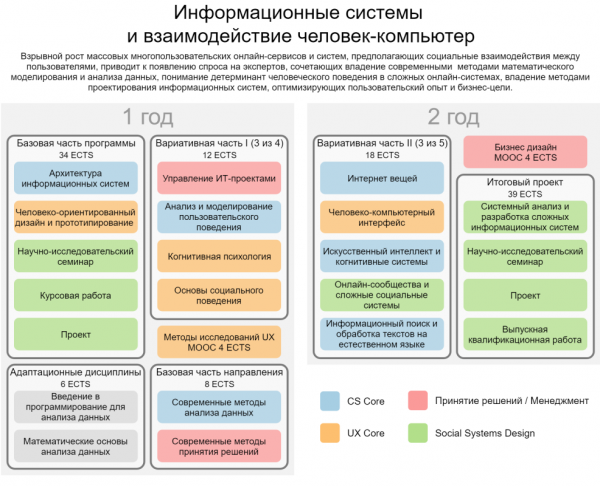
A brief overview of my program and interesting topics covered in it.
Let’s take a look at my typical week.
I work Monday through Friday, study 2-5 days in the evenings during the week and Saturday mornings (which saddens me quite a bit, but there's nothing to be done). If I study, I wake up around eight in the morning to get to work by nine, and leave just before six to go to the educational building. There, classes are from half-past six to nine in the evening, and I return home around eleven. Of course, if there are no classes, life is easier, I can sleep in, and even by nine I’m comfortably home (I used to tear up at this fact), but let’s focus on another important aspect.
I’m enrolled in a master’s program, and some of my classmates also work. The professors understand this, but homework is still expected, just as is the coursework and mandatory project work. So if you want to live – you need to be adaptable, manage your time, and set priorities.
Homework is usually done in the evenings on non-school days and during the one and a half remaining weekends. Most of it is group work, so you can quickly do your part and switch to other tasks. However, as it is known, any plan is flawed when there are people involved, so it's best to always monitor group projects to ensure that everyone doesn’t end up failing. Plus, until recently, teachers loved to send assignments just a day before class, which meant having to rush to complete them the same evening, regardless of getting home at eleven. But the pros and cons are detailed a bit further down.
The specifics of evening master's studies (and its working students) also relate to the fact that tardiness and absences are tolerated until they forget what you look like. And for some time after that. Late submissions of final assignments are also overlooked until the exam session looms (but no one has checked on coursework yet). Due to the quirks of our beloved Higher School, we have 4 exam sessions: autumn and spring, each lasting 1 week, winter and summer – 2 weeks each. However, since no one wants to do anything during the exam period, the real stress kicks in a week before – all assignments need to be submitted and grades received to avoid attending exams. But during the May holidays (when no one does anything due to the festivities), coursework writing is due, so everyone feels a bit pressured. Summer is approaching, and soon all project deadlines will arrive, putting even more pressure on everyone. But that's a later concern.

In general, there are pros and cons to balancing work and study. For me, it looks something like this:
Advantages
+ Independence. Financial independence, that is. After all, having the ability not to ask your parents for money every month is a joy for any student. And at the end of the month, you are accountable only to yourself for your lighter wallet.
+ Experience. Both in terms of "work experience" (which is always needed) and "life experience". This is facilitated by dorm life, which always has a bunch of amazing stories, as well as just existing in such a way – after that, nearly nothing seems frightening.
That moment when you read in the job ad "10+ years of experience in Go required"
+ The ability to prioritize. Knowing when to skip a couple of things, when to let homework slide, whom to delegate tasks to, and how to accomplish everything to stay on track. This lifestyle effectively weeds out the 'inner perfectionist' and teaches you to distinguish what is truly important and urgent.
+ Saving. Saving time – you're learning and already gaining work experience. Saving money – living in a dormitory is cheaper. Saving energy – well, that's not applicable here, of course.
+ You can do your internship at work. It's convenient.
+ New people, new acquaintances. Just like always, but twice as many.
Cons
And now for the downsides:
– Routine. I'm a 'night owl,' and early wakes are pure torture, as are wake-ups on weekends.
– Free time, or rather, its complete absence. Rare weekday evenings go to homework, and the one and a half remaining weekends are spent on household chores and homework. So when people ask me what I've managed to see in St. Petersburg, I nervously laugh and say, 'the educational building, the office, and the road between them.'

In fact, you can see the sights even from the office windows.
– Stress. Triggered by the previous two factors and generally by the shift to a more hectic lifestyle. This is more of a starting situation (people – they're such creatures, they adapt to everything), and in moments of releases/sessions, when you just want to lie down and die. But this phase passes, nerves gradually recover, and at work, I'm surrounded by surprisingly understanding people. Sometimes I feel like I don't deserve this.
– Loss of time perception. Something akin to my grandmother's stories about how 'it feels like just yesterday you went to first grade.' Six-day weeks, locked into 'work-study-sleep-eat-chores,' fly by astonishingly quickly, sometimes too quickly (deadlines are always looming), weekends are surprisingly short, and there's an endless list of things to do. The end of May arrived quite unexpectedly, and I found myself thinking that I don't remember the rest of the month at all. It just whizzed by. I hope this will pass with the end of my studies.
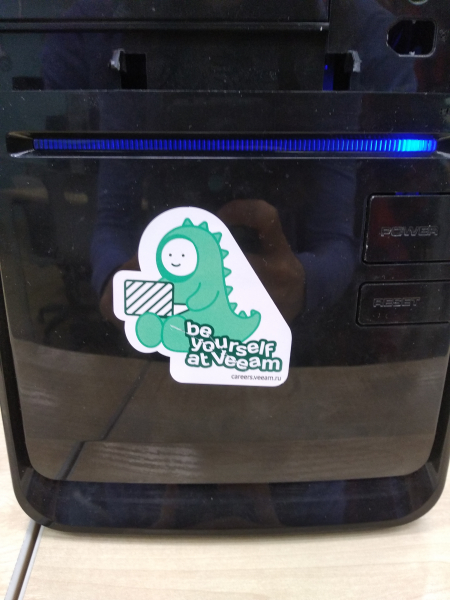
And I found such traces of Veeam in one of the computer labs at HSE. They probably handed these out on Career Day to undergraduates)) I want something like this, but all the master's students work on Career Day.
There are still a few issues related to the untested program (it's the first set, after all), but overall the advantages outweigh the drawbacks, or I'm just an optimist. In general, it's not that complicated, and this will last just 2 years (only a little over a year left). Moreover, such an experience toughens character and teaches many new things—both professionally and personally. It also allows you to discover a lot about yourself (including "how much time it takes to write a thesis").
Perhaps when my studies finally come to an end, I might even miss them (not really).
Source: habr.com
