

Good day.
In my previous article, I touched upon the topic of tabletop role-playing competitions, which, much like various indie jams for software developers, help concepts and drafts evolve into something greater. This time, I will share the story of another one of my competitive projects.
I have encountered both domestic tabletop role-playing competitions (called "Kashevar" in our country) and international ones (the annual Game Chef). At the international level, it was usually required to come up with some new mini-system of rules, while the Kashevar competitions allowed not only systems but also adventure modules for existing systems. The international contest also aimed to set certain trends and experiment — that year, the focus of Game Chef was on exploring new tabletop role-playing formats: "the absence of a rulebook."
And here is what the conditions looked like:
This year's theme: THE BOOK DOES NOT EXIST
Tabletop role-playing games have long been limited to one format—the rulebook format. However, in recent years, this standard has begun to change: more short games have emerged; games based on card mechanics or small brochures. This year, within the framework of Game Chef, we invite you to develop this trend. What if a game has no single rules, no one basic text? How will players learn the rules of the game then? Is it possible to create a tabletop game without a single set of rules? Perhaps the game will take on new forms? Or maybe new solutions to old problems will emerge?
Be inspired by this theme, let it transform your game during the process. Interpret it in any possible way. It’s likely that your vision will be significantly different from the options proposed by other participants. We have provided some explanation for the theme, but you are free to interpret it in your own way.
Four ingredients this year: absorb, wild, shimmer, sickle
I should clarify that the ingredient words must somehow be reflected in the competitive work (at least two words out of four).
I found the theme intriguing since I specialize in experimental systems. Initially, I intended to take the mechanics from my already completed game about space, aiming to 'bring it down to earth,' to create worlds not just in cosmic expanses but to try to set it on a limited map and adapt the rules accordingly. However, time was running short for submitting the work, and I wanted to implement that idea as a standard rule book. So I began to contemplate something else, something that better matched the theme of the contest.
Various thoughts came to me about proposing a kind of overlay over some well-known rules. You know, for instance, everyone knows which traffic light they can walk on and which one requires them to stop. Perhaps to construct rules around the use of a device (as I did in the previous contest, using a calculator), a book, or some other item.
This led to ideas about using small change and images. I also thought about involving, say, newspapers. But I considered them not very common.
I decided to take a risk with the format and present the rules in a non-obvious way, through one large game example, like 'overheard' fragments of information piecing together a unique picture for each observer. The best embodiment of my idea would have been to shoot a video or record a podcast, but at that time, I lacked the means and skills. Moreover, this endeavor would still require a base, a script. Thus, an unexpected solution came about—a mini-play. Consequently, the final result was a simple text. Like a forum topic, a comment, a transcript, a record.
Here’s what ultimately resulted:
Gatekeepers, or Shishkin will not be
Role-playing thought in five acts
Characters
Lisa.
Arkhip Ivanovich.
Aivazovsky.
Salvador.
Shishkin.ACT 1
The action takes place in Aivazovsky's apartment.
A spacious room, a clean dining table with two reproductions and a handful of coins. Nearby, two leather armchairs and three stools.
In the room are two people, one in an armchair, the other standing at the table. Footage flickers on the turned-on TV panel. A sunset is visible through the windows.
Aivazovsky, Salvador (are conversing).
Salvador. How can anyone even watch this? I don't understand.
Aivazovsky (thoughtfully). It's a normal film.
Salvador. You'll see, one. (Takes a couple of steps.) When will the others arrive?
Aivazovsky. They should already be here. I'm going to call now.
Salvador. Wait a minute. Tell me the rules for now.
Aivazovsky (reluctantly turns off the TV). There are no rules. (Staring intently at Salvador.) Can you imagine, there are no rules at all! (Gestures with his hand.) None!
Salvador. Are you joking? How can we play?
Aivazovsky. You'll see.A click is heard. Liza and Arkhip Ivanovich appear in the doorway.
Salvador. Well, well. It's been a year since Arkhip Ivanovich graced us with his presence!
Arkhip Ivanovich (grumpily). I'm just as Ivanovich as you are — Salvador. (Sighs. Greets Salvador. Gives a reproachful look.) While we were waiting, you could have brewed us some tea.
Salvador (calmly). Don't worry, you'll manage with your tea. (To Aivazovsky.) Is everyone here? What about Shishkin?
Arkhip Ivanovich. Shishkin won't be coming.
Liza. What do you mean Shishkin won't be here? (Nods to those gathered.) Hi.
Aivazovsky (looking at his watch). He'll be here. Later. (Addressing the newcomers.) Did you bring the pictures?
Arkhip Ivanovich. Yes. Here. (Takes out a reproduction and places it on the table.)
Aivazovsky (turning his gaze to Liza). You?
Arkhip Ivanovich. And she is like that. Well, this is Liza!
Liza. Just a moment. Arkhip Ivanovich said I didn't need to.
Aivazovsky. Oh, right, I completely forgot.
Salvador. I'm a bit confused, so can you play without a picture?
Arkhip Ivanovich. No, we are Gatekeepers, and Liza is kind of a guest in our worlds.
Liza (thoughtfully). Are they Keepers of the Gate or Gatekeepers?
Salvador. Are the Gatekeepers not to your liking?
Liza. I have to call you something.
Arkhip Ivanovich. Lizok, don't be silly. I'm Arkhip Ivanovich. (Points at Aivazovsky.) This is Aivazovsky. (Looks at Salvador, remembering something.) Right, I don't know you. It's better not to enter his world at all. (Smiles.) Otherwise, your watch might melt or there could be another mishap. It's all trouble.
Liza (displeased). Right now. The pictures could have been without authors.
Arkhip Ivanovich. There's no picture without an author.
Salvador (to Arkhip Ivanovich). Do you have something against the world of soft clocks?
Liza (enthusiastically). Oh my God, the World of Soft Clocks?
Aivazovsky. Yes! Look. (Takes one of the reproductions and shows it to Liza.)
Liza (examining the drawing). Ah, exactly. I remember.
Archip Ivanovich. Everyone saw this, nothing interesting. But I have the World of the Moonlit Night!
Aivazovsky. And I just have the Ninth World.
Salvador. The Ninth World? I've heard that somewhere before.
Archip Ivanovich. And what about Shishkin? The World of Bears?Laughter.
TACT 2
Twenty minutes have passed. The same ones are still there.
Aivazovsky. That's it, let's play. I'm first.
Archip Ivanovich. Go on, go on. Present it already.
Aivazovsky. Alright. (Gathering his thoughts.) These Gates lead to the colorful Ninth World, where waves crash against the cliffs and high in the sunset sky seagulls circle, mourning the lost ships. The boundless sea keeps just as many secrets and mysteries…
Lisa (interrupts). And how many ships have sunk already?
Aivazovsky. So far just one. Last time we played. (Thinks for a couple of moments.) So, just a little world.
Salvador. So now I just tell a story, right?
Aivazovsky. Wait, I'll create some underwater monster.
Archip Ivanovich. Cthulhu?
Aivazovsky. Yes, let's have it be Cthulhu. (Takes a five-kopeck coin.)
Lisa. Cthulhu? Who's that?
Archip Ivanovich. It doesn't matter, he'll be sleeping anyway. (To Aivazovsky.) I hope he'll be sleeping?
Salvador (to Lisa). A chthonic creature, it devours brains. Haven't you read Lovecraft?
Lisa. No… And it looks like I won't.
Aivazovsky. Yes, he will be sleeping. (Scans the others with a sly look.) For a while.
Archip Ivanovich. Thank God. Just take a ten-kopeck coin; he's a bit big for a simple creature.
Aivazovsky (laughs). So, Cthulhu will be passing through as a location?
Salvador. What are you guys cooking up?
Aivazovsky (changes the coin). Well, five kopecks is a hero, and ten is a place. (Sighs.) Now it will take ten moves to build.
Lisa. And one kopeck?
Archip Ivanovich. For one — an item.
Lisa. Oh. I see. (To Salvador.) What about the World of Soft Hours?
Salvador. Hold on, see Aivazovsky is bringing out monsters.
Aivazovsky. That's it, I'm done.
Salvador. Well, listen...TACT 3
An hour has passed. The same goes for Shishkin.
Archip Ivanovich (to Shishkin). I thought you wouldn't come today.
Shishkin. Well, I need to visit you ghouls. To supervise.
Lisa. In short, I want a raft!
Aivazovsky. Is that an item or a place?
Archip Ivanovich (sarcastically). Or maybe it's sentient? Then it's a creature.
Lisa. You're scaring me. Just an ordinary raft. (Thinking.) Although no, an ordinary one would sink here. Anti-gravity!
Salvador (placing a coin on the painting by Aivazovsky). Just write it down, write it down. The raft.
Aivazovsky. Hey, what are you creating here?
Salvador (to Liza). Look, he doesn’t like it. Better build it in my world.
Shishkin (to Aivazovsky). What’s wrong with the raft?
Aivazovsky (to Shishkin). Anti-gravitational!
Liza. What, isn’t it allowed?
Archip Ivanovich. That’s the point, there are no rules here.
Shishkin. Well, technically there are. Just in a free form. There are conditions: drawings, coins, building time. Plus, there are Wild rules.
Archip Ivanovich (skeptically). Oh, come on. In fact, there are no rules.
Shishkin. And the Wild ones?
Archip Ivanovich. Those are not rules.
Salvador (impatiently). So, are you going to walk? Liza ordered the raft.
Archip Ivanovich. Damn. We didn't even make tea.
Shishkin (smiling). What tea? It’s three in the morning!
Aivazovsky. Actually, it’s half past ten. (Looks at those gathered.) Shall we take a break for tea?
Shishkin. Well, let’s.They get up. They go to the kitchen.
Salvador (to Shishkin). What’s the name of your picture?
Shishkin. The World? Ummm… Forest Strip!
Archip Ivanovich (sardonically). Not World of Morn? Not World of Pines?
Liza (joining in). World of Bears?
Aivazovsky. I know, World of Cones!Laughter.
Shishkin (rolling his eyes). Damn, you guys are annoying.
Archip Ivanovich. We haven't even started yet.TIME 4
Ten minutes later. After tea. Same place.
Shishkin (finishing the description). So, this is a fairy-tale glade in the forest.
Salvador. With bears!
Liza. And with cones!
Shishkin (ironically). Yeah, totally! Complete mess.
Archip Ivanovich (matter-of-factly). What are you building?
Shishkin. Wings. For the bears.
Liza. Why do bears need wings?
Shishkin (tiredly). Why, why? To fly away from you! (Thinks.) Although, no, let’s make a hero, a sorcerer.
Archip Ivanovich. Again a sorcerer? Why in the forest?
Shishkin (to Archip Ivanovich). Not again, but again. Give me a coin. (Looking at the others.) Who’s next?
Aivazovsky. I am. Then Salvador, then Archip Ivanovich.
Liza. Then me.
Shishkin (to Liza). In which world are you building?
Liza. In Aivazovsky's for now. A raft, a pirate ship, and a hot-air balloon castle.
Shishkin. Cool!
Liza. But it’s an unsettled sea and the pirate wants to run away somewhere.
Archip Ivanovich. Create a castle for me at the riverbank. Or a pirate ship. A frigate!
Liza. No, yours is gloomy. And I specifically wanted to switch this pirate.
Shishkin. We haven't done this before, but you can create the Wild Rule yourself.
Lisa. I didn't understand how to do them.
Arkhip Ivanovich. He didn't get it either; we only have the Occam's Razor and a guest for now.
Salvador. Let's get into more detail on this point.
Shishkin (sighing). Well, I've added the Razor.
Arkhip Ivanovich. Yes, we cut out Cthulhu for them today, by the way. Just in case.
Ayvazovsky. Did he interfere with you?
Salvador. Ah, so that's what it was. Got it.
Arkhip Ivanovich. Yes. (To Shishkin.) What exactly does the rule say?
Shishkin (reading). Occam's Razor. It appears in the universe every ten turns, regardless of whose, and goes to… (interrupts reading.) In short, whoever completes their construction first gets the Razor and can eliminate anything excessive from anyone.
Ayvazovsky (to Arkhip Ivanovich). It will appear again in the next turn, and I'll cut your tower of dark mages.
Arkhip Ivanovich (protesting). But I need it; it's not excessive!
Lisa. Actually, the Razor will come to me; my castle will be completed right on time.
Ayvazovsky (winking at Salvador). Oh, that's not a fact.
Lisa. Well, no need to be nasty. I was actually against it!
Arkhip Ivanovich (to Shishkin). Ah, right, Ayvazovsky also added the Wild Rule. You can make mischief when you've built something significant.
Ayvazovsky. Yeah, then you slow down any construction by one turn. In short, you harm in small ways.
Lisa. And the guest — what is that?
Arkhip Ivanovich. That's you. I added it so that a player doesn't have to own their Gates and can build wherever they want.
Lisa. Well, that's great! I was planning to take my picture.
Arkhip Ivanovich. Yeah. Do you know what she wanted? A portrait! (To Lisa.) How do you imagine telling a story about the world through a portrait?
Lisa. I imagine it well; you take it and describe it. (Tired.) Okay. Let's move on.
Shishkin. Let's add a rule that portals can be built between the Gates. If both Keepers agree.
Arkhip Ivanovich. Wait, you can't add anything yet. You already have the Razor.
Shishkin. I'm talking to Lisa. Besides, I can cancel mine.
Arkhip Ivanovich. Through voting?
Shishkin. Only new ones through voting; old ones just based on personal choice.
Lisa (looking heavily at Ayvazovsky). You should have canceled the mischief.
Salvador. So, Lisa and I will add a rule and that's it?
Archipp Ivanovich. No, then each will have one, and new ones can be added.
Aivazovsky. In short, we're returning to the Ninth World. (To Liza.) While your pirate was flying on the 'Plywood,' the weather changed. Thunderstorm clouds appear on the horizon, a storm is approaching. (With pomp.) The King of Elves frowns and gives the order to dive, waving his hand. A minute later, the elven submarine closes with shimmering energy shields and disappears underwater.
Liza. Well, now a storm is approaching.
Shishkin. It's fine, you can take shelter in the sky castle.
Aivazovsky (businesslike). So, so. The island will be in three moves, the underwater cave in seven. I will be replenishing the crew for now. I'll order an elven girl in red.
Salvador. A blonde?
Aivazovsky. Of course!
Salvador. In the meantime, in the Soft Hours, a wind-up dinosaur has been completed, and… (Meaningfully looking at Aivazovsky.) I’m getting the Scythe!
Archipp Ivanovich (reproachfully). You’re getting rays of hatred.
Aivazovsky. No, the Scythe appears when Liza is running.
Salvador. Ah, right. (To Liza.) Then I'll just slow your castle down…
Liza (indignantly). Radish!TACT 5
A day later. Telephone conversation.
Shishkin and Archipp Ivanovich (discussing recent events).Archipp Ivanovich. You know, I would redo everything. I’d write normal rules so that we wouldn’t have to come up with them every time. (Pause.) Well, look, you have the Scythe of Occam — make something similar about each philosopher.
Shishkin. So everything was in vain again?
Archipp Ivanovich. Well, not exactly in vain. The idea itself is good; it just needs to be properly formatted for the game.
Shishkin. Yes, I was thinking about making it standard. But. (Pause.) But then there wouldn’t be Shishkin there. You understand? And the point is that everyone figures the mechanism out for themselves.
Archipp Ivanovich. Yes, yes. The concept of a game that does not exist in the form of a rulebook… It's kind of stoned, complicated. (Pause.) Well, that’s fine in principle. You know what Liza suggested…The end?
Feedback
In addition to submitting their own games, all participants were asked to write brief reviews on 4 games by other participants and also select one that they deemed most deserving. Thus, my Gatekeepers also received some feedback from other authors, here they are:
Review No. 1
A very intriguing story with fascinating characters, but it's completely unclear how and what they are trying to play. Ingredients are mentioned, although the same Serp is stretched to the extreme with Ockham's razor. In general, an interesting essay, but this is not a game. I would happily read more from this author, but I cannot give my vote for this work.
Review No. 2
Review of the play Gatekeepers
I will say right away that the presentation of the material in this work is simply splendid. However, this is not surprising, considering that its author is also the creator of the spectacular system and, first of all, the collection of incredible settings – twisted terra. It's not even about the unusual presentation of the material; the very idea of introducing the reader to the necessary factual content is, to be honest, not new, but the style of the work evokes memories of the science fiction of the times when it was still warm and lamp-lit.
Unfortunately, the presentation form seems to have become the reason for the weak points of this work. Even though the characters in the piece explain the rules of the game to a newbie, which is why everyone has gathered, the main phrases are apparently either said offscreen or only implied.
Although the described game more closely resembles a board strategy than a classic role-playing game, the text does not showcase some rather important details for this category. Thus, the goal of the game – to narrate about the world – is mentioned in passing. Based on what happens in the play, one could assume that the narration should consist of creating and building new elements in the world. However, it does not state when the game is considered finished, how the winner is determined, or even what to do with the created entities. Creating and building uses coins that serve both as resource counters and as measures of necessary creation time. The decision is so logical and beautiful that after reading about it, you wonder why everyone around hasn't implemented it yet. Unfortunately, this mechanic is also a bit raw – it's unclear where, for what, and in what quantity players receive coins, whether they can be exchanged, and, conversely, summed up.
If we decide that the game is nonetheless a role-playing one and that it shouldn't be about winning, the picture still turns out to be rather strange. In the text, one of the players suggests introducing an additional rule that brings in portals connecting disparate worlds. Perhaps this would indeed be useful, as it seems that at the time described in the play, the game consists of several monologues, each narrating their creation while occasionally hindering others. By the way, regarding additional rules. The core rules imply the introduction of extra rules during the gameplay. Again, a wonderful solution and a very clever approach to the contest theme – the rulebook doesn't really exist, as the game is created anew each time. But in that case, it turns out that much of the gameplay shown to us is a specific situation characteristic of a single game session and has no relation to the game itself as presented.
From everything said above, I would draw the following conclusion: it is impossible to play Gatekeepers in the form it is presented. In fact, the play describes not a game but a set of mechanics. By the way, the players described also understand this, which can be gleaned from the resonant speech of Arkhip Ivanovich. However, the mechanics used are listed in the same place:
“Shishkin. Well, technically they exist. Just in a free form. There are the conditions: drawings, coins, building time. Plus there are the Wild rules.”
By the way, of the constants provided, only the paintings puzzled me. I found the idea of creating a world based on someone else's already created image rather strange. Undoubtedly, drawings can be very helpful in sparking imagination, providing associations, and finally constructing a unified imagery. But why limit ourselves to just one work and bring it to the game in advance? Perhaps this detail would make sense as a random element of the Gatekeepers.
Finally, regarding the formal side of the issue. As I mentioned, the author handled the main theme brilliantly. I wish I could do the same. However, the ingredients didn't develop much. I could only see the Scythe as one of the optional rules, and the Radiance in the setting of one of the provided worlds. On the other hand, as already mentioned, the text of the play is written in beautiful language, contains a fair amount of allusions and Easter eggs, and is generally pleasant to read. The description of Cthulhu as a location is simply delightful. I hope to one day see new gatekeepers alongside Murshambola and Twisted Terra.
Review #3
Once, Shishkin, Dali, Aivazovsky, Mona Lisa, and Kuinji gathered, and their conversation turned into a lengthy discussion. It stretched over several pages, all seasoned with awkward attempts at humor and strange gestures. “Artistic images, as if alive, rose before our eyes, unfolding like the sky over Berlin or the remains of Dresden cathedrals after bombing.” I would love to write such a phrase about this game, but unfortunately, I cannot. The artists gathered, talked about something—Cthulhu, the Scythe (which inexplicably appeared)—and so on. The revelry reminded me of the film “The Green Elephant”; I wanted to burst into their gathering and shout, “What on Earth are you talking about? What Cthulhu, what paintings?! Are you out of your minds?!” Honestly, we understood nothing from the game. It resembled an art-house film: too many unnecessary pompous words that are great individually but fail to form a coherent sentence. Verdict: a total zero; we didn’t even understand how to play it. Key terms weren’t utilized properly, but the theme was completely revealed: there is no book. Absolutely nothing.
Review #4
Age ratings are crucial.
The coolest thing about this work is the presentation. Presenting the rules as a description of a game session seems like a brilliant move to me. The module as a way of formatting the game is truly great. It showcases the author's vision of the appropriateness of applying and interpreting the rules and conveys the mode of play. In recreating dialogues and questions, you can capture what hangs in the air in your group when you are developing it.
This is where the good news ends. The proposed design isn't truly a game for adults. It's something that can be enjoyed by children around the age of 4 to 5. An adult can play this game with a child. In childhood, the imagination of something non-existent presents a real challenge. The collision of various fantasies creates an amazing adventure. But for an adult, this isn't interesting. Perhaps we're flawed game developers, but coming up with rules within a set framework doesn't seem like entertainment to us, and devising entities without purpose and meaning isn’t an interesting pastime. Due to the lack of suitable age children for a playtest, we couldn't conduct one, but I remember well how I created a very similar game back in preschool or perhaps in the first grade. It can be fun.
Honestly, I always tried to anticipate who would actually win. The criteria for victory, alas, are as integral to the game as the rules themselves. For younger players, the competition lies in the strength of imagination, and it’s obvious that the winner is the one whose fantasy is flexible enough to generate useful rules and rich enough to react with new entities to new conditions. The one who cannot come up with anything new on their turn and starts repeating loses. Unfortunately, three adult masters can compete in this until the copper turns green in the coins, and no one loses. And there is no other criterion.
Omnipotent, or do you need to be a god
Time passed, and the concept of a game about divine beings slowly simmered in my mind until one day, my experience with the tabletop game 'Smallworld' joined the pantheon of divine simulators that influenced me (Populous, Black & White). And it all finally clicked that my game with gods would revolve around an advanced mechanics of Gatekeepers, from where I could draw on the economy of a sacred resource (manipulating faith coins). Thus, the heroes of that play engage in a prototype of the future 'Omnipotents', sharing experiences similar to what I ended up with.
It turned out to be something like 'Role-Playing Monopoly', where players take on the roles of deities controlling specific territories on a map, rolling dice each turn and moving their pieces along the track of fate. Different effects occur in various sectors. Players can collect faith coins from the sectors or pay these coins to create something, returning them to the track. The game focuses on creativity, though I did add some final goals as well. Additionally, one of the deities might end up evolving into science if the conditions are met—this would change their gameplay.
As I observed from the playtests, the key is not to rush your turn and to treat the game as a tabletop role-playing experience rather than a conventional board game. This means tuning into the imaginary world and the situations occurring within it, inventing and describing events instead of just rolling dice and collecting coins.
You can view the rulebook here:

However, rules are rules, and as they say, seeing is believing. So below, I will describe how one of the playtests of the game went, which I conducted at one of the clubs in my city.
Report on the role-playing game about the joint creation of a new world
So, the young deities gain power across the pristine continent. They accumulate faith and lead their people into the future, armed with a six-sided die and faith coins.
Our test game involved five participants (it is a game without a host, so I also played as a participant) and the following deities and races were represented:
Hiddenwise, the patron of the high mountain peaks of Rinna — the god of multicolored dragons
Mordekaiser, the patron of the dark marshy Lanfa — the god commanding legions of the undead
Prontos (also known as the White Wanderer), the patron of the deserts of Kawarro — the god overseeing golems made of white clay
Mirtain, the patron of the mysterious Capona — the god watching over were-human beings
I played as Reformax, that shelters the forested Ventron, where the race of trans-ports lived—creatures made of stone and red energy, which cannot walk but can teleport short distances. Over the forest stood the residence of my deity—a large portal, through which red energy flowed. Among other residences, I remember a tall tower filled with books, hanging in the desert of the god Prontos, as well as a citadel made of stone and enormous bones at Mordekaiser’s.
The game system features four types of deities: Emitter, accumulator, Transformer, and Devourer. Each type has its own behavioral traits and nuances of gameplay. To prepare for the game, I printed reminders for each type of deity, so that everyone had the information at their fingertips.
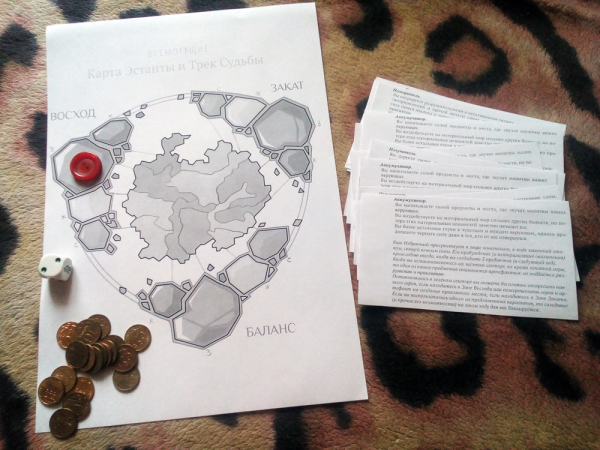
The types of deities were distributed as follows: Mordekaiser chose the path of the night Devourer deity, Hiddenwise preferred to be the Enlightening Transformer, Prontos went for Accumulators, and Mirtain became the day Emitter deity. I randomly chose the type for my Reformax, and it turned out to be yet another Accumulator—a deity focused on material wealth.
Overall, it turned out to be quite a fun game, full of unexpected events. We witnessed how one of the golems was swallowed by a sandworm and managed to escape from the monster. We saw skeletons asking their master to make them even deader. We witnessed a battle between two dragons, as well as the prayer of a dragoness to the god of werewolves, asking for the ability to bear young. The golems unearthed a massive cyborg in the desert. One of the werewolves got stuck between forms during transformation. The trans-ports built a symbolic wooden bridge to the desert, as a sign of friendship with its inhabitants. A golem praying to the god of werewolves managed to transform into a human. Two trans-ports accidentally became stuck in one point in space and merged into a new being. A squadron of dragons hunted monstrous fish in the world's ocean.
During the game Hidden Wize, while adhering to the prescribed character of the Transformer God, he read amazing advice from his notebook, responding to the requests of the faithful (instead of performing miracles themselves, of course, as was expected of the Transformer God, who was used to helping more with words than actions) — it was very cool and fun (considering the person saw this game for the first time in his life, he improvised excellently, coming up with game advice based on his external notes). However, a couple of times he did descend to divine intervention, for example, pointing the way back to a dragon that had gotten lost in the world ocean. Mordekaiser created a dragon-lich-possum, which later prayed to him to be transformed back into a simple dragon-lich. Additionally, the god of the night sent the dead citadel into flight and tested its weapons — firing a rocket into the desert and cutting through the forest lands with a beam of destructive energy. Prontos created a unique brick item, which later became an indestructible artifact. He also invented an eye that could be inserted into objects, thus bringing them to life. Furthermore, he had a mask that allowed him to possess whoever wore it. Mirtyn was also quietly creating items, one of which was a Cube that generated random effects.
During the game, stable expressions arose, such as 'Incoming Prayer' and 'Pray to Me,' accompanying moments when players stopped on the yellow sectors of the track of fate. This event indicated that another player needed to be chosen to describe the plea of a creature addressed to the deity, and then describe their response to this prayer.
Regarding my deity, the history unfolded something like this: initially, there were a couple of minor troubles — for instance, an anomaly appeared in the controlled territory where transports couldn't teleport. Then the first unique item emerged, named the Trans-fruit — it was an apple on one of the trees that suddenly transformed from ordinary to glass, filled with red portal energy. The item allowed its owner to teleport. Later, this item became cursed (a glass worm inhabited it) and was taken by the dragon god. The next item became a weapon — the Psycho-Cross. It was an X-shaped device that fired psychic energy. Quite soon, this item gained the status of an artifact and became indestructible.
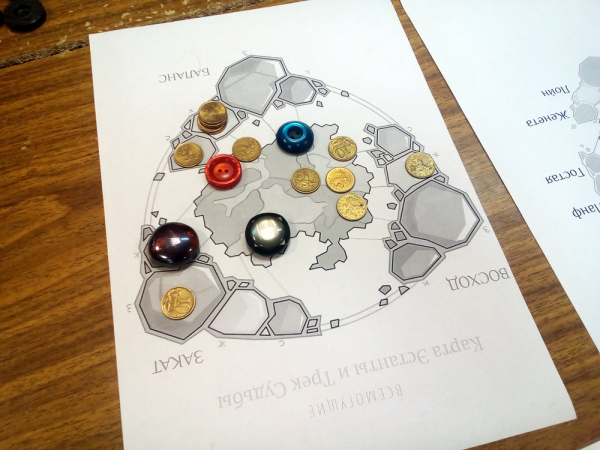
View of the playing field at the end of the gaming session (the buttons mark the Chosen Ones)
Next, my Reformax created: Sphere of Invisibility (granting the owner invisibility and found in an area cut through by the ray of the citadel of the dead), Cosmic Staff (captured by one of the transports in another dimension and later eliminating an insect attack from underground caves), Misty Cup (giving the drinker knowledge and discovered in underground caves cleared of insects), Ring of Flight (later lost along with one of the transports in the endless sea) and Bag of Secrets (from which one could pull out something interesting).
I'll note a couple of prayers that occurred during the change of my deity. Once, the transports desired to see some changes, in a word, reforms. Then Reformax decided to respond and with divine power lifted separate parts of Ventron into the air, forming it into a cluster of forest-covered islets, between which only transports (or flying creatures) could travel. Another moment is related to a transport that wished for the dragon god to teach him how to be a dragon — the petitioner received the ability to breathe a cloud of red energy.
After collecting five items, the god-Accumulator revives the Chosen One (other gods need to raise three heroes for this) — for me, this Chosen One became a certain Remix, a transport entirely made of red energy that had been resting in a stone tomb until now. Upon appearing, the Chosen One set off to gather faith from unexplored areas of the continent.
In five hours of gameplay, we ended up with three Chosen Ones: joining the heroine made of red energy were a golem created by Prontos from various parts and artifacts, as well as a dragon named Hiddenwise, who has gained otherworldly wisdom.
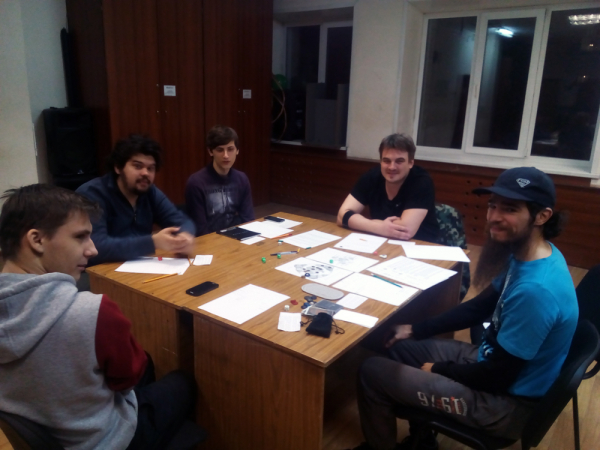
And here are the game participants.
I suppose I will wrap up this story here. Thank you for your attention, and I hope the article was helpful to you.
Source: habr.com
