

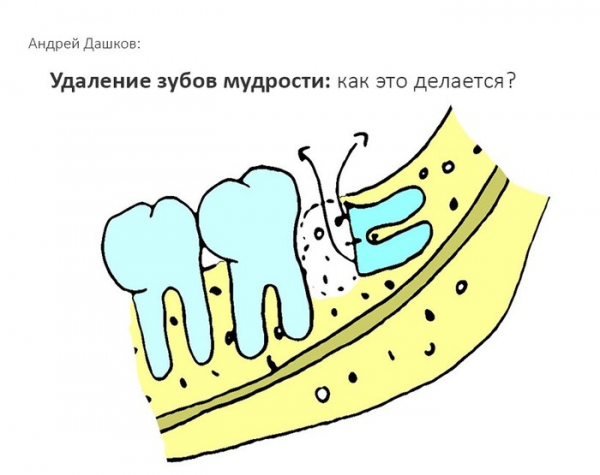
Dear friends, last time we talked about Today, I will detail how the removal of the 'doomed' teeth actually takes place. With pictures. Therefore, I recommend particularly sensitive individuals and pregnant women to press 'Ctrl +' for zooming in. Just kidding.
So, how does the removal of the 8th tooth, and indeed any other tooth, begin?
With anesthesia.
So:
Anesthesia (pain relief)
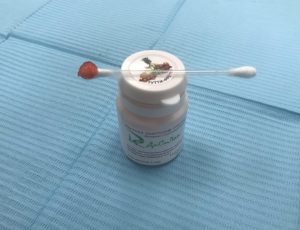
To minimize discomfort during the injection, the injection site should be treated with a special anesthetic gel. This is known as topical anesthesia. It is often used in pediatric dentistry, but we use it with adults as well. Experience shows that unpleasant sensations are reduced, and the taste is pleasant... at least some joy.
When removing teeth from the upper jaw, usually simple infiltration anesthesia of the area around the tooth being removed is enough. This is done using a special syringe with specifically selected anesthetics and is referred to as infiltration anesthesia.
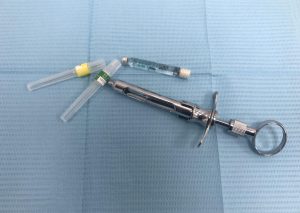
When removing teeth from the lower jaw, infiltration anesthesia is usually insufficient (except for the front group of teeth, from canine to canine). Therefore, the pain relief technique changes slightly — the anesthetic is delivered directly to the nerve bundle responsible for innervating the affected areas using a long but very thin needle. This type of anesthesia allows for the 'switching off' of sensation not only in the area of the removed tooth but also in the lip, chin, part of the tongue, etc.
It should be noted that during and immediately after the anesthesia procedure, several interesting phenomena may occur — increased heart rate, tremors in the limbs, an inexplicable feeling of anxiety. Many patients begin to panic about this. But there is no need to panic! These are side effects of most modern anesthetics, which pass by themselves within 10-15 minutes.
Well, the anesthesia is done! Now we need to make sure — has it been successful?
The areas that ideally should go numb are listed above. Additionally, with the help of a special tool and pressure applied to the gums around the operated tooth, we determine whether there are still any painful sensations or if they are gone. The only thing that should be felt is the sensation of something touching the gums. This means that tactile sensations are still present, but pain is no longer felt.
From here, our actions differ depending on the type of wisdom tooth we are dealing with.
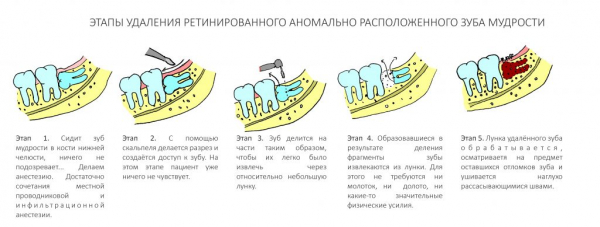
Impacted wisdom tooth
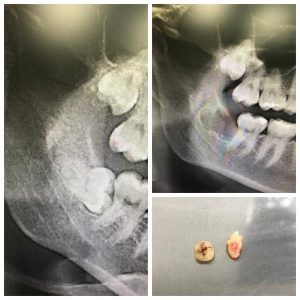
These are generally the most difficult eighth teeth to remove compared to the others.
We have already anesthetized the surgical field. What comes next?
It's under the gums! So, we take a scalpel and make a very delicate incision in the area of the tooth being removed. This creates access to the wisdom tooth that is being extracted. It is isolated from the surrounding tissues using special tools, allowing us to visually assess its position and choose the method for removal.
If the tooth has not erupted, something is obstructing it. This 'something' will also hinder its removal, and it could be an adjacent tooth, a bone protrusion, etc. However, you wouldn’t remove the seventh tooth just to access the wisdom tooth, right?
Therefore, we divide the tooth into parts. Using a special handpiece with a drill speed of 150,000 revolutions per minute — this is no longer a simple angled handpiece, but not yet a turbine one. The latter is, by the way, highly discouraged for tooth extractions, as at 500,000 revolutions per minute, you can easily burn everything to a crisp and with air from the cooling nozzle, even blow up emphysema on half of the face. In general, it's crucial to choose the right tools for removal; there are no small details or compromises to be made here. And you should think a hundred times before extracting such problematic teeth in a dental office with just one chair in the collective farm club 'Half-Empty Granaries.'
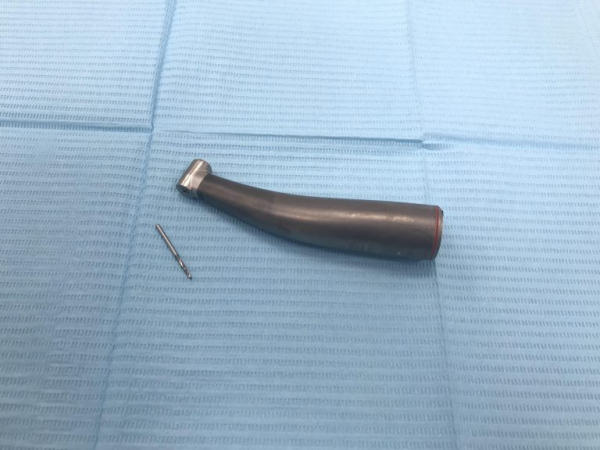
Special surgical handpiece for wisdom tooth extraction. It rotates at the required speed, provides the necessary torque, does not burn tissues, and does not inflate emphysema. In surgery, we only use such devices.
So, we divide the tooth into 2-3 parts to carefully and minimally invasively remove it from the surrounding tissue. Teeth are usually removed using an "elevator" (see image on the left). The forceps that everyone associates with tooth extraction are actually used very rarely.
Well, the tooth has been removed. Next, we clean the tooth socket of the "shavings" and small fragments of the tooth that may have remained using a curette.
During the extraction of wisdom teeth, biomaterials are not used; the socket fills itself with a blood clot, which is sufficient for normal healing.
Moreover, "packing" biomaterials into the socket can complicate the healing process, so let the regeneration process occur naturally and simply, not in a bizarre way as some doctors suggest.
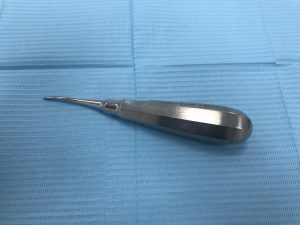
Impacted teeth are removed mainly with an elevator, not forceps, as many are accustomed to think.
The clot is in place. Next, we bring the edges of the wound together and apply stitches to prevent food from getting into the wound, minimize bleeding, and promote healing. However, the stitches should not be tight, as the wound may bleed significantly in the first day. If drainage is not created, swelling often develops.
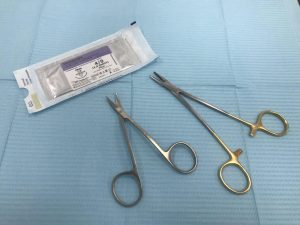
After extraction, resorbable (dissolvable) stitches are placed in the socket, and most of the time they do not need to be removed. But everything is individual.
Partially impacted tooth
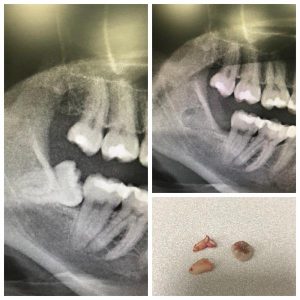
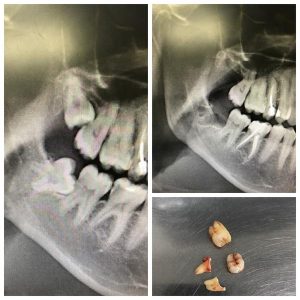
In principle, the method of removing such a tooth is no different from the removal of a completely impacted tooth. However, it usually goes a little easier because the tooth is not as deep. The main stages are essentially the same: anesthesia, creating access to the tooth (and sometimes incisions can be avoided), fragmenting (dividing the tooth into parts), and, in fact, removing the tooth in pieces.
After the removal of a lower partially impacted tooth, stitches are applied; for the upper wisdom teeth, stitches are not always necessary.
Distoverted tooth
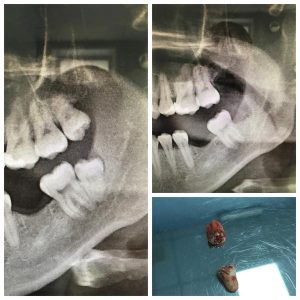
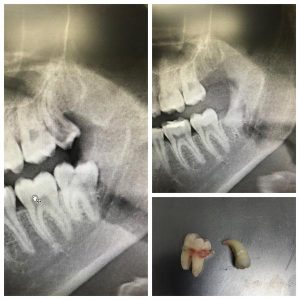
The removal of such teeth can be considered a simpler case compared to others, but only if the tooth has one straight root. In that case, the extraction can go quite quickly. However, such clinical cases are extremely rare. Upon examining the X-ray, we see hooks instead of roots, which, under sufficient pressure, could simply break. Usually, there are 2 roots, and in this case, we need to separate one root from the other using the same tool — the 'elevating' tip. We then carefully extract each root separately. The beginning and end of the extraction process are the same as with all other teeth.
A fully erupted tooth that is in the dental arch
As we established from , we leave such teeth in place. They simply require care and monitoring, just like regular teeth.
And then there are cases…
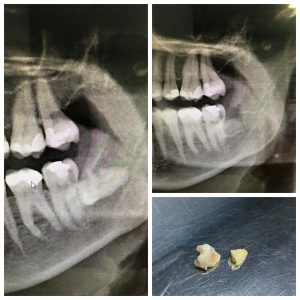
… where wisdom teeth block neighboring molars, preventing them from erupting properly. In such cases, patients are referred to a surgeon by an orthodontist.
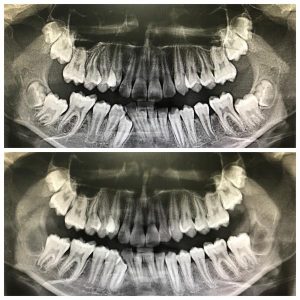
Of course, the bud of the eighth tooth needs to be removed. This is quite a simple and relatively comfortable procedure.
Look at the X-rays. There is a three-week difference between the upper and lower ones. It is clear that after the removal of the eighth tooth buds and ‘unblocking,’ the seventh teeth immediately began to grow.
The wisdom tooth has been removed. The patient is satisfied. But the most interesting part is yet to come. Namely — the postoperative period.
After the removal of the eighth teeth, strict recommendations must be followed:
- Under no circumstances should you rinse or heat the area of the removed tooth. Forget about and ignore advice like 'you should rinse with a concoction of shark fins and mammoth tusks.' No! That should not be done. Why? Because the blood clot, which, as we have determined, should remain in the socket to protect it, can be easily rinsed away. And we will return to the same inflammation and, accordingly, to long healing times.
- Exclude physical activity for at least 2-3 days. Why? Because with activity, the pressure inevitably rises (yes, yes, even Arnold Schwarzenegger and Rocco Siffredi!!!), and since the clot has not yet fully formed, the wound may start to bleed a little and may heal poorly.
- We also avoid general overheating of the body. Saunas, baths, hot baths are prohibited. All these may also contribute to bleeding.
- Do not eat until the anesthesia has completely worn off. Otherwise, the risk of biting your lip, tongue, or cheek severely and not noticing it is quite high. This usually takes about 2-3 hours. Ideally, it's cold food and rest for the first few days.
- Once you finally get to eat, chew only on the side opposite to the extraction to minimize food entering the socket.
- Don't forget about brushing your teeth! Teeth should be brushed regularly, ideally with a soft toothbrush, to avoid injuring the area of the extracted tooth. And remember, the tooth is no longer there, so be especially gentle in that area with the brush. And! Definitely! DO NOT TRY to scrape off the white coating that may cover the gums in the area of the extracted tooth. This is NOT pus! This is FIBRIN! A protein whose presence indicates normal healing of the socket.
- Ice is also provided after the tooth extraction. It is recommended to apply it to the cheek in the area of the extracted tooth for the remainder of the day. Approximately 15-20 minutes every hour. This is also to minimize swelling. But don't overdo it, so as not to freeze your throat and lymph nodes (if you hold the ice in the wrong place or too long).
In addition to these recommendations, medications are also prescribed, namely, antibacterial and anti-inflammatory therapy. This is because the area around the 8th teeth is very prone to inflammation, and we would like to avoid that. Along with taking antibiotics, natural yogurts and other dairy products work well — let's not forget to support gut microflora.
If the extraction was done correctly and the patient followed all recommendations and doctor's orders, then the risks of post-operative complications are quite low.

Stay tuned!
Sincerely, Andrey Dashkov.
Source: habr.com
