

Hello! I wanted to mention that our third book was released yesterday, and the posts from Habr were quite helpful (some even made it into the book). The story goes like this: for about 5 years, people approached us who didn’t understand project thinking, didn’t grasp various business issues, and kept asking the same questions.
We sent them away politely. I mean, we kindly declined, as we didn’t feel qualified to give advice.
Because we weren’t sure ourselves. Then we crossed into small business and moved to medium-sized enterprises, reworking the methodology of plugging holes into proper processes, dealing with all sorts of issues like employee theft, overwhelming bureaucracy, and other joys of a large company, then we sat down with game theory and arrived at a very logical and unexpected solution regarding a major partnership.
That’s when we started answering questions. Notably, these were the same questions that required the same answers. Two years ago, we felt we had the moral right to share what we had learned along the way. Six months ago, the book was finished. Yesterday, it finally came out.
When you write a third book, you start getting a handle on what and how to do it. Below are stories about what you should know when you write your own. Of course, this is my personal opinion, not a ready-made methodology.
How to Write
Create a rough table of contents, write 3-5 chapters with the most interesting content. Then show it to the publisher. In your cover letter, briefly introduce who you are, what you have done, and why it’s important. Our letter went something like this: "It seems to be the best systematic view in Russia on how to conduct a small business." Not without bias, but there were simply no other perspectives. Just recently, Tinkov’s book (judging by the language, Ilyakhov’s) "Business Without an MBA" came out. It’s great, and it’s about similar themes but from a different angle.
The publisher reads your prototype chapters and asks what the hook is. We say — we don’t give advice on how to live. We discuss specific situations and what happened in them. How often does this occur? How to test hypotheses with examples. What to pay attention to so you don’t mess up.
Here’s the table of contents:
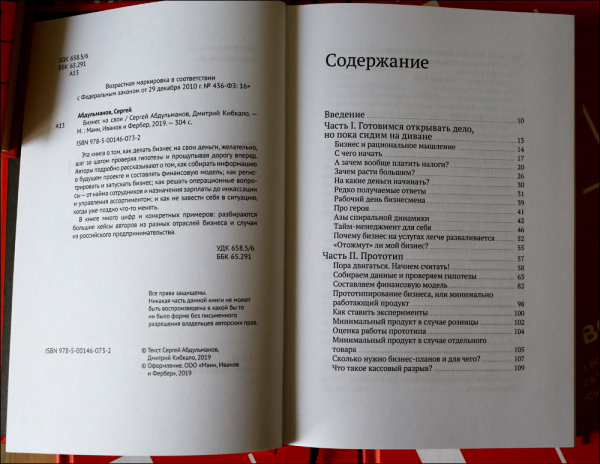
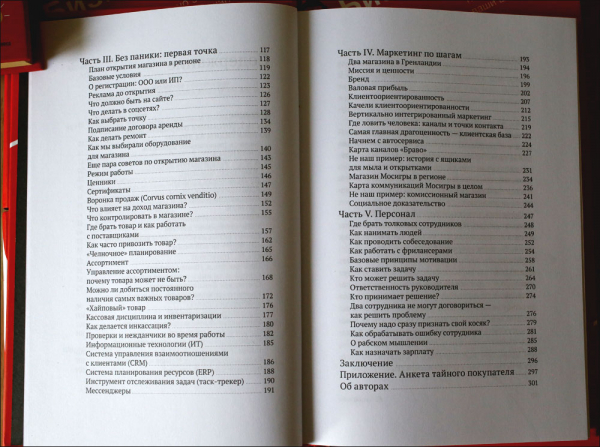
Our main goal is to show not "successful success", but how things really are.
You know, it's like marrying someone you don't know too well. You can enter into this union 'on a whim' and then get divorced, or you can learn something about your potential other half in advance. We're all for the latter. Even if something terrible comes up. Because we've seen people sell their apartments to pay off their business debts. And then end up on the street with their family and two children.
Avoid this if possible.
So, the publisher says — fundamentally 'yes'. And offers to send the manuscript. There's just one last thing to do — draw the remaining owl.
By that point, I had already written two books and had a rough idea of the process. But it was very challenging. We rewrote the book twice because we kept discovering new things. What helped was that we recorded for Coursera in Russian during the process. It contains many ideas that made it into the book. The course helped us understand what we wanted: it has assignments and educational outcomes.
In the assignments, I let loose and got a better idea of what stories were needed for the book. Here are a couple of spoilers with answers:
This is a long text with examples
You decided to check if you can sell ice cream on the beach in a resort town. How would you empirically verify that there will be demand on the beach?
[x] Buy ice cream from a grocery store, get dry ice and a box — sell it for one day.
[] Buy a portable refrigerator and ice cream from a wholesaler and sell it for one day.
[] Acquire everything needed for trading and complete all legal formalities to start operating.
[] Ask acquaintances from other cities.
The faster and with fewer expenses you validate the hypothesis, the better. The origin of the ice cream and other factors won't significantly impact the demand.
You have a product called 'Eyecatching Toothbrush', similar to 'Vivid Toothbrush', but less popular. You planned to sell 2,000 toothbrushes in December, but now it's already April and there are still 1,800 left in stock. Meanwhile, the 'Vivid Toothbrush' is being sold at a rate of 250 units per month. You acquired the 'Eyecatching' at a very good price in November with a prepayment. Returns to the supplier can be no more than 30%. What should you do in this general case?
[x] Return as many as you can to the supplier.
[x] Try to sell them off at a discount or with a promotion like 'buy two for the price of one'.
[] Let them lie on the shelves — they don’t interfere, so let them stay.
[] Let them lie on the shelves, but move them to the worst spot in the display.
[] Remove the remaining stock from sale at the end of the month and dispose of it.
[x] Donate them (as many as left at the end of the month) for humanitarian aid.You have clearly 'frozen' money in this product. Therefore, the task is to free up funds to invest in fast-moving products that will yield higher profits in the same timeframe. First, you return as much as you can to the supplier, and then sell them off at a discount. Oddly enough, you can also use them for donations if you are already doing that — otherwise, you will have to donate something you have in a more liquid form.
The same question regarding the brushes, but now they were sent to you for sale. What changes in relation to them?
[] Return as much as possible to the supplier.
[] Try to sell them off with a discount or a promotion like 'buy two for the price of one.'
[] Let them lie on the shelves — they don’t interfere, so let them stay.
[x] Let them lie on the shelves, but move them to the worst spot in the display.
[] Remove the remaining stock from sale at the end of the month and dispose of it.
[] Donate as many as left at the end of the month for humanitarian aid.Yes, that's correct; in the case of sales, their presence is neither hot nor cold for you. Just push them aside, and if the rental cost of the display space does not exceed the profit from them (which is likely, given their poor placement), then let them stay. They will slowly bring you money.
Should a small store compare itself to a larger one in advertising?
[x] Yes, because being second in the market and nibbling at the first place is always cool. AVIS's strategy — 'We work because we want to surpass them; we have something to strive for.'
[x] No, because you should stand out with your mind, not by belittling your neighbor.
[] No, because then the large one will get offended and start 'pressuring' the small one.
[] Yes, because prices are better in a small store, and everyone should see that.You might laugh now, but options 1 and 2 are correct. Yes, it’s worth it for the mentioned reason — it’s a strong position. But no, it’s not worth it for the second reason stated, because it’s a long-term play. Stores are already in a state of war, so (3) is irrelevant, and prices aren’t discussed. Furthermore, in a village of 700-900 residents, price information is available not through advertising, but from the local grandmothers. Instant and accurate. Perhaps it's better to spread word-of-mouth about comparison products rather than push this in advertising.
What could it mean if a person on the street doesn't know how to find your store — one of 20 stores in the chain?
[x] That he's a newcomer
[x] That you’re not working well enough on local marketing
[x] That he’s an idiot
[x] That you’re not working well enough on global marketing
[x] It’s not a big deal, not everyone has to know, maybe we sell French literature hereThat can mean anything, yes. Only those who are in your target audience should know about you. Work with them.
There were 120 candidates, you invited 30 for an interview, 5 were hired, 3 remained after the first three days. Should you respond to the 25 who didn’t pass the interview?
[x] Yes, inform them that the position has been filled.
[] No, don’t write unnecessarily to avoid reminding them of the negative. Plus, it wastes your time.You should respond to everyone. It's etiquette. Plus, each of them is your potential client. Maintain good relationships.
A customer bought a chair a week ago, lost the receipt, and wants to return it because he no longer likes it. The chair is still in its packaging. Can the return be made?
[x] Yes
[] No
[] At the seller's discretionAccording to consumer protection law — yes, you can return without a receipt. You need to confirm the purchase in some other way — a bank statement, a record in your database, or witnesses will suffice. The reason for the return is not important, only the timeline matters.
A customer bought a book a week ago at another location, wants to return it because it doesn’t match the wallpaper. Do we return it?
[] Yes
[х] No
[] At the seller's discretionBooks, newspapers, sheet music, bras, and other strange items are things that cannot be returned by law. But wouldn't that be great, right?
Crime statistics in the region suggest that there is a 0.273% chance that you will be attacked while transporting money to the bank. You carry money to the bank every evening. The daily revenue averages 30,000 rubles.
The cash collection service costs 40,000 rubles per year, and let's assume the medical bill is 5,000 rubles, after which you recover without impacting your business. Is it economically justified to take such risks?
[x] Yes
[] NoThe probability reaches one over a year, meaning the expected losses amount to 35,000 rubles. Meanwhile, cash collection costs 40,000 rubles.
The book lacks practical exercises, but it contains a lot of real information. Here’s an example:
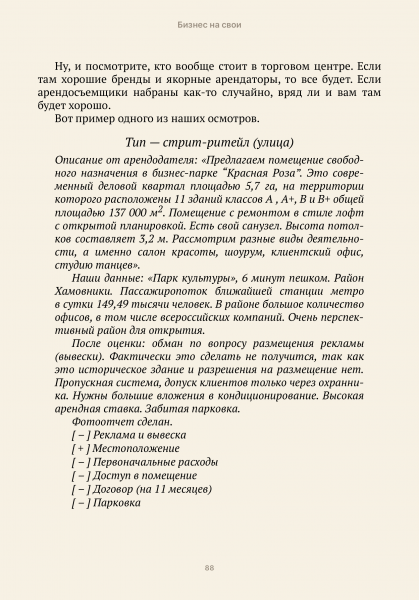
Okay, let’s return to the project. After all, you are the one writing. By the way, working in pairs makes it exponentially easier than working alone, as where one stops, the other already knows what to say, which prevents 'hanging up', plus you gain a second opinion. Many years ago, the first published material — in Astrakhan, for a newspaper — we also wrote together. I recommend it. Night sessions with a huge pile of printouts, writing pens in the 'Cup' under football (because that was the only one that worked) — that’s a bonus.
The next step is for the publisher to take the manuscript. They read it and confirm their opinion that the book will be fine. In our case, the opinion was: 'Oh, I've also learned something for managing the publishing house.' Awesome.
Then comes the contract and all the formalities.
The contract and all the formalities
The publishing house wants an exclusive license, meaning you won't be able to upload a copy without typos to Flibusta. More importantly, the publishing house wants a worldwide license, meaning you can't translate and start selling on Amazon. But they want 5 years, after which you must renew. This means that there are only a couple of years left until I make a break for one day to officially and correctly hand my first book over to pirates.
There is currently a trend in the development of numerous smart speakers and wireless headphones, which is revitalizing the podcast market in the West. We'll notice this in our region in about a year, but audio versions are needed right now. The consequence is that we must immediately sign an addendum regarding audio. It's best to record the audio version in the author's voice, but since I can't pronounce the letter "r," I joyfully declared this and got the opportunity to choose a narrator. Hooray. The problem with the audio version is the tables. They are included in the book. The heavy ones have been linked.
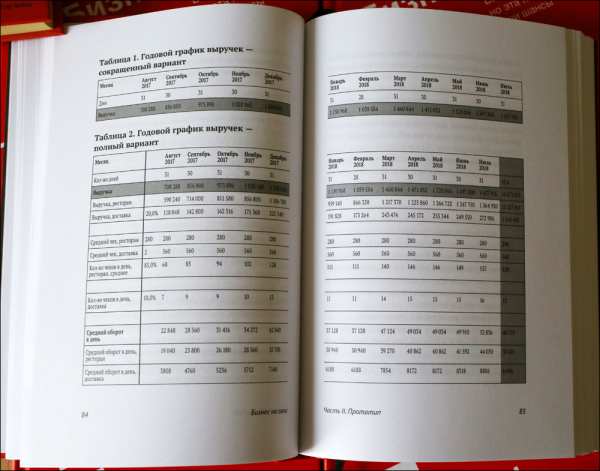
In our contracts, we also changed the order of approvals (not "the publisher suggested, and the author went nowhere," but a more correct one) and the quotation order (I can quote up to half of the book online). Over the years, MIF has become so author-friendly that it's truly delightful.
If the cover was simply suggested to us the first time, now we've been asked to fill out a brief. As a result, we got a design as we wanted, not as it turned out. And without capitalized text. And with more or less correct kerning. And without centering the title.
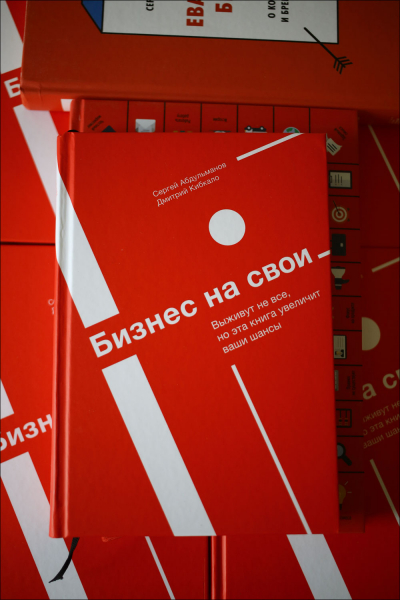
For MIF, this was somewhat bold. But I’m happy.
At the same time, I'm working with an editor and a proofreader. These are publishing services included in the preparation package. In our case, the editor suggested swapping a couple of chapters for better logic, requested a bunch of footnotes with explanations, pointed out where I need to add a few chapters and what they should be about, monitored the logic, and everything else.
The proofreader simply drove me crazy. I returned the first version with a comment that all edits unrelated to errors need to be rolled back. Because the proofreader decided he wanted to write the book himself and corrected everything in the language to the level of an official police report.
The publishing house agreed that they might have gone a bit overboard. And they made it right. But still, there were language corrections, so I had to read everything carefully. By the way, a peculiar joy in defending the language is to say that if anything, I'll replace all terms with the word "hren," because it's a plant and it's literary. This cannot be disputed within the rules. After this revelation, it became somewhat easier.
Oh, and one more thing. They make adjustments in Word, and around the third iteration, they only focus on the corrections. So if you add something as an Easter egg in white text on a white background, later, in the layout, they apply styles, and everything turns black. Note the Latin name for the sales funnel (specifically the funnel) in the table of contents.
Promotion
When you have a formatted preliminary version file (without output data and cover), it needs to be reviewed by people. We gave it to Evgeny from 'Vkusvill', and he wrote a review indicating that they encountered pretty much the same things but are a bit hesitant to talk about it. A couple of others just didn't have time to read it (we shared it with friends from large businesses, and for many, the next window wasn't until May when the print run is coming out), Tinkoff didn’t respond at all.
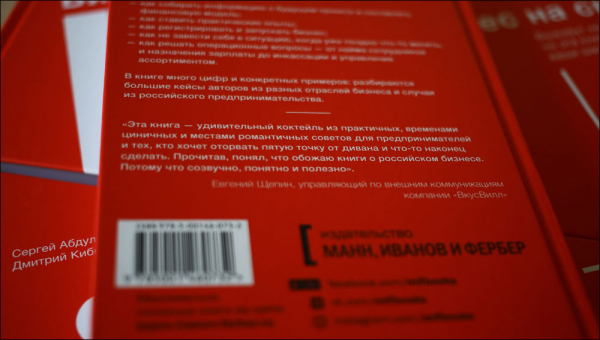
It turned out that MIF doesn’t label the files they send out. That is, in the event of a leak, it’s unclear who leaked it. Here’s the thing: I’m not against leaks, but I want to understand the vectors. So we labeled ours. The technology was described in a science fiction story from my childhood — I recommend the story 'Destruction of Angkor Apeiron' by Fred Saberhagen.
The print run arrives almost at the last minute. This time the format is smaller than 'Business as a Game' and 'Business Evangelist', the paper is thick and white (it used to be thick and yellowish), and the bug with the ribbon bookmark, which could get caught under the cover during production, has been fixed, making it look like this:

This is a rare case in 'Business as a Game'
Then you all collectively agree on participation in promotion. I already knew I would have to talk to journalists, participate in broadcasts, do a signing session (I declined), and this year, an Instagram live was added. Plus, there were requests for additional materials. As usual, journalists will be given chapters to quote directly. I think the logic of breaking down 'Why Pay Taxes' will appeal to them. Spoiler: not because it's important. But because there’s the Gafin principle — you assess the chance of getting caught and the benefit from the crime. And if there is one — it has justification. Plus other reasons. The rational play is that there are smart people in the tax office who build restrictions precisely based on this principle. However, the problem in Russia is that there are also traditions.
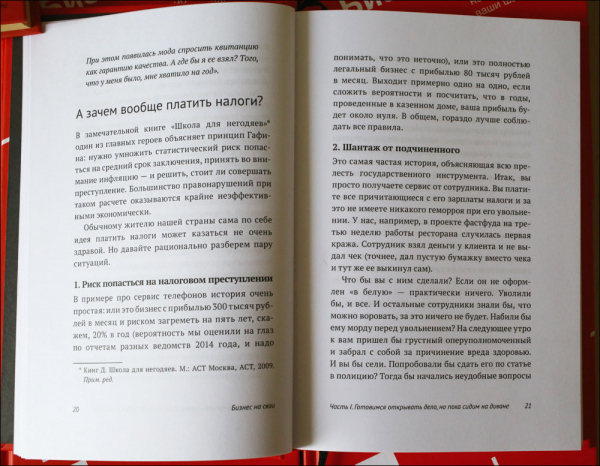
The book itself
There are five main parts:
- Project preparation before you start doing anything: these are basic things like understanding what you are getting into. The story goes: there is a chance to earn a lot and lose a lot. And that will definitely take a couple of years of your time. The first chance is low, the second one is higher. If you could buy a lottery ticket instead of starting a project — would you take it?
- Now for the numbers: we calculate the financial model, conduct reconnaissance, and run experiments. This is the most important part of the project because if you don’t understand on the shore what can and cannot be done — everything will go wrong.
- Opening the first location using a store as an example, everything from beginning to end. Here, you can find some of my posts from Habra, adapted for the book. Why a store? Because it includes all the operations typical for other types of offline businesses, plus more.
- Marketing — the basics. We hardly touch on online aspects (specific details become outdated by the time the book is released), but we provide general principles on how and what to assess.
- Personnel — an extremely important chapter on how to manage a team at a basic level for introverts.
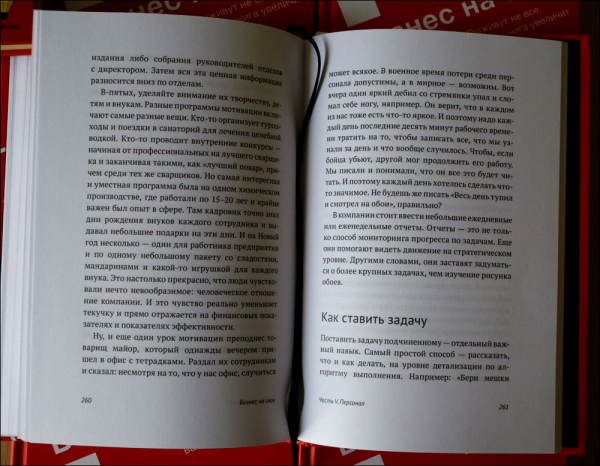
As usual, all this is filled with stories. Major Tosh from my childhood read the previous book and said he was very glad. I think another greeting from the past awaits him.
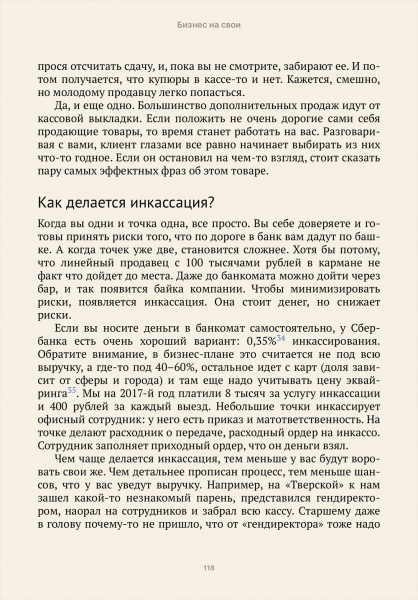
And practice, a lot of practice. Note the last story on this page.
Some chapters are very large and dense with information:
A canvas image under the spoiler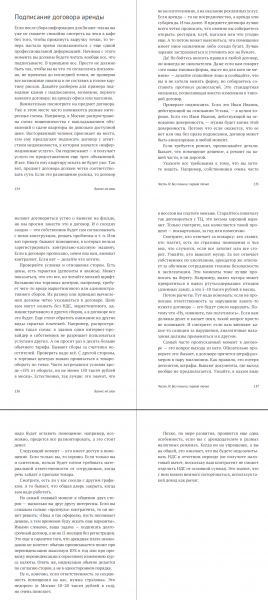
This year we tried an exclusive arrangement with the publisher: it is very important for them to see sales in their online store and build the initial audience (otherwise we would sell everything directly from our website and in our stores). Therefore, for two weeks the book is only with them, but in exchange, they invest much more in promotion than usual and promise good sales numbers.
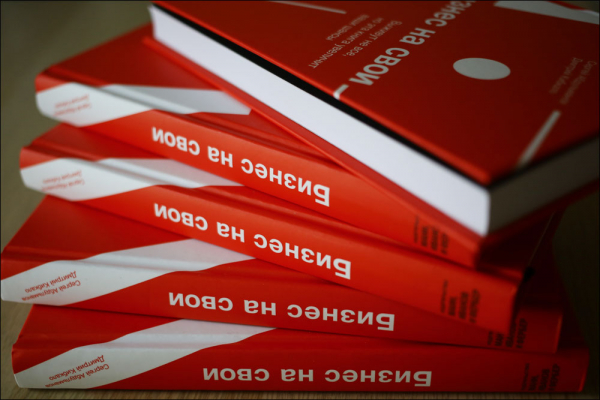
Here , it can also be purchased there. Well, I want to thank everyone who asked us uncomfortable questions (about half of them — on Habra), which helped us really address what is important.
Source: habr.com
