

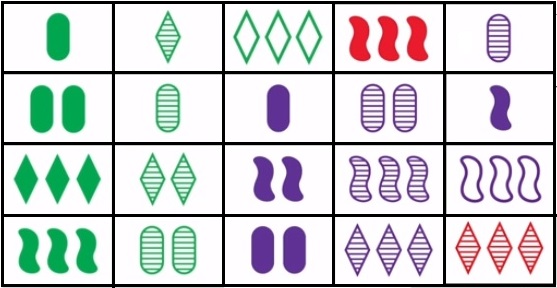
Whoever finds a 'set' here will get a chocolate from me.
'Set' is a brilliant game that we played about 5 years ago. Shouts, screams, photographing combinations.
The game's rules state that it was invented in 1991 by geneticist Marsha Falco, who made notes while researching epilepsy in German shepherds in 1974. For those whose brains are sufficiently exhausted by mathematics, there eventually arises a suspicion that there are echoes of planar geometry and drawing lines through points. (For any two cards there is exactly one card that forms a set with them.)

Marsha Falco seemingly asks: 'So, didn’t you find the “set”?'
Let’s recall the rules
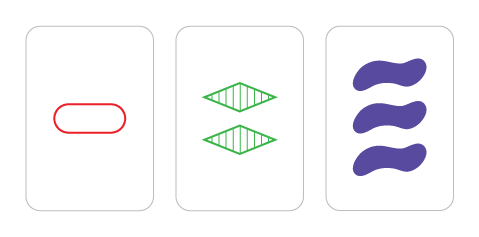
'Set' is a card game. All cards have four parameters, each of which can have three values (thus 3 x 3 x 3 x 3 = 81 cards).
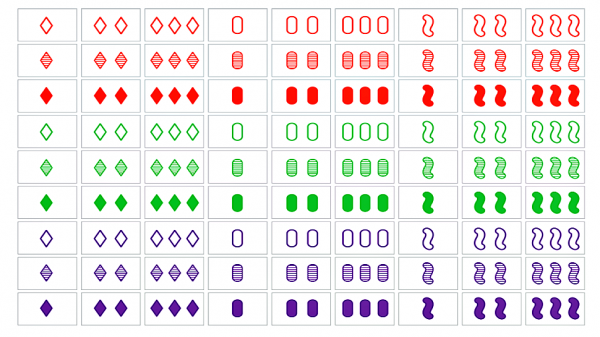
The types and values of the parameters are as follows:
- shape ::= ellipse | diamond | 'squiggle'
- color ::= red | green | purple
- shading ::= solid | striped | open
- number ::= 1 | 2 | 3
The goal of the game is to find special combinations of three cards. Three cards are called a 'set' if for each of the four attributes, the cards are either all the same or all all different.
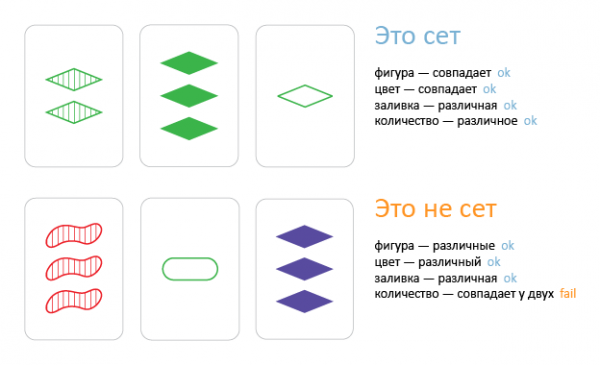
In other words, three cards do not form a set if two cards have one value for a parameter and the third card has a different value. It can be seen that for any two cards, there will always be a third (and only one) that forms a set with them.
Game play: the dealer lays out 12 cards. When someone finds a set, they shout 'Set!' and then calmly take the cards that make up the set. If there’s no set among the laid out cards (it often seems that there isn’t), the dealer lays out three more cards.
The maximum number of cards without a set is 20. The round continues until the deck is depleted. The player who collects the most sets wins.
Mathematicians have provided a combination of 20 cards. Anyone who considers themselves Chuck Norris can forget this picture and try to collect the 'solitaire' without a set on their own.
Or check if there might still be a 'set' here?
20 cards without a set
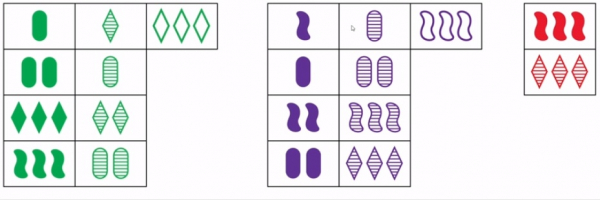
It's easy to check that there is no 'set by color'.
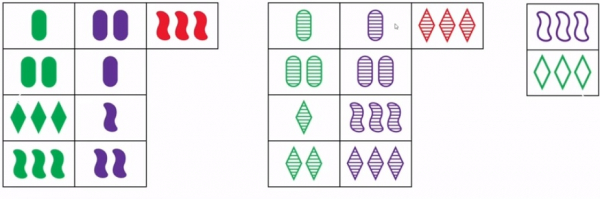
The same cards, but the arrangement shows no sets by the 'shading' parameter.
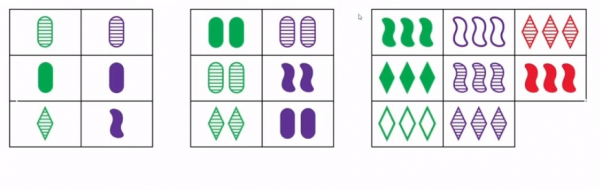
By number.
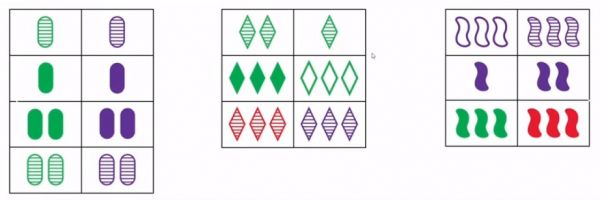
By shapes.
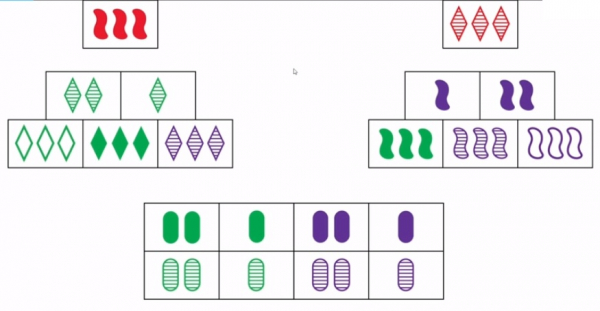
No set by attribute differences.
An open unresolved problem in mathematics
What is the maximum number of cards that can be laid out without forming a single 'set'? The attribute has three values.
with 1 'attribute' — 2 cards
2 attributes — 4 cards
3 attributes — 9 cards
4 attributes — 20 cards
5 attributes — 45 cards
6 attributes — 112 cards
7 attributes — unknown
And when n → ∞?
Video
Game creator:

Alexey Savvateev brilliantly explains the game of Set:

Articles
Source: habr.com
