

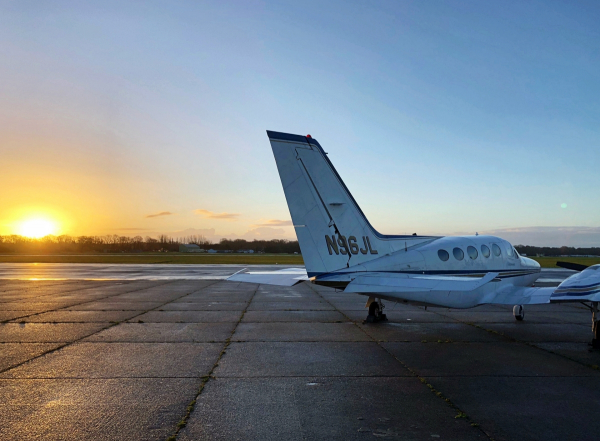
Hello! Today I will talk about how to get into the sky, what you need to do for this, and how much it all costs. I will also share my experience of training as a private pilot in the UK and debunk some myths related to aviation. There’s a lot of text and pictures under the cut 🙂
First Flight
First, let's figure out how to take the controls. Although I am studying in London, I try to fly in every country I visit. In all countries, it is done in roughly the same way.
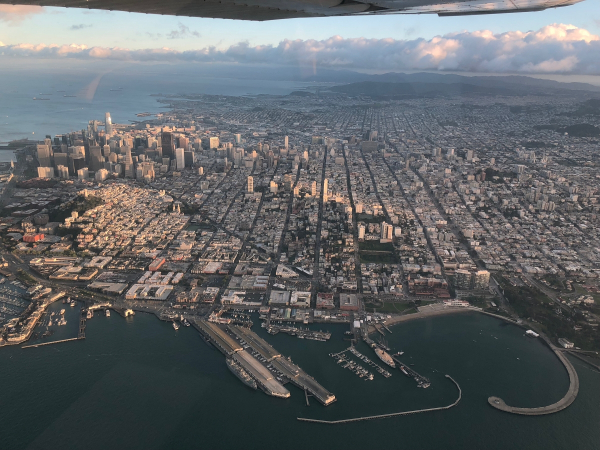
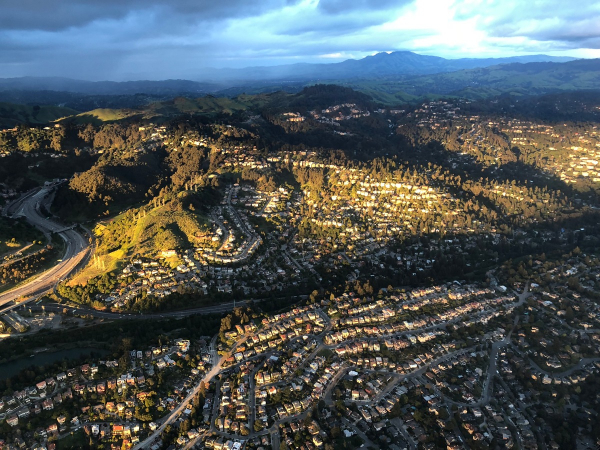
San Francisco from 3000 feet, sunset
First of all, you need to find the nearest airfield. For Russia, Ukraine, Belarus, and Kazakhstan, it's worth checking out and looking for airfields there. In Europe and the USA, you can just Google airports. We need small (Heathrow won’t do!) airfields as close to the city as possible. If the search yields nothing, you can install a trial version of ForeFlight / Garmin Pilot / SkyDemon and look for airfields on the map. In the end, you can ask acquaintances who are pilots (if any) or look for aviation chats on Telegram.
Here is a list of airfields I know for some cities:
- Moscow
- Aerograd Mozhaisky
- Vatulino Airfield
- Saint Petersburg
- Gostilitsy Airfield
- Kiev
- Chayka Airfield
- Borodyanka Airfield
- Gogolev Airfield
- London
- Elstree Aerodrome
- Biggin Hill Airport
- Stapleford Aerodrome
- Rochester Airport
- Frankfurt
- Saint-Cyr Aerodrome
- Cannes, Nice
- Aéroport Cannes Mandelieu
- Rome
- Rome Urbe Airport
- New York
- Republic Airport
- San Francisco, Oakland, Valley
- Hayward Executive Airport
Once we find the airfield, we need to look for information about flight schools on its website. In principle, we can also start Googling for flight schools right away. If we can’t find a flight school—look for any 'flights on airplanes in St. Petersburg'. Our task now is to find someone willing to show us the world of aviation.
Now we just need to contact the person we found. We call, ask for the opportunity to fly the plane (in English it’s called a trial or gift flight), book a day that works for us, and that’s it. There’s nothing more to do.
A simple phone call is all that stands between you and a real flight on a real airplane. Contrary to popular myths and stereotypes, you do not need to pass a flight medical examination or take theoretical exams for this. It works even when you're just a tourist. Even if you have no idea how to operate an aircraft.
Such a pleasure will cost about $220 per hour. This figure includes: fuel costs, aircraft maintenance fees, your instructor's salary, as well as takeoff and landing fees at the airport. The price may vary slightly depending on the country (it's a bit more expensive in England, a bit cheaper in Russia). Yes, it's not the cheapest pleasure, but at the same time, it's not astronomically expensive. You don't have to be a millionaire to rent a private plane. Plus, you're usually allowed to bring passengers along, and they can also split the cost of the flight with you.
I want to emphasize separately: getting into the sky is very simple, all it takes is a phone call. And it's worth it. No words, photos, or videos can convey the sensations that unfold during flight. Each person's experience is unique. It’s a feeling of freedom, inspiration, and new horizons. Taking control of your own life can be a bit daunting at first, even with an instructor by your side. However, after the first flight, you realize that more effort is needed to start taking risks. Flying is no more difficult than driving a car; it just requires a considerable amount of knowledge for safe operations. The instructor ensures safety.
Be prepared that you won't be allowed to take off and land during your first flight. Generally, airports for private aviation are not very large and have various local peculiarities (trees at the end of the runway, short runways, dirt runways, “humped” runways). There are practically no exceptions for simulator enthusiasts and pilots. However, the amount of new information will already be overwhelming, so you won’t get bored 🙂
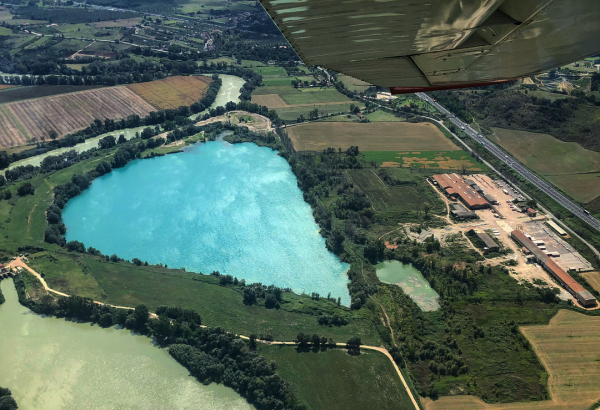
A curious body of water near Rome
Pilot licenses
Okay, let's assume that you like flying and now you want to have your own license. Is it difficult to make it happen? The answer depends on which specific license you want. There are three main types of licenses.
PPL (Private Pilot License)
Capabilities:
- Non-commercial flights on airplanes. In other words, you are not allowed to earn money from this.
- However, in some countries, you can share the cost of fuel with passengers (yes, you can take passengers onboard).
- You can fly a vast range of aircraft, from piston planes to some jets.
- You are not allowed to fly aircraft certified for commercial licenses (e.g., Boeing or Airbus).
- You can rent planes from many flying clubs or buy your own (and it's much cheaper than it seems).
- The license is valid worldwide; the only limitation is that you can only fly aircraft registered in the country that issued your license (in America, you can fly with a Russian license on a Russian plane).
- You can come to Russia with a foreign license and, with almost no training, obtain a Russian license (thus unlocking all Russian aircraft). This process is called validation.
- You can cross international borders.
Requirements:
- A medical certificate confirming flight fitness. The requirements are quite lenient, including vision.
- Completed theory course, the simplest one. More details below.
- Having a small amount of flight time (42 hours in Russia / 45 in Europe / 40 in the U.S.).
- Passed practical exam.
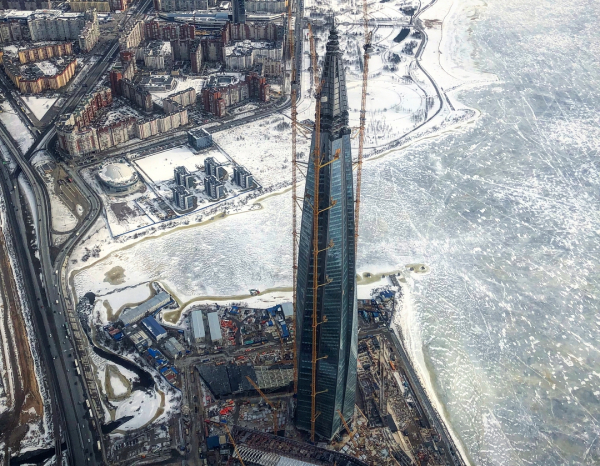
Lakhta Center, St. Petersburg.
Commercial licenses are hidden under a spoiler.
CPL (Commercial Pilot License)
Capabilities:
- Everything is the same as for PPL.
- Working in airlines or business aviation.
- Flights on passenger liners.
Requirements:
- Possession of a PPL.
- About 200 hours of flight time with a PPL.
- Stricter medical examination.
- Stricter exams.
ATPL (Airline Transport Pilot License)
Capabilities:
- Everything is the same as in CPL.
- Ability to work as a captain of an aircraft on airliners.
Requirements:
- Possession of a CPL.
- Possession of around 1500 hours of flight time with a CPL.
- Typically, this license is required by airlines.
As you can see, each subsequent license level requires the previous one. This means that by obtaining a private pilot license, you unlock the opportunity to receive a commercial license, and potentially move on to work for an airline.does not work in Russia, they still want a diploma from the vocational school.).
In addition to licenses, it is worth mentioning the so-called ratings, which open up additional opportunities for each type of license:
- Night Rating — flying at night.
- Instrument Rating — flying in instrument conditions (for example, in fog). It also allows you to fly on air routes.
- Multi-Engine Rating — flying on aircraft with two or more engines.
- Type Rating — flying on a specific model of aircraft. This usually involves complex airplanes like Airbus or Boeing.
- And a bunch of others, according to your taste and imagination.
From here on, we will consider the peculiarities of training for PPL — given that the author does not have the rest 🙂.
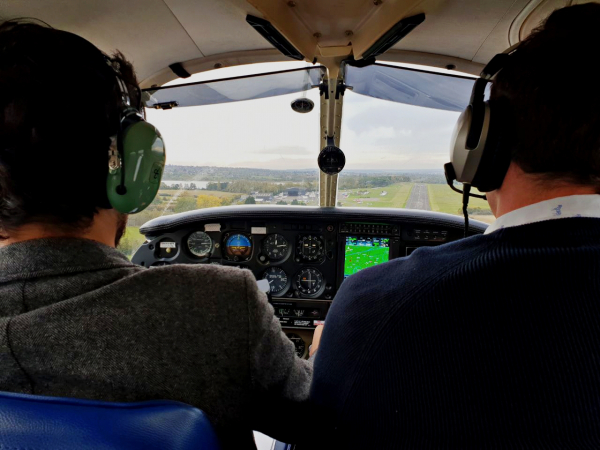
Approach for landing in London.
Before training.
Abroad, there are many organizations that standardize licenses, but for now, it is worth highlighting two:
- FAA (Federal Aviation Administration) — licenses for the USA.
- EASA (European Union Aviation Safety Agency) — licenses for all of Europe (which means you can fly a French aircraft with an Italian pilot license).
To obtain an FAA license, you usually fly to Florida. The weather conditions are good there and there is a wide selection of schools, but prices are not the cheapest. Alternatively, you can train in the central part of the States (for example, Texas) where prices will be slightly lower.
EASA licenses are obtained in Spain, the Czech Republic, or the Baltic countries. They offer a good balance between weather and training costs. After completing training, both licenses can be easily validated in Russia.
Of course, no one prevents you from learning to fly in Russia. However, it is worth noting that there have been cases in Russia where flight schools closed and licenses of their graduates were revoked. A well-chosen flight school largely protects you from such situations, but no one can provide guarantees.
Good flight schools place a significant emphasis on flight safety, psychology, and the development of proper leadership qualities. You will learn to meticulously check checklists, carefully analyze weather conditions, avoid any risks in every situation, and make sound decisions. Statistics on incidents show that this approach truly works.
Also pay attention to the training format. Some flight schools offer the option to pay for all required flight hours upfront, while others provide packages of 10 hours, and some simply charge separately for each hour of flight. Choose the training format that works best for you. For example, if you live nearby, paying hourly may be the most convenient format. Keep in mind that there is no requirement to complete your training within a specified timeframe—you can fly as little as one hour a month until you accumulate the necessary flight hours.
Theory is sometimes taught on-site and sometimes provided through self-study with books. In the United States, you may also be offered instructional videos.
Carefully examine the condition of the airplanes and note how well the instructor prepares you for procedures during the trial lesson. A good instructor should teach you to read the checklists thoughtfully and avoid skipping them, especially when there's enough time.
Finally, it makes sense to undergo a medical examination before starting your training. The European medical certificate is issued quite easily, with minimal requirements on your part. The Russian VLEK, which many find intimidating, is also greatly simplified for private pilots. However, there is a risk of not passing, and it’s better to find out before you start spending money on training. In Russia, this is actually a legislative requirement.
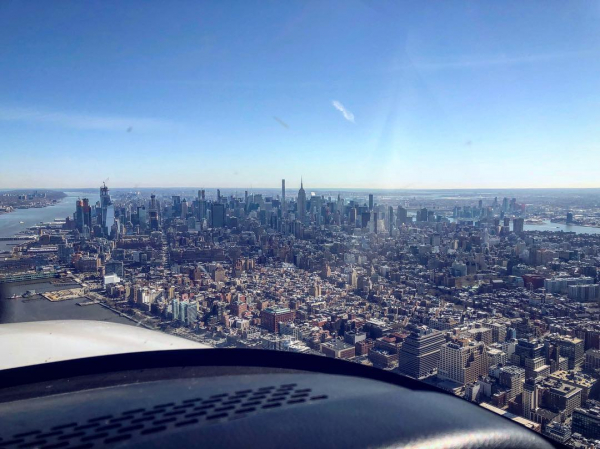
Manhattan, New York
Theory
From here on, I will discuss the training for the EASA license. Details will vary in other countries.
Theory is not as daunting as it seems. You will need to read a few books and prepare for 9 theoretical exams.
- Air Law — Learn about types of airspace, flight rules, border crossing, and the requirements for aircraft and pilots.
- Operation Procedures — will explain some procedures, such as extinguishing fires in flight, landing on wet runways, dealing with wind shifts, and wake turbulence from other aircraft.
- Human Performance and Limitations. Optical, auditory, and spatial illusions, the impact of sleep on flights, aviation psychology, decision-making, and first aid.
- Navigation — navigation in the sky. Navigation calculations, accounting for wind, correctly identifying landmarks, correcting navigation errors, fuel calculations, and the basics of radio navigation.
- Communication. Communication with controllers, flight procedures in different airspace classes, signaling emergencies and distress, crossing airspaces and militarized zones.
- Meteorology. How clouds and winds form, which clouds to avoid, hazards at weather front boundaries, and how to read aviation weather reports (METAR and TAF).
- Principles of Flight. Where lift comes from, how the fin and stabilizer work, how the aircraft is controlled along three axes, and why stalling occurs.
- Aircraft General Knowledge. How the aircraft is constructed, its systems, how the engine works, and all instruments.
- Flight Performance and Planning. Calculating the aircraft's balance, its loading, and the required takeoff distance.
Yes, the list seems impressive, but the questions on the exams are quite simple. Some just memorize the answers. However, I wouldn't recommend doing that—each of these subjects is essential and can save your life.
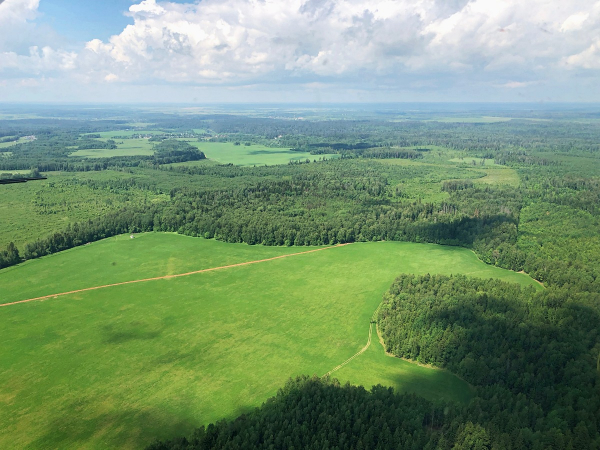
Flights in the Moscow Region, the surroundings of Vatulino
Practice
Practice often begins concurrently with theory, and sometimes even before.
You will start with the basics—how control surfaces and engine thrust affect the aircraft's behavior. Then you will learn to taxi on the ground and maintain straight and level flight in the air. After that, you will master the correct techniques for climbing and descending. In the next lesson, you will be shown how to turn properly, including during climbs or descents.
Then a bit of excitement will begin. You'll start doing slow flights with a stall warning sounding, followed by the stall itself and possibly a spin (yes, almost all training aircraft can do that). You'll also learn how to perform turns with a steep bank and recover the aircraft from a spiral—a rather tricky maneuver. As you can imagine, this is essential for developing the skills to avoid such situations and, in cases of emergencies, to exit them safely.
Next, the so-called circuits at the airfield will finally begin. You will fly a rectangular pattern around the airfield while learning to take off and, indeed, land. Once you confidently land the aircraft, including in crosswinds, without an engine and flaps, you'll be entrusted with the holy grail of any trainee—a solo flight. It will be scary, even if you feel like a bird in the air.
From this point on, you will be given more opportunities to fly solo. The sky does not forgive uncorrected mistakes, and you will have to realize this on your own, without an instructor guiding you. You will learn the most important skill of a pilot—the ability to make decisions. Naturally, you will be monitored very closely from the ground (and assistance will be provided if necessary).
Then you will start flying cross-country. You will begin to fly to other airfields, navigate out of situations where you are lost, plan route changes in the air, and attempt to intercept radials from radio beacons. You will fly to a designated point and turn back, then head to another airfield and, perhaps, finish by flying to a large controlled international airport. All this will start with an instructor and then move to solo flights.
Then you will begin preparation for the exam. First, you'll need to complete a long and complex cross-country flight with several stops at airports. By yourself. It's called a cross-country solo. You will then repeat some of the exercises from the beginning to ensure you can pass the exam.
And then there's the exam itself. It consists of several sections and takes several hours. Its purpose is to ensure that you can fly—not perfectly, but safely.
In Europe, you will also need to pass a practical radio communication exam and possibly a separate English language exam. The latter will not pose much of a challenge after reading books and practicing radio communication that you will learn during flights 🙂
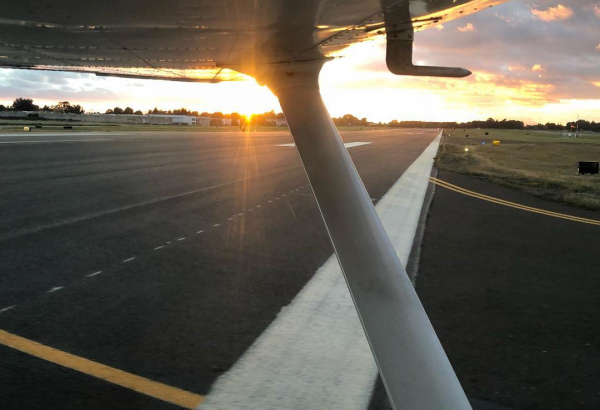
Sunset flights are breathtaking, but there's no point in them without sunglasses.
Inspiration
Aviation is not just about flying. It's an opportunity to realize much more than we have access to. It teaches us to be responsible, to handle mistakes properly, to listen to others, and to inspire them. It provides the opportunity to learn decision-making, effective team management, correct assessment of one's resources, risk management, and safety evaluation. It allows you to be anywhere and see familiar cities from entirely different perspectives.
It's a chance to connect with one of the most curious communities, where people almost always try to help each other. An opportunity to meet many interesting individuals and make new friends in nearly every corner of the world.
Let me reiterate that no text, video, or photo can convey the feelings of a minute in flight. You need to come and experience it for yourself. And it's not that difficult. Come to the skies, and try it out! Here's a bit of inspiration for you:
- My , where I regularly share my flying experiences.
- Denis Okanya
- Channel on YouTube
- Channel on YouTube
- Channel on YouTube (in English)
I would like to take this opportunity to express my immense gratitude to everyone who reviewed the article before publication.
Wishing you a smooth takeoff, and perhaps we will hear each other again on the frequency!
Source: habr.com
