

It is generally accepted that programming languages such as Rust, Erlang, Dart, and some others are among the rarest in the IT world. As I recruit IT specialists for companies, constantly interacting with tech professionals and employers, I decided to conduct my own research to find out if this is really the case. This information is relevant to the IT market in Russia.
Data Collection
To gather the information, I examined the number of job vacancies that required proficiency in these languages, as well as the number of resumes featuring this skill. I collected data from LinkedIn, HeadHunter, and through the Amazing Hiring service. Additionally, I have personal statistics on applications to my agency.
In total, my research focused on eight languages.
Rust
Global Statistics: According to statistics as of 2018, Rust ranked first (for the third consecutive year) on the list of developers' most loved languages and sixth in the list of most expensive languages by salary level ($69,000 per year).
Despite the language being quite popular worldwide, in Russia it remains one of the rarest programming languages.
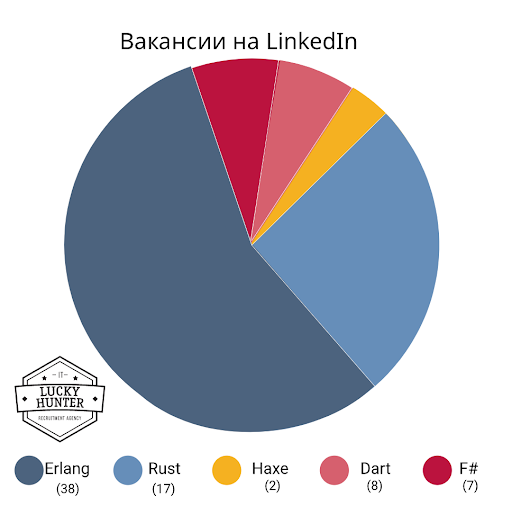
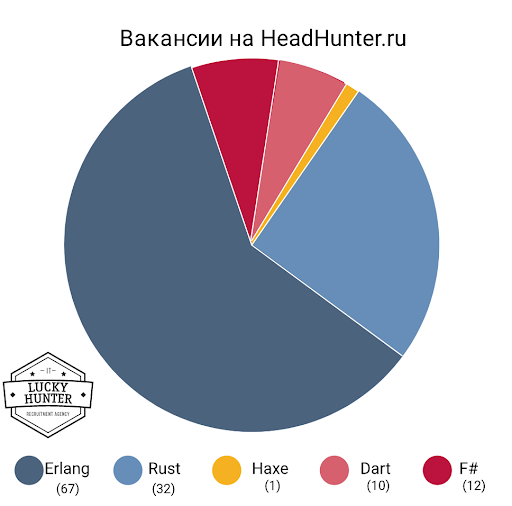
In key skills, knowledge of Rust was found among 319 specialists on Headhunter and 360 on LinkedIn. However, only 24 developers identified themselves as Rust developers on Headhunter. It is informally believed that only two companies in Russia use Rust. There are 32 companies offering jobs to Rust developers on Headhunter and 17 on LinkedIn.
My agency regularly receives applications for Rust developer positions. However, there are so few specialists that I already feel acquainted with all the Rust development experts in the country. Therefore, in the case of Rust, many candidates interested in the vacancy learn the language as they work on the tasks.
Erlang
According to the same statistics Erlang is not far behind Rust and has also made it onto various rankings. On the list of developers' favorite languages, Erlang occupies the twenty-first position, and in terms of salary level, Erlang follows Rust closely, ranking seventh ($67,000 per year).
On Headhunter, there are 67 job offers for developers skilled in Erlang. On LinkedIn, there are 38. When it comes to resumes, direct proficiency in Erlang as a key language (mentioned in the headline) was only found in 55 developers on Headhunter and 38 specialists had Erlang listed in their job titles on LinkedIn.
Moreover, there is a trend of hiring individuals proficient in Google's Go or Golang instead of Erlang developers, as they are more numerous and demand lower salaries. However, my personal opinion (based on my agency's data) is that Go will not displace Erlang, as Erlang is indispensable for truly high-load and complex projects.
Haxe
It is mainly used for game development. There are hardly any job openings (literally one on Headhunter). On LinkedIn, only two companies require knowledge of this language. Regarding supply, nearly two hundred developers listed this language on LinkedIn, while on Headhunter there are 109, of which 10 highlighted Haxe in their resume titles. This indicates that the programming language Haxe is under-demanded in the Russian market, with supply exceeding demand.
Dart
Invented by Google, this language is becoming increasingly popular in the market. There are 10 job postings on Headhunter and 8 on LinkedIn, though employers do not list this language among their key skills. The main requirement is a solid background in JavaScript and a competent approach to problem-solving.
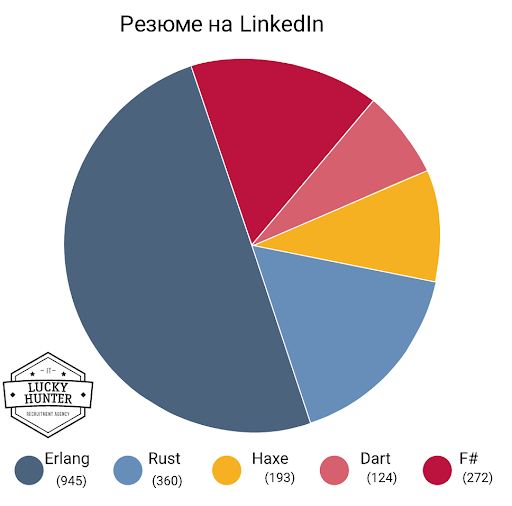
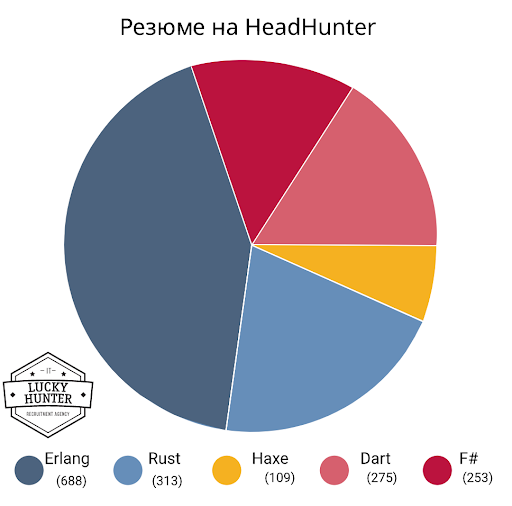
The number of developers familiar with this programming language is 275, but again, only 11 consider Dart their main skill. On LinkedIn, 124 people mentioned the language in their resumes in one way or another.
My personal experience and my agency's statistics indicate that this language is already being used by major IT companies. This suggests it will soon be removed from the list of rare programming languages. Moreover, specialists who are proficient in Dart are commanding high salaries in the market.
F#
A fairly rare programming language developed by Microsoft. There are only a few companies in Russia (12 on Headhunter and 7 on LinkedIn) looking for F# developers. In other cases, knowledge of the language is optional. Interestingly, the number of developers knowledgeable in F# is gradually increasing. The language has even made it into a recent ranking. It ranks ninth among the most beloved languages among developers, and in terms of salary level, it turned out to be first ($74,000 per year).
When it comes to the number of published resumes, there are 253 on Headhunter, but very few specialists consider F# as their primary language. Only three people mentioned F# in their resume title. The situation on LinkedIn is similar: 272 developers mentioned F# in their portfolios, with only six listing F# as their position.
The statistics are as follows:
The total number of vacancies is 122 on Headhunter and 72 on LinkedIn. The most in-demand language among those studied is Erlang. More than 50% of companies are asking for knowledge of Erlang. The least demanded language turned out to be Haxe, with only 1% and 3% of companies on Headhunter and LinkedIn respectively seeking specialists with knowledge of Haxe.
The situation with published resumes is quite similar. Of the 1,644 published resumes on Headhunter, over forty percent (688) relate to Erlang, while the least resumes (7%) were posted by specialists with Haxe development skills. The data from LinkedIn differs slightly. The fewest resumes were published by individuals proficient in Dart, with only 124 out of 1,894 portfolios related to Dart development.
Opa, Fantom, Zimbu
I decided to combine all three of these languages into one point for one simple reason — they are truly rare languages. There are no vacancies and practically no resumes. One can count the developers who included any of these languages in their skills on their fingers.
Since these languages are not included in the annual Stackoverflow report, nor are they found in job vacancies, I will write a few words about what these languages are.
Opa — a web programming language that aims to replace HTML, CSS, JavaScript, and PHP all at once. Developed in 2011, Opa is provided for free and is currently only available for 64-bit Linux and Mac OS X platforms.
Fantom — a general-purpose language that compiles to Java Runtime Environment, JavaScript, and .NET Common Language Runtime. Developed in 2005.
Zimbu — a unique and specific language that can be used to develop just about anything from GUI applications to OS kernels. Currently considered an experimental language, not all of its features are fully developed.
In addition to programming languages, I also included the position of cybersecurity specialist. The number of job openings compared to the number of resumes is low (about 20). This means that supply exceeds demand (similar to the case with Haxe), which is quite atypical for the IT sector. Salaries for information security specialists are not high. For instance, in Saint Petersburg, an experienced cyber security specialist is offered 80,000 to 100,000 rubles.
My small research shows that the 'top' programming languages to learn are Rust, Erlang, and Dart — there is demand and high salaries. In contrast, lesser-known languages like Haxe, Opa, Fantom, and Zimbu are not in high demand. F# is popular abroad, but the Russian IT market has not yet embraced this language.
Source: habr.com
