


Dear friends, in previous articles, we discussed — and . Today, I'd like to shift gears a bit and talk about dental implants, specifically immediate implantation — when the implant is placed directly into the extraction socket of the removed tooth and about sinus lifting — the increase in bone tissue volume in height. This is necessary when placing implants in the area of the 6th, 7th, and less often, 5th teeth on the upper jaw. Bone augmentation is needed because there is a cavity in the upper jaw — the maxillary sinus. Most often, it occupies a larger part of the upper jaw, and the distance from the edge of the bone to the bottom of this sinus is insufficient for installing an implant of the required length.
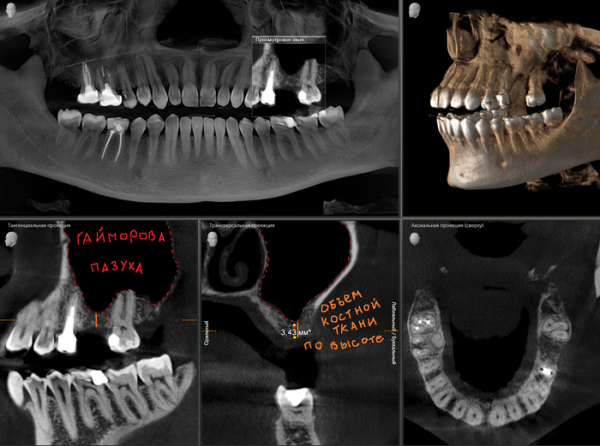
Computer tomography clearly shows that there is a gap in the area of the missing tooth.
I often hear doctors say, "No, no, no, we cannot place the implant right away! First, we will remove the tooth, and once it heals, we will install it!" A reasonable question — why? Who knows. I'm curious myself. Either it's due to uncertainty in predictions or fear of complications, which are actually no more than with a classic operation. Of course, provided everything is done correctly. In my practice, the percentage of immediate implantation compared to the classical approach is about 85% to 15%. Agree, that's quite a lot. Where practically every operation that involves tooth extraction ends with implant placement. The only exception might be acute inflammation in the area of the problematic tooth, when pus is mixed with mucus. Or when the implant is completely unstable and wobbles in the socket like a pencil in a cup. Financial capabilities also play a significant role. Everyone is more willing to spend money on anything but dental work. This is undeniable. But there is one "but"! You must understand that the longer the time passes from the moment of tooth extraction to the beginning of prosthetics, the worse the conditions for placing the implant become. As they say: "an empty space is never truly empty." Over time, a number of severe problems arise that also need to be addressed. And this always means additional, often considerable expenses. Do you really want that?
So, let's move on to the examples.
The simplest case of immediate implantation is a single-rooted tooth, whether it's in the upper or lower jaw.
This computed tomography was taken before the tooth completely fell apart.
What do we see?
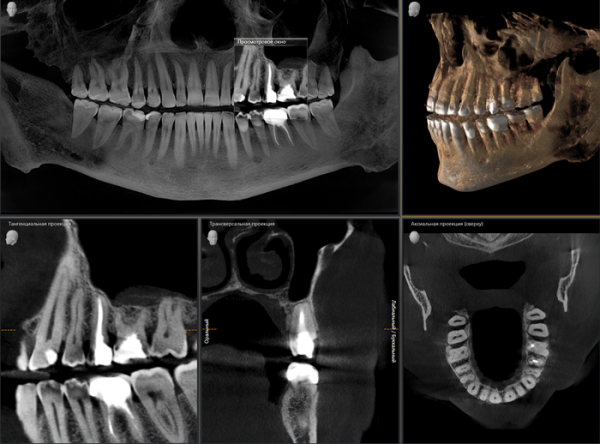
The upper left 5, which is not suitable for therapeutic or orthopedic treatment. What do we do? Right — we remove the tooth and screw in a bolt.
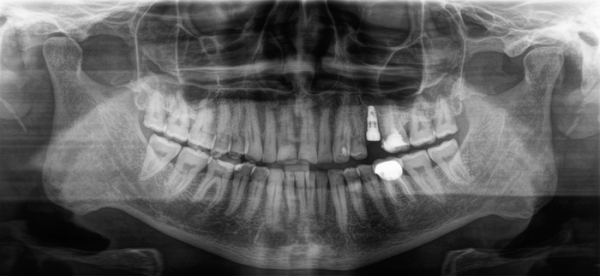
I performed a delicate, atraumatic tooth extraction and installed an implant with a gingival former.
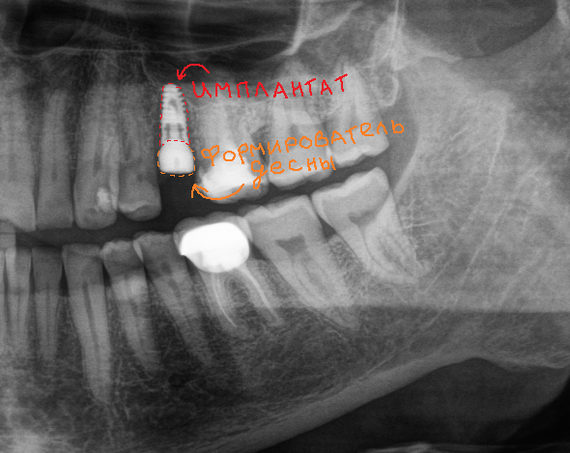
A gingival former is something like a low (about 3mm high) metal stump that slightly protrudes above the gum level, thereby shaping its contour before placing the crown. It looks something like this:
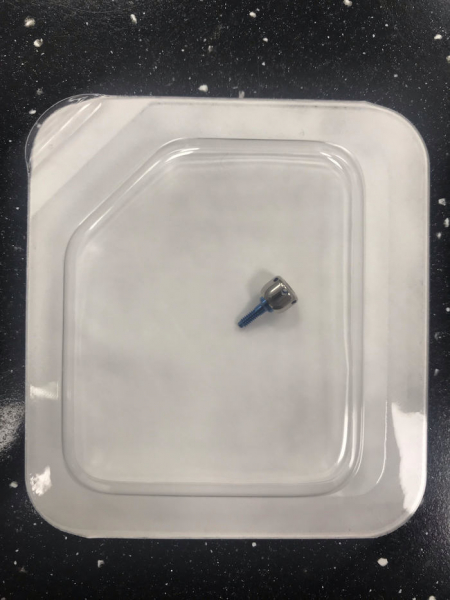
And here is what the implant looks like:
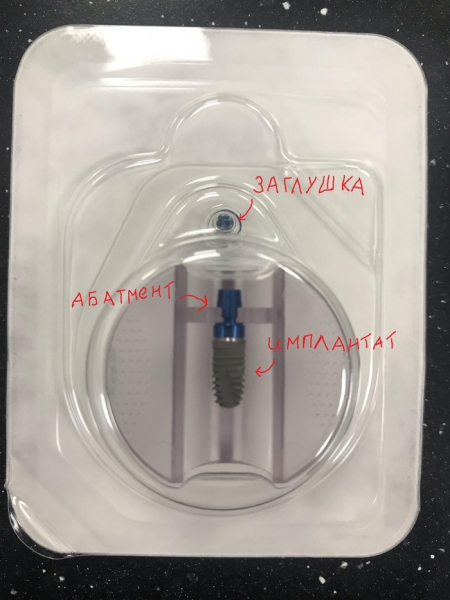
The gray part is the implant itself. The blue part is the so-called temporary abutment, on which a temporary crown can be attached if the implantation involves immediate loading. Mostly, this abutment serves as an implant holder. After the implant is installed, the abutment is unscrewed like a constructor with a special screwdriver, and in its place, a plug is screwed in. This is done if it is impossible to install the gingival former immediately. Then the implant and all its components remain completely beneath the gum, so after the operation, we won't see anything in the oral cavity. Well, except for stitches and... other teeth, if any are left. In this case, the former is installed only after the implant integrates.
Next, we choose the next level of complexity when we have to remove the 6th tooth on the lower jaw. This tooth is double-rooted. Of course, we will not install one implant in the area of each root, as someone might think. Although I have seen similar cases. The doctor apparently had a mortgage to pay off.
Thus, we need to install one implant, but clearly in the center. We will aim for the bone septum between the two roots.
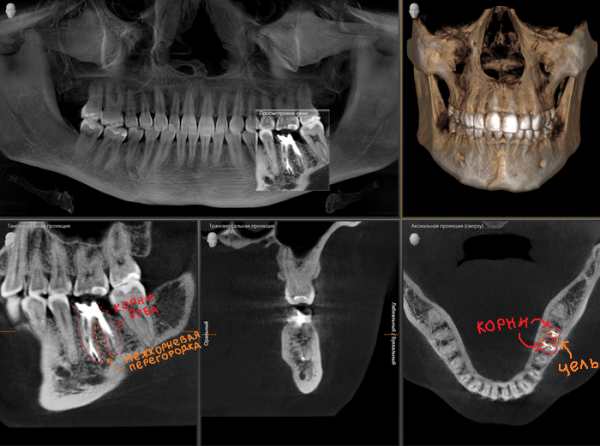
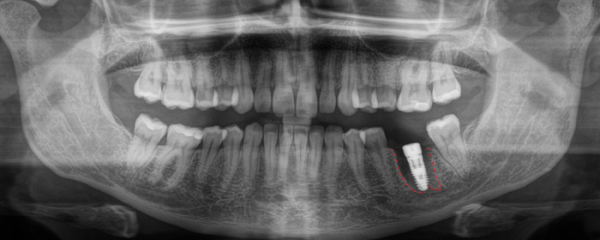
We install the implant. The sockets from the recently extracted tooth are clearly visible to the left and right of it in the image, which will gradually close up as healing occurs.
Now it's time to consider the case where a tooth needs to be removed, an implant placed, and bone augmentation performed on the upper jaw – sinus lifting. Meanwhile, the level of complexity is increasing. It's not a helicopter mission from Vice City, of course, but you need to be a little more careful than in the previous case.
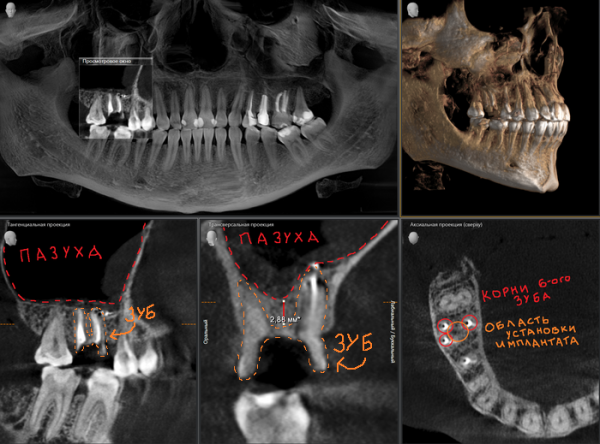
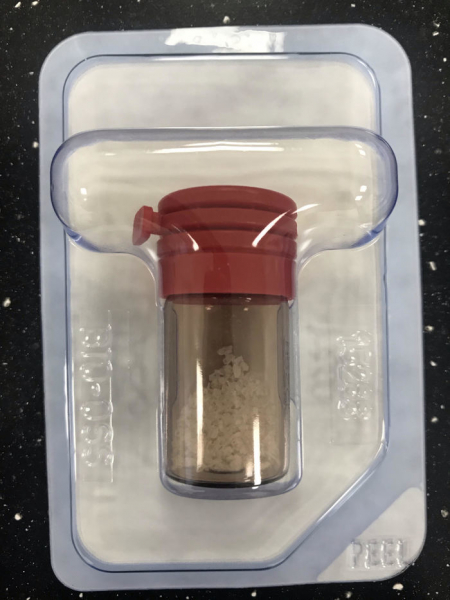
Remember I mentioned that the implant should be positioned centrally? Well, a three-rooted tooth is no exception. The implant is placed, just like in the previous case, in the septum, but now of a three-rooted tooth. As we can see, the bone height in this area is about 3mm. This volume is insufficient for placing an implant of optimal length, so the volume needs to be increased. The procedure is performed using a special 'bone material.’ Some call it 'bone powder,’ not to be confused with 'white powder,' although it is white, but is still presented in the form of granules. It is available either in glass containers,
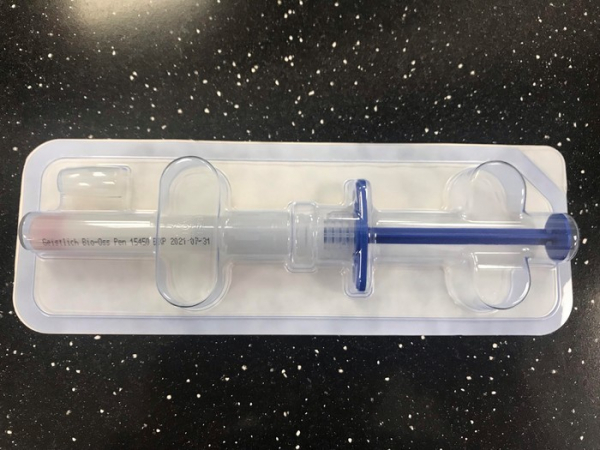
or in a more convenient form — special syringes, which make it easier to work with and introduce the material into the operative field.
It would be a mistake to think that sinus lifting is an operation 'in' the maxillary (antrum) sinus. In reality, the procedure is performed 'under' it. As we have already established, the sinus is a cavity in the upper jaw, an emptiness, if you like, lined internally with a thin mucous membrane with ciliated epithelium. To ensure the operation is successful, local detachment of the mucous membrane from the bone tissue is performed, and the 'bone material' is placed in the resulting space between the bottom of the sinus and the mucous membrane, like in an envelope. In this case, it is done alongside the installation of the implant.
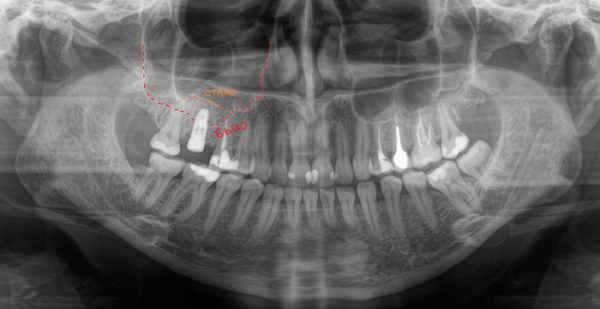
And now an example of sinus lifting and implantation, but two months after the removal of the sixth tooth from the upper jaw. This patient had their sixth tooth removed about a week ago at another clinic. The assistant performed a computed tomography scan.
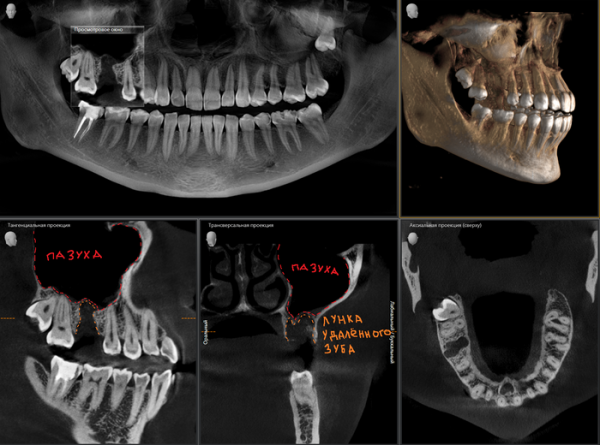
Since only a week has passed since the extraction, we see a "dark hole" in the image, similar to what your ex left in your heart. It's the area where the tooth used to be. In other words, there's no bone tissue in this region. I began the surgery two months later. We didn't perform a follow-up CT scan after the socket healed, but believe me, everything had healed sufficiently to proceed with the surgery. During the operation, we couldn't achieve firm stabilization of the implant, so I decided to install a cap instead of a gum former. Why? Because if the patient starts chewing dry bread, there could be significant pressure on the implant, particularly the gum former, which may cause the implant to loosen or "fly away" into the sinus. We also disposed of the eighth tooth.
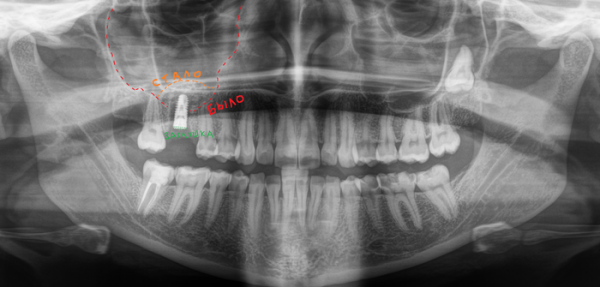
Now, the last example for today — the extraction of 2 teeth, the installation of 2 implants, and a sinus lift.
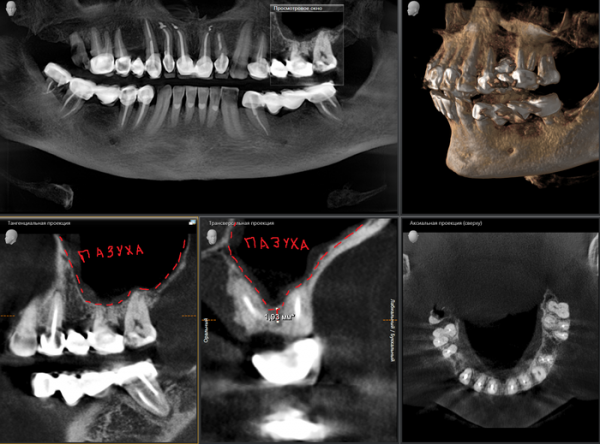
As we can see, the conditions in this case are somewhat worse at about 2mm. But this did not prevent us from carrying out the surgery in full.
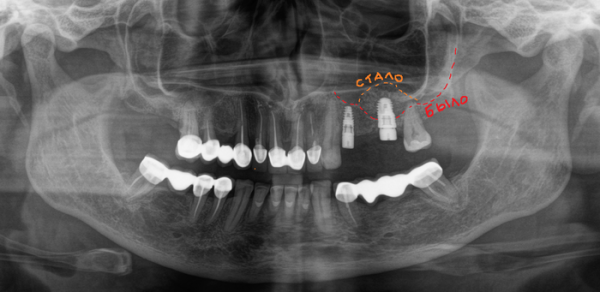
You might ask: - "Why are there 2 implants instead of 3?" "Will there be a bridge prosthesis?" "What about load distribution?" and so on?
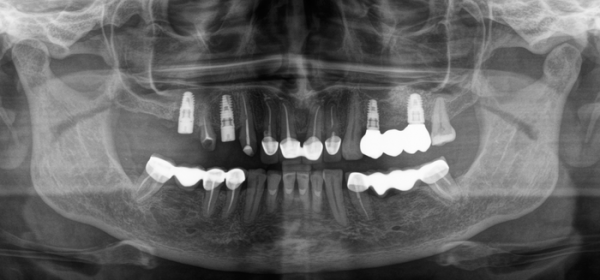
In reality, the overload issues associated with bridge prostheses only concern natural teeth. Natural teeth have a periodontal apparatus. That is, they are not rigidly fused to the bone, but rather they have a spring-like quality within it. Here’s a diagram:
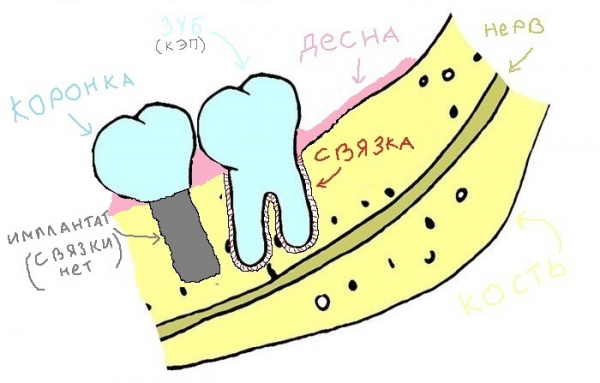
With a bridge prosthesis, the supporting teeth bear both their own load and the load of the missing tooth. This leads to an overload of the teeth, which subsequently end up with the tooth fairy. An implant, on the other hand, does not have this connection. It fuses firmly with the surrounding tissues, which is why it doesn't face the same problems as natural teeth. However, this does not mean that a massive bridge can be mounted on two implants that span the entire jaw. The only drawback of bridge prostheses is hygiene; it requires extra attention, as caring for standalone teeth is much easier than for such prostheses.

That's all for today. I would be happy to answer your questions!
Stay tuned!
Sincerely, Andrey Dashkov.
Source: habr.com
