

WARNING
Given the unprecedented high ratio of silently dissatisfied individuals to those who have comments to offer, it is clear that many readers do not realize that:
1) This is purely a theoretical discussion article. There will be no practical recommendations on selecting tools for cryptocurrency mining or assembling a multivibrator to blink two bulbs.
2) This is not a popular science article. It will not explain the principles of a Turing machine in simple terms using the example of matchboxes.
3) Think carefully before continuing to read! Are you attracted to the posture of aggressive amateurism: downvoting everything you don't understand?
Thank you in advance to everyone who decides not to read this article!
A daemon is a computer program in UNIX-like systems that is started by the system itself and runs in the background without direct user interaction.
Even in preschool, I heard a tale about a wizard's apprentice. I will retell it in my own words:
Once upon a time in medieval Europe, there lived a wizard. He had a large spellbook bound in black calfskin with clasps and iron corners. When the wizard needed to read a spell, he would unlock it with a large iron key that he always carried on his belt in a special pouch. The wizard also had an apprentice who served him, but he was forbidden from looking into the spellbook.
Once, a wizard left for the day on business. As soon as he left the house, his apprentice rushed into the dungeon, where the alchemical laboratory was, containing a spellbook chained to the table. The apprentice grabbed the crucibles in which the wizard melted lead to turn it into gold, set them on the brazier, and fanned the flames. The lead melted quickly, but did not turn into gold. Then the apprentice remembered that the wizard, after melting the lead, would unlock the book with a key and whisper a spell from it for a long time. The apprentice hopelessly looked at the locked book and saw that next to it lay a key forgotten by the wizard. Then he rushed to the table, unlocked the book, opened it, and loudly read the very first spell, carefully pronouncing the unfamiliar words, assuming that such an important spell as the transmutation of lead into gold would surely be the first one.
But nothing happened: the lead refused to transform. The apprentice wanted to try another spell, but just then, a thunderclap shook the house, and a massive, terrifying demon appeared before the apprentice, summoned by the spell he had just read.
— Command me! — growled the demon.
Out of fear, all thoughts left the apprentice's head, and he couldn't even move.
— Command me, or I will eat you! — the demon growled again, extending a massive hand towards the apprentice to grab him.
In despair, the apprentice mumbled the first thing that came to mind:
— Water this flower.
He pointed to the geranium, with its pot standing on the floor in the corner of the laboratory. Above the flower, there was the only small window in the dungeon, through which barely a trace of sunlight made it through. The demon disappeared but reappeared a moment later with a gigantic barrel of water, which he upended over the flower, pouring out the water. He vanished again and came back holding a full barrel.
— Enough! — shouted the apprentice, now standing waist-deep in water.
But it seems that one desire was not enough — the demon kept hauling water in a barrel, pouring it into the corner where a flower once stood, hidden under the water. Perhaps a special spell was needed to drive the demon away. But the table with the book was already submerged in murky water, which floated ashes and embers from the stove, empty retorts, flasks, stools, galvanometers, dosimeters, disposable syringes, and other junk, so even if the apprentice knew how to find the right spell, he wouldn't have been able to do it. The water rose, and the apprentice scrambled onto the table to avoid drowning. But this didn’t help for long — the demon methodically continued to haul water. The apprentice was already up to his neck in water when the sorcerer returned, realizing he had forgotten the key to the book at home, and drove the demon away. The end of the tale.
Let's start with the obvious. The natural intelligence (NI) of the apprentice seems pretty straightforward — a fool, and it will take a long time to look for someone even more foolish. But the intelligence of the demon — by the way, what does he have: NI or AI? — is ambiguous. Different versions are legitimate (and questions will arise about them):
Version 1) The demon is even more foolish than the apprentice. He received an order and will carry it out indefinitely, even when all meaning disappears: the flower will disappear — the object of watering, the corner to which the coordinates of the flower are tied will disappear, the planet Earth will disappear, and the foolish demon will continue to deliver water to a specific point in space. And if a supernova erupts at that point, it won’t matter to the demon where to carry the water. Moreover: how foolish must one be to water a small flower from a huge barrel? This is not called watering a flower, but drowning a flower. Does he even understand the meaning of orders?
Version 2) The demon understands everything but is bound by obligations. So he conducts something like an Italian strike. Until he is officially driven away according to all the rules, he will not stop.
Question 1 for versions 1, 2) How to distinguish a completely foolish demon in version 1 from a completely not foolish one in version 2?
Question 2 for versions 1, 2) Would the demon correctly perform a more accurate formulation (from the apprentice's perspective)? For example, if the apprentice said: take that empty one-liter flask that is on the shelf, fill it with water, and water that flower once. Or, for example, if the apprentice said: go away.
Version 3) The sorcerer cast an additional spell on the demon, according to which if anyone other than the sorcerer uses the demon's services, the demon must immediately inform the sorcerer about this fact.
Version 4) The demon holds no grudge against the sorcerer and his apprentice, so seeing that the situation spiraled out of control, while moving with the barrel, he appeared behind the sorcerer and roared: "You forgot the key at home, there's a flood." The sorcerer wouldn't have remembered it himself.
Note 1 for version 4) It is particularly worth noting that native speakers of EI can have a very imperfect memory.
Next versions can multiply like "Fibonacci rabbits," i.e., through a not very complex algorithm. For example:
Version 5) The demon takes vengeance on the apprentice for his worry.
Version 6) The demon holds no grudge against the apprentice, but seeks revenge on the sorcerer.
Version 6) The demon takes vengeance on everyone.
Version 7) The demon does not take vengeance but entertains himself. He will stop when he gets bored.
And so on.
So, it's clear about the demon that nothing is clear. It's no better with the sorcerer. One can come up with no less versions: that he intentionally decided to punish the apprentice, who is always poking his curious nose everywhere; that he wanted to drown the apprentice, but when the demon roared about the flood, he got scared — what if someone from the passersby heard, then suspicion would fall on the sorcerer; he wanted to awaken interest in spells in the apprentice, etc.
Here a child might ask: which of the proposed versions is correct? Apparently, any of them. In the fairy tale, there is no unused information to prefer one version over the others. Here we deal with a rather common case in artistic works with the possibility of ambiguous interpretation. For example, if some director wants to stage this fairy tale in a theater or make a movie out of it, he can choose the interpretation that seems most appealing to him. For another director, a different interpretation might seem more appealing. At the same time, appeal can be determined by additional considerations, such as the appeal to viewers to ensure maximum box office returns, or the appeal for demonstrating some super-idea: the idea of good triumphing over evil, the idea of duty, a rebellious idea — for example, in Dostoevsky: the apprentice, like Raskolnikov, asks the question "Is he a trembling creature or does he have the right?" and so on.
Another question arises.
Another question). How can we teach AI to prefer one of the aforementioned versions if we ourselves, possessing Artificial Intelligence, cannot always consciously choose one of them?
Returning to the wizard, a very plausible version is that he wanted a diligent and obedient student, like a demon, who would not stick his nose into forbidden books and places where he is not invited. The same is often desired of AI nowadays. At first glance, these are normal traditional requirements for any machine: complete obedience, disobedience is unacceptable. But in the case of AI, the question of versions 1,2 (see above) may arise, i.e., AI degenerates — a 'piece of hardware' can think anything about its creators and owners, but it will not perform any actions related to AI, meaning instead of AI we get a dumb primitive machine. This raises suspicion: perhaps the wizard did not want to make the student as unintelligent a performer as a demon? That is, the idea of AI with limitations emerges. It’s even more complicated here in the sphere of Artificial Intelligence: remember the eternal conflicts of 'parents and children', 'teacher and student', 'boss and subordinate'.
In choosing a definition of AI from the possible options, I noted:
For a human, sorting through several tens of thousands of words alphabetically will be tedious, it will take a long time, and the likelihood of errors for an average performer with an average level of responsibility will be significant. A modern computer will accomplish this task without errors in a very short time (fractions of a second) compared to a human.
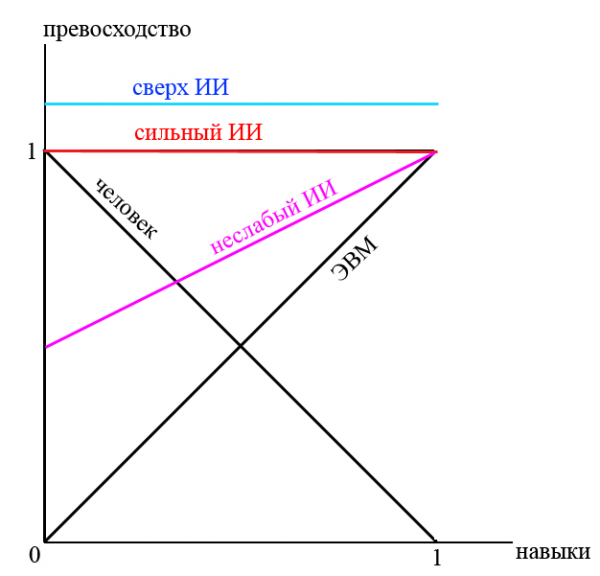
I settled on the following definition: AI refers to tasks that a computer does significantly worse than a human..
This definition takes into account the considerations mentioned above and is convenient for practice; at the same time, it is not perfect, if only because the lists of tasks 'that a computer does significantly worse than a human' differ at present from those of 20 years ago. But in my opinion, no one has come up with a more perfect definition yet.
What has been said clearly illustrates the diagram at the beginning of the article. On the coordinate axis of 'skills', skills near zero (zero and slightly above) correspond to abilities where a person surpasses a computer, such as the ability to make unconventional decisions. Skills near one (one and slightly below) correspond to abilities where a computer surpasses a person: calculation ability, memory. By setting maximum superiority equal to a conditional one on the coordinate axis of 'superiority', we get the dependency of superiority on skills for both humans and computers represented as diagonals of a unit square. This is the current situation. But is a strong AI possible, where all skills would be at their maximum (the red line)? Or even beyond that (a super AI – the blue line)? Perhaps an intermediate goal of progress should be not a strong, but a not-so-weak
AI (the purple line), which would lag behind general intelligence in certain skills, but not as significantly as it does now.
Returning to our literary fairy-tale model, one might say that all its heroes did not perform well: the clumsy wizard forgot the key and got a flood in his dungeon, the apprentice, out of foolishness and carelessness, had a bunch of extreme experiences and almost drowned, and the demon was kicked out without any gratitude. As for the demon’s intelligence – it has already been noted that it is difficult to clearly classify it as AI or general intelligence, but the intelligence (although not impressive) of the others clearly belongs to general intelligence. It can be said that making dangerous mistakes in decisions, showing inattentiveness, forgetting necessary things and becoming tired are their main inherent traits. Unfortunately, these traits are also present in all other carriers of general intelligence to a greater or lesser extent. The unreliability of sorting words or numbers has already been noted above, but seemingly a simpler task – simply remembering a number turns out to be very complicated for people. For machines, the ability to remember the digits of pi is limited only by the size of memory, while most people have to use , like 'What do I know about circles'. It might seem that in the string '3.1416' there are fewer characters than in the specified mnemonic, yet for some reason, people prefer to remember in a less economical way. And it's longer:
Learn and remember among the famous number the digit, how to notice luck.
To avoid mistakes,
We must read correctly.
Three, fourteen, fifteen.
Ninety-two and six.
To remember the colors of the rainbow:
Every designer wants to know where to download Photoshop.
And the beginning of the Mendeleev table:
They mixed native water (Hydrogen) with Helium (Helium) to pour (Lithium). Yes, take and pour (Beryllium) in the pine forest (Boron), where from under the corner of the native (Carbon) peeks Nitrogen (Nitrogen), with such a sour face (Oxygen) that Fluorine (Fluorine) didn't want to look. But it wasn't Neon (Neon) we needed, so we stepped three (Sodium) meters back and reached Magnesium (Magnesium), where we applied a cream (Silicon) with Phosphorus (Phosphorus) content to Alu in a mini (Aluminum) skirt, so she wouldn't be gray (Sulfur). After that, Alia took Chlorine (Chlorine) and washed the ship of the Argonauts (Argon).
But why such a glaring imperfection in such a perfect EI? Perhaps, thanks to the ability to forget the simplest facts, a person gains the freedom to combine fragments of their thoughts in a random wild order and find non-standard solutions? If so, then strong AI is impossible. It will either forget like a human or will not be capable of non-standard solutions. In any case, from these assumptions follows the necessity to delineate the goals of AI: one goal is modeling EI, the other is creating strong AI. Achieving one may exclude achieving the other.
As we see, in the field of AI, too many questions arise with ambiguous answers, so it is unclear in which direction to move. As often happens in such cases, attempts are made to move in all directions at once. Meanwhile, due to the lack of mathematically rigorous formulations, we have to turn to philosophy and artistic-literary modeling. One of the most well-known examples in this area is the book 'Choosing by Turing' (1992) by one of the pioneers of AI, Marvin Lee Minsky, and the famous science fiction writer, Harry Harrison. I will quote from this book, which may explain the previously mentioned phenomenon of mnemonics:
Human memory is not a tape recorder that records everything in chronological order. It is structured quite differently—more like a messy filing system equipped with a convoluted and contradictory index. And not just convoluted; from time to time, we change the principles for classifying concepts.
An interesting interpretation of the tape recorder metaphor appears in another literary work, Stanisław Lem's short story "Terminus" (from the series "Tales of Pilot Pirx"). Here, there's a case of a peculiar "intellectual tape recorder": an old robot aboard an old spaceship that had once crashed is engaged in routine repairs, accompanied by tapping sounds. But if you listen closely, it’s not just background technological noise; it’s a recording of Morse code—the conversations of the crew of the doomed ship. Pirx intervenes in these conversations and unexpectedly receives responses from long-dead cosmonauts. It turns out that this primitive repair robot somewhat retains copies of their consciousness or is it cognitive distortions of Pilot Pirx's perception?
In another story "Ananke" (from the same series), a copy of AI in the control computer of a spacecraft leads to its paranoid overload with test tasks, resulting in a catastrophe.
In the story "Accident," an overly anthropomorphically programmed robot meets its demise during a mountaineering expedition it decided to undertake during its free time. Do we need such performers? However, the demons fixated on watering a flower are also not always necessary.
Some specialists in AI do not appreciate such "philosophizing" and "literary excesses"; however, these "philosophizing" and "literary excesses" are traditionally inherent in AI analysis and are inevitable as long as AI is compared to human intelligence, especially when attempts are made to replicate human intelligence in AI.
In conclusion, a survey on a number of emerging questions.
Only registered users can participate in the survey. , please.
1. Are there tasks related to AI that computers solve significantly worse than humans?
Yes
No
I know a better definition. I will provide it in the comments.
I find it difficult to answer.
34 users voted. 7 users abstained.
2. Should AI only be a performer, understanding all commands literally? For example, if told to water a flower—does that mean to keep watering it until dismissed?
Yes
No
I find it difficult to answer.
37 users voted. 6 users abstained.
3. Is it possible to have a strong AI with maximized skills (the red line in the figure at the beginning of the article)?
Yes
No
I find it difficult to answer.
35 users voted. 7 users abstained.
4. Is superintelligent AI possible (the blue line in the figure at the beginning of the article)?
Yes
No
I find it difficult to answer.
36 users voted. 7 users abstained.
5. Should the intermediate goal be not a strong AI but also not a completely weak AI (the purple line in the figure at the beginning of the article), which would lag behind human intelligence in several skills, but not as much as it does now?
Yes
No
I find it difficult to answer.
33 users voted. 5 users abstained.
6. Is making dangerous mistakes in decisions, demonstrating carelessness, forgetting necessary things, and getting tired—core inevitable traits of artificial intelligence?
Yes
No
I have another opinion, which I will present in the comments.
I find it difficult to answer.
33 users voted. 5 users abstained.
7. Thanks to the ability to forget the simplest facts, a person gains the freedom to combine fragments of their thoughts in arbitrary wild orders and find unconventional solutions?
Yes
No
I have another opinion, which I will present in the comments.
I find it difficult to answer.
31 users voted. 4 users abstained.
8. Modeling artificial intelligence and creating strong AI are two different tasks that may be addressed using different methods?
Yes
No
I have another opinion, which I will present in the comments.
I find it difficult to answer.
32 users voted. 4 users abstained.
Source: habr.com
