

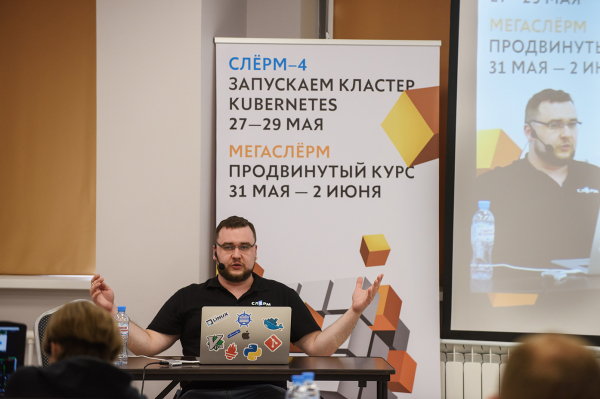
<TL;DR>
- Slurm truly helps you dive into Kubernetes or enhance your knowledge.
- Participants are satisfied. Only a handful felt they didn’t learn anything new or solve their problems. Only one person took advantage of the first day's money-back guarantee ("If you feel Slurm isn't for you, we'll refund the full ticket price"), justifying it by overestimating their capabilities.
- The next Slurm will take place in early September in St. Petersburg. Selectel, our consistent sponsor, provides not only cloud services for booths but also its conference hall.
- We are repeating the basic Slurm (September 9-11) and introducing a new program: Slurm DevOps (September 4-6).
What is Slurm and how has it evolved
A year ago, we came up with the idea of conducting courses on Kubernetes. In August '18, Slurm-1 took place: challenging, with continuous presentations (where presentations are refined on stage), along with a bunch of logistical issues. Trials unite: participants of the first Slurm, like the Fellowship of the Ring, still communicate with each other.
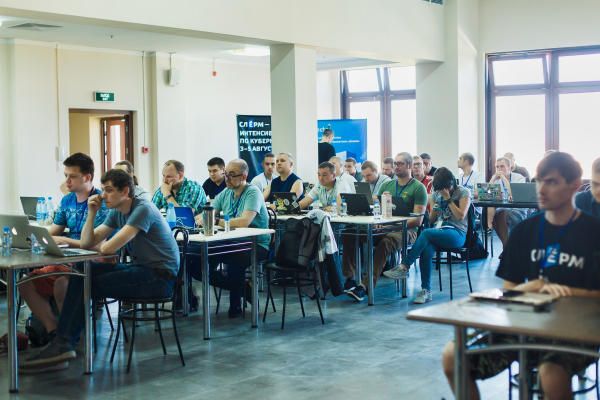
This was how Slurm-1 looked
At the first Slurm, the idea of holding a MegaSlurm was born. We asked people what topics interest them, and in October, we held an advanced course "By Participants' Requests." It turned out interesting but was a one-off event. By May '19, we prepared a real advanced course with its own logic and internal storyline.
Over the year, Slurm has also transformed organizationally:
— Docker and Ansible were removed from the main program and made into separate online courses.
— We organized technical support to help students troubleshoot educational clusters.
— Speakers now have methodological support.
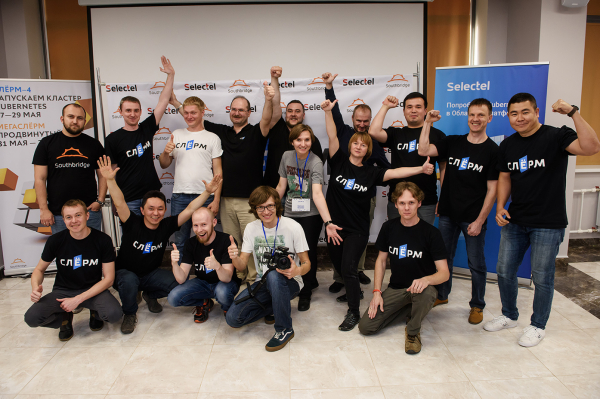
The team who organized Slurm-4
Participant feedback
We set another record: 170 participants at the basic Slurm, 75 at the MegaSlurm.
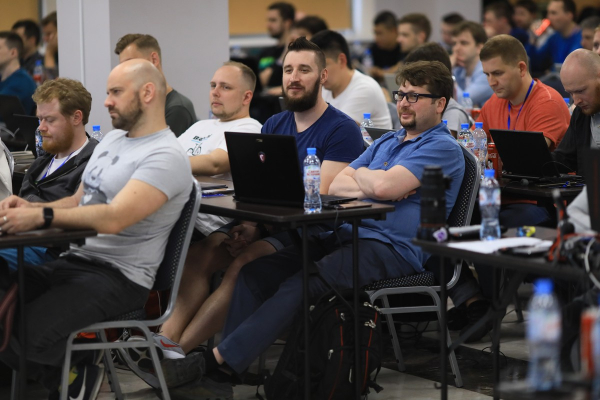
Slurm-4
101 out of 170 people filled out the feedback form.
Is Kubernetes clearer now?
41 — I still don’t understand k8s, but I see where to dig.
36 — I didn’t know k8s before, now I understand it.
23 — I already knew k8s, now I know it better.
1 — I didn’t learn anything new.
0 — I didn’t understand anything about k8s.
How did you find the intensity of Slurm?
16 people feel that Slurm is too simple and slow, and 14 think it’s too complicated and fast. For the rest, it's just right.
Did you solve the problem you came to Slurm with?
90 — Yes.
11 — No.
MegaSlurm
40 people filled out the feedback form. 2 people said it was too easy and slow. 1 person couldn’t solve the task they came to Mega with. The rest are all good.
Speaker Reviews
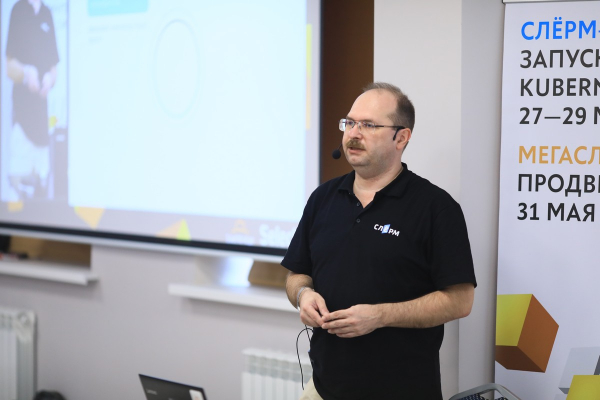
While at the St. Petersburg Slurm in February there were mainly beginners, at the Moscow Slurm, people generally had already tried Kubernetes. There were many advanced questions that made us think.
While in St. Petersburg they asked when we would release our fork of kubespray, in Moscow they were already asking why we suggest using our fork instead of the original kubespray. This shows critical thinking from mid-senior level participants.
The practice was challenging, and people made many mistakes, which is great: you need to learn from mistakes during training, not in battle.
We frequently encountered limits on obtaining certificates, limits on downloads from GitHub, etc. This is life—we simultaneously deployed about 200 clusters in the Selectel cloud. No one prepares their resources and limits for such demands.
Slurm Announcement at Selectel
→
Price: 25,000 ₽
Program:
Topic #1: Introduction to Kubernetes, Core Components
— Introduction to k8s technology. Description, applications, concepts.
— Pod, ReplicaSet, Deployment, Service, Ingress, PV, PVC, ConfigMap, Secret
Topic #2: Cluster Structure, Core Components, Fault Tolerance, k8s Network
— Cluster structure, core components, fault tolerance.
— k8s Network
Topic #3: Kubespray, Tuning and Configuring Kubernetes Clusters
— Kubespray, configuring and tuning the Kubernetes cluster.
Topic #4: Advanced Kubernetes Abstractions
— DaemonSet, StatefulSet, RBAC, Job, CronJob, Pod Scheduling, InitContainer
Topic #5: Publishing Services and Applications
— Overview of service publishing methods: NodePort vs LoadBalancer vs Ingress.
— Ingress controller (Nginx): balancing incoming traffic.
— Cert-manager: automatically obtaining SSL/TLS certificates.
Topic #6: Introduction to Helm
Topic #7: Installing cert-manager
Topic #8: Ceph: Installation in 'Do as I do' Mode
Topic #9: Logging and Monitoring
— Cluster monitoring, Prometheus.
— Cluster logging, Fluentd/Elastic/Kibana.
Topic #10: Updating the Cluster
Topic #11: Practical Work, Dockerizing an Application and Running in the Cluster.
Courses on Docker and Ansible at stepik.org are included in the price.
→
Price: 45,000 ₽
Program:
Topic #1: Introduction to Git
— Basic commands git init, commit, add, diff, log, status, pull, push.
— Setting Up a Local Environment: Practical Recommendations
— Git Flow, Branches and Tags, Merge Strategies
— Working with Multiple Remote Repos
Topic #2: Team Collaboration with Git
— GitHub Flow
— Fork, Remote, Pull Request
— Conflicts, Releases, Again on Gitflow and Other Flows for Teams
Topic #3: CI/CD Introduction to Automation
— Automation in Git (Bots, Introduction to CI, Hooks)
— Tools (Bash, Make, Gradle)
— Factory CI/CD Pipelines and Their Applications in IT
Topic #4: CI/CD: Working with GitLab
— Build, Test, Deploy
— Stages, Variables, Execution Control (only, when, include)
Topic #5: Working with Applications from a Development Perspective
— Writing a Microservice in Python (Including Tests)
— Using Docker Compose in Development
Topic #6: Infrastructure as Code
— IaC: An Approach to Infrastructure as Code
— IaC Using Terraform
— IaC Using Ansible
— Idempotence, Declarativity
— Practice of Creating Ansible Playbooks
— Storing Configurations, Collaboration, Application Automation
Topic #7: Infrastructure Testing
— Testing and Continuous Integration with Molecule and GitLab CI
Topic #8: Server Provisioning Automation
— Building Images
— PXE and DHCP
Topic #9: Infrastructure Automation
— Example of an Infrastructure Service for Server Authorization
— ChatOps (Integration of Messengers with Pipelines)
Topic #10: Security Automation
— Signing CI/CD Artifacts
— Vulnerability Scanning
Topic #11: Monitoring
— Defining SLA, SLO, Error Budget and Other Scary Terms from the SRE World
— SRE: Practice of Monitoring SLI and SLO
— SRE: Practice of Using Error Budget
— SRE: Managing Downtime and Operational Load (API Gateway, Service Mesh, Circuit Breakers)
— Monitoring Pipelines and Development Metrics
Source: habr.com
