


The headend collects signals from multiple sources, processes them, and broadcasts them to the cable network.
Contents of the article series
- Part 9: Headend
- Part 10: Troubleshooting in the CATV network
There is already a great article on Habr about how a headend works: . I won't rewrite it in my own words and will simply recommend those interested to check it out. A description of what is under my management would be less interesting, as we do not have such a variety of equipment, and all signal processing is handled by AppearTV chassis with various expansion cards, the variety of which allows all functionality to fit into a few four-rack units.
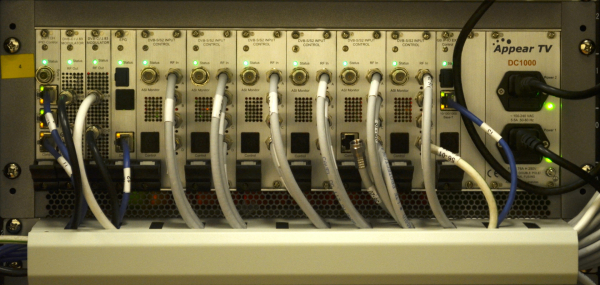
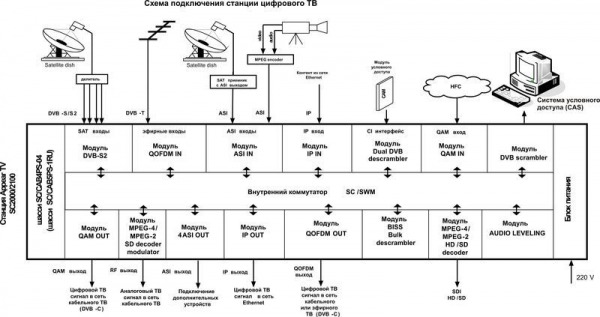
Image from the site
These devices allow controlling all processes through a functional web interface, which depends on the hardware filling of the chassis.
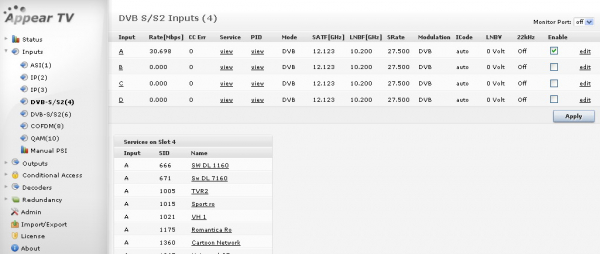
Moreover, we do not collect the broadcast signal, so our antenna post looks something like this:
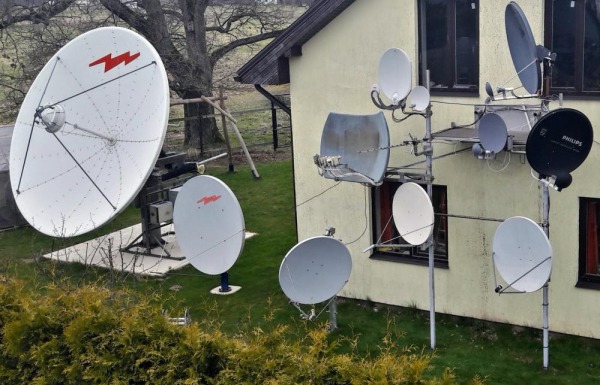
Image from the forum I was not allowed to post a real photo of our station.
Such a number of dishes is necessary to receive channels from several satellites simultaneously.
Satellite signals are generally encrypted using scrambling: this is a type of encryption where the symbols of the sequence are mixed according to a specified algorithm. This does not require much computational power and time to execute, meaning the signal is processed without delay. The hardware identifier of the subscriber (even if it is a provider transmitting the signal further into its network) is a familiar chip card that is inserted into a conditional access module (CAM) with a CI interface, just like in any modern television.
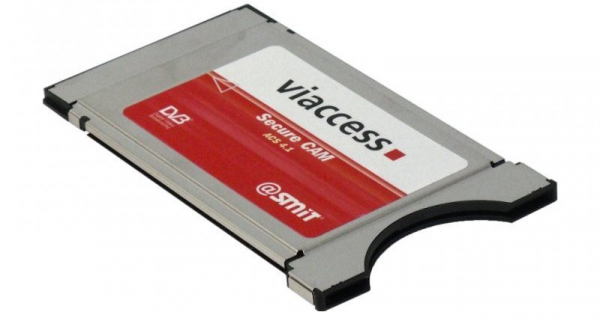
Actually, all the math is performed inside the module, and the card contains a set of keys. The operator can encrypt the stream using the keys known to the card (which the operator has recorded in the card) and thus control the set of subscriptions all the way to completely disconnecting the card from the system by changing the main 'operator' identifier. This is just a general description of how conditional access systems work; in reality, there are many different ones: on one hand, they are constantly being hacked, and on the other, algorithms are becoming more complex, but that’s a whole other story…
Since the operator also provides paid channel packages within its network, it is necessary to encode them before transmission. This task is carried out by the third-party equipment of the conditional access system provider, which offers it as a service to the operator. The equipment installed at the headend ensures the functioning of the conditional access system for content: both encryption and control of the keys stored in smart cards.
P.S. No one helped me with the article on DOCSIS, so if anyone is willing — I'd appreciate it, just reach out.
Source: habr.com
