

We often create our own problems with our own hands… through our worldview… our inaction… our laziness… our fears. It becomes quite convenient to float along with the societal flow of canned templates… as it's warm and fun, and everything else just doesn't matter – we adjust to it. But after a harsh failure comes the realization of a simple truth – instead of generating an endless stream of excuses, self-pity, and justifications, it's enough to just take action on what you consider most important for yourself. That will be the starting point of your new reality.
For me, what is written below is exactly such a starting point. The journey will not be an easy one…
All people are socially dependent and subconsciously, we all want to be part of society, seeking approval for our actions from others. But along with that approval, we will constantly be surrounded by societal judgment, reinforced by internal complexes and persistent limitations.
Often we fear failure, constantly postponing important things for ourselves and then logically rationalizing in our minds to calm ourselves: 'it won't amount to anything anyway', 'it won't find approval from others', and 'what's the point in doing this?'. Many simply don’t know how strong they are because they’ve never tried to change something in their lives.
For if a person only does what they can – they automatically create a pattern in their mind: 'I can do this… I will do this…'. But there is nothing extraordinary about doing only what you can. You did it because you could, yet you remained within the same range of your initial capabilities. But if you couldn't and you did it – that's when you're truly impressive. For only when we step out of our comfort zone and work beyond our capabilities – only then do we grow and become better.
My first attempt to create something meaningful began back in my fourth year at university. I already had basic knowledge of C++ and one unsuccessful attempt to memorize all of Richter's books at the urging of a potential employer. By chance, I came across the OpenCV library and a couple of demos on pattern recognition. Surprisingly, I started staying up late trying to figure out how to improve the functionality of this library. Many things didn’t work out, and through reverse engineering, I tried to look at products with similar aims. I even learned how to dissect a commercial library and slowly pulled algorithms from it that I couldn’t implement myself.
As the end of my fifth year approached, I increasingly enjoyed what I had been doing all this time. Since it was time to start working in earnest, I decided to write to the developers of that very commercial library from which I drew my ideas. I thought they would easily take me on, but after a couple of emails expressing my desire to work with them, our conversation led nowhere. This brought a slight disappointment and a strong motivation to prove that I could achieve something on my own.
Over the course of a month, I created a website, uploaded everything to a free hosting service, prepared documentation, and began selling. I had no money for advertising, so to somehow attract potential customers, I started distributing my creations as open-source. The response was about 70%, but unexpectedly, the remaining crowd, albeit reluctantly, began to make purchases. Neither my poor English nor the free hosting on which the site was located deterred them. People were satisfied with the combination of low price and basic functionality that met their essential needs.
I had a few regular clients who wanted to invest in my venture as partners. Then, unexpectedly, the developers of the very library from which I had learned so much in the past showed up. They subtly hinted that their algorithms were patented and that I shouldn't provoke them by stealing their clientele. Our conversation was far from polite, and at a certain point, I decided to point them toward the search for three eternal letters of the alphabet. The next day, they sent an official letter stating their willingness to collaborate with me, but I abruptly cut off communication with them. To protect myself from future attacks from these guys, I began preparing patent documentation and a copyright application.
Time passed, and this story gradually began to fade from memory. I had plans to hire a more experienced person to help me, but there was not enough money for that. Greed played a role, and I wanted to make a big score. A meeting was scheduled with a new client who, as it turned out during our conversation, was located in the same city as I was. Sweetly outlining the prospects of our collaboration, he suggested we meet in person.
In fact, instead of him, young men of pleasant appearance showed up for the meeting and, without really asking for my opinion, suggested we take a drive out of town, justifying it with the urgent necessity to 'breathe fresh air.' Once we arrived, they handed me a personalized shovel to test the skills I had learned in my childhood on my grandmother's potato fields. For an hour, they thoroughly explained my prospects, suggested that I stop spreading myself too thin, cease engaging in foolishness, and, most importantly, stop being rude to serious people.
At that moment, the world stopped seeming like a sunny and pleasant place. It's hard to say if I acted correctly back then... but I gave up... threw my hands down and retreated into a corner. This largely determined what happened next: latent anger toward those around me due to unfulfilled potential, insecurity for many years, apathy in making important decisions for myself, and shifting responsibility for my mistakes onto someone else.
The money set aside was quickly running out, and I urgently needed to get my life in order, but everything was falling apart. At that time, my father helped a lot; through acquaintances, he found a place where I could be accepted without too many questions. Later, I learned that he got involved with some not-so-pleasant people because of me, but he gave me a chance to prove myself.
Preparing for my new job, I started reading Richter and diligently studied Schildt again. I planned to focus on .NET development, but fate had other plans for me during my very first month of official work. One of the employees unexpectedly left the project, and fresh talent was thrown into the gap.
While my colleague was packing up, I had a rather epic dialogue with the finance director:
— Do you know databases?
— No.
— Learn it overnight. Tomorrow I'll be selling you as a mid-level database specialist to the client.
And that’s how my acquaintance with SQL Server began. Everything was new and confusing, usually done by trial and error. I really missed having a competent mentor nearby that I could look up to.
The next few months felt like total chaos. The projects were interesting, but they were left to run on autopilot by management. There were emergencies, constant overtime, and tasks that no one could even articulate properly. My favorite activity became endlessly refining a report on arranging finished cakes into simple semi-finished products. But since any cake could be part of another cake, this harsh business logic made my head spin.
I realized things would only get worse and decided to take action. I refreshed my memory on the theory and decided to try my luck elsewhere, but during interviews, I lacked the experience to qualify even as a solid junior. For the first couple of days, I was impressed by my failures and seriously considered that it was still too early to change jobs and that I needed to gain more experience.
I began to intensively study the technical aspects of SQL Server and over time completely immersed myself in database development. I won’t hide the fact that this job felt like a living hell for me, where, on one hand, a practicing schizophrenic, my CTO, entertained me every day, while on the other hand, the CFO, an Afghan, would bite the heads off rubber ducks during lunch breaks in fits of emotion.
At one fine moment, I realized I was ready. I took on all the critically important tasks, ensured a high release frequency, and directly normalized relationships with clients. As a result, I confronted the CFO, putting him in a position reminiscent of a felled birch tree. One could make a joke about 23-year-old seniors, but that’s how I managed to quadruple my salary.
The next month, I was bursting with pride over what I had achieved, but at what cost? My workday began at 7:30 AM and lasted until 10 PM. My health started to show the first signs of breaking down, and this occurred against a background of gradual hints from the management that it would be better for us to deliberately fail the project than to let you earn more than what is considered 'average for our hospital.' In some sense, they kept their word, and I was faced with the dilemma of looking for a new job.
After a while, I was invited for an interview at a product company. I planned to move to a similar position in .NET, but I unfortunately flunked the practical task. We were already about to say our goodbyes when the most interesting thing happened: the potential employers learned that I had experience working with SQL Server. I hadn’t elaborated on it much in my resume since I never considered myself to be very knowledgeable in that area. However, the interviewers thought otherwise.
I was offered to improve the existing product line related to SQL Server. Previously, they did not have a dedicated specialist focused on this activity. Everything was often done through trial and error. New features were frequently simply copied from competitors without delving into the details. My task was to demonstrate that it was possible to take a different approach, developing queries to system views more thoroughly than our competitors.
These couple of months became an invaluable new experience for me compared to my previous activities with puff pastry. But all good things come to an end sooner or later, and the management unexpectedly shifted priorities. At that moment, the work had been done, and I was left with no better option than to retrain as a tester, which somewhat contradicted our agreements on developing new products. I was quickly given an alternative – 'just wait a bit,' try to engage in social activities, and at the same time voluntarily agree to leave development for manual testing.
The work turned into a monotonous series of regressions, which did not motivate further development. To officially shirk from regressions, I started writing technical articles on Habr and then on other resources. Initially, it didn't go too well, but the important thing is that I began to enjoy it.
Over time, I was trusted with raising the official company profile rating on Stack Overflow. Every day, I encountered interesting cases, sifted through tons of Indian code, helped people, and, most importantly – I learned and gained experience.
By chance, I joined my first SQL Saturday, which was held in Kharkiv. My colleague was supposed to present on database development using products we had been working on all this time. I don't remember why, but at the last moment, I had to do the presentation myself. Denis Reznik, with his traditionally friendly smile, handed me the microphone, and you stumble through your speech trying to tell the audience something. At first, it was scary, but then 'Ostap went on a roll.'
After the event, Denis approached me and suggested I speak at a smaller format event that traditionally took place at KHIRe. Time passed, the names of conferences changed, and gradually the audiences grew in which I conducted meetups. Back then, I didn't know what I was signing up for, but a series of coincidences shaped my life choices and what I decided to dedicate myself to moving forward.
Looking up to specialists like Reznik, Korotkevich, Pilugin, and other cool guys I've had the chance to meet... I realized that in my current job, I wouldn't have tasks that would lead to rapid progress. I had a solid theoretical background, but I lacked practical experience.
I was offered to start a new project from scratch in a new place. Work was buzzing from day one. Everything I had ever wanted from life was there: an interesting project, a high salary, the ability to influence the quality of the product. But at a certain point, I relaxed and made a serious mistake right after we finished creating the MVP for the client.
As I tried to focus on development and provide a higher quality solution, I found it increasingly difficult to allocate time for management and client communication. They assigned me a new person to handle this on my behalf. At that time, I struggled to understand the cause-and-effect relationships, but afterward, our relationship with the client began to deteriorate quickly, with increasing overtime and tension within the team.
I attempted to rectify the situation on the project, restore order, and return to a calmer development pace, but I wasn't allowed to do that. Everyone seemed satisfied with the constant fires that needed to be extinguished.
After analyzing the situation, I decided I wanted to take a break from this circus and suggested to the CEO from my previous job that we return together to work on a new project. We discussed all the details and planned to start development in a month. A month passed... then another... and another. The constant response to all my questions was – wait. The thought of doing something on my own never left me, but I had to temporarily turn to freelancing, helping people from Central Asia conquer Ukraine's banking sector.
Just a month later, I learned that the development of my project had quietly begun with unofficial individuals with the former management's permission. These guys were exceptional .NET developers but had no expertise in what they were supposed to do. From the outside, it looked like I was being quietly sidelined from the project. In reality, that was true. In a fit of frustration, I started working on this project myself, but my motivation quickly faded.
The former CTO offered to help him with current projects, and I started doing what I did best – putting out fires. Falling back into workaholism, I reaped its consequences: poor nutrition, a sleep routine far from normal, and constant stress. This was all explained by two projects that I was alternately dragging towards a bright future. One project brought joy with its 24/7 work mode, while the other had simply twisted management practices, causing the team to work in a state of perpetual crisis. This period in my life could only be described as masochism, but there were also some fun moments.
You’re calmly digging potatoes at your parents' dacha to some retro wave music when you get an unexpected call: "Seryoga… the horses have stopped running…". After a couple of seconds of contemplation, standing on the shovel and meanwhile honing your skills like grandma Vanga, you dictate from memory the sequel commands so the person can fix the problem on the server. Not a minute do I wish to trade this experience – it was awesome!
But then the most interesting part begins…
One meeting in late September 2017 dramatically changed my life.
At that time, to shake myself out of the work routine, I planned to speak at a conference. During lunch, I accidentally exchanged a couple of words with a colleague in the kitchen. He casually mentioned, "It turns out you're a well-known personality… people even know you in other cities." At first, not understanding what he meant, he showed me a chat message in Telegram. I immediately recognized the girl who had come to my talks when I traveled to Dnipro for presentations. I was incredibly pleased that someone remembered me. Without further thoughts, I decided to write to her and invited her to Kharkiv for the conference, where I was preparing my talks.
I was one of the first to speak, and I immediately saw her in the second row. Her arrival was unexpected and a pleasant surprise for me. We exchanged a few phrases, and thus began my long six-hour marathon of speaking. That day was one of the brightest in my life: a completely packed hall, five back-to-back presentations, and the indescribable feeling of having people enjoy listening to you. I found it hard to focus on the entire audience as my gaze instinctively gravitated toward her… the girl who had come from another city… the one I had known for two years, but we had not spoken… we just knew of each other all this time.
After the conference ended, I was exhausted and feeling quite depressed, but I still wanted to treat the girl nicely – inviting her to dinner with the people we both knew. To be honest, I was a terrible conversationalist back then, constantly sarcastic and demanding attention. It’s hard to say what was going on in my mind at that time. Our stroll through the night city didn’t go well either. I thought it would be better to take her to the hotel and then go home to get some sleep. The next day, I spent in bed, unable to get up, and only by evening did I start replaying her words in my mind: “Sergey, I came here for you…”. I genuinely wanted to see her again, but by that time she had already left.
We communicated for a couple of weeks until I decided that I needed to go visit her…
The day before the release, nobody needed any crap for clients, so I postponed the deployment and went to Dnipro. It’s hard to say what was happening in my mind, but I wanted to see her, even without knowing what I would be talking about. We agreed to meet in a park, but I epicly mixed up the address and ended up walking in the wrong direction for five kilometers. After a while, realizing my mistake, I quickly returned by taxi with flowers I found in some dodgy area. And all that time she was waiting for me with cocoa.
We sat on an unfinished theater stage, drank cold cocoa, and talked about everything that came to our minds. Jumping from topic to topic, she told me about her difficult past, about the immutability of string data types in .NET… I hung on her every word. She was insightful and intelligent, sometimes funny, a tad naive, but everything she said was sincere. Even then, I realized I had fallen in love with her.
Returning to work, I was desperately trying to carve out a few days of leave to visit her for the second time to confess my feelings. In reality, everything turned out differently...
My immaturity, foolishness, old complexes, and unwillingness to fully trust someone led to me hurting a girl who genuinely tried to impress me. In the morning, I realized what I had done and went to ask for her forgiveness in person at the first opportunity. But she didn't want to see me. On the way back, I tried to convince myself that I didn't need her, but was that really the case...
For a month, I was angry at myself... taking it out on those around me... I said such things to a person I genuinely liked that are impossible to forgive. This made me feel even worse inside, and it ultimately ended with a nervous breakdown and severe depression.
A former colleague, Dmitry Skripka, helped me find a way out of the vicious circle of self-flagellation and internal complexes by introducing me to the gym.
After that, my life changed significantly. I came to truly understand what it means to be weak and insecure. But when I started training, I felt the best that the gym can give. That feeling of confidence in myself and my abilities. The realization of how others' attitudes change towards you. And at that moment, I knew I didn’t want to go back to the former life I had. I decided to dedicate myself to what I had been putting off in my life.
But have you noticed that when a person starts something new, they begin to declare their intentions to the surrounding reality? They constantly tell everyone with shining eyes about their plans, but as time goes by, nothing happens. Such people continually talk about the future: "I will do it," "I will achieve it," "I will change," and year after year, they live with their desires. They are like a finger battery – the motivational charge is enough for just one flash, and then it's over. I was just like that...
Initially, I planned that with a company of motivated colleagues, we could move mountains, but often expectations for a bright future diverge from practice. As we started working on our project, we constantly planned and discussed instead of just taking action.
Often, everyone wants to go fast... everyone wants to succeed on the first try... everyone is a sprinter... everyone starts running, but over time... one gives up... another gives up. When the finish line isn’t visible on the horizon, few want to push through just because they have to complete the distance to the end... in the morning, during the day, or deep at night... when no one sees, no one praises, and no one appreciates what you’re doing.
Never share your plans until you've realized them. Only share results, no matter how hard it is to do it all by yourself. Yes, in that case, the path we've chosen won't always bring joy and pink unicorns with a rainbow from our backside. We won't always be guided by bright motives while working on our priorities. Often, life will continuously send us in directions we don't want to go. But every time I open Visual Studio or go to the gym, I remember who I was and who I can be. I recall meeting that girl from Dnipro, who made me reflect on my attitude towards life... I learned a lot.
Usually, the concluding word should be impactful enough to stay in memory for a long time. I want to quote words I once heard in the hall from a wise person.
Do you think you come to the gym to fight with weights? No... you fight with yourself... with your patterns... with your laziness... with the limits you've imposed on yourself. Do you constantly want to solve other people's problems, putting your own off for later? Even if it's with small steps, you need to confidently move towards finding your happiness in life at some point. Because happiness is when principles and rules imposed by others don't weigh you down. Happiness is when you have a direction for development, and you enjoy the journey, not just the final goal. So, maybe it's worth getting off your... and starting to work on yourself?
Ah, yes, I almost forgot... originally, this article was intended to introduce people to the project I've been working on all this time. But it turned out that in the process of writing, the focus shifted to describing the reasons why I started this activity and why I don't want to give it up in the future. Briefly about the project...
is a free and more functional alternative to commercial products from Devart ($99) and RedGate ($155), designed for managing SQL Server and Azure indexes. I can't say that my application is better than the scripts by Ola Hallengren, but due to a more optimized metadata description and the presence of various useful features, this product will certainly be helpful for someone in everyday tasks.
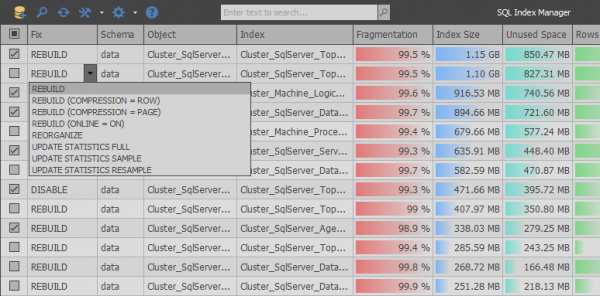
The latest version of the application can be downloaded from . The source files are there as well.
I welcome criticism and feedback 🙂
Source: habr.com
