


*, or Frequency Illusion — a cognitive distortion where recently learned information, appearing again after a short period of time, is perceived as occurring very frequently.
Everywhere there are "bugs"...
Each of our "softwares" is packed with "bugs" — .
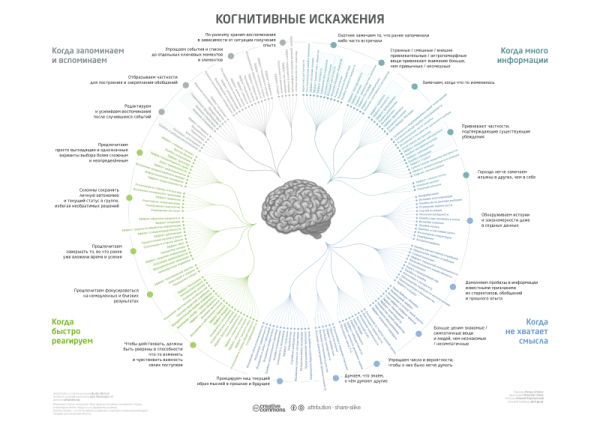
The question arises: how can a person perceive reality without them? Can human consciousness be fundamentally free from systematic deviations in perception? How would human society and the world change if each person were free from them?
Until there are answers to these questions and until none of us is free from them, marketers, advertisers, and other practitioners of successfully exploit this "Achilles' heel" of human perception. They have managed to create manipulative techniques effectively utilizing our cognitive distortions for, for example, achieving corporate commercial goals.
The author found practical applications for cognitive distortions in another field — foreign language learning.
Psychological inertia of the native language in learning a foreign one
As a specialist working with people's consciousness, the author knows very well how painful and ineffective the struggle against the psychological inertia of the native language is when learning English.
Cognitive science has revealed that even if a person is well aware of their cognitive distortions, this knowledge does not provide any immunity against falling into them. In language learning, the goal is practical mastery of the language as a tool, not the struggle against inevitable cognitive distortions that hinder achieving this goal. At the same time, encounters with cognitive distortions in the process of mastering a foreign language are inevitable.
Unfortunately, the popular technologies and methods for teaching foreign languages today do not take into account the natural resistance of the psyche to integrate incomprehensible language constructs. They are, in fact, more like long-term projects of forcefully breaking through closed doors rather than a pleasant process of mastering important skills, accompanied by the enjoyment of feeling growth in expertise and the profitability of intellectual, time, and financial investments.
Through pedagogical practice, the author has learned one truth: fighting against distortions in language perception is as unproductive as battling one's own Shadows according to Jung, which can only be overcome by identifying, recognizing, and accepting them within oneself. When the repressed Shadow is reintegrated into the personality, it transforms into a powerful resource.

From this conclusion arose the idea of 'riding' the inertia of cognitive distortions, to controllably play along with consciousness in such a way that distortions assist, rather than hinder, the quick assimilation of material.
Thus, Method 12 (link in the profile) emerged — a heuristic way of 'immersing' the system of 'tenses' in English grammar. In this process, some of our cognitive distortions, which usually act as obstacles, instead serve as our allies, paradoxically ensuring awareness and comfort in the learning process, significant savings in time and finances — overall, a rather simple, algorithmized, and engaging shortcut to the goal.
'Those who hinder us, help us!'
In the system of mastering the twelve English tense forms, Method 12 incorporates the principle of Aikido: 'Those who hinder us, help us!'

Indeed, why invest in a grueling struggle against cognitive distortions when they can be utilized as mighty allies, making it much easier to triumphantly enter a new skill?
What are these , that help us assimilate material within the Method 12 framework, and which traditional teaching approaches interact with so irrationally?
To begin with, any traditional approach to language acquisition involves its study from the outside. as an existing phenomenon. The prospect of further integrating this foreign system into one's own consciousness appears to the learner as tenuous as breaching a fortress wall in a leap. There is me, and there is the giant Englishman, and I have to eat and digest this elephant by slowly cutting off small pieces.
Guarding the moment when this eaten elephant becomes an integrated part of your consciousness is a cognitive distortion referred to as “” (which is associated with “”). Method 12 takes this psychological phenomenon into account, as well as the similar “” (which is an objective property of the psyche, not a cognitive distortion), building an educational space on their inertia.
Let's consider how Method 12 interacts with each of them
Let's consider how Method 12 interacts with each of them and how—traditional approaches:
| The IKEA Effect, description | Method 12 | Traditional teaching methods |
|---|---|---|
| People tend to value more highly what they have contributed to creating. Because a lot of effort has been invested in the project, people often tend to continue investing in obviously failing projects. | Within the framework of Method 12, a person independently constructs the system of English tenses by answering the teacher's questions proposed in a specific sequence. Learners see how many steps are left to complete the construction and measure the profitability of their investments. When the construction is complete, they stop investing in its creation and realize that they are entering the stage of perfecting their command of the construction. | The learner creates nothing on their own; they merely try to blindly seize some abstract external substance. Typically, people try to understand the tense system for years and remain unsatisfied with their understanding and mastery of this material. Learners either step back for a time, later returning under the pressure of objective necessity to attempt to master the material; or stubbornly continue to invest in what they are patently failing at without realization. |
| Generation Effect, or Manifestation, description | Method 12 | Traditional teaching methods |
|---|---|---|
| The best mastery of material occurs when a person independently generates or completes it themselves, rather than simply reading. This is manifested through a deeper processing of the generated information, which carries more semantic load. It involves establishing a greater number of associative connections, increasing the number of "access routes" to the generated information, unlike mere "reading.} | Within the framework of the 12 Method, a person generates a system by responding to a series of cognitive questions, invoking familiar and understandable elements of their native language from their consciousness, and reassembling them into a different system of the target language. Thus, the new system is the creation of the student, rather than an external object to be studied. The identity of the present system to the system of English "tenses" is the responsibility of the teacher and developer, not the student. | The learner does not create anything themselves; they merely attempt to blindly study some abstract unfamiliar external material, using relatively non-systematic rules and exercises developed by third parties. |
These two phenomena, one of which is a cognitive distortion, are the pillars upon which two of the four (the symmetric first and third) stages of the 12 Method are built, where the construct of the system of English aspect-time forms is revealed.
The Triumph of the Owl and the Globe
Furthermore, the 12 Method successfully overcomes the eternal problem faced by learners of "stretching the Russian owl over the English globe," which has already been mentioned by the author It seems that this cognitive distortion is a derivative of the distortions of "
Confirmation Bias”, “Illusory CorrelationThey are united by our mind's tendency to seek or interpret new information in such a way that it fits into the existing paradigm in our consciousness. In the case of learning English, it is the phenomenon of persistently searching for Russian cognitive logic in a foreign language, which, of course, is almost non-existent in the desired form.
Instead of arguing with a powerful force that, beyond our will, begins to "stretch" a new material, which is outside the paradigm of the native Russian language, onto this very paradigm, rather than hammering in nails of rules into this spontaneous process and snapping the whip of correction over the endless errors in speech and exercises, we, like a wise psychiatrist, gently agree with the rebellious consciousness. "Yes, dear. You want it that way? Of course, my good one, let it be as you wish." And we shape the necessary channel for the element.
A comforted consciousness stops stressing and panicking over the inability to "fit the unfit." Meanwhile, we gently present it with a representation of the system of tenses, encoded into a system of familiar, “peaceful” realities and symbols, — “facts,” “processes,” “deadlines,” “completed facts,” etc. This auxiliary symbolic structure is composed in such a way that it is identical to the system of twelve English tenses in the active voice. After a few hours of training, the consciousness smoothly overlays the auxiliary 3D structure onto the system of English Tenses and naturally integrates once-hated and incomprehensible Present Perfect Simple and Future Perfect Progressive. An analogy can be drawn with a situation where medication needs to be delivered to the bloodstream of a sick animal. The beast will refuse to take the tablet in its pure form, and instead of wasting time on its resistance and aggression, the owner simply mixes the pill into a treat. Voila.
As a result, we allowed the mind to 'stretch' for its own pleasure, but we slightly adjusted this process: the 'owl' became English, and the 'globe' became Russian. That is, under the careful guidance of the teacher, the mind stopped looking for Russian cognitive logic in English, and instead, found elements of English cognitive logic in Russian, structuring these common elements in understandable and familiar categories using a system identical to the English tense forms. We smoothly and comfortably overcame the mind's resistance, sidestepping the fruitless struggle against it, using the mechanisms of the aforementioned cognitive distortions to enhance the quality and depth of skill internalization.
Moreover, in developing the internal terminology of the Method 12, we utilize natural inertia. and , conditionally coding some of the most complex cognitive constructions for Russian speakers into simple phrases like: 'the early bird gets the worm', 'I walked and walked, found a pie, sat down, ate, and then walked on', 'scissors', 'pins', 'segments'. Now that we have such concise memes in our arsenal, we have mercifully lightened the mind: to embed the formidable Past Perfect into our Russian paradigm, we don't need convoluted definitions like 'an action completed prior to some past point of time specified or implied, formed in English by had and the past participle'. It's enough to conspiratorially hint: 'whose slippers?'
It might not sound very scientific, I agree. But without cognitive distortions, it is reduced to a logical system, simple and reliable, like an AK-47. Taken out of the context of the constructed system, this 'pragmateterminology' loses all meaning.
It is worth mentioning that the course is structured cyclically, in the best traditions. and The material of the first stage is processed on a new, deeper level in the third stage, while the second stage mirrors the 'enriched' fourth stage. And beyond that — the sky is the limit... A strong "skeleton" of English grammar is implanted in the student's mind. Further, it is possible to build up relief "muscles" and polish other linguistic beauty as long as the student desires and needs.
The sinister sin of the teacher
We have thought a lot about the learners. What about the teacher? They are also a person with their own distortions. What does a teacher overcome within themselves when teaching using the Method 12? The distortion of perception with the sinister name "": “one of the cognitive distortions in human thinking, which consists of the fact that more informed people find it extremely difficult to consider any problem from the perspective of less informed individuals.” With such a transparent technology in play, the teacher has no chance of accidentally confusing the student. It is quite possible that while teaching using Method 12, as in that joke, "while explaining — I understood myself," the teacher, while explaining the material, may sometimes see things they hadn’t noticed before.
I would like to know what perception difficulties those who have read this text have faced while learning languages. And a big request to those who have no cognitive distortions — please do not throw stones of criticism at the Method if possible. The author has tried.
Source: habr.com
