

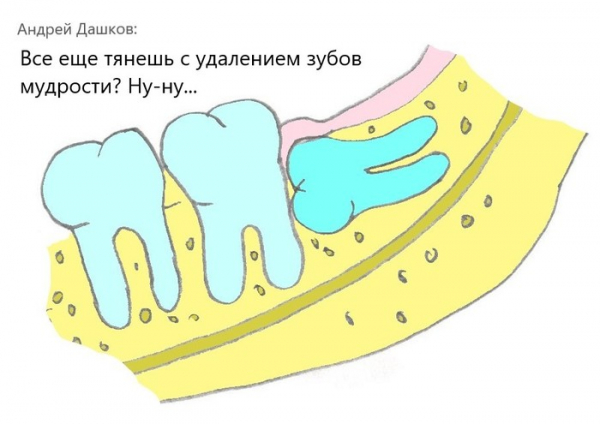
Hello again! Today I would like to write a mini post and answer the question - "Why remove wisdom teeth if they don't cause any problems?" I also want to comment on the statement - "My relatives and friends, dad/mom/grandpa/grandma/neighbors/pet had their tooth removed and everything went wrong. Absolutely everyone had complications and now there are no removals." First of all, I want to say that complications arose not from the fact of tooth removal, but from how this removal was conducted. This could happen for several reasons:
- During the removal, something went wrong and it was improperly performed.
For example, a fragment of the root might have been left behind that could not be removed. Sometimes it does happen that a piece of the root breaks off and cannot be retrieved. The doctor decides not to further torture the patient to avoid causing even more harm. Or to not disturb the inferior alveolar nerve that runs very close to the roots of the lower 8th teeth while trying to extract that piece. You might ask - "How is that possible?" It is possible. If there was no acute, and even worse, purulent inflammation, and a small, immobile fragment of the root remains in the socket, nothing terrible will happen, it will just heal. Naturally, I am not saying that broken roots should be left in the sockets without trying to remove them. But if the doctor understands that "picking" may only cause harm - that is not the worst decision. I repeat, if there was no acute inflammation; otherwise, the tooth must be completely removed as it is infected.
- Sterility was not maintained during the procedure.
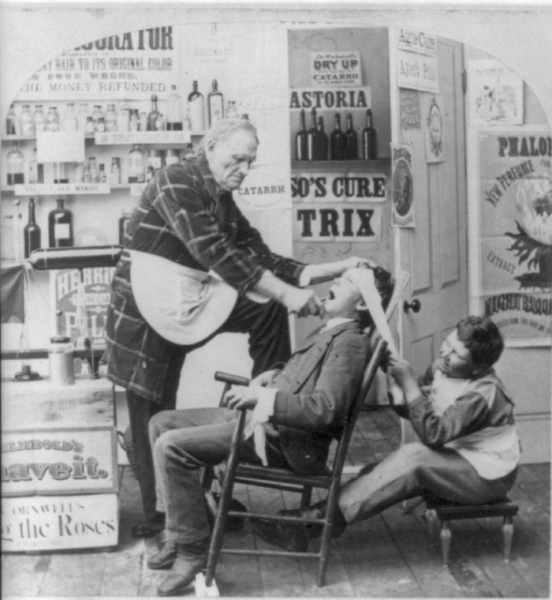
I am not even talking about instrument processing and their sterilization, which should be perfect in every medical institution. Elementary the doctor might not wash their hands and, after putting on gloves, touch something, a phone, a computer mouse, a patient's bag that they asked to hand over, there are many options, and then those hands go into your mouth. Asepsis and antiseptics have not been canceled.
- The patient neglected the recommendations given by the doctor.

If everything I mentioned above can indeed happen, although I think there aren’t many doctors like that. At least, I hope so. Some time ago, when I was working at a clinic located in a 'sleeping' district of the capital, patients often came in who completely ignored recommendations.
And they would go to the bathhouse — 'How is that not allowed? I've been going for 20 years! Consistently, every week!'
And they were actively involved in sports — 'How could I stop training, I’m preparing for the Olympics!'
And it seemed they didn't want to hear that rinsing is absolutely NOT allowed! — 'After the extraction, I came home and immediately rinsed with a decoction of medicinal herbs, chamomile, oak bark, and infusions on deer antlers to disinfect. My neighbor advised me to do that.'
Even a simple unilateral refusal to take prescribed medications can lead to a multitude of complications. You might ask, — which medications? Classically, no one wants to take antibiotics. Although there are those who, at the first sign of a sore throat or a runny nose, start taking antibiotics like candy, not realizing that it's not an antiviral medication. And here, people don’t want to. Antibiotics are not prescribed just like that; they are given to prevent complications. The area where the 8th teeth are located is especially prone to inflammation and purulence. Therefore, taking antibiotics after the removal of impacted 8th teeth is mandatory. If, of course, you want to take a risk and develop a peritonsillar abscess, like one of my patients who decided to ignore the recommendations, then by all means.
So what was I saying… Oh yes. It doesn't hurt!
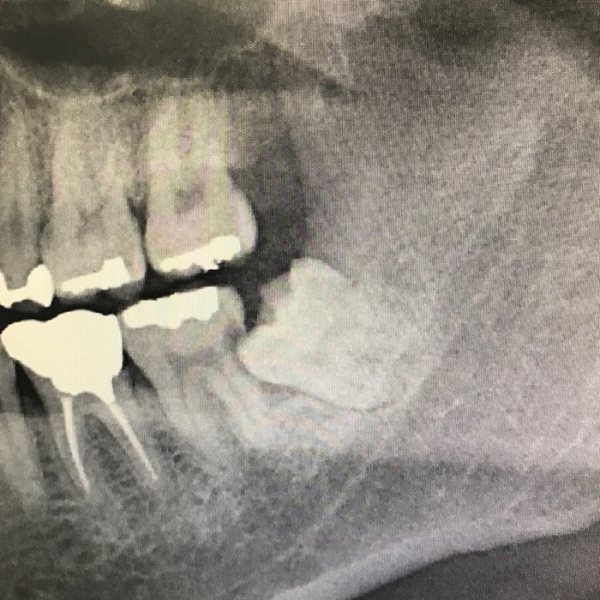
Here's a vivid example of what can happen due to the untimely removal of a wisdom tooth. And yet it doesn’t hurt! A man came in with a completely different problem; it was found accidentally when a panoramic X-ray of the teeth was done.
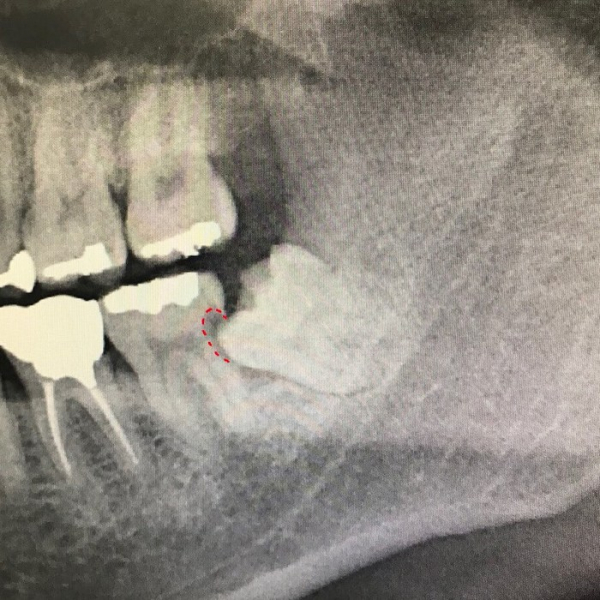
Due to the improper position of the 8th tooth against the contact surface of tooth number 7, a sufficiently deep carious cavity formed, extending deeply under the gum.
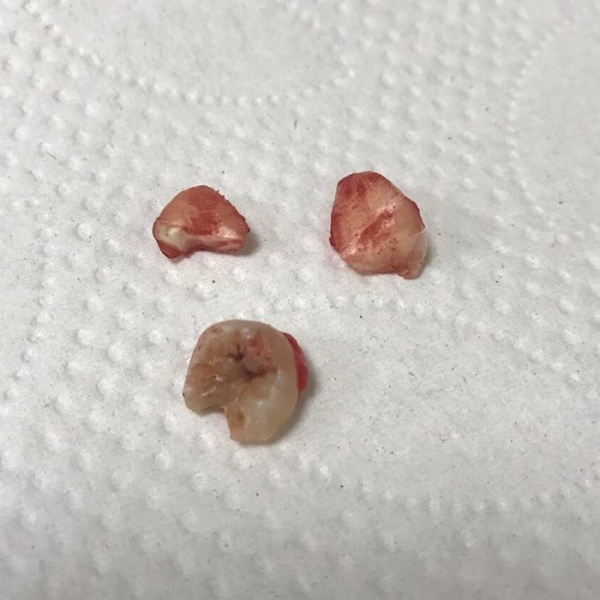
The wisdom tooth was successfully removed, but the 7th tooth is next… (the 8th tooth was divided into three fragments — the crown part and two roots)
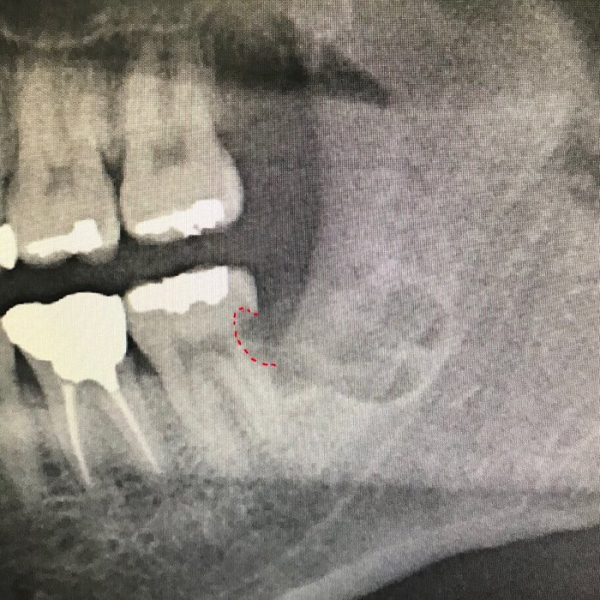
It seemed like a normal tooth. "Well, it's just a cavity, and the filling costs one, just get another one, no big deal!" It's not that simple, as the carious cavity extends deeply under the gum, such teeth are not treatable. Why? Because when placing a filling, the treated cavity must be dry. Achieving this in such cases is impossible. At the very least, due to the fact that the gum contains "gum fluid," which will constantly seep into this area.
What should be done? There’s only one option — tooth extraction and implantation. Unfortunately.
Let’s move on!
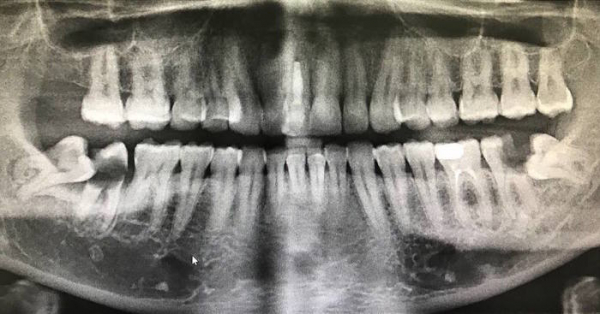
What do you think the patient came for? No, not with severe pain or swelling, as many might think. But with this — "I have food getting stuck at the bottom right, take a look." So the young man is only bothered by the fact that food is getting stuck… just food getting stuck, Carl! When asked if it hurt? The answer was — "No, it never hurt and nothing bothered me." Well… the order of actions in this case you already know. Here’s the reasoning — "I’ll wait until it bothers me."
If you think this is the worst thing that could happen to you, think again.
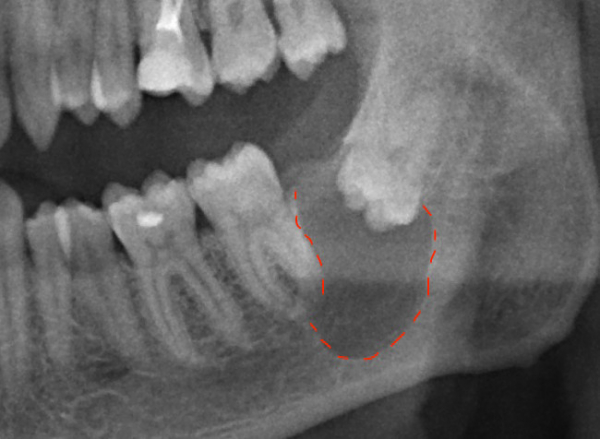
Such cysts (and this is not even the largest) can grow in your jaw and not bother you at all. Naturally, the tooth needs to be removed. To prevent this neoplasm from enlarging and to avoid possible complications. Before this, the canals in the neighboring 7th tooth need to be treated, as its roots are located within the cyst.
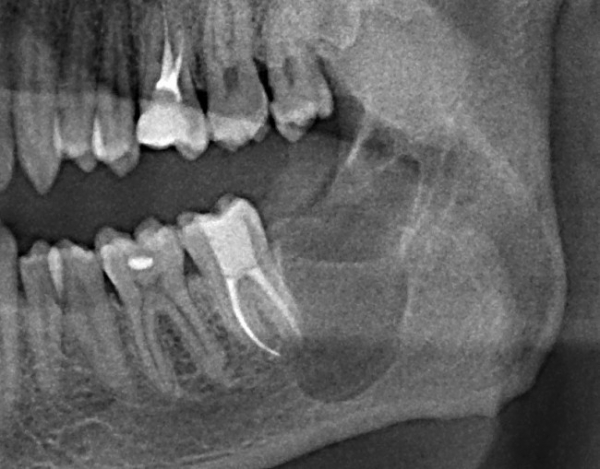
The problem is solved. The patient is happy. All of this could have been avoided by going for a routine check-up with the dentist.
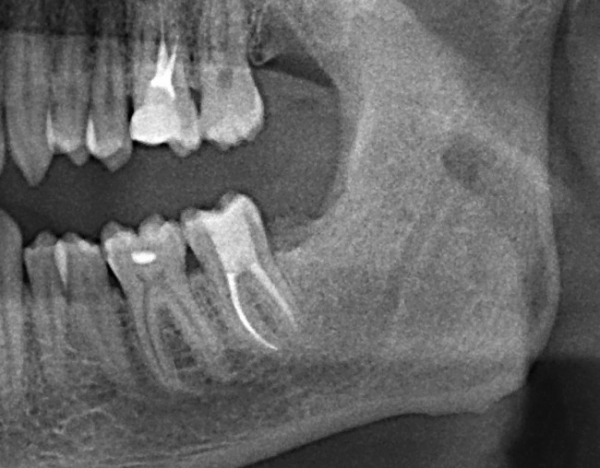
This is what we saw a year after the extraction. Everything got dragged out. Everything is perfect!
And this could threaten with a fracture of the jaw, as well as damage to the inferior alveolar nerve, which is accompanied by numbness of the lip and chin on the side of the affected tooth, and this numbness can last a lifetime.
The problem is that many don’t go to the doctor, even when it hurts. Although, I don’t think this applies to the users of Habr. But for a certain category of people, it’s quite difficult to convey that "not bothering" is not an indication that everything is fine.
Questions may arise like — "I have a crooked 8, does it need to be removed?" I’ll answer right away. Wisdom teeth need to be removed almost always! All these "almost always" I have already described , but how are these teeth removed — . Especially when the wisdom teeth have erupted incorrectly or haven't erupted at all.
If all your wisdom teeth have 'come out', don't rush to rejoice and think that everything is fine. You might think they are in the correct position, but don't hesitate to visit a dentist; this could be a misconception.
That's all for today, thank you for your attention!
Stay tuned!
Sincerely, Andrey Dashkov
Source: habr.com
