

Firearms are increasingly being used in public places. Recently, the world was shaken by the tragic news of a mass shooting at the Christchurch mosques. While social media the spread of violent images and the overall ideology of terrorism, other tech companies are developing technologies that could prevent such tragedies. For instance, is bringing to market a radar scanning and visualization system — Hexwave, which uses artificial intelligence (AI) and deep learning to detect concealed weapons on individuals. This week, the company announced a partnership with the German football club Bayern Munich to beta test the new technology at the Allianz Arena in Munich.
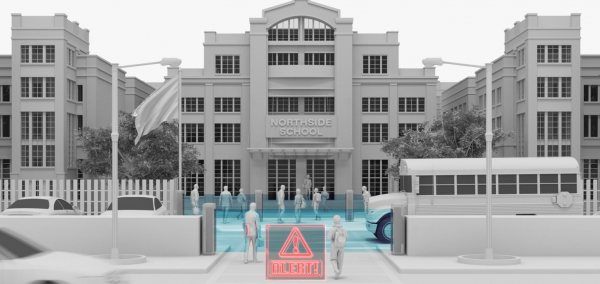
Bayern Munich has become Liberty Defense's first client in Europe, and at the same time, the company has already signed a number of agreements and contracts in the U.S. and Canada, including with Vancouver Arena Limited Partnership, which manages Rogers Arena in Vancouver, and with Sleiman Enterprises, which manages about 150 shopping centers in the U.S., as well as with the Attorney General of Utah, who signed a memorandum for beta testing Hexwave statewide.
Liberty Defense was founded in 2018 by Bill Riker, who claims to have over thirty years of experience in the defense and security industry and has previously held leadership positions at Smiths Detention, DRS Technologies, General Dynamics, and the U.S. Department of Defense. His company received an exclusive license from the Massachusetts Institute of Technology (MIT) along with an agreement to transfer all necessary patents related to the three-dimensional radar visualization technology that currently underpins the company's main product called Hexwave.
"Hexwave has been received fantastically, and we are excited to work together with FC Bayern Munich, a football club known in both Europe and North America," said Riker. "Our ability to deploy Hexwave both indoors and outdoors using both overt and covert installation sets us apart from competitors and is generating increasing interest from the market."
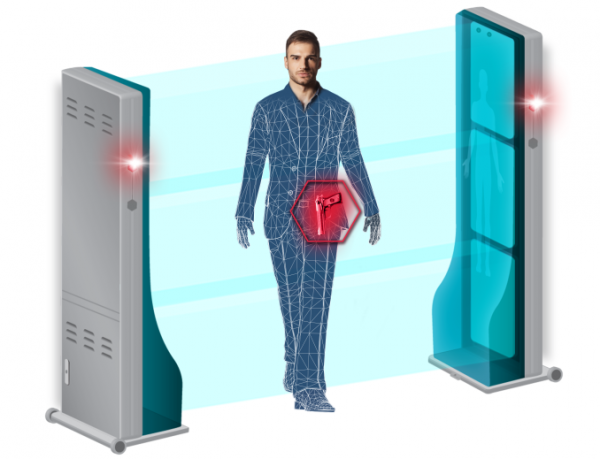
Hexwave operates on the basis of a special low-energy radar that uses microwaves, which is 200 times weaker than standard Wi-Fi. Its signal easily passes through various materials, including clothing and bags, and then reflects off the human body, creating a 3D image of everything on the surface of the body. This system can detect the outlines of firearms, knives, and explosive belts.
The radar itself is built on technology, as previously mentioned, , including an antenna array and a transceiver, which allow it to capture data in real time, as well as software for generating three-dimensional images. However, Liberty Defense has also added its technologies to the acquired development, such as a functional user interface and an artificial intelligence system for continuous threat detection without human involvement.
Of course, the same X-rays and millimeter-wave scanners are already used in many security systems, for example, to scan bags in airports or train stations, and they can also provide 3D scanning of the human body. But what Liberty Defense offers is the detection of potentially dangerous weapons while someone is literally passing by. A person simply needs to walk past the installed device for Hexwave to capture an image, which the AI immediately analyzes.
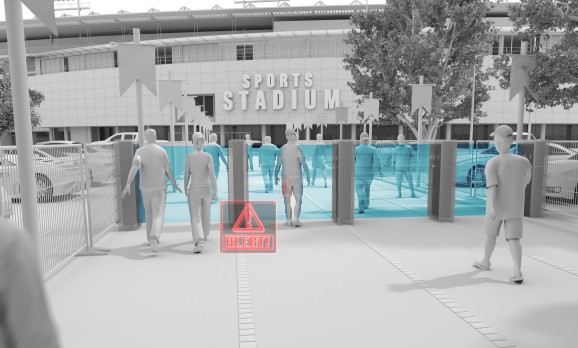
“Hexwave creates 3D images at high speed in real time and can assess threats when a person simply walks by, which means it is well-suited for locations with higher foot traffic and numerous people,” said Riker in a letter to VentureBeat.
So far, Liberty Defense has raised approximately 5 million USD for the commercialization of its product and beta testing in various public places. It is also worth noting that the company recently achieved public status in Canada after undergoing a reverse acquisition process, which will allow it to trade its shares and secure additional investments.
"Publicity not only helps us inform the public about our product but also allows us to access the next tranche of funding we need to continue developing Hexwave," commented Ryker to VentureBeat.
In addition to Liberty Defense, there are several other companies that use AI for weapons detection. For example, from Austin uses computer vision for this purpose, although their system is not capable of detecting hidden threats, while the Canadian company and the American , supported by Bill Gates, are developing products similar to Hexwave. Meanwhile, Oakland International Airport has already installed the Evolv system last year as part of a staff screening program, and this system is currently being tested at Gillette Stadium in Norfolk County, Massachusetts.
All these companies and their products undoubtedly reflect the growing demand for automated threat detection in public spaces such as airports, shopping malls, and sports stadiums. Liberty Defense cites data from Homeland Security Research, indicating that by 2025, the weapons detection system industry is expected to reach $7.5 billion compared to the current $4.9 billion. Therefore, the company has big plans and intends to actively conduct trials of its product in real conditions throughout 2019 and 2020, starting with North America and Europe.
You can watch the Hexwave video presentation in English below.
Source: 3dnews.ru
