


Humans are social beings. No matter how much an individual tries to isolate or withdraw themselves, they will be influenced by others, whether those others intend to or not. This phenomenon is called interspecific bidirectional psycho-emotional reaction. A key term in this lengthy definition is "interspecific." This means that such reactions can be observed not only in groups of people but also in flocks of birds, prides of lions, or even herds of sheep. Organisms that remain in close contact for a long time will inevitably impact one another, including in aspects of their psycho-emotional states. Today, we will discuss a study whose results, according to the authors, provide the first tangible evidence of interspecific bidirectional psycho-emotional reaction. How exactly does this phenomenon manifest, who were the subjects in the study, and what supports the scientists' conclusions? We will find out from the research group's report. Let's go.
The foundation of the research
If you ask what characteristics set humans apart from other beings, many will first mention intelligence, and they would be correct. Others might add sociability and emotionality, but these traits are not exclusive to humans. Any creatures living in groups are social. Regarding emotions, while humans may possess a broader spectrum of emotions and ways to express them than, say, a meerkat, emotions are not their unique characteristic.
An individual's psycho-emotional state is heavily influenced by their environment, particularly the society that surrounds them. Scientists refer to this as contagious emotions, among which the strongest "infection" is stress. For instance, it has been established that students whose teacher consistently experiences stress exhibit elevated levels of cortisol*.
Cortisol* is a biologically active glucocorticoid hormone that plays a role in the body's responses to stressful situations.

A similar pattern can be observed even in prairie voles (Microtus ochrogaster), which show a correlation of stress levels with a partner that has previously been exposed to a stressor*.
Stressor* — any factor that causes stress.
However, these are examples of intraspecies correlation of stress. Interspecies correlation also exists, although it is less studied. To address this, researchers proposed examining stress levels in dogs and their owners. As we discussed in , humans and dogs have coexisted for thousands of years. Both are social beings, so it is quite expected that a psycho-emotional connection exists in such relationships.
Scientists claim that between a human and their four-legged friend, interspecies long-term synchronization of stress hormones (cortisol) may occur, the level of which can be tested through hair. They decided to discard blood and saliva, as these materials yield results that describe recent periods, while hair allows for the assessment of long-term hormonal background. Hair grows, as trivial as it may sound, and cortisol leaves its mark on it; analyzing which can provide a retrospective calendar of concentrations of this hormone. Similar analyses have previously been conducted involving mothers and their children, whose cortisol levels were found to be synchronized.
As for dogs, an important aspect of the human-animal relationship is training and establishing a hierarchy. If a dog is not trained, it may misbehave (for instance, watering your favorite flowers in ways you'd rather it didn't, or barking and lunging at passing people). To achieve discipline, the dog must understand that its owner is the leader, i.e., the dominant individual in the pack. The process of training and disciplining dogs not only leads to an emotional bond between the dog and the human but also bidirectionally influences the behavior of both dyads*.
Dyad* — a symbiosis that involves hierarchical dependence. A dyad is also a totality of two interconnected objects, that is, a pair.
Cortisol levels, as studies have shown, in both dogs and humans also depend on the personality traits of the owner and even the combination of the dog's/owner's gender in the dyad.
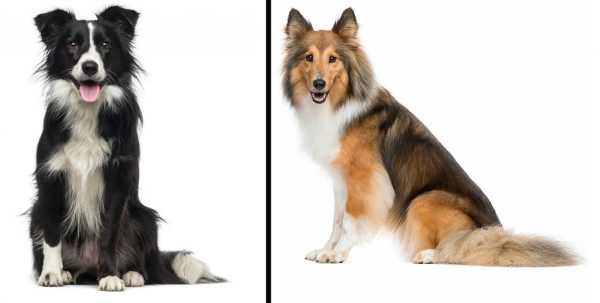
Study participants: border collie (on the left) and Sheltie (on the right).
In this study, researchers aimed to delve deeper into the issue of interspecies psycho-emotional synchronization using the example of the human-dog dyad. For this purpose, 58 individuals and their pets (i.e., 58 dyads) were invited as subjects. The researchers monitored each dog's physical activity through a special collar that transmitted data on the dog's physiological state. The cortisol levels of both dogs and their owners were measured during the summer and winter months to analyze changes over the periods between the collection of biological samples (hair). The study included dogs of two breeds — Shetland Sheepdogs (33 individuals: 18 females and 15 males) and Border Collies (25 individuals: 13 females and 12 males), consisting of both regular pets and permanent participants in various competitions. All dog owners were women. The average age of the furry subjects was 4.7 ± 0.4 years for regular pets and 4.7 ± 0.7 years for competition participants. The average age of the dog owners was 46.3 ± 1.7 years.
Research Results
To analyze the effect of humans on dogs, a generalized linear model was used, considering the gender, breed, and lifestyle of the pets.
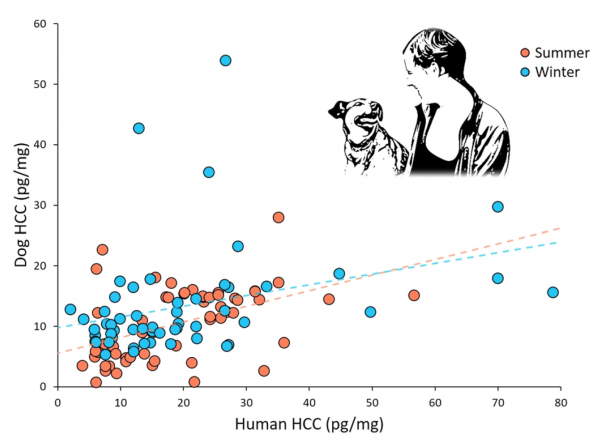
Image No. 1
As shown in the graph above, the owner's cortisol level significantly impacts the same measure in dogs during both winter (N = 55, χ2 = 13.796, P < 0.001, β = 0.027) and summer (N = 57, χ2 = 23.697, P < 0.001, β = 0.235). In simpler terms, when cortisol levels increase in humans, the same occurs in dogs.
During the summer months, the most pronounced relationships were noted between HCC (hair cortisol concentration) in humans and the lifestyle of dogs (χ2 = 6.268, P = 0.012, 2A) and between HCC and the gender of the dog (χ2 = 5.200, P = 0.023, 2B).
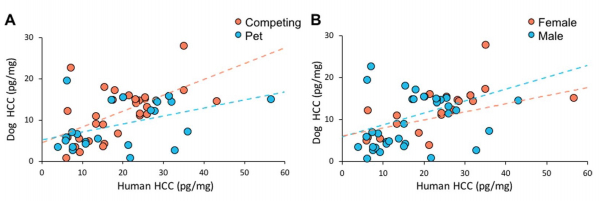
Image #2: relationship between HCC and lifestyle (2A); relationship between HCC and the gender of the dog (2B).
The impact on HCC from humans affected all dogs regardless of gender and lifestyle, but the strongest effect was observed in females and dogs participating in competitions.
In winter, breed played a significant role (χ2 = 6.451, P = 0.011): HCC was significantly higher in Shetland Sheepdogs than in Border Collies (12.905 ± 1.417 vs. 12.069 ± 1.203).
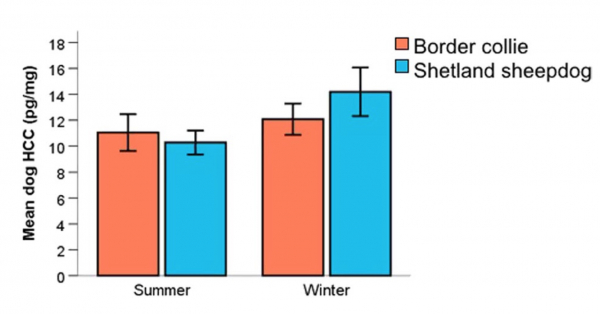
Image #3: relationship between HCC and the season when biological samples for analysis were collected.
In addition to the factors mentioned above, there are others (such as whether the dog owner works, the age of the dog, whether it has lived with other pets, etc.). However, these factors had virtually no impact on the results, so the researchers did not pay attention to them.
However, physical activity can really affect cortisol levels in the body, so scientists decided to check the relationship between long-term cortisol levels and dog activity. The dogs' condition was monitored using a special collar for one week, during which the researchers singled out three working days and one day off for analysis.
The amount of time spent by dogs in moderate to high physical activity correlated with the dogs' HCC. However, no significant correlations were found either with summer HCC (N = 44, r = -0.213, P = 0.165) or with winter HCC (N = 43, r = -0.239, P = 0.122).
The most interesting influencing factor on cortisol levels for scientists remained the personality traits of both the dog and its owner. The study participants filled out two questionnaires: DPQ (Dog Personality Questionnaire) and The Big Five Inventory (regarding human personality traits).
It turned out that the owner's personality strongly influences the pet's cortisol level. Thus, a higher level of neuroticism in a person negatively affected the dog's HCC (summer: χ2 = 7.951, P = 0.005, β = −0.364; winter: χ2 = 4.919, P = 0.027, β = −0.026).
Finally, the scientists examined how the season affects cortisol levels, as samples were deliberately taken in summer and winter. It was found that cortisol levels are significantly higher in winter than in summer.
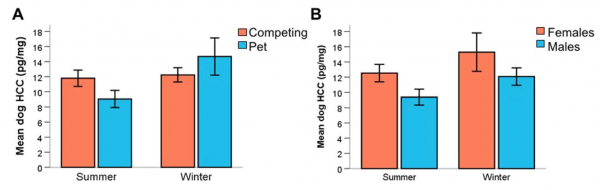
Image No. 4
The analysis of the relationship between the time of year and lifestyle showed that household dogs have higher cortisol levels in winter, while competition dogs have higher levels in summer (4A). When discussing gender differences, females exhibited higher HCC both in winter and summer (4B).
For a more detailed understanding of the nuances of the research, I recommend checking out the .
Epilogue
The interrelationship of psycho-emotional states between two or more individuals of the same species living together for an extended period has been and remains undeniable. As for interspecies synchronization of cortisol, there are no particularly astonishing discoveries. This work was not aimed at breakthroughs but was necessary to confirm the previously expressed theory that humans and dogs, as representatives of social species, significantly influence one another.
Researchers from Linköping University (Sweden), who conducted this study, believe that dogs are projections of their owners' emotional states. This means that humans have a greater influence on dogs regarding long-term synchronization of cortisol levels. Moreover, they assert that earlier studies of this kind had not been conducted.
Are we surprised by the results of this work? Were they unexpected for us? More often no than yes. However, we have once again received scientific support for the phrase 'we are responsible for those we tame.'
Friday off-topic:

Thank you for your attention, stay curious, love animals, and have a great weekend, everyone! 🙂
Thank you for staying with us. Do you enjoy our articles? Would you like to see more interesting materials? Support us by placing an order or recommending us to your friends. 30% discount for Habr users on a unique entry-level server designed by us for you: (options available with RAID1 and RAID10, up to 24 cores and up to 40GB DDR4).
Dell R730xd for half the price? Only with us in the Netherlands! Dell R420 — 2x E5-2430 2.2GHz 6C 128GB DDR3 2x960GB SSD 1Gbps 100TB — from $99! Read about how
Source: habr.com
