

platform release , for organizing the development process of distributions and software products, including preparation and support of releases and updates. The system allows cross-compilation of packages for most major Linux distributions or the creation of a custom distribution based on a specified package base.
Building is supported for 21 target platforms (distributions), including CentOS, Debian, Fedora, OpenMandriva, openSUSE, SUSE Enterprise Linux, Red Hat Enterprise Linux (RHEL), and Ubuntu. Builds are possible for 6 architectures, including i386, x86_64, and ARM. OBS covers over 140,000 packages and is used as the primary system for building projects like openSUSE, Tizen, Sailfish/Mer, NextCloud, and VideoLAN, as well as for building Linux products in companies like Dell, Cray, and Intel.
To build the latest version of a specified program as a binary package for the desired system, it is sufficient to create a spec file or connect to the package repository available at . Additionally, a ready-made minimalist environment can be formed for use in virtualization systems, cloud environments, or for booting as a Live distribution. When working with OBS, the developer can use the ready online service or or a similar system on their own server. Moreover, it is possible to quickly deploy one's own infrastructure using specially prepared for virtual machines, containers, local installations, or for PXE booting over the network.
It is possible to automate the download of source texts from external Git or Subversion repositories or code archives from ftp and web servers of primary projects, which eliminates the need for intermediate manual uploads of code archives to the local machine of the developer and subsequent imports into the openSUSE Build Service. Accompanying packages provide tools for determining dependencies on other packages with automatic rebuilding of those dependencies when changes are made. When adding patches, there is the possibility to test them with similar packages from other projects.
Open Build Service can be managed using both command-line tools and a web interface. There are tools for connecting third-party clients and utilizing resources from external services such as GitHub, SourceForge, and kde-apps.org. Developers have access to tools for creating groups and organizing collaboration. The code for all system components, including the web interface, package testing system, and build backends, is licensed under GPLv2.
Among , added in Open Build Service 2.10:
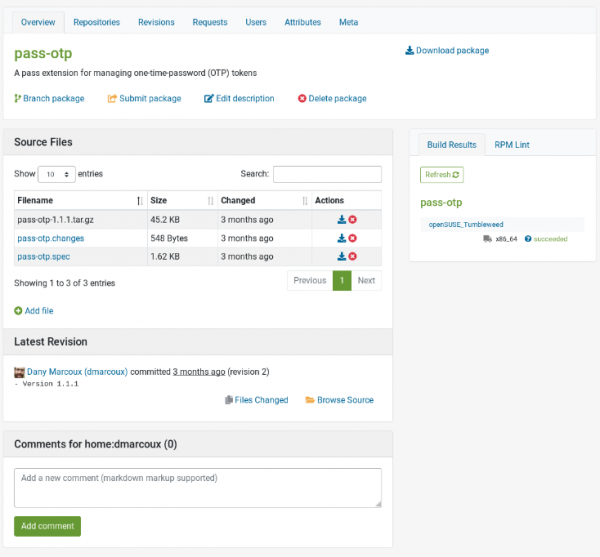
- Fully a web interface that has been rewritten using components from the Bootstrap framework, which has simplified code maintenance, standardized the design of various parts, and eliminated many complexities (previously, the 960 Grid System, a custom theme for jQuery UI, and an abundance of specific CSS were used). Despite the radical overhaul, developers made an effort to preserve the recognition of elements and the familiar workflow to reduce discomfort when transitioning to the new version;

- Work has been done to improve support for the delivery and deployment of applications for isolated containers. A for distributing containers has been prepared. For example, to launch a fresh environment based on the Tumbleweed repository, it is now sufficient to execute “docker run -ti —rm registry.opensuse.org/opensuse/tumbleweed /bin/bash”. Support has been provided for
tracking the status of binary builds (release control) in containers. Support for kiwi profiles and the ability to generate multi-arch manifests have been added; - Modules for integration with GitLab have been added, , allowing specific actions in OBS to be tied to new commits or to specified events in these systems.
- The ability to upload to cloud environments Amazon EC2 and Microsoft Azure has been built in, as well as publishing through Vagrant;
- Sysv init scripts have been replaced with systemd files;
- Support for storing metrics with performance data in the InfluxDB database has been added;
- The use of emojis is now permitted in text fields (to enable this in database.yml, the utf8mb4 encoding must be set);
- An option has been added to send notifications to message owners about issues, with information about new comments appearing;
- A request pre-approval feature has emerged (requests are accepted only after review is completed);
- Performance optimization has been completed for product generation and publication in the repository. The planner now includes the ability for incremental project updates.
Source: opennet.ru
