

The Semicon West 2019 conference, held under the auspices of Applied Materials, has already yielded results in the form of interesting statements from AMD CEO Lisa Su. Although AMD has long ceased to manufacture processors independently, this year it outpaced its main competitor in terms of the progressive technologies being used. While GlobalFoundries left AMD to fend for itself against TSMC in the race for 7nm technology standards, the successes in mastering this stage of the lithographic process are credited to AMD. After all, the company continues to design its processors independently, and TSMC simply offered to adapt these designs for its manufacturing capabilities.
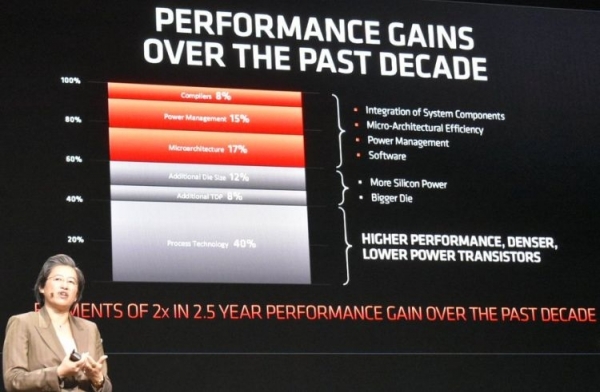
As can be judged from the fragmented photographs published by industry blogger David Schor at the Semicon West conference, Lisa Su addressed current issues facing the semiconductor industry. In AMD's understanding, it is still too early to dismiss the so-called ‘Moore's Law’ as a misguided theory, since progress in the lithography field has allowed the company to double the performance of its processors over the last two and a half years compared to products from the previous decade.
In any case, the manufacturing process contributed at least 40% to the performance increase, as AMD notes on the slide. If we add another 20% attributed to optimizations at the silicon level, that amounts to a total of 60%. Changes at the microarchitecture level accounted for 17% of the overall increase, energy consumption management was responsible for 15%, and compilers contributed an additional 8%. Ultimately, without advancements in lithography, AMD would not have achieved such success.
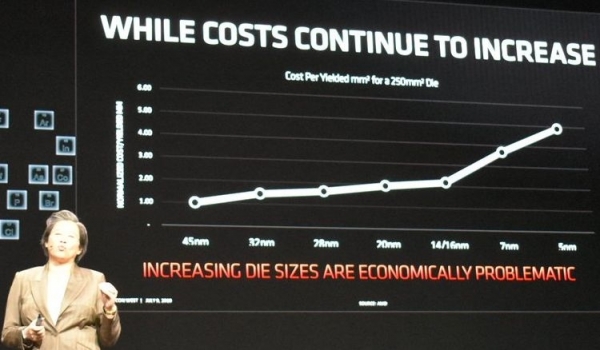
AMD's management highlights another trend: the ‘thinner’ the process technology, the more expensive it becomes to manufacture large chips. For example, a hypothetical chip with a core area of 250 mm2 will be five times more expensive in terms of unit cost per area when transitioning from a 45nm to a 5nm process technology. Therefore, to maintain economically viable production costs, processor chips must become more compact. AMD implements this principle by transitioning to the use of so-called ‘chiplets’—small chips combined on a single substrate.
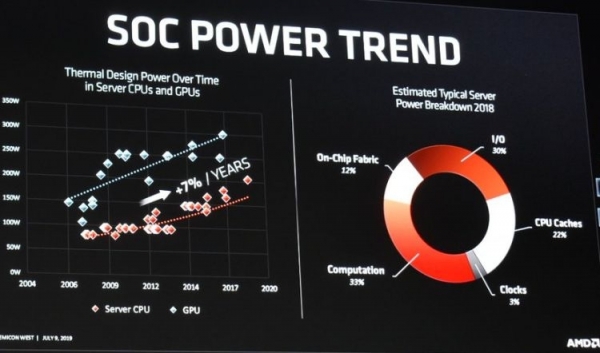
The third slide captured by the blogger's camera discusses the distribution of electricity consumption in modern highly integrated processors. Only one-third of energy expenditure is attributed to computational work. The rest is consumed by cache memory, input-output logic, and various interfaces. Since 2006, the TDP levels of server central and graphics processors have been increasing by 7% annually, as noted by AMD. However, energy efficiency is not as high as one would hope.
Source: 3dnews.ru
