


The familiar principle of 'bigger means more powerful' has long been established in many areas of society, including science and technology. However, in modern realities, we increasingly see the practical implementation of the saying 'small but mighty.' This is evident in computers that once occupied entire rooms but now fit in a child's palm, as well as in particle accelerators. Yes, remember the Large Hadron Collider (LHC), whose impressive dimensions (26,659 m in length) are literally indicated in its name? According to scientists from DESY, who developed a miniature version of the accelerator, this is already a thing of the past. The mini accelerator not only matches its full-sized predecessor in performance but even set a new world record among terahertz accelerators, doubling the energy of the injected electrons. How was this miniature accelerator developed? What are its main operating principles, and what did practical experiments reveal? A report from the research team will help us find out. Let's dive in.
The foundation of the research
According to Dongfang Zhang and his colleagues from DESY (German Electron Synchrotron), who developed the mini-accelerator, ultrafast electron sources play an incredibly important role in modern society. Many of them manifest in medicine, electronics development, and scientific research. The biggest problems with current linear accelerators, which use radio frequency generators, are their high costs, complex infrastructure, and significant power consumption. These drawbacks severely limit the accessibility of such technologies for a wider range of users.
These obvious problems serve as an excellent motivation for developing devices whose size won't evoke fear, nor will their power consumption.
Among the relative novelties in this field, terahertz accelerators offer several 'advantages':
- it is expected that short waves and short pulses of terahertz radiation will significantly increase the threshold of breakdown*, caused by the field, which will increase acceleration gradients;
Electrical breakdown* — a sharp increase in current when a voltage above a critical level is applied.
- The existence of effective methods for generating high-field terahertz radiation allows for internal synchronization between electrons and excitation fields;
- Classical methods can be used to create such devices, but their cost, production time, and size will be significantly reduced.
Scientists believe that their terahertz accelerator at millimeter scales is a compromise between conventional accelerators available today and micro-accelerators under development, which have many drawbacks due to their very small size.
Researchers do not deny that terahertz acceleration technology has been under development for some time. However, they believe there are still many aspects in this field that have not been studied, verified, or implemented.
In their work, which we are reviewing today, scientists demonstrate the capabilities of STEAM (segmented terahertz electron accelerator and manipulator) — a segmented terahertz electron accelerator and manipulator. STEAM reduces the length of the electron bunch to sub-picosecond duration, thus providing femtosecond control over the acceleration phase.
They achieved an acceleration field of 200 MV/m (MV - megavolt), resulting in a record terahertz acceleration of > 70 keV (kiloelectronvolts) from an injected electron bunch with energy of 55 keV. Thus, accelerated electrons up to 125 keV were obtained.
Device structure and its implementation
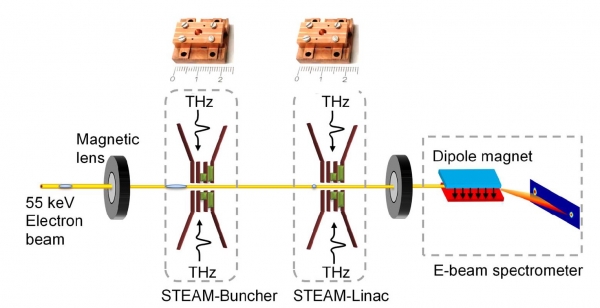
Figure 1: schematic of the researched device.
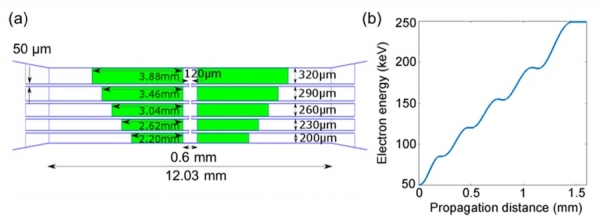
Figure 1-2: a — schematic of the developed 5-layer segmented structure, b — relation of calculated acceleration to the direction of electron propagation.
Electron bunches (55 keV) are generated from an electron gun* and injected into the terahertz STEAM-buncher (bunch compressor), after which they proceed into the STEAM-linac (linear accelerator*).
Electron gun* — a device for generating an electron bunch of required configuration and energy.
Linear accelerator* — an accelerator in which charged particles pass through a structure only once, distinguishing linear accelerators from circular ones (e.g., LHC).
Both STEAM devices receive terahertz pulses from a single near-infrared (NIR) laser, which also triggers the photocathode of the electron gun, leading to internal synchronization between electrons and accelerating fields. Ultraviolet pulses for photoemission on the photocathode are generated through two sequential stages. THG* of the fundamental wavelength of near-infrared light. This process converts a laser pulse with a wavelength of 1020 nm first to 510 nm and then to 255 nm.
THG* (second harmonic generation) — the process of combining photons with the same frequency during interaction with a nonlinear material, resulting in the formation of new photons with double the energy and frequency and half the wavelength.
The remaining part of the NIR laser beam is divided into 4 beams, which are used to generate four single-cycle terahertz pulses by generating differences in the intra-pulse frequencies.
Two terahertz pulses are then fed into each STEAM device through symmetric horn structures that direct terahertz energy into the interaction region across the direction of electron propagation.
When electrons enter each STEAM device, they are subjected to the electric and magnetic components of the Lorentz force*.
The Lorentz force* is the force with which an electromagnetic field acts on a charged particle.
In this case, the electric field is responsible for acceleration and deceleration, while the magnetic field causes transverse deflections.
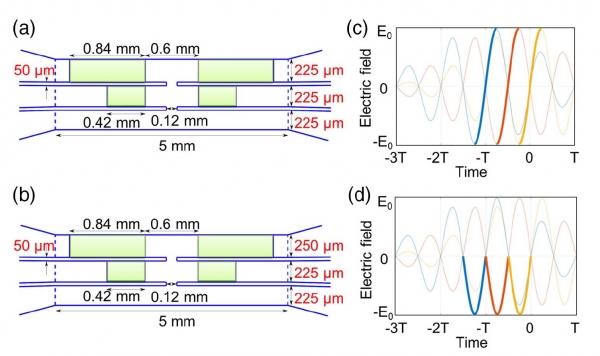
Image #2
As we can see in the images 2a and 2b, inside each STEAM device, terahertz beams are divided transversely by thin metal sheets in several layers of varying thickness, each of which acts as a waveguide carrying part of the total energy into the interaction area. Dielectric plates are also present in each layer to synchronize the arrival time of the terahertz wavefront* with the electron front.
Wavefront* is the surface to which the wave has propagated.
Both STEAM devices operate in electric mode, meaning they produce an overlapping electric field and suppress the magnetic field in the center of the interaction area.
In the first device, the electrons are timed to pass through zero crossing* the terahertz field, where the temporal gradients of the electric field are maximized, and the average field is minimized.
Zero crossing* is the point where there is no voltage.
This configuration causes the tail of the electron beam to accelerate and its head to decelerate, resulting in ballistic longitudinal focusing (2a and 2c).
In the second device, the synchronization of the electron and the terahertz radiation is set so that the electron beam experiences only the negative half-cycle of the terahertz electric field. This configuration leads to pure continuous acceleration (2b and 2d).
The NIR laser resembles a cryogenically cooled Yb:YLF system, which outputs optical pulses with a duration of 1.2 ps and energy of 50 mJ at a wavelength of 1020 nm and a repetition rate of 10 Hz. Terahertz pulses with a central frequency of 0.29 terahertz (period of 3.44 ps) are generated using the pulse front tilt method.
Only 2 x 50 nJ of terahertz energy was used to power the STEAM buncher (beam compressor), while the STEAM linac (linear accelerator) required 2 x 15 mJ.
The diameter of the input and output apertures of both STEAM devices is 120 μm.
The beam compressor is designed with three layers of equal height (0.225 mm), equipped with plates made of fused quartz (ϵr = 4.41) measuring 0.42 and 0.84 mm for controlling temporal synchronization. The equal heights of the compressor layers reflect the fact that no acceleration occurs (2c).
In contrast, in the linear accelerator, the heights differ — 0.225, 0.225, and 0.250 mm (+ fused quartz plates of 0.42 and 0.84 mm). The increased layer height explains the increase in electron speed during acceleration.
Scientists note that the number of layers directly corresponds to the functionality of each of the two devices. To achieve a higher degree of acceleration, for instance, more layers and a different height configuration will be needed to optimize the interaction.
Results of practical experiments
First and foremost, researchers remind us that in traditional accelerators based on radio frequencies, the temporal duration of the injected electron beam affects the properties of the accelerated beam due to changes in the electric field experienced during the interaction by various electrons within the beam, arriving at different times. Thus, it can be assumed that fields with higher gradients and beams with longer durations will lead to greater energy spread. Injected beams of longer duration may also lead to higher values. emittance*.
Emittance* — the phase space occupied by the accelerated beam of charged particles.
In the case of a terahertz accelerator, the field excitation period is approximately 200 times shorter. Consequently, the intensity* of the sustained field will be ten times higher.
Electric field intensity* — a measure of the electric field, equal to the ratio of the force applied to a stationary point charge placed at a given point in the field to the magnitude of that charge.
Thus, in a terahertz accelerator, the field gradients experienced by electrons can be several orders of magnitude higher than in a conventional device. The timescale at which the curvature of the field is noticeable will also be significantly shorter. This implies that the duration of the injected electron beam will have a more pronounced effect.
Scientists decided to test the theory in practice. To do this, they injected electron beams of varying durations, which were controlled by compression through the first STEAM device (STEAM-buncher).
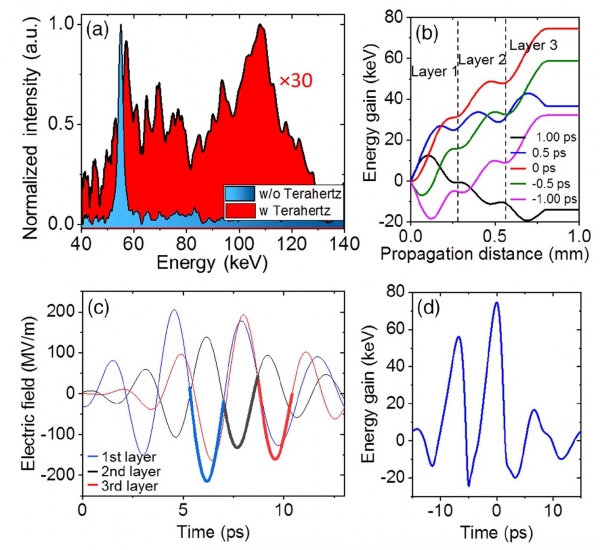
Image #3
In the case where the compressor was not connected to the power source, electron beams (55 keV) with a charge of approximately 1 fC (femtocoulomb) traveled about 300 mm from the electron gun to the linear accelerator device (STEAM-linac). These electrons could expand under the influence of space charge forces up to durations of more than 1000 fs (femtoseconds).
At such a duration, the electron beam occupied about 60% of half a cycle of the accelerating field with a frequency of 1.7 ps, resulting in an energy spectrum after acceleration with a peak at 115 keV and a full width at half maximum of the energy distribution of more than 60 keV.3a).
To compare these results with the expected ones, a scenario of electron propagation through a linear accelerator was modeled, where the electrons were desynchronized (i.e., not aligned) with respect to the optimal injection time. Calculations of such a situation showed that the energy gain of the electrons is highly dependent on the injection timing, down to sub-picosecond time scales (3b). That is, with optimal settings, the electron will experience the full half-period of the terahertz radiation acceleration in each layer (3c).
If the electrons arrive at different times, they experience less acceleration in the first layer, requiring more time to traverse it. The desynchronization then increases in the subsequent layers, leading to undesirable delays (3d).
In order to minimize the negative effect of the temporal spread of the electron bunch, the first STEAM device operated in compression mode. The duration of the electron bunch in the linear accelerator was optimized to a minimum of ~ 350 fs (full width) by adjusting the terahertz energy supplied to the compressor and switching the linear accelerator to a stroking mode (4b).
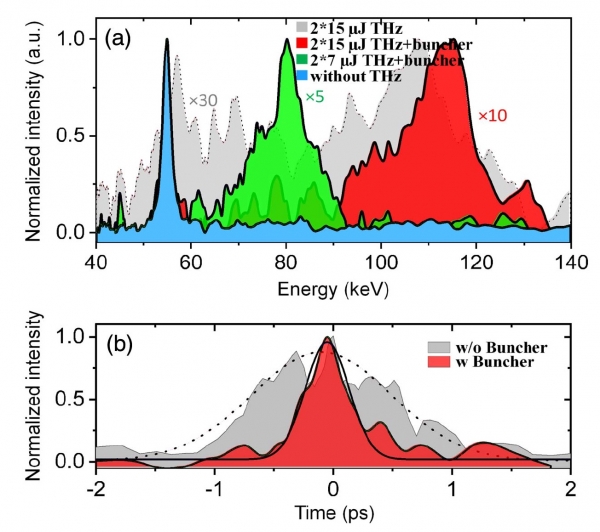
Image No. 4
The minimum bunch duration was set in accordance with the duration of the UV pulse from the photocathode, which was approximately ~ 600 fs. The distance between the compressor and the strip also played an important role, limiting the compression strength depending on speed. Together, these measures ensure femtosecond precision of the injection phase during acceleration.
In the image 4a It is evident that the energy spread of the compressed electron bunch after optimized acceleration in the linear accelerator decreases by ~ 4 times compared to the uncompressed bunch. Due to the acceleration, the energy spectrum of the compressed bunch is shifted towards higher energies, unlike the uncompressed bunch. The peak energy spectrum after acceleration reaches about 115 keV, while the high-energy tail extends to about 125 keV.
These parameters, according to the modest claims of the researchers, represent a new acceleration record (previously, it was 70 keV) in the terahertz range.
However, to reduce the energy spread (4a), it is necessary to achieve an even shorter bunch.
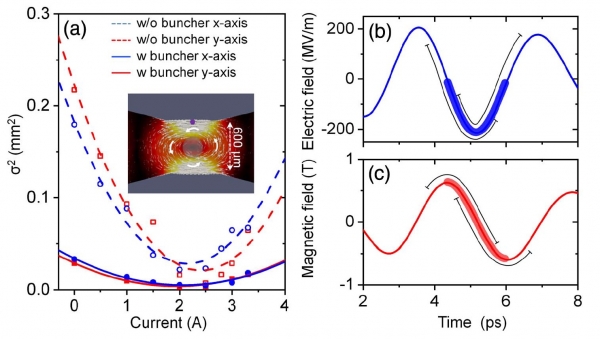
Image No. 5
In the case of the uncompressed beam, the parabolic dependence of the beam size on the current reveals the transverse emittance in the horizontal and vertical directions: εx,n = 1.703 mm*mrad and εy,n = 1.491 mm*mrad (5a).
Compression, in turn, improved the transverse emittance by 6 times to εx,n = 0.285 mm*mrad (horizontal) and εy,n = 0.246 mm*mrad (vertical).
It is worth noting that the degree of reduction in emittance is approximately twice that of the reduction in beam duration, which is a measure of the nonlinearity of the dynamics of time interaction, when electrons experience strong focusing and defocusing of the magnetic field during acceleration (5b and 5c).
In the image 5b it can be seen that electrons introduced at the optimal time undergo the entire half-period of acceleration by the electric field. However, electrons arriving before or after the optimal moment experience less acceleration and even partial deceleration. As a result, such electrons gain less energy, roughly speaking.
A similar situation is observed under the influence of the magnetic field. Electrons introduced at the optimal time experience a symmetric amount of positive and negative magnetic fields. If the introduction of electrons occurs earlier than the optimal time, there are more positive fields and fewer negative ones. In the case of introducing electrons later than the optimal time, there are fewer positive and more negative fields (5c). Such deviations lead to the electron being deflected left, right, up, or down depending on its position relative to the axis, resulting in an increase in transverse momentum corresponding to the focusing or defocusing of the beam.
For a more detailed understanding of the nuances of the research, I recommend checking out the and related to it.
Epilogue
In summary, the performance of the accelerator will improve with the reduction of electron beam duration. In this work, the achievable beam duration was limited by the geometry of the setup. However, in theory, the beam duration can reach less than 100 fs.
Scientists also note that the quality of the beam can be further improved by reducing the height of the layers and increasing their number. However, this method is not without problems, particularly increasing the complexity of the device's production.
This work is the initial stage of a more extensive and detailed study of the miniature version of the linear accelerator. Although the tested version already shows excellent results that can rightfully be called record-breaking, there is still a lot of work to be done.
Thank you for your attention, stay curious, and have a great working week, everyone! 🙂
Thank you for staying with us. Do you enjoy our articles? Would you like to see more interesting materials? Support us by placing an order or recommending us to your friends. 30% discount for Habr users on a unique entry-level server designed by us for you: (options available with RAID1 and RAID10, up to 24 cores and up to 40GB DDR4).
Dell R730xd for half the price? Only with us in the Netherlands! Dell R420 — 2x E5-2430 2.2GHz 6C 128GB DDR3 2x960GB SSD 1Gbps 100TB — from $99! Read about how
Source: habr.com
