

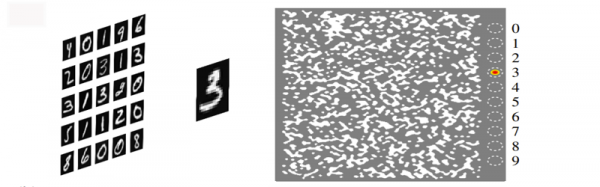
We are all familiar with the capability of neural networks to recognize handwritten text. The foundations of this technology have existed for many years, but it is only recently that advances in computing power and parallel data processing have turned this technology into a very practical solution. However, this practical solution will fundamentally be represented as a digital computer that repeatedly alters bits, just like when executing any other program. But with the neural network developed by researchers from the universities of Wisconsin, MIT, and Columbia, the situation is different. They .
This glass contains precisely arranged inclusions, such as air bubbles, graphene, and other materials. When light hits the glass, complex wave patterns emerge, causing the light to become more intense in one of ten areas. Each of these areas corresponds to a specific number. For example, below are two examples showing how light spreads when recognizing the number 'two'.
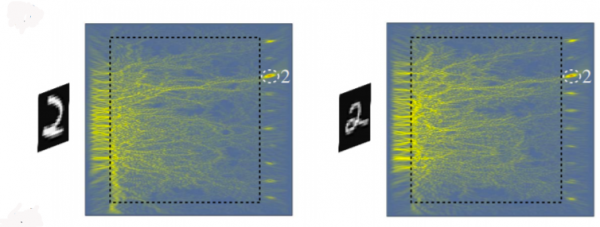
With a training set of 5000 images, the neural network can correctly recognize 79% of 1000 input images. The team believes they could improve the results if they could overcome the limitations imposed by the glass manufacturing process. They started with a very limited device design to obtain a working prototype. Next, they plan to continue exploring various methods to enhance recognition quality while striving not to overly complicate the technology so it can later be utilized in production. The team also has plans to create a three-dimensional neural network in the glass.
Source: habr.com
