

Not long ago, we published a semi-serious ‘What will you be paying for in 20 years?’ These were our own expectations based on emerging technologies and scientific advancements. However, in the U.S., they went further. A whole symposium was held, aimed at predicting the future that awaits humanity in 2050.
The organizers approached the issue with all seriousness: even the dinner was prepared with scientists' expectations in mind regarding possible climate problems that will arise in 30 years. We want to tell you about this unusual dinner.
How will climate change affect the global food system by 2050, and what will change in people's diets? Leading research scientist at MIT, and designer from New York University, decided to answer this question by developing a menu for the (the site is hazardous to your health, – ed. ), dedicated to the role and impact of climate change on our lives.
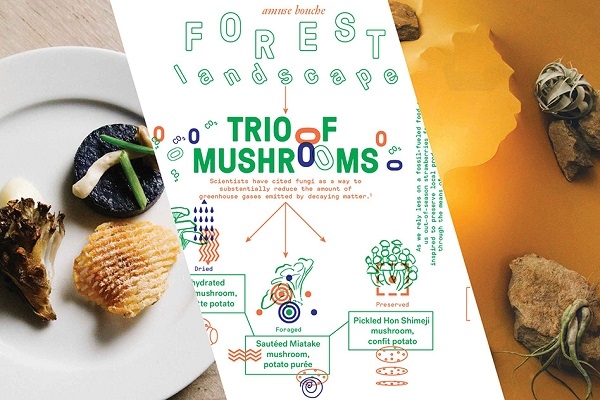
The futuristic dinner took place at ArtScience cafe (Cambridge, Massachusetts) and consisted of four courses, each representing a distinct natural landscape. For instance, the appetizer featured a mushroom trio: canned, dried, and freshly picked mushrooms. As is known, mushrooms help the soil accumulate carbon dioxide, thereby slowing the rate of climate change.
For the main course, symposium participants had two options reflecting possible climate changes. One represents more comfortable conditions that may arise from the active implementation of ecological programs and a drastic reduction in greenhouse gas emissions. The second, a pessimistic dish, embodies a bleak future resulting from the lack of implemented environmental protection programs.

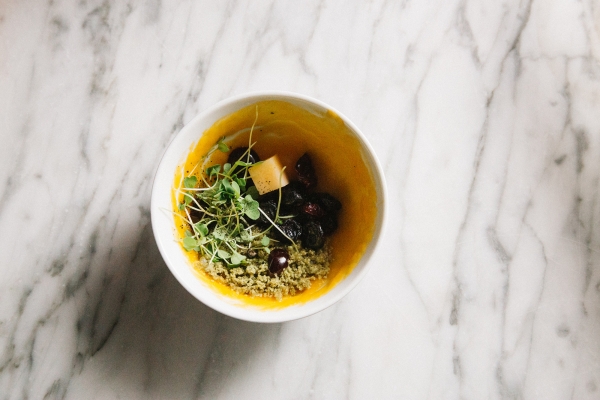
For the first dish, representing the desert, the choice was between a pumpkin pie with sorghum honey and a fruit cactus gel with dehydrated fruits.
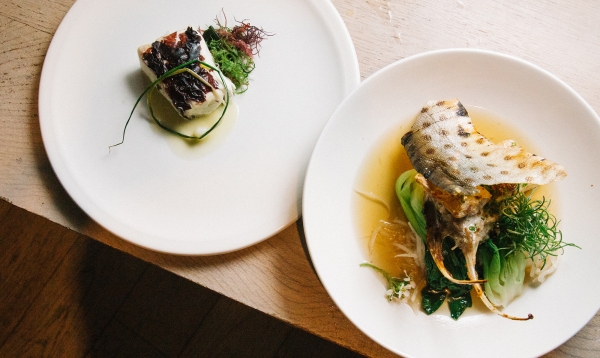
For the second, representing the ocean, the guests were offered wild striped bass. However, only half of the diners could enjoy the exquisite taste of the fish, while the other half was served the less appetizing portion filled with bones.
The dessert prompted thoughts about the melting glaciers and the threat to the Arctic landscape. It was a parfait made from pine milk, "dressed" with coniferous smoke and topped with fresh berries and juniper.

Before dinner, Monier and Wist gave a brief presentation on the complexity of modeling the global food system. They emphasized that climate models predict increases and decreases in yield for various regions in Africa, and that uncertainty in the models can lead to a wide range of forecasts for some regions.
This is all interesting, but what does it have to do with Habr?
At least in that artificial intelligence has only recently started to , suggesting that nature itself is to blame for global warming. In other words, human calculations have been completely opposite to those of the AI.
Modeling the future food system at MIT was carried out using complex mathematical calculations. A powerful resource base was engaged, weather reports from recent decades were studied, and numerous environmental reports were analyzed. However, the results of this extensive work are challenged by two scientists who deny climatology and the negative impact of humans on the climate.
They believe that there has been too little research on the subject over the past 100 years to prove that carbon dioxide has the ability to influence the Earth's temperature. To prove their point, and they collected information from previous studies that calculated temperature over the past two thousand years based on tree rings, coral cores, and similar methods.
They then fed this data into a neural network, and the program determined that the temperature had been rising at roughly the same rate throughout this period. This suggests that carbon dioxide is likely not the cause of global warming. The scientists also note that during the medieval warm period, which lasted from 986 to 1234, the temperature was about the same as it is today.
It's clear that speculation is possible here, and the truth, as usual, lies somewhere in the middle. However, it would be interesting to hear your opinion on this matter.
What else useful can be read in the Cloud4Y blog?
→
→
→
→
→
Subscribe to our -channel so you won’t miss another article! We write no more than twice a week and only when necessary.
Source: habr.com
