

Who will benefit from this article:
- students who have decided to earn extra money through tutoring
- postgraduates or specialists who have been assigned a seminar group
- older siblings when younger ones ask to teach programming (cross-stitching, speaking Chinese, market analysis, job searching)
In other words, everyone who needs to teach, explain, and who doesn't know where to start, how to plan lessons, and what to tell.
Here you will find: links to educational courses and books on pedagogy and education, materials on where to read about learning goals, attracting attention, and simplifying material.

who I am and why I was looking for this informationI am a programmer but have been teaching since my early university years. I've taught mathematics to 8th-9th graders in evening school, conducted seminars on Python, and have been tutoring math and programming for over 5 years. However, despite my experience, I planned only 1-2 lessons in advance and often saw the unasked question on my students' faces: 'Why are we learning this? Do we really need it?'. As a result, I decided to find out what could be improved in teaching and how. I researched all the materials I could get my hands on.
So. The materials found about pedagogy and education. These are books, courses on Coursera, and paid online courses.
Books
If you don’t have time to search for information and take courses, but you want to enhance your teaching skills — read this book. It itself is a great example of how to create clear and memorable learning experiences. It discusses motivation, memory work, how to lead students to results, and how to motivate them.
The author states obvious things that everyone already knows since childhood. But then you come to realize that you aren’t using this information in any way and that it can significantly improve students' understanding of the material.
A book about the laws of behavior in humans and animals. I recommend reading it not only for teachers but also for owners of unruly pets, parents, and managers. It discusses what feedback is, positive reinforcement, and how they work. The book has changed my views on punishment and explains why schools perform poorly in teaching. You will find 75 pages of information, over 100 (I didn't count) examples of various training or persuasion methods. Not all information can be applied to teaching; some information is only applicable to training.
If you are teaching elementary school students in a group, this is a must-read for you. The book contains simple methods that will improve your students' results. However, if you teach adults in small groups, you will find little that is useful. Besides tips on conducting the lesson itself, you can find information about how to arrange desks, plan lessons, and greet students before a lesson.
To extract nuggets of useful information, you need to wade through heaps of stories and the author's company advertisements. However, useful information on organizing presentations and designing explanations can be gleaned.
Courses on Coursera
You can access all materials (including some tests) for free if you audit the course.
how to audit a course on Coursera On Coursera, you can access materials for most courses for free. You won’t have access to graded courses, you won’t receive a certificate, but all materials will be available to you.
To do this, click the button to enroll in the course (specifically in the course, not the specialization! This is important):
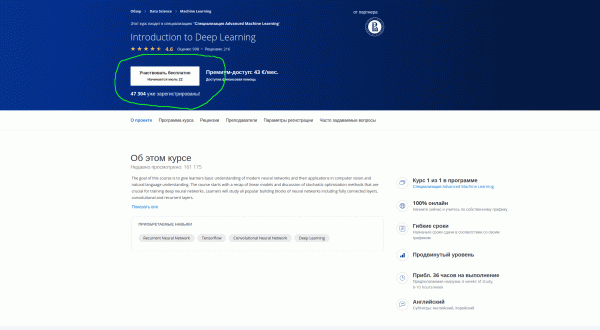
At the bottom, after the offer to get the first 7 days free, there will be a small note: 'Audit the course'
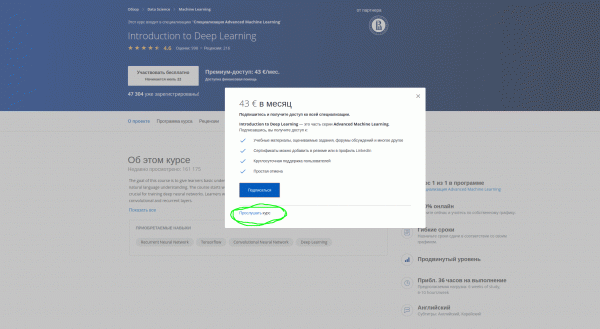
Click it. Voila, you are wonderful. You now have access to almost all course materials.
A wealth of information with examples of its application. How to create assignments, provide feedback, engage students in learning, and much more. Examples of real lectures and seminars are shown; if you teach large groups, I highly recommend watching. Here you will find many links to articles and studies on various methodologies.
The course explains how digital technologies can positively transform the learning process. There is little practical information, but it is very interesting to listen to — we are currently living through these changes, and perhaps our children will learn based on new principles. This is not about enhancing teaching skills, but about how education can change now.
Looks interesting, but since there has already been an overload of information, I didn't watch.
I managed to get through only two lectures. I haven't heard such a monotonous voice in a long time. The material may be good, but it's very hard to process. It can be used as an example of how not to conduct training. I recommend it as a sleep aid.
Paid courses
You can find a lot of information necessary for improving teaching skills for free. It's worth considering paid courses if you want feedback and personal answers to your questions.
A two-month course with enormous homework assignments. It's worth attending for the handouts and the feedback on assignments. In the course, you will create a syllabus for your course, analyze the audience, set goals, and think about how to motivate students. You will receive feedback on everything done. The course has a specific format — many short videos ranging from 1 to 20 minutes. As a fan of two-hour lectures at 2x speed, I found it challenging. There isn’t a proper page for the course yet, but there should be another launch.
I also found a lot of materials for retraining teachers here. I can't say anything about them, as I haven't listened.
Conclusion
In conclusion — my personal top materials:
- First, read “The Art of Teaching”. Minimum time investment, maximum benefit.
- If you have everything under control with planning and learning objectives, check out the course on Coursera from the University of Hong Kong. There, you'll find plenty of advice that you can gradually implement in practice.
- If you have no idea what to do or where to start improving the program, take the course 'Fundamentals of Educational Design'. They will help you organize your thoughts and guide you from 'What should I teach and how?' to 'Wow, I have a great plan!'.
Present material in an engaging way, learn to teach your students effectively, and enjoy life :)
P.S. I would appreciate any useful links and materials :)
P.P.S. Are you interested in notes about teaching? Following the courses, I can share insights on audience analysis, setting educational goals, and maintaining student motivation. Should I write a note on teaching?
Source: habr.com
