

After almost two years of development Release of the free 3D modeling package , which has become one of the most significant releases in the project's history.
Key :
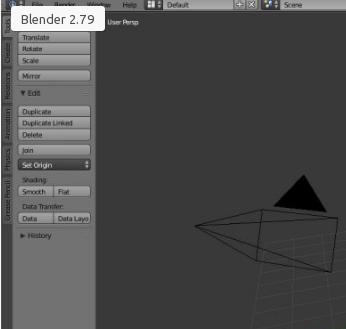
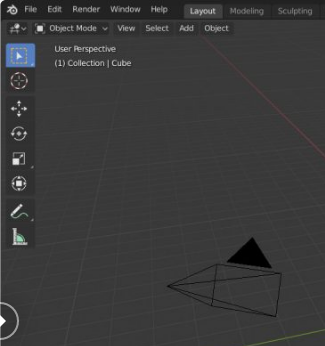
- Radically the user interface, which has become more familiar to users experienced with other graphic software. A new dark theme has been introduced, along with familiar panels featuring a modern set of icons instead of text descriptions.


Changes have also been made to mouse/tablet interaction methods and keyboard shortcuts. For example, selection is now performed by default with a left click or by dragging while holding the left mouse button, and the context menu is accessed with a right click. A quick access menu to the most frequently used functions has been added. The layout in the properties editor and the settings sections has been updated. Concepts for templates and workspaces (tabs) have been proposed to facilitate quick initiation of tasks or switching between multiple tasks (e.g., sculpting, texture painting, or motion tracking), allowing users to tailor the interface to their preferences.
- A completely rewritten Viewport mode allows for displaying the 3D scene in a form optimized for various tasks and integrated with the workflow. A for fast workspace rendering (Workbench) has been optimized for modern graphics cards and allows for active previews while manipulating the scene layout, modeling, and sculpting.
The Workbench engine supports , which allow for changing the visibility of elements and managing their layering. Overlays are also now supported when previewing rendering results with Eevee and Cycles renders, enabling scene editing with full shading.
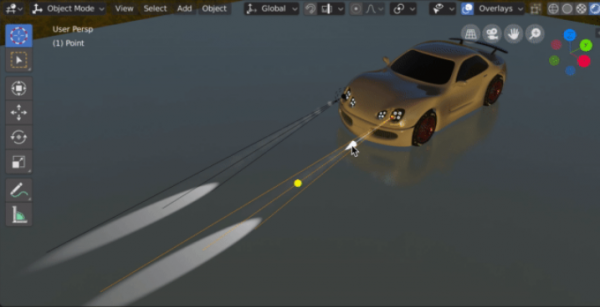
The smoke and fire simulation preview has been revamped, closely resembling the results obtained with physically accurate rendering. - Based on the Eevee engine, a new LookDev rendering mode has been prepared, allowing testing of extended brightness ranges (HDRI) without altering lighting source settings. The LookDev mode can also be applied for previewing work with the Cycles rendering engine.
- In the 3D Viewport and UV editor new interactive tools and gizmos, as well as a new contextual toolbar that includes tools previously accessed only through keyboard shortcuts. Gizmos for adjusting shape and attributes have been added to various elements, including light sources, the camera, and the compositing background;

- A new render has been added , supporting physically accurate real-time rendering and using only GPU (OpenGL) for rendering. Eevee can be used for both final rendering and in the Viewport for creating resources in real-time. Eevee supports materials created using shader nodes consistent with the Cycles engine, allowing for the rendering of existing scenes without separate setup, even in real-time. For game asset creators, the Principled BSDF shader is provided, compatible with many game engine shader models;

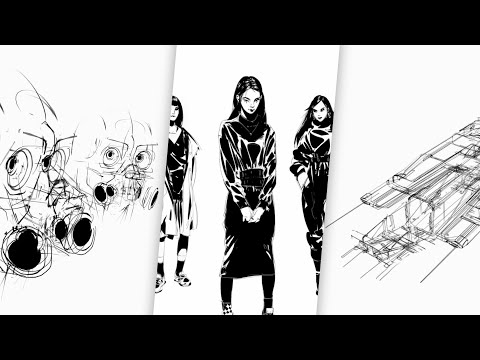
- A 2D drawing and animation system, Grease Pencil, has been added, allowing for the creation of sketches in 2D and then using them in a 3D environment as three-dimensional objects (a 3D model is formed from several flat sketches from different angles). Grease Pencil objects are an integral part of Blender and integrate with existing object selection, editing, management, and linking tools. Sketches can be converted into layers and rendered using materials and textures, as well as edited and applied during sculpt modeling similarly to meshes. Standard mesh modifiers can be used for deformation and coloring. During rendering, effects such as blur, shadow creation, or edge lighting can be applied.
- In the Cycles rendering system support for features such as creating backdrops for compositing using , hair and volume shading based on , and applying random subsurface scattering (). A combined rendering mode has been implemented, using both GPU and CPU simultaneously. Rendering with OpenCL has been significantly accelerated. Support for CUDA has been added for scenes that do not fit in GPU memory;
- In edit mode, it is now possible to edit multiple meshes simultaneously, including texture overlay (UV mapping), as well as edit and position the rig of multiple objects. The technology for controlling model detail while performing smoothing is involved. ;
- Reference background images for outlining are now placed as objects and can be composed and transformed together with the scene;
- Layers and groups have been replaced with collections, allowing for the organization of object placement in the scene and manipulation of groups of objects and their bindings using an easy drag & drop style interface. Quick operations for moving objects between collections have been added to the 3D Viewport, along with tools for more precise control of their visibility, supporting both temporary and permanent hiding, including by object type;
- The tools for animation and have been improved. New constraints, modifiers, and bending forms for rig elements have been introduced. The animation editor now features keyframe visualization and editing tools;
- The implementation of the dependency graph, key modifiers, and the animation evaluation system has been completely overhauled. On modern multi-core CPUs, scenes with a large number of objects and complex rigs are now processed significantly faster;
- A more realistic physics model for fabric behavior and its deformation has been implemented;
- The Python API has been updated, introducing changes that break compatibility and, in certain cases, require reworking of scripts and add-ons. However, most add-ons available for release 2.79 have already been adapted for version 2.80;
- The Blender Internal real-time rendering engine has been removed, replaced by the EEVEE engine;
- The Blender Game Engine has been removed, and it is recommended to use existing open alternatives, such as the engine. The code of the previously integrated game engine is now being developed as a separate project ;
- Support for importing and exporting files in the glTF 2.0 format, which is commonly used for loading 3D resources in games and the web, has been built-in;
- The tools for importing and exporting video have been enhanced with support for metadata and the WebM format.
Source: opennet.ru
