

After reading articles about life in Cyprus, I decided to share my experience, which complements what previous authors have described. Arrived on a work visa, with my own company that can handle visas, green card (LTRP), citizenship — a total of 15 years. And I want to add more numbers. This may be useful for potential IT immigrants.
The narrative will be as concise as possible without any fluff.
IT Specialist Work
Previous articles have mostly covered everything. Most local job openings are somehow related to forex (fin-tech companies); system administrators should probably look towards DevOps there as well.
Taxes
This is the main advantage — they are probably the lowest in the European Union.
Social Insurance (ESN) from the employee is -8.3%, from the employer -8.3% +2% +1.2% +0.5% +8%. The last 8% goes towards future vacation and is returned to the employee.
Since June, there has been an additional tax for healthcare.
Income tax (PIT) up to €19,500 a year after all deductions is 0%, then from €20,000 to €35,000.
VAT (VAT) is 19%.
The first 5 years after moving — a 20% discount on taxable income.
, since then, Social Insurance has increased.
Work visa -> LTRP -> citizenship
If the employer has a good lawyer, and all formalities are observed, the documents can be processed in a week with no breaks. In reality, date breaks matter only when obtaining a residence permit (LTRP Long Term Resident Permit); when acquiring citizenship, there is a court decision stating that if the migration department issued the next permit, it means they considered the person to have been legally in Cyprus during the break.
As I mentioned before, if you have a good lawyer and don't drag out the application process, there will be no breaks; they usually arise due to Siga-Siga the company's manager not preparing the documents in time.
After 5 years of residence, you can apply for the green card LTRP. The process is not complicated, you just need to pass the Greek language exam at level A2. I'm not a humanities person, this would have been impossible for me, but I received it when the exam was still not required.
After 7 years of continuous residence in Cyprus (2,560 days need to account for all arrivals and departures), you can apply for citizenship; language knowledge is not required. If you have financial resources and a good lawyer, you can obtain it in a couple of years. If you are willing to try without a pushy lawyer, you may end up waiting another 7 years and still end up going to one anyway.
In addition to finding a job where a work visa can be obtained, you can also open your own company, pass through the account €171,000 as an investment, and gain the ability to issue work visas yourself. I have gone through this process myself, and if you're interested, I can outline it in detail.
Visas for Schengen and the UK
Unfortunately, Cyprus is not part of the Schengen Area, so a work and residency permit and green card do not allow for free travel. Until you have a Cypriot passport, you need to constantly apply for Schengen and UK visas. You can also obtain a second Russian passport, as it is not expensive and relatively quick; there are two Russian consulates in Cyprus — in Nicosia and Limassol.
Housing
This is a topic for a separate article.
For comfortable living, double glazing, blinds without gaps, and thick walls are desirable. Generally, all houses built after 2000-2004 meet these parameters; the main thing is to avoid housing built for refugees, where there may be walls as thin as half a brick facing south. Tenant and landlord relations are regulated by law. Rent can increase by 10% every two years. A tenant cannot terminate the contract. Additionally, Cyprus is a place where you can sleep with the window open year-round, so it's better if there are no noisy streets underneath.
Air conditioners should be new, inverter types. As practice shows, replacing old units with new ones can cut electricity bills by almost half.
Roads
There are traffic jams, but they are not very large; the only problem is getting into the city from surrounding villages at the start of school.
Parking — if not in the center, you can find free parking within 100m; in the center, it's €2-3. This applies to Limassol, it's worse in Nicosia.
A special feature about navigating roundabouts is the English system; you need to get into the correct lane ahead of time, especially frustrating when there’s a 10-minute jam in your lane while the neighboring one is empty. The speed limit on the highway is 100 km/h with an allowed excess of 20, and 50 km/h with an allowed excess of 15 in the city, but recently many speed bumps have appeared, so the speed in the city has dropped to 30-50, even in soft cars, and 20-40 in hard vehicles.
On the highway, you can set the cruise control to 122 km/h and drive to the capital (80 km) without needing to brake once. From Limassol to any airport, you should allocate 45 minutes, and you will always make it on time.
Cars
Very cheap used cars from England, but these are northern cars with dark interiors and miles on the odometer. Taxi drivers using cars from England cover the seats with towels when parking during the day to avoid cooking their passengers and themselves. Prices for new cars are similar to those in Russia, with occasional large discounts. I've never seen winter tires; there are many front-wheel-drive crossover models.
Fuel is currently €1.3 per liter. Car taxes are based on CO emissions. For example, a 2.2 diesel Euro 6 costs €60 per year, while a 3-liter Euro 4 diesel costs over €500.
Having half a bottle of wine at dinner and driving home is considered normal.
Internet
It was mentioned about home setups in the comments.
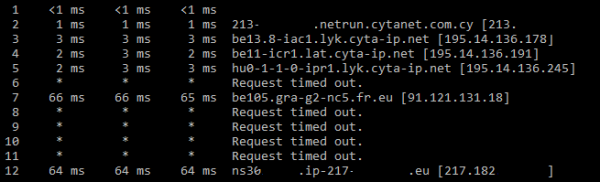
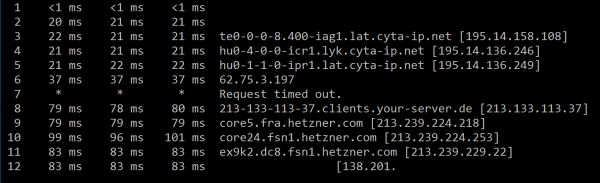
All home tariffs have a maximum upload of 8mb/s; if more is needed, it's from €300 and that’s xDSL or coaxial (horribly unreliable provider). Symmetrical optical service at 50mb/s costs €2000/month + VAT. And there's latency. Working entirely on a VDI (RDS) infrastructure in European data centers on ADSL isn't very comfortable; on optical, it's acceptable.
Traceroutes to Hetzner and OVH: the first ones are from optical, the second from xDSL.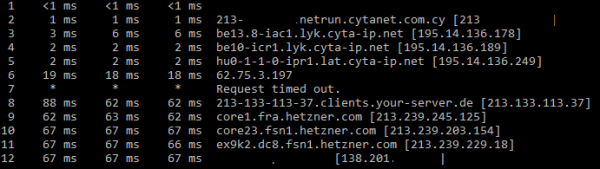
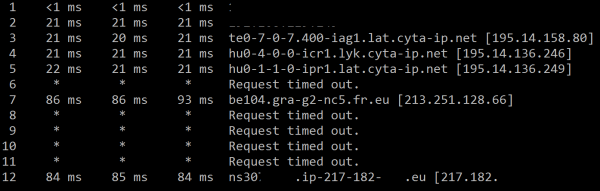
Currently, the state provider has introduced subsidized tariffs. but so far none of my acquaintances have tried it.
Utility payments
Water is expensive, the system is complex, and bills are issued every 4 months.
tariffs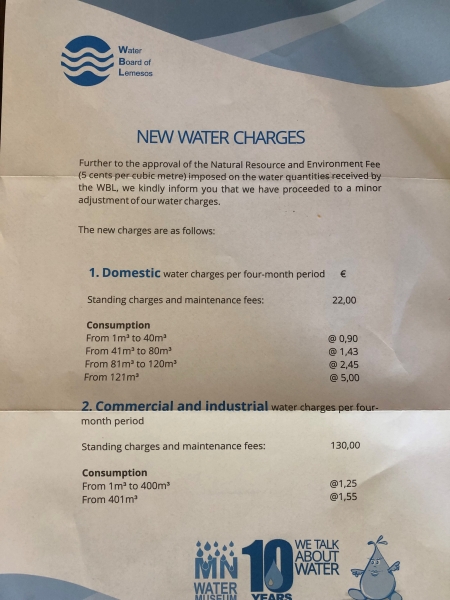
The meter is outside, and the pipe from the meter to the house is usually underground. Depending on the incompetence and greed of the builder, this pipe might be made of low-pressure polyethylene, even with twists, all buried in concrete. Combined with a lot of minor earthquakes, this results in a nearly 100% chance of leaks. And since readings are taken manually every 4 months, the number on the bill can be quite surprising.
An example of such a bill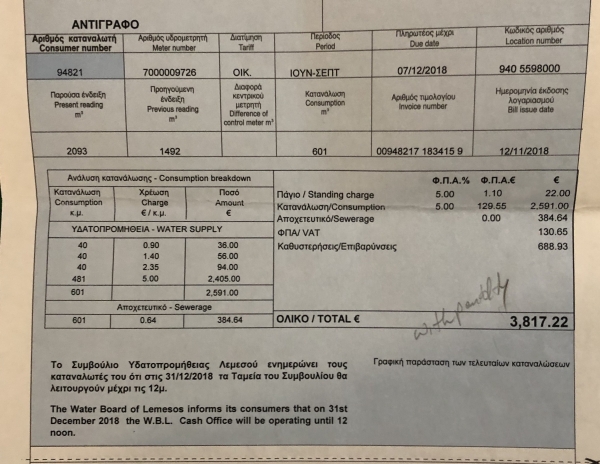
Fortunately, for the first time and sometimes even the second, such a leak is overlooked.
A startup idea — a meter sending data to the cloud and alerts and statistics to mobile.
Electricity costs around €0.25 per kilowatt; you can install solar panels on your home. At that price and with the number of sunny days, they pay for themselves in 4-5 years. However, they have a downside — birds love to build nests under them and screech in the mornings.
An example of a bill with solar panels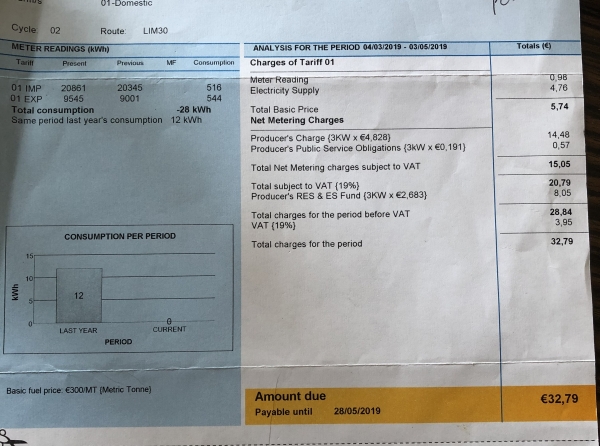
Garbage costs €150 per year.
Kerosene or diesel for heating is sold at a discount; this year it was €0.89 per liter. If there is a heating system in the house, it is cheaper and more comfortable to heat than with electricity.
Schools
Greek schools are free, based on residency. English schools cost on average €4,000 per year for primary and €7,000-€10,000 for high school. Limassol has two Russian schools that cost about the same.
Medicine
There are very good doctors, their names are passed from mouth to mouth. The cost of a visit is €40-50; tests are significantly more expensive than in Russia. Soon everything should change due to the introduction of free healthcare.
Weather
Many things have been said in previous articles and discussions. If there is heating in the house, winter is easy to bear. If in summer you reduce fat intake and go to the gym two or three times a week, the heat won't bother you either. Problems arise from frequent dust storms coming from the Sahara; heat and dust are issues, especially for those with asthma.
dust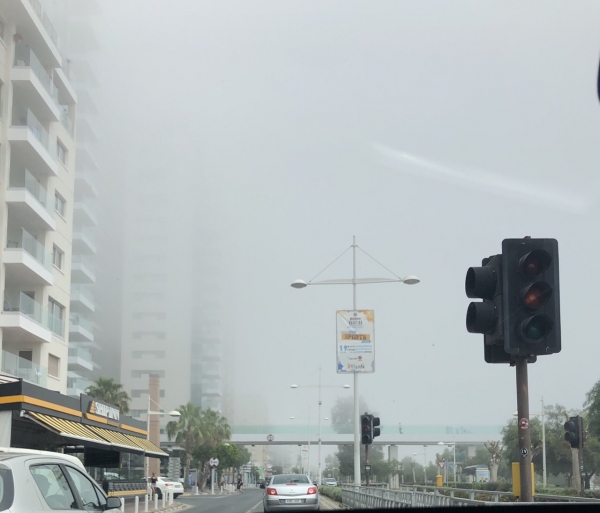
In my opinion, one of the most challenging organizations in Cyprus. First, delivery is very slow; many sellers from Amazon UK and DE do not ship to Cyprus at all.
Second, customs clearance: all packages from outside the EU that cost more than €17.1 are subject to customs clearance, which means standing in line at the central post office, €3.6 plus VAT on the assessment, and it is difficult to find free parking there.
Considering that the range of local stores is limited, this is a problem.
Lastly, here are two small life hacks about water supply to have hot water in winter and cold water in summer.
- You must install a temperature gauge for hot water in the tank on the roof (any thermometer with a high-resistance resistor or a digital sensor, so that a long cable from the roof does not affect the readings) — this will prevent unpleasant surprises in the mornings.
- In the summer, the water in the cold tank on the roof heats up above 30 degrees, making it impossible to take a cold shower. I installed two electric valves + check valves, a power supply, and a switch, so now in summer I can switch the cold water from the tank to the mains.
Source: habr.com
