


Less than a day remains until the launch of the new AMD EPYC™ Rome processors. In this article, we decided to recall the history of the rivalry between the two largest CPU manufacturers.
The world's first commercially available 8-bit processor was the Intel® i8008, released in 1972. The processor had a clock speed of 200 kHz, was manufactured using a 10 µm (10,000 nm) technology process, and was intended for 'advanced' calculators, input-output terminals, and bottling machines.
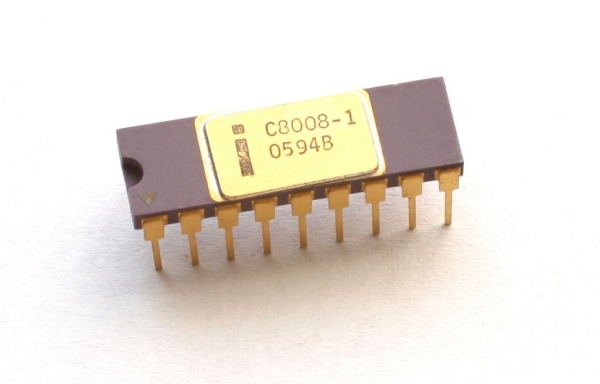
In 1974, this processor became the foundation for the Mark-8 microcomputer, presented as a DIY project on the cover of Radio-Electronics magazine. The project author, Jonathan Titus, offered interested individuals a brochure costing $5, containing schematics of printed circuit boards and assembly instructions. Soon after, a similar personal microcomputer project emerged: the Altair 8800, created by MITS (Micro Instrumentation and Telemetry Systems).
The Beginning of the Rivalry
Two years after the creation of the i8008, Intel released its new chip — the i8080, based on an enhanced architecture of the i8008 and manufactured using a 6 µm (6,000 nm) technology process. This processor was about 10 times faster than its predecessor (with a clock speed of 2 MHz) and featured a more advanced instruction set.
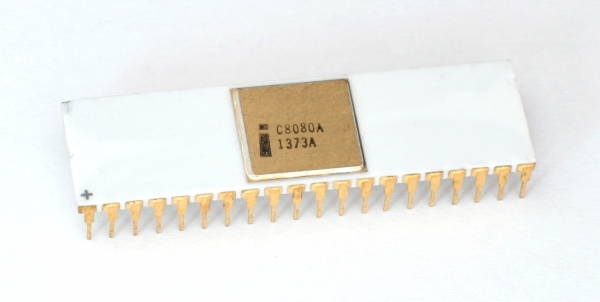
Reverse engineering of the Intel® i8080 processor, carried out by three talented engineers — Sean and Kim Haley, as well as Jay Kumar, led to the creation of a modified clone called the AMD AM9080.
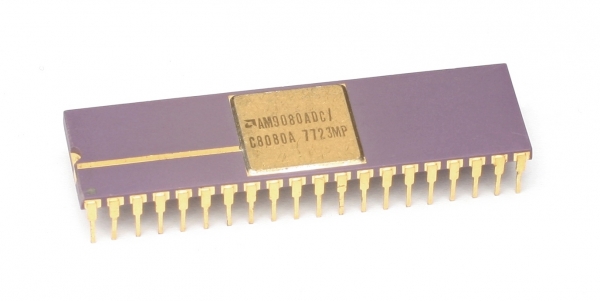
Initially, the AMD AM9080 was produced without a license; however, a licensing agreement was later established with Intel. This allowed both companies to gain an advantage in the chip markets, as customers sought to avoid potential dependency on a single supplier. The initial sales were extremely profitable, with a production cost of 50 cents, while the chips were actively purchased by the military for $700 each.
After this, Kim Haley decided to try his hand at reverse engineering the Intel® EPROM 1702 memory chip. At that time, it was the most advanced non-volatile memory technology. The attempt was only partially successful — the created clone stored data for only 3 weeks at room temperature.
After breaking several chips and drawing on his chemistry knowledge, Kim concluded that without knowing the exact growth temperature of the oxide, achieving Intel's claimed metrics (10 years at 85 degrees) would be impossible. Demonstrating his social engineering talent, he called Intel's production and asked at what temperature their furnaces operated. Surprisingly, they provided him with the exact figure—830 degrees. Bingo! Of course, such tricks were bound to have negative consequences.
The First Lawsuit
At the beginning of 1981, Intel was preparing to finalize a contract to produce processors for IBM, the largest computer manufacturer in the world at that time. Intel did not yet have sufficient manufacturing capacity to meet IBM's needs, so to avoid losing the contract, they had to compromise. This compromise was a licensing agreement between Intel and AMD, allowing the latter to start producing clones of the Intel® 8086, 80186, and 80286.
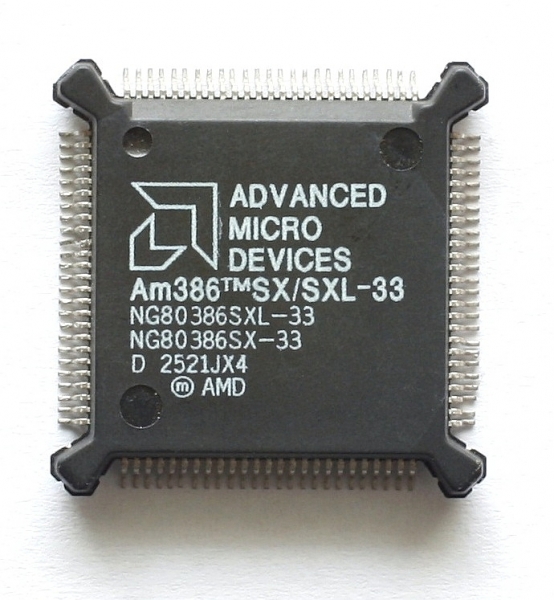
Four years later, the latest Intel® 80386 with a clock speed of 33 MHz and built using a 1 µm (1000 nm) technology process was introduced to the x86 processor market. During this time, AMD was also preparing a similar chip called Am386™, but its release was postponed indefinitely due to Intel's categorical refusal to provide technology data under the licensing agreement. This became the reason for the lawsuit.
In the lawsuit, Intel tried to prove that the terms of the agreement applied only to previous generations of processors released before the 80386. AMD, on the other hand, insisted that the terms of the agreement allowed it to not only reproduce the 80386 but also future models based on the x86 architecture.
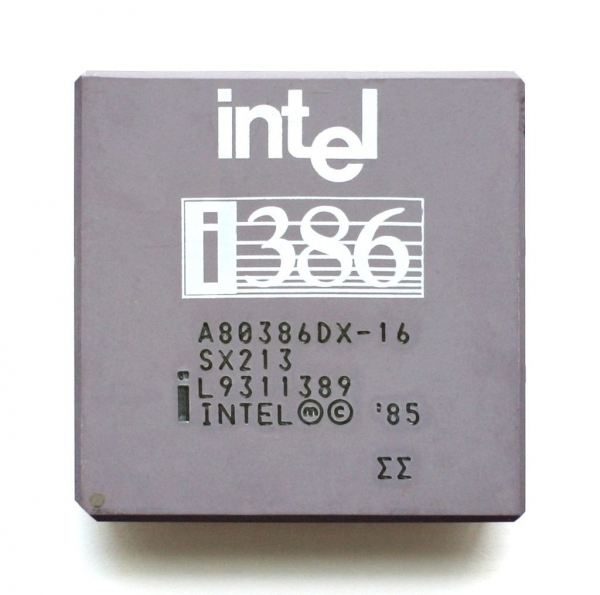
The legal proceedings dragged on for several years and ended with a victory for AMD (Intel paid AMD 1 billion dollars). The trust between the companies came to an end, and the Am386™ was released only in 1991. Nevertheless, the processor was highly sought after, as it operated at a higher frequency than the original (40 MHz versus 33 MHz).
The Rise of Competition
The first processor in the world based on a hybrid CISC-RISC core and featuring a floating-point unit (FPU) directly on the same chip was the Intel® 80486. The FPU significantly accelerated floating-point operations, reducing the load on the CPU. Another innovation was the introduction of an instruction pipelining mechanism, which also increased performance. The size of one element ranged from 600 to 1000 nm, and the chip contained from 0.9 to 1.6 million transistors.
AMD, in turn, introduced a fully functional analog called Am486 using the Intel® 80386 microcode and the Intel® 80287 coprocessor. This led to numerous legal disputes. A court ruling in 1992 confirmed that AMD had violated copyright regarding the FPU 80287 microcode, after which the company began developing its own microcode.
Subsequent legal proceedings confirmed and denied AMD's rights to use Intel® microcodes. The final ruling came from the California Supreme Court, which ruled that AMD's use of the 80386 microcode was illegal. The outcome was an agreement between the two companies, allowing AMD to manufacture and sell processors containing the 80287, 80386, and 80486 microcodes.
Other players in the x86 market, such as Cyrix, Texas Instruments, and UMC, also sought to replicate Intel's success by releasing functional analogs of the 80486 chip. In one way or another, they failed to do so. UMC dropped out of the race after a court ban on selling its Green CPU in the United States. Cyrix was unable to secure profitable contracts with major assemblers and faced legal battles with Intel over the use of patented technologies. Thus, Intel and AMD remained the market leaders in x86.
Increasing the pace
In a bid for dominance, both Intel and AMD sought to achieve maximum performance and speed. AMD was the first in the world to surpass the 1 GHz mark with its Athlon™ (37 million transistors, 130 nm) based on the Thunderbird core. At this stage of the 'race,' Intel faced issues with the instability of the second-level cache in its Pentium® III based on the Coppermine core, which caused delays in product release.
An interesting fact — the name Athlon comes from ancient Greek and can be translated as 'competition' or 'battleground, arena.'
Equally successful milestones for AMD included the release of the dual-core Athlon™ X2 (90 nm), and two years later, the Quad-Core Opteron™ (65 nm), where all four cores are manufactured on a single die instead of being a combination of two dies with two cores each. At the same time, Intel launched its famous Core™ 2 Duo and Core™ 2 Quad, produced using the 65 nm technology.
With rising clock speeds and increasing core counts, the need for mastering new technological processes and entering other markets became urgent. The biggest deal for AMD was the acquisition of ATI Technologies for $5.4 billion. This allowed AMD to enter the graphics accelerator market and become a major competitor to Nvidia. Conversely, Intel acquired one of Texas Instruments' divisions, as well as Altera for $16.7 billion. The outcome was entry into the market of programmable logic devices and SoCs for consumer electronics.
Notably, since 2009 AMD has abandoned its own manufacturing, focusing exclusively on development. Modern AMD processors are produced at the facilities of GlobalFoundries and TSMC. In contrast, Intel continues to develop its own semiconductor manufacturing capabilities.
Since 2018, in addition to direct competition, both companies have launched joint projects. A prominent example is the release of Intel® Core™ 8th generation processors with integrated AMD Radeon™ RX Vega M graphics, combining the strengths of both companies. This solution will allow for smaller laptops and mini-computers while simultaneously increasing performance and battery life.
Conclusion
Throughout the history of both companies, there have been many episodes of disagreements and mutual claims. The struggle for leadership has been continuous and persists to this day. This year, we have seen a significant update in the Intel® Xeon® Scalable Processors lineup, which we have already reported , and now it is AMD's turn to take the stage.
Very soon, the new AMD EPYC™ Rome processors will arrive in our lab. about their arrival first.
Source: habr.com
